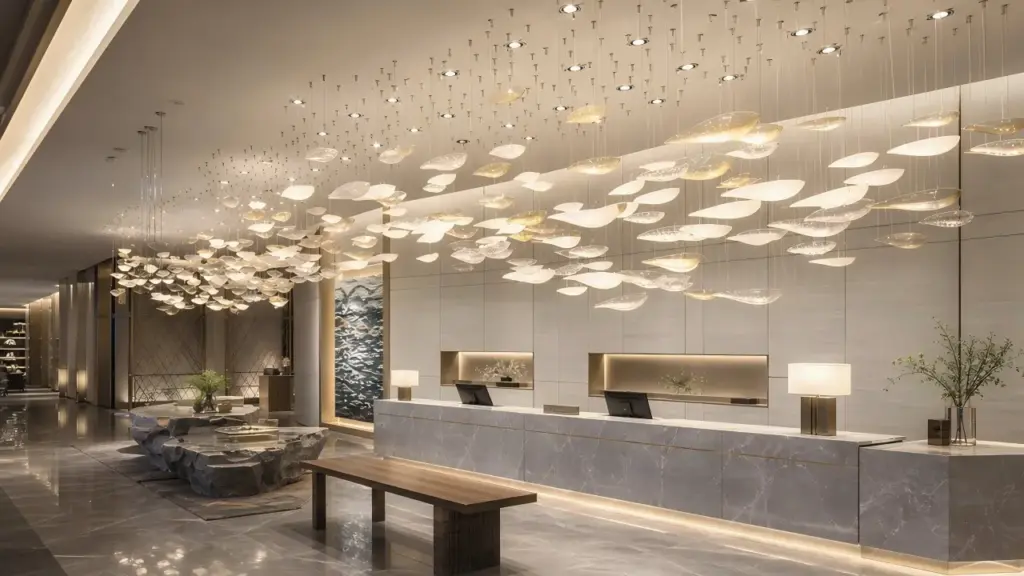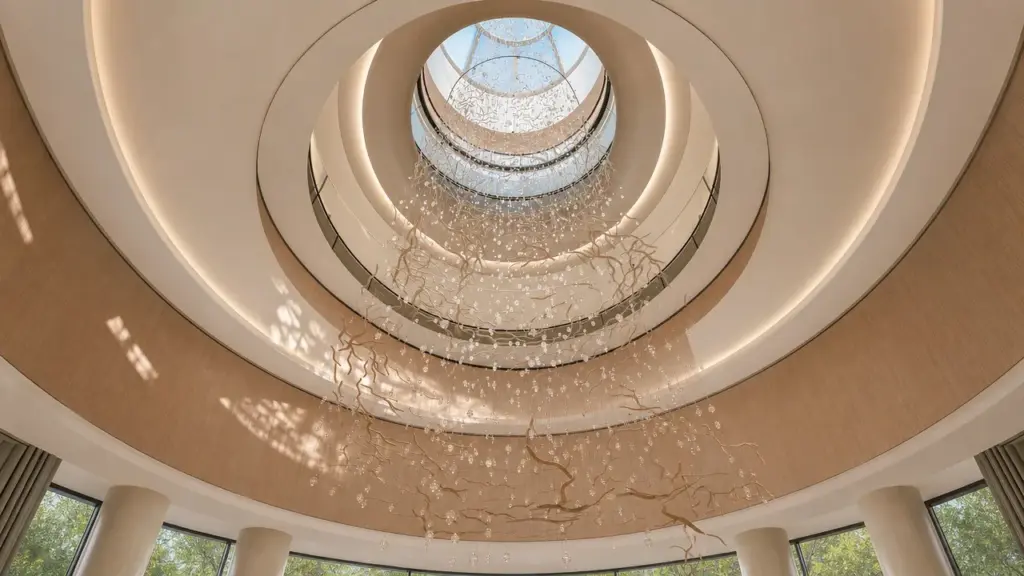
Eine Größenformel für Hotel-Lobby-Kronleuchter sollte visuelles Volumen messen, nicht nur Raumlänge und Raumbreite. In einer zweigeschossigen Lobby wird die Leuchte als dreidimensionales Objekt im Raumvolumen gelesen; deshalb müssen Durchmesser, vertikale Abhängung, Sichtdistanz und niedrigste lichte Höhe zusammen gelöst werden. Bei einem 12 m x 18 m x 7,5 m sichtbaren Raumvolumen, einem Zielwert von 1,5 Prozent Leuchtenvolumen und einer Kronleuchter-Abhängung von 3,2 m ergibt sich beispielhaft ein Durchmesser von etwa 3,1 m. Die Entscheidung ist nicht, diese Zahl zu kopieren. Die Entscheidung ist zu prüfen, ob Volumen, Ansichten, Tragwerk, Reinigungszugang und Gästezirkulation vor Produktionsfreigabe zusammenpassen.
Einfache Kronleuchterregeln sind nützlich, weil sie eine erste Zahl auf die Seite bringen. In Hotel-Lobbys werden sie aber gefährlich, weil Gäste die Leuchte aus großer Annäherungsdistanz, von unten, vom Empfang, aus Loungezonen, von Treppen und manchmal von Balkonen sehen. Eine zweigeschossige Lobby ist kein Esszimmer mit höherer Decke. Sie ist ein vertikales öffentliches Volumen, in dem Architektur, Menschen, Gepäck, Kameras, Tageslicht und Deckensysteme gleichzeitig um Aufmerksamkeit konkurrieren.
Wichtigste Erkenntnisse
- Mit Volumen beginnen: Zweigeschossige Lobbys brauchen eine dreidimensionale Größenprüfung, nicht nur eine Länge-plus-Breite-Regel.
- Sichere Annahme nutzen: Behandeln Sie die Volumenformel als illustrativen Schätzwert und prüfen Sie danach Ansichten und Struktur.
- Abhängung kontrollieren: Durchmesser und Kronleuchterhöhe hängen zusammen; eine flache Leuchte braucht mehr Breite, um dasselbe visuelle Volumen zu halten.
- Lichte Höhe schützen: Der niedrigste Punkt muss Gästezirkulation, Gepäckbewegung, Reinigungszugang und lokale Sicherheitsprüfung respektieren.
- Mit Nachweis freigeben: Vor Produktion sollten 3D-Ansichten, Lastannahmen, Materialmuster, Verpackungsplan und Montagezugang angefordert werden.
Visuelles Volumen vor dem Durchmesser wählen
Ein Kronleuchter in einer zweigeschossigen Lobby wird nicht nur im Grundriss dimensioniert; er wird als sichtbares Objekt in einem öffentlichen Raumvolumen dimensioniert.
Die übliche wohnraumartige Startregel addiert Raumlänge und Raumbreite in Fuß und liest die Summe als Durchmesser in Zoll. Diese Regel kann verhindern, dass eine normale Raumleuchte zu klein wird, adressiert aber keine Hotel-Lobby mit 7 m, 9 m oder 12 m vertikalem Volumen. Die IES Lighting Library erinnert daran, dass Lichtqualität vom Anwendungskontext abhängt. Für einen Lobby-Kronleuchter gehören dazu Sichtdistanz, Deckenhöhe, Möbelzonen, Empfangssichtachsen, reflektierende Oberflächen und Wartungsstrategie.
Die Volumenformel ist ein Größen-Gespräch, kein Standard
Verwenden Sie die folgende Formel als illustratives Planungswerkzeug, nicht als Norm oder offiziellen Standard. Berechnen Sie zuerst das sichtbare Lobbyvolumen: Länge x Breite x sichtbare Höhe. Die sichtbare Höhe kann Deckenhöhe minus angenommene Augenhöhe sein oder ein projektspezifischer Betrachtungsbereich. Danach wählen Sie ein Zielverhältnis für das Leuchtenvolumen. Für viele große Custom-Diskussionen kann ein Bereich von 1,0 bis 2,0 Prozent des sichtbaren Volumens den Anfang bilden. Wenn der Kronleuchter grob als Zylinder behandelt wird, lässt sich der Durchmesser aus Leuchtenvolumen und geplanter Abhängung lösen.
Formel: Sichtbares Leuchtenvolumen = sichtbares Lobbyvolumen x Zielverhältnis. Durchmesser = sqrt((4 x sichtbares Leuchtenvolumen) / (pi x Kronleuchter-Abhängung)).
Das Beispiel einer zweigeschossigen Lobby rechnen
Die Berechnung sollte eine testbare Zahl erzeugen; danach sollte das Designteam versuchen, sie mit Ansichten, lichter Höhe und Struktur zu widerlegen.
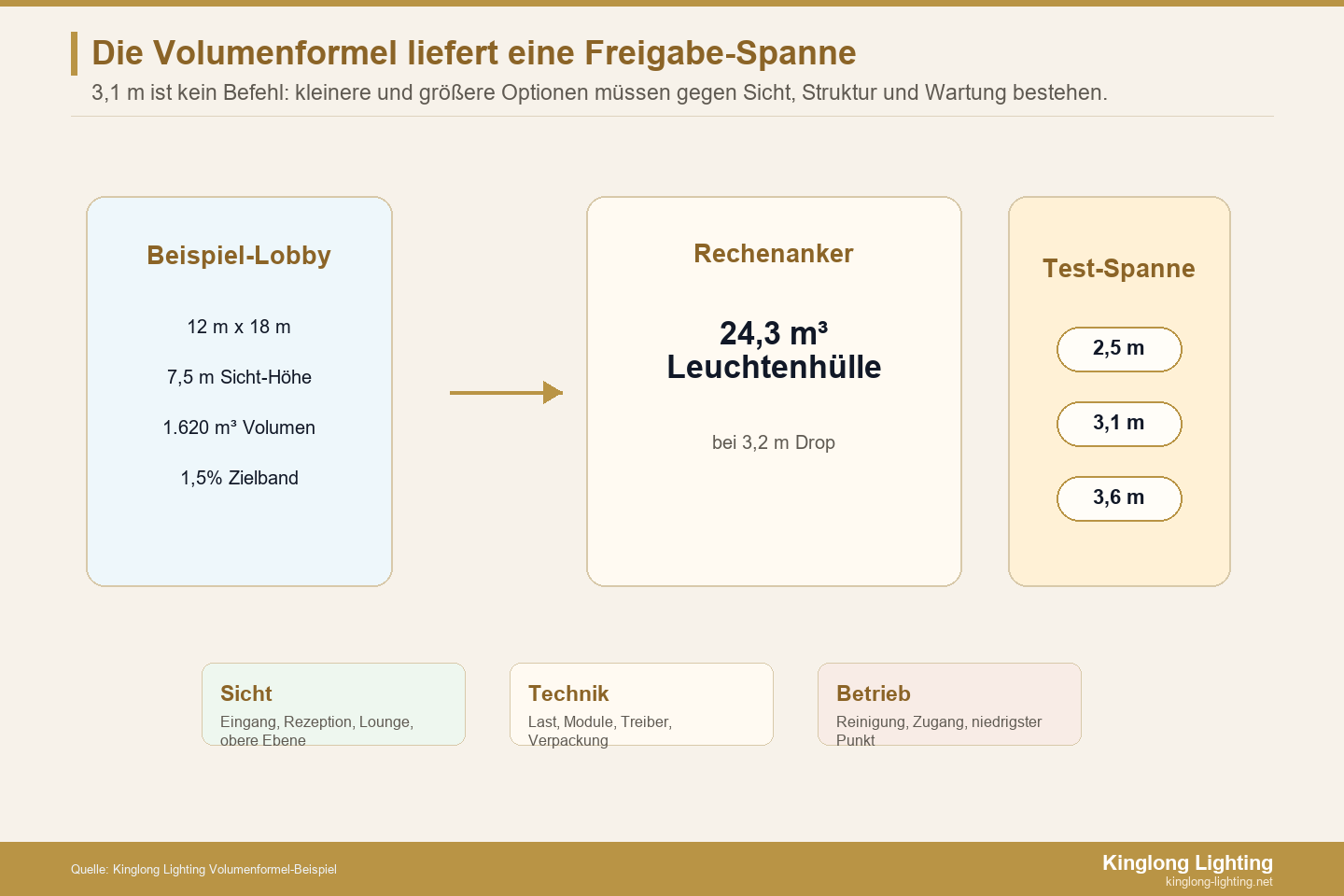
Nehmen wir eine Lobbyzone mit 12 m Breite, 18 m Länge und 9 m Deckenhöhe an. Wenn die ungefähre Betrachtungshöhe 1,5 m beträgt, liegt die sichtbare Höhe bei 7,5 m. Das sichtbare Volumen beträgt also 12 x 18 x 7,5 = 1.620 m3. Wenn das Zielverhältnis für die Leuchtenhülle 1,5 Prozent beträgt, entsteht eine visuelle Kronleuchterhülle von 24,3 m3. Bei einer geplanten Abhängung von 3,2 m ergibt die Durchmesserabschätzung sqrt((4 x 24,3) / (3,1416 x 3,2)), also etwa 3,1 m.
Das Ergebnis mit Designurteil interpretieren
Eine Antwort von 3,1 m bedeutet nicht, dass jede 12 m x 18 m große Lobby einen 3,1 m Kronleuchter braucht. Sie bedeutet, dass das Designteam nun eine 2,6 m, eine 3,1 m und eine 3,6 m Option aus Eingang, Empfangstresen, Lounge-Sitzbereich, oberem Blick und Kameraachsen prüfen sollte. Wenn die Lobby starkes Tageslicht, dunkle Oberflächen, tiefe Deckenkassetten, eine enge Ankunftsachse oder eine große Kunstwand hat, kann die Leuchte eine andere visuelle Dichte brauchen. Wenn der Kronleuchter ein Cluster statt ein massives Objekt ist, verändert sich das wahrgenommene Volumen erneut.
Sichtlinien prüfen, bevor die Zahl freigegeben wird
Die richtige Größe ist die, die den Ankunftsblick hält, ohne Service, Bewegung oder architektonische Hierarchie zu blockieren.
Prüfen Sie mindestens fünf Ansichten: Haupteingang, Check-in am Empfang, Lounge-Sitzbereich, Ankunft am Aufzug und obere Ebene oder Treppenblick, wenn vorhanden. Ein Kronleuchter, der vom Eingang ideal wirkt, kann aus der Lounge zu tief erscheinen. Eine Leuchte, die am Empfang sicher wirkt, kann von außen durch die Glasfassade verschwinden. Das WELL v2 Light Konzept hält das Gespräch bei visueller Behaglichkeit und menschlicher Erfahrung, statt nur bei Spektakel.
Die Mofun Designplattform von Kinglong Lighting ist an dieser Stelle nützlich, weil Maßstab in einem räumlichen Kontext geprüft werden sollte, bevor Metall, Glas, Kristall, Treiber und Aufhängungsdetails festgelegt werden. Ziel ist nicht, das Rendering dramatischer zu machen. Ziel ist zu testen, ob die Volumenformel echte Lobbyansichten übersteht.
Größe mit Struktur, Sicherheit und Wartung verbinden
Großer Durchmesser wird zum Projektrisiko, wenn Lastpfad, Treiberzugang, Reinigungsmethode und Kistenroute nicht gleichzeitig dimensioniert werden.
Ein Kronleuchter in einer zweigeschossigen Lobby kann kundenspezifische Aufhängung, modulare Montage, Treiberzugang, Hebezugang oder motorisierte Wartungsplanung benötigen. Der Projektingenieur sollte Lastannahmen und lokale Code-Anforderungen bestätigen. Für elektrische und produktsicherheitsrelevante Begriffe können Teams je nach Projektstandort und zuständiger Stelle UL-Leuchtenprüfung, das OSHA-NRTL-Programm und IEC 60598 heranziehen. Die wichtigste Einkaufsregel lautet: Größenfreigabe und Sicherheitsnachweis müssen gemeinsam bewegt werden.
| Größenprüfung | Zu beantwortende Frage | Nachweis vor Freigabe |
|---|---|---|
| Volumen | Hält die Leuchte genug dreidimensionale Präsenz? | Formelschätzwert plus drei Alternativgrößen |
| Sichtlinie | Funktioniert sie aus Eingang, Empfang, Lounge und oberem Blick? | 3D-Ansichten oder Fotoüberlagerungen |
| Lichte Höhe | Schützt der niedrigste Punkt Bewegung und Gepäck? | Schnittzeichnung mit menschlichem Maßstab |
| Struktur | Können Decke und Aufhängepfad die Baugruppe tragen? | Gewichtsschätzung und Annahmen zu Fixpunkten |
| Wartung | Kann das Personal sicher reinigen und warten? | Lift-, Winden-, Modul- oder Zugangsplan |
Lieferantenprüfung vor Produktionsfreigabe nutzen
Die Formel erzeugt eine Entwurfsgröße; das Nachweispaket des Lieferanten entscheidet, ob diese Größe baubar ist.
Für eine zweigeschossige Lobby sollte der Lieferant Zeichnungen, Tragwerksannahmen, Modulaufteilung, Materialmuster, Lichtquellendaten, Treiberzugang, Verpackungsplan und Montagefolge liefern. Die Hotelbeleuchtung und kundenspezifische Fertigung von Kinglong Lighting sind relevant, weil übergroße Lobby-Leuchten zugleich Design-, Engineering-, Produktions- und Baustellenprojekte sind.
Aus dem Beispiel gerechnet ergeben 12 m x 18 m x 7,5 m ein sichtbares Volumen von 1.620 m3, und ein Zielwert von 1,5 Prozent erzeugt eine Kronleuchterhülle von 24,3 m3. Bei 3,2 m Abhängung führt diese Hülle zu etwa 3,1 m Durchmesser; bei 1,0 Prozent liegt der Schätzwert nahe 2,5 m, bei 2,0 Prozent nahe 3,6 m. Aus unserer Analyse folgt die Entscheidungsregel: Diese drei Größen sind Testoptionen, keine festen Antworten. In der Praxis ist eine Zahl erst nützlich, wenn Eingang, Empfang, Lounge, obere Ebene, Struktur und Wartung übereinstimmen. Wenn eine Ansicht funktioniert und eine andere scheitert, sollte die nächste Designbewegung nicht die Verteidigung der Formel sein, sondern Anpassung von Abhängung, Dichte, Clusterung oder Aufhängungsstrategie.
Die finale Größennotiz sollte deshalb abgelehnte Optionen genauso dokumentieren wie die freigegebene. Diese verworfenen Ansichten erklären, warum der gewählte Kronleuchter verteidigbar ist. Sie helfen auch später, wenn Eigentümer, Designer oder Einkauf fragen, warum nicht die größte oder günstigste Option gewählt wurde.
Verwandte Leitfäden
- Designentscheidungen für Hotel-Lobby-Kronleuchter
- Spezifikationsleitfaden für Fünf-Sterne-Hotel-Kronleuchter
- Beschaffungsrahmen für Hotelbeleuchtung
Aktionskarte für Lobby-Größenfreigabe
- Sichtbares Volumen und drei Durchmesseroptionen berechnen.
- Eingang, Empfang, Lounge, obere Ebene und Kameraansichten testen.
- Lichte Höhe, Last, Treiberzugang und Wartungsmethode bestätigen.
- Kinglong Lighting bitten, die Größenakte vor Produktionsfreigabe zu prüfen.
- Abmessungen, Deckenhöhe, Ansichten, Zeichnungen, Zielort und bevorzugte Materialien über die Anfrage für kundenspezifische Lobby-Kronleuchter senden.
Eine Lobby-Größendatei sollte die Formel in eine Freigabe-Spanne verwandeln
Die Volumenformel ist wertvoll, weil sie eine Zahl schafft, die das Team testen kann. Sie sollte kein Ein-Zahlen-Befehl werden. Ein Kronleuchter in einer zweigeschossigen Lobby braucht eine freigegebene Spanne, die visuelle Masse, niedrigsten Punkt, Struktur, Modulaufteilung, Reinigungszugang und Gästezirkulation verbindet. Ein 3,1-m-Schätzwert kann richtig sein, aber das Projekt sollte trotzdem fragen, ob 2,6 m zu schwach wirkt, ob 3,6 m Blickachsen blockiert und ob die gewählte Abhängung sicher installiert und gewartet werden kann.
Sichtlinien die Formel herausfordern lassen
Die Größendatei sollte je nach Projekt Eingang, Empfang, Lounge, Aufzug, Treppe und obere Ebene enthalten. Jede Ansicht prüft ein anderes Risiko. Der Eingang prüft Landmarkenstärke. Der Empfang prüft, ob der Kronleuchter vom Tresen ablenkt. Lounge-Sitzplätze prüfen Blendung und wahrgenommene Höhe. Obere Blicke prüfen Top-Geometrie und Staubsichtbarkeit. Diese Ansichten halten die Berechnung an die Gästeerfahrung gebunden, statt die Formel über den Raum entscheiden zu lassen.
Durchmesser mit Modul- und Verpackungslogik verbinden
Ein großer Durchmesser verändert die Herstellung. Er kann segmentierte Ringe, indexierte Kristall- oder Glasmodule, Sonderkisten, stärkere Aufhängung oder präzisere Baustellenmontage erfordern. Kinglong Lighting sollte die Größen-Spanne vor Produktionsfreigabe erhalten, damit die Fabrik erkennen kann, welche Option für Fertigung, Verpackung, Hebung und Wartung realistisch ist. Eine schöne 3D-Ansicht reicht nicht, wenn Kistenroute oder Aufhängepunkt offen bleiben.
Die Einschränkungen einfrieren, die die Spanne schützen
Die finale Freigabedatei sollte genehmigte Durchmesser-Spanne, maximale Abhängung, niedrigste lichte Höhe, angenommene Leuchtenlast, Modulzahl, Reinigungszugang, Treiberzugang und Montageweg festhalten. Wenn sich eine dieser Einschränkungen ändert, muss die Größe erneut geprüft werden. So verhindert das Team, dass eine späte Struktur- oder Baustellenbedingung den Kronleuchter still in ein anderes Objekt verwandelt.
Wartungszugang als Größenbegrenzer nutzen
Wartung ist ein nützlicher Realitätstest, weil sie Maßstab in Hotelbetrieb übersetzt. Ein größerer Kronleuchter kann in einem hohen Raum proportionaler wirken, aber besonderen Liftzugang, abnehmbare Abschnitte, motorisiertes Absenken oder längere Raumsperrung erfordern. Ein kleinerer Kronleuchter kann leichter zu warten sein, aber aus dem Eingang zu schwach wirken. Die Größendatei sollte die Designspanne vor Käuferfreigabe mit der Zugangsmethode vergleichen.
Der praktische nächste Schritt ist, Kinglong Lighting Lobbyabmessungen, Deckenschnitt, Ansichtsreferenzen, gewünschtes Material, Abhängungslimit und Zugangsroute zusammen zu senden. Die Lieferantenantwort sollte bestätigen, welche Größe die Designabsicht halten kann, ohne vermeidbares Montage- oder Servicerisiko zu erzeugen.
Diese Antwort sollte auch den Punkt benennen, an dem eine Größenänderung eine neue Engineering-Prüfung auslöst. Eine Anpassung von 100 mm kann harmlos sein, während ein größerer Durchmesser, ein schwereres Material oder eine tiefere Abhängung Last, Verpackung, Treiberzugang und Montagefolge verändern kann. Ein benannter Prüfpunkt verhindert, dass spätere Designverfeinerung zu undokumentiertem Produktionsrisiko wird.
Die Freigabe-Spanne sollte außerdem gegen nicht lichtbezogene Lobby-Elemente geprüft werden. Hohe Pflanzgefäße, Kunstwände, Empfangsbeschilderung, Rolltreppen, Balkonränder und Tageslichtreflexe können verändern, wie groß der Kronleuchter wirkt. Wenn diese Elemente im Innenausbaupaket noch in Bewegung sind, sollte die Kronleuchtergröße bedingt bleiben. Zu frühes Einfrieren zwingt das Lichtpaket, einen Raum auszugleichen, der sich noch um die Leuchte herum verändert.
Die Größenakte sollte außerdem festhalten, welche Annahme vom Hotelteam und welche vom Lieferanten kommt. Der Designer besitzt vielleicht die Sichtachsen, der Ingenieur die Lastgrenze, der Contractor die Zugangsroute und die Fabrik die Modul- und Verpackungslogik. Wenn diese Eigentümer nicht benannt werden, wandert ein scheinbar technischer Größenwert durch Meetings, ohne dass jemand die Konsequenzen einer Änderung vollständig besitzt. Eine freigegebene Spanne funktioniert nur, wenn jede Grenze einen Verantwortlichen hat.
Bei Renovierungen wird diese Disziplin noch wichtiger. Bestehende Deckenöffnungen, Sprinklerköpfe, Kameras, Lautsprecher und Rauchmelder können die theoretisch passende Größe einschränken. Die Volumenformel bleibt dann ein Startpunkt, aber die Freigabe muss beweisen, dass der Kronleuchter im vorhandenen Raum montierbar, zugänglich und brandschutztechnisch koordinierbar bleibt. Das schützt den Entwurf vor einer späten Verkleinerung, die visuell wie ein Kompromiss wirkt.
Häufig gestellte Fragen
Was ist die beste Formel für die Größe eines Hotel-Lobby-Kronleuchters?
Nutzen Sie Länge-plus-Breite-Regeln nur als erste Skizze. Für zweigeschossige Hotel-Lobbys sollte eine Volumenprüfung hinzukommen: sichtbares Raumvolumen berechnen, ein illustratives Leuchtenvolumen wählen, daraus mit geplanter Abhängung einen Durchmesser lösen und anschließend Ansichten, Struktur und lichte Höhe prüfen.
Ist das Ziel von 1,0 bis 2,0 Prozent Leuchtenvolumen ein offizieller Standard?
Nein. Es ist eine illustrative Designheuristik für frühe Größenbesprechungen, kein Code und kein offizieller Lichtstandard. Die finale Freigabe muss aus projektspezifischer Designprüfung, Engineering, lokaler Code-Prüfung und Mock-up oder Visualisierung entstehen.
Wie tief sollte ein Hotel-Lobby-Kronleuchter hängen?
Der niedrigste Punkt sollte Gästezirkulation, Gepäckbewegung, Reinigungszugang und lokale Sicherheitsprüfung schützen. In zweigeschossigen Räumen ist die bessere Frage nicht nur lichte Höhe, sondern ob Abhängung, Durchmesser und visuelle Dichte aus den wichtigsten Gästeblicken zusammen funktionieren.
Wann sollte ein Lobby-Kronleuchter in mehrere Leuchten aufgeteilt werden?
Mehrere Leuchten sind sinnvoll, wenn ein einzelnes Objekt Blickachsen blockiert, die Decke überlastet, Wartung erschwert oder eine lange Ankunftsachse nicht füllt. Ein Cluster kann visuelles Volumen mit besserem Servicezugang schaffen, braucht aber dennoch eine einheitliche Zeichnung und Steuerungslogik.