Sequence one-off feature lights and repeated guestroom fixtures as separate approval and production streams, then reconcile their shared resources and actual installation dates. Start resolving the feature light’s uncertain design and building interfaces early. In parallel, establish the room-fixture configuration that can be repeated without carrying an unresolved detail into every room. Neither “make the largest quantity first” nor “finish the statement piece first” is a dependable rule. For a fit-out contractor, the useful question is which ready work protects the next installation window without taking a resource already needed elsewhere.
Two Release Streams, One Resource Calendar
Separate approval status does not create separate factory capacity: the two streams can progress independently only where their inputs and resources permit. A release stream is a group of work with its own settled inputs and authorization. Keeping two streams distinct prevents an unresolved lobby detail from automatically holding approved room fixtures; a shared capacity calendar prevents both from being promised the same finishing slot.
Use separate release decisions, but review their dependencies together. The feature stream needs early attention to geometry, supporting interfaces, assembly and access. The repeated stream needs a stable reference configuration and controlled quantities by room type. Reconnect them where they share materials, finish references, equipment, specialist labor, inspection space or shipments. This is a recommended planning model, not a claim that every factory has two dedicated production lines.
Separate Design Risk from Repetition Risk
Investigate unresolved feature-light geometry and interfaces early, while qualifying the approved room configuration before authorizing repetition. The feature light may have a low unit count but a large unresolved question: whether its suspension arrangement, canopy and assembled dimensions fit the coordinated building design. A room fixture presents a different exposure: a small mistake in its connection, handed version or finish can be repeated throughout the order.
Give the feature work an engineering sequence before treating it as a manufacturing sequence. Identify the decisions that can still change the object, the people who can settle them and the evidence each decision needs. A view of the overall form may settle appearance while leaving connection details open. Assign those unresolved details to the affected operation rather than labeling the whole feature “approved” because one presentation was accepted.
For room fixtures, establish which sample represents which configuration. A bedside lamp for a standard room does not automatically represent a differently handed suite fitting. Record the matching drawing, components, finish and connection details before repeating that version. Qualifying repetition is about making the reference dependable, not waiting until the feature design is finished.
The Lean Enterprise Institute defines pull production through downstream activities signaling their needs to upstream activities. For the contractor’s planning conversation, that makes the receiving room or public-area installation a useful starting point. It does not mean a hotel supplier should adopt a particular factory-control system.
Where fixture descriptions are still incomplete, use the lighting specification and procurement resources to resolve the specification questions before requesting a firm production sequence.
Work Back from Installation, Then Check Forward Feasibility
Set a separate site need for each usable installation group, not just one hotel-opening date. Room floors may be handed over in stages, while a lobby feature may need access before another trade closes an opening. The relevant date is when the named work can be installed under the coordinated site plan, not simply when the purchase order wants everything “delivered.”
Microsoft Dynamics 365 describes backward scheduling as working back from the required production finish to the latest possible production start. A contractor can use that direction of reasoning while keeping the factory finish distinct from site arrival and installation.
- Confirm the installation window and receiving conditions with the site team.
- Work back through receipt, agreed transport and any destination handling to the required dispatch.
- Allow for the specified checks, packing and any agreed assembly review before dispatch.
- Ask the factory to place its actual operation durations and resource reservations behind that finish.
Use working calendars and agreed transport assumptions. Do not subtract a generic “manufacturing lead time” from a calendar date and treat the result as verified. A feature may have a separate access deadline; room batches may require separate completeness checks and receiving space. Record those differences even when they travel under the same order.
Compare that backward-required start with the earliest feasible start after approval, material availability and reserved resources. If the feasible start is later, the schedule contains a conflict. Resolve it through a changed scope, resource plan, delivery arrangement or installation window; moving a bar on the drawing does not remove the missing prerequisite.
Release Only the Work Whose Inputs Are Settled
The Lean Construction Institute describes make-ready planning as removing constraints ahead of time so planned work can happen. Here, distinguish a desired production start from work whose drawing, materials, authorization and next operation are actually ready.
For the feature light, review the buildable geometry, relevant site interfaces, selected materials and electrical arrangement, then identify the exact work being authorized. Depending on the design, the unresolved item might affect a complete assembly, a canopy, a suspension detail or only a replaceable element. A procurement manager should not infer technical independence; the responsible designer and manufacturer need to establish it.
For the room stream, sample approval supports repetition only for the approved fixture configuration. Link that reference to the drawing and component revision, room-type quantities, finish and agreed checks. A feature geometry revision can remain separate; a shared finish change cannot be assumed to leave the room configuration untouched.
Record the operation and quantity released, not merely “rooms approved.” If a room sample is accepted except for a connection detail that changes assembly, the factory still needs that detail settled before the dependent assembly work. Conversely, administrative consolidation of the whole lighting package should not quietly reopen an unchanged, separately authorized room configuration.
Kinglong Lighting describes drawings, scale models and material samples for approval before production, alongside logistics coordinated for project-phase delivery, in its hotel lighting project scope. Use those stated activities to discuss the evidence and handoffs your package needs. They do not establish a reserved production slot or guarantee the dates on a proposed program.
Reserve Shared Finishing and Assembly Capacity Explicitly
Check the operations where the streams meet. Two different fixtures may use the same finishing equipment, the same specialist assembler or the same inspection area. Identical finish names also do not establish that parts can share one run: the manufacturer needs to confirm material, preparation, process and reference compatibility.
In Microsoft Dynamics 365 job scheduling, finite capacity accounts for available resource time and existing reservations; finite materials checks availability at the operation start. That distinction helps interrogate a supplier plan without assuming the supplier uses this software: both an available slot and the required materials matter.
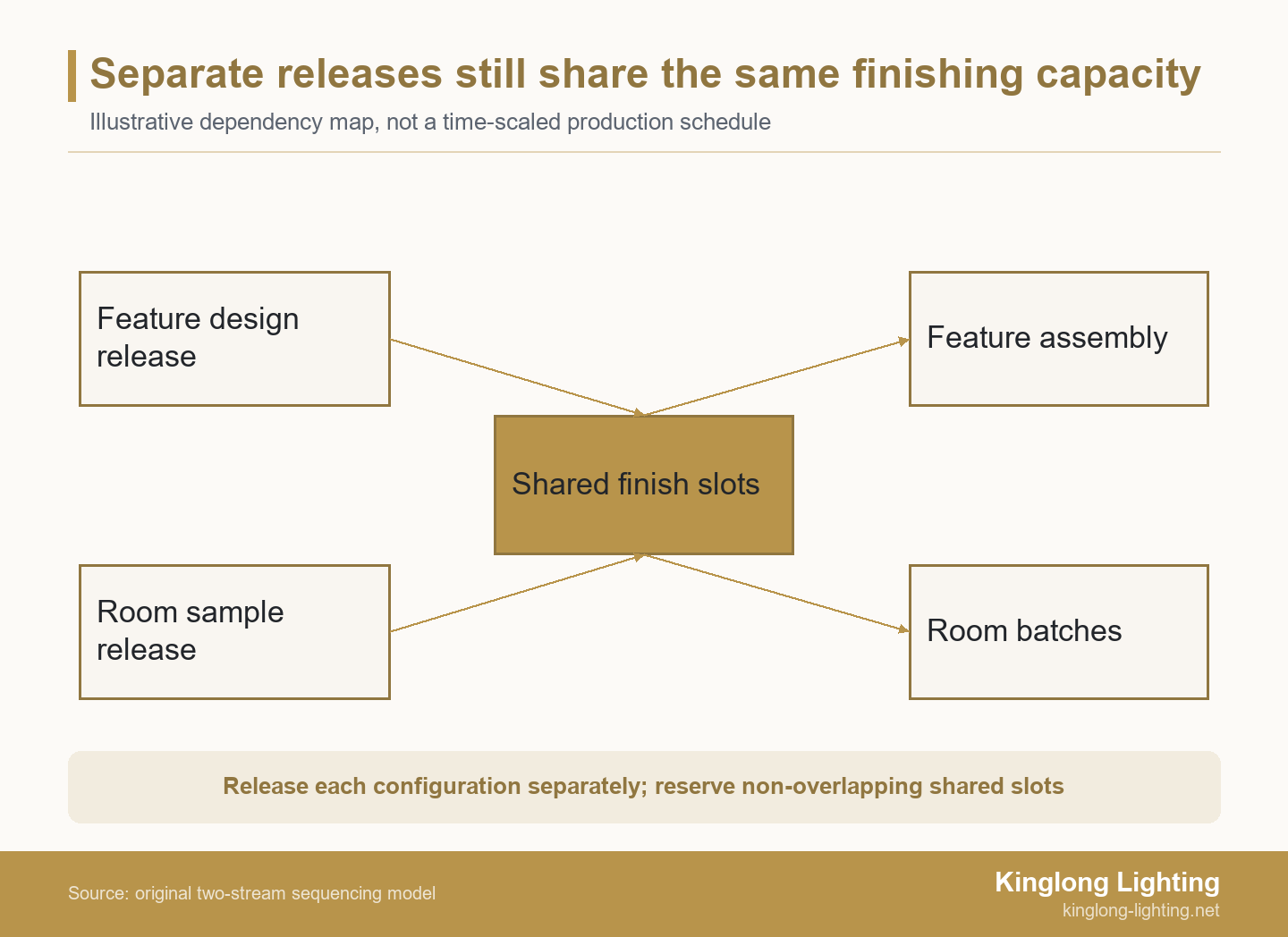
Protect the feature’s uncertain engineering work early, but do not let an unresolved feature consume a firm finishing reservation indefinitely while ready room work waits. The planner can retain an agreed decision cutoff and recovery option. After a cutoff is missed, the feature needs a new feasible slot rather than an unsupported promise that it will fit between committed room batches.
Ask who can authorize changes to those reservations and which downstream dates a change affects. Keep purchasing, finishing and final assembly visible separately; expediting a component does not necessarily create an assembly slot. A genuinely additional resource also needs the relevant capability and quality checks, not just an empty calendar entry.
Use Kinglong’s published project contexts as a starting point for relevant references. A project image can illustrate design context; current slot availability and comparable sequencing evidence require a separate discussion.
A Sequencing Board for the Contractor and Factory
Use one sequencing row per releasable work package, with its prerequisite, reserved operation, next handoff, site need and exception action visible. Split a row when different room phases need different dates or when one operation remains held while another is independently authorized. Keep the item and revision identifiers attached as the work moves.
The following board is a reusable field template. Populate the entries from the controlled schedule, actual factory plan and site program; its prompts are not production permissions.
| Field | Enter for each work package | Decision it supports |
|---|---|---|
| Scope and version | Fixture code, drawing revision, configuration and quantity | Identify exactly what the row covers |
| Ready-to-start condition | Required approval, available material and unresolved prerequisite | Separate ready work from a desired date |
| Shared operation | Resource, reserved slot, quantity and preceding reservation | Expose capacity conflicts between streams |
| Next handoff | Receiving operation, required contents and acceptance check | Avoid pushing unfinished or unusable work onward |
| Site destination | Room phase or public area, receipt and installation window | Connect production to usable site work |
| Exception action | Decision owner, cutoff, affected successor and recovery option | Escalate the dependency before the window is lost |
The Lean Enterprise Institute describes batch-and-queue as moving large lots onward regardless of actual need and leaving them waiting at the next process. Check the receiving operation before celebrating a finished batch. A room-phase group still needs its full fixture mix and required accessories, not merely a large number of finished wall lights.
At the coordination meeting, compare the next promised handoff with its prerequisites and receiving capacity. Update a missed decision’s consequence, not just its color. If the only recovery involves changing the product, use the decorative-lighting value engineering guide to structure the specification trade-off rather than making an undocumented substitution to preserve the date.
Illustrative Sequence: One Feature Light and 120 Guestrooms
In this illustrative package, 120 guestrooms each need two wall lights and one pendant: 240 wall lights and 120 pendants, plus one lobby feature light, for 361 fixtures in total. This is a hypothetical planning example, not a Kinglong project or a measured factory output. Assume three equal room phases, each containing 40 rooms, and a separately scheduled lobby installation.
The approved room configuration and its materials are ready, but the lobby canopy interface is unresolved. Assume that the manufacturer has confirmed the room fixtures are unaffected by that interface and has allocated distinct shared finishing slots. The contractor therefore releases the identified room run while retaining the hold on dependent lobby fabrication. Feature engineering continues so its remaining decisions can be closed before a later feasible slot is confirmed.
| Work package | Quantity | Sequence decision | Next usable handoff |
|---|---|---|---|
| Room phase A | 80 wall lights + 40 pendants | Use its confirmed finishing and assembly reservations after release | Complete fixture mix and accessories for 40 rooms |
| Room phase B | 80 wall lights + 40 pendants | Follow its own reserved operations; keep the reference configuration unchanged | Complete fixture mix and accessories for the next 40 rooms |
| Room phase C | 80 wall lights + 40 pendants | Retain later reservations matched to its site need | Complete fixture mix and accessories for the final 40 rooms |
| Lobby feature | 1 feature light | Resolve canopy interface; then authorize dependent work and confirm a feasible slot | Agreed assembly evidence and complete installation contents |
The phase groups describe delivery needs, not a mandatory division into three factory lots. The factory may manufacture compatible parts together, provided the reservations, identities and complete phase handoffs remain controlled. No durations are assumed here: the supplier still has to demonstrate that the sequence fits its operations and the actual installation windows.
After the canopy issue is resolved, check the revised drawing and relevant approval before removing the hold. Then verify the feature’s resource booking, assembly review and dispatch assumptions. If the available slot misses the lobby access window, the outcome remains a schedule exception even though the room plan is intact. Do not report the whole package on time just because most of its 361 pieces are progressing.
Replan the Affected Dependency, Not the Whole Package
An isolated lobby geometry change need not stop an already released room run. A changed shared finish or electrical configuration may affect both streams. Start the review with the changed input and identify every operation and approved reference that depends on it.
For a common finish revision, distinguish unprocessed material, parts already finished and completed fixtures. The response may involve a new reference, segregation, rework or a separately agreed scope. Have the responsible parties approve that response before resuming affected work; an unchanged room drawing alone does not establish that its finish remains acceptable.
For a missed resource slot, identify the next feasible reservation and its downstream consequence. For a deferred site phase, confirm storage, protection and responsibility before producing ahead. For an incomplete phase shipment, obtain an agreed installation or receiving plan instead of treating partial arrival as completed delivery. These are different exceptions and need different decisions. Record which dates remain firm and which require a new commitment.
Bring Both Streams into the Supplier Discussion
For a project-specific discussion with Kinglong Lighting, send separate feature and guestroom fixture schedules, current drawings and sample approvals, unresolved interfaces, site installation windows and packaging needs. Identify the decisions already settled and the ones for which you are seeking input.
Ask the team to review the design brief and agree the scope and missing inputs for a supplier proposal. Use that conversation to distinguish the feature’s remaining development from the room configuration proposed for repetition, and to establish what phased delivery would mean for this project. To discuss the two-stream lighting package, include the actual site constraints rather than only an opening date. Manufacturing reservations, detailed dates and installation responsibilities remain matters to confirm in the project agreement.
Frequently Asked Questions
Can the two streams be placed under one purchase order?
Yes, provided the order separates their configurations, quantities, releases, delivery groups and commercial responsibilities. One order does not require one approval date or one shipment. Agree how partial releases, deposits, storage and delayed portions will be handled, including who can authorize a change. Keep those commercial arrangements consistent with the separately identified work rather than relying on a single package status.
Does the feature light always need a full-size prototype?
No; the evidence needed depends on its unresolved risks and the project requirements. A material sample, connection mock-up, dimensional review or assembly check answers different questions. Select the evidence with the responsible designer and manufacturer, and state what it does not establish. A finish sample cannot demonstrate that the assembled feature fits its access route or interfaces correctly with the building.
Should every guestroom fixture be manufactured in one batch?
Not automatically; the chosen batch size should reflect confirmed setup constraints, materials, storage and room handovers. Production grouping and shipment grouping can differ. If compatible parts are processed together, retain identification and a plan for completing each required room mix. Ask how the chosen grouping affects the next handoff rather than assuming either one large run or many small runs is universally faster.
Does partial shipment transfer installation responsibility to the supplier?
No; shipment grouping does not by itself change the installation responsibilities agreed for the project. Confirm who receives, checks, stores, assembles and installs each group, and who supplies any required instructions or supervision. A phase can be physically delivered while the site is not ready to install it. Resolve that receiving and storage arrangement explicitly instead of treating transport completion as acceptance of all installation obligations.