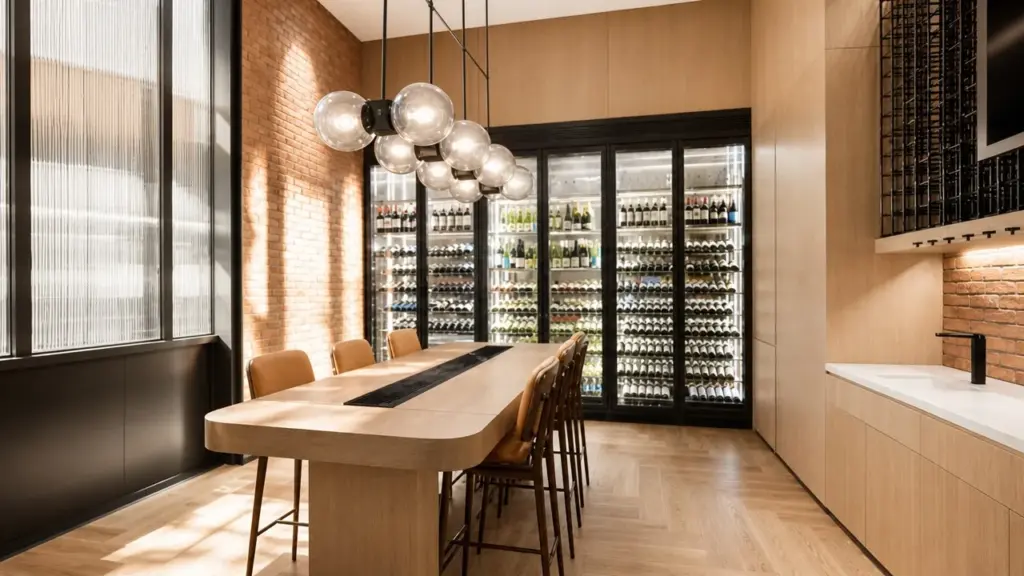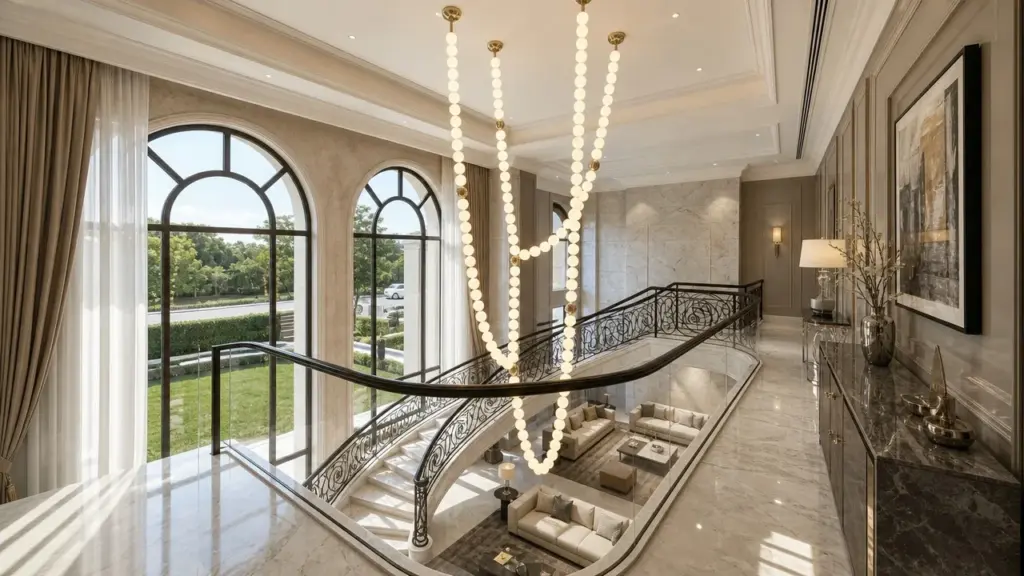
Hotel Lighting Project Procurement: From RFQ to Commissioning is a project-control topic before it is a decorative lighting topic. The buyer is not only choosing a chandelier, sconce, or decorative lighting package. The buyer is deciding how design intent, supplier proof, site constraints, production sequence, and final acceptance will stay aligned.
The common failure is to treat hotel lighting procurement process as a document or meeting that can be cleaned up late. By then, the ceiling interface, samples, control scenes, packaging, shipping terms, and installation responsibilities may already point in different directions.
Kinglong Lighting approaches this kind of article from the manufacturer’s side of the table. A useful lighting supplier should help the project team turn preferences into evidence, evidence into release gates, and release gates into a handover file the hotel can actually operate.
Key Takeaways
- Proof beats preference: every key decision should name the evidence needed before release.
- The supplier file must be useful on site: drawings, samples, labels, and access notes should reduce installation questions.
- Local review still matters: factory information supports local professionals but does not replace them.
- Acceptance should be defined early: final quality cannot be judged only by whether the fixture turns on.
- Soft CTA belongs before FAQ: buyers should know what to send when they ask Kinglong Lighting for help.
Procurement fails when price arrives before proof
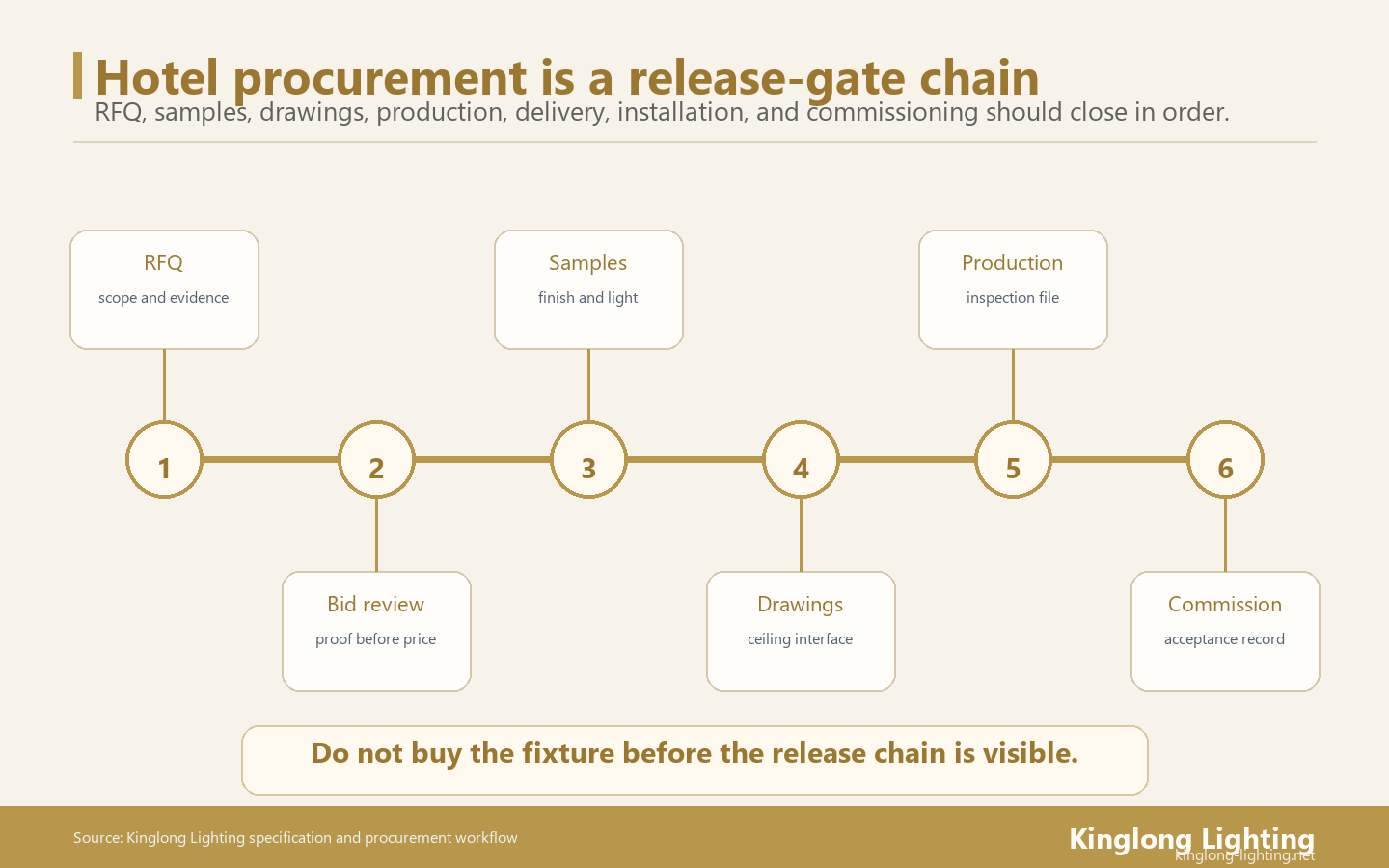
The strongest hotel lighting procurement file makes every stage answer what is being approved, who owns it, and what evidence closes the gate.
Hotel lighting procurement looks simple when reduced to supplier, price, and delivery date. In practice, the process has to protect design intent, electrical evidence, ceiling coordination, shipment responsibility, site access, and final commissioning. Each stage should close a different kind of risk.
The WBDG building commissioning page is useful because commissioning turns design intent into verified operation and handover evidence. For hotel procurement directors, design managers, and owner representatives buying decorative lighting packages, that turns the discussion into a stage-by-stage release plan from RFQ to commissioning instead of a preference argument.
RFQ: ask for proof, not only price
The RFQ should define the evidence that makes supplier pricing comparable.
The UL 1598 standard page is useful because decorative chandeliers remain luminaires that need product and installation evidence. For hotel procurement directors, design managers, and owner representatives buying decorative lighting packages, that turns the discussion into a commissioning-aware RFQ with acceptance criteria instead of a preference argument.
Room schedule anchors the scope
RFQ scope becomes important when a hotel asks for a decorative lighting quote without a room-by-room schedule. The project team should not treat this as a late coordination detail, because the choice changes cost, sequence, drawing responsibility, and the evidence a buyer can reasonably approve. If the issue is left open, the supplier may quote an attractive fixture while the building team silently carries an unresolved constraint.
The practical answer is to name fixture counts, room roles, drawings, finish targets, and control expectations before release. That proof gives the owner a decision rule: compare suppliers on the same package rather than on different hidden assumptions. It also keeps Kinglong Lighting’s role honest. The factory can provide drawings, samples, product information, packing logic, and manufacturing options, while local professionals still confirm the building, code, and site-specific safety requirements.
Evidence fields make prices comparable
Bid comparability becomes important when one quote includes samples and packing while another excludes them. The project team should not treat this as a late coordination detail, because the choice changes cost, sequence, drawing responsibility, and the evidence a buyer can reasonably approve. If the issue is left open, the supplier may quote an attractive fixture while the building team silently carries an unresolved constraint.
The practical answer is to name a proof checklist for samples, drawings, testing, packing, and installation notes before release. That proof gives the owner a decision rule: normalize evidence before ranking price. It also keeps Kinglong Lighting’s role honest. The factory can provide drawings, samples, product information, packing logic, and manufacturing options, while local professionals still confirm the building, code, and site-specific safety requirements.
Bid review: separate capability from confidence
Supplier confidence is useful, but procurement should ask what the supplier can prove.
The NFPA 70 National Electrical Code page is useful because electrical installation decisions need qualified local code review. For hotel procurement directors, design managers, and owner representatives buying decorative lighting packages, that turns the discussion into luminaire evidence, manufacturing capability, and sample plan instead of a preference argument.
Product evidence belongs in the bid
Supplier review becomes important when the team accepts attractive renders and broad claims instead of product evidence. The project team should not treat this as a late coordination detail, because the choice changes cost, sequence, drawing responsibility, and the evidence a buyer can reasonably approve. If the issue is left open, the supplier may quote an attractive fixture while the building team silently carries an unresolved constraint.
The practical answer is to name component notes, installation instructions, and market-specific documentation before release. That proof gives the owner a decision rule: shortlist the supplier that can close the evidence gap. It also keeps Kinglong Lighting’s role honest. The factory can provide drawings, samples, product information, packing logic, and manufacturing options, while local professionals still confirm the building, code, and site-specific safety requirements.
Electrical assumptions need local review
Electrical review becomes important when driver and control decisions stay vague until site work begins. The project team should not treat this as a late coordination detail, because the choice changes cost, sequence, drawing responsibility, and the evidence a buyer can reasonably approve. If the issue is left open, the supplier may quote an attractive fixture while the building team silently carries an unresolved constraint.
The practical answer is to name voltage, driver, dimming, circuit, and local review notes before release. That proof gives the owner a decision rule: do not release the package until electrical assumptions can be read by the local team. It also keeps Kinglong Lighting’s role honest. The factory can provide drawings, samples, product information, packing logic, and manufacturing options, while local professionals still confirm the building, code, and site-specific safety requirements.
Samples and shop drawings: freeze what production must repeat
The sample and drawing stages translate design language into repeatable production instructions.
Samples answer the riskiest aesthetic question
Sample approval becomes important when the designer approves a mood but not the production reference. The project team should not treat this as a late coordination detail, because the choice changes cost, sequence, drawing responsibility, and the evidence a buyer can reasonably approve. If the issue is left open, the supplier may quote an attractive fixture while the building team silently carries an unresolved constraint.
The practical answer is to name finish master, glass sample, crystal density, and light behavior notes before release. That proof gives the owner a decision rule: release production only from a named master sample. It also keeps Kinglong Lighting’s role honest. The factory can provide drawings, samples, product information, packing logic, and manufacturing options, while local professionals still confirm the building, code, and site-specific safety requirements.
Shop drawings protect the ceiling
Shop drawing review becomes important when fixture geometry changes while ceiling reservations are already moving. The project team should not treat this as a late coordination detail, because the choice changes cost, sequence, drawing responsibility, and the evidence a buyer can reasonably approve. If the issue is left open, the supplier may quote an attractive fixture while the building team silently carries an unresolved constraint.
The practical answer is to name current drawings with dimensions, drop, canopy, suspension, driver, and access notes before release. That proof gives the owner a decision rule: stop any drawing that cannot be installed as shown. It also keeps Kinglong Lighting’s role honest. The factory can provide drawings, samples, product information, packing logic, and manufacturing options, while local professionals still confirm the building, code, and site-specific safety requirements.
Shipment and site work: make handoff visible
International decorative lighting handoff is a quality stage, not a logistics footnote.
The ICC Incoterms 2020 page is useful because international delivery responsibility should be named before production and shipment. For hotel procurement directors, design managers, and owner representatives buying decorative lighting packages, that turns the discussion into delivery terms, crate sequence, and receiving readiness instead of a preference argument.
Delivery terms affect schedule risk
Delivery terms becomes important when the buyer discovers responsibility gaps after the goods are ready. The project team should not treat this as a late coordination detail, because the choice changes cost, sequence, drawing responsibility, and the evidence a buyer can reasonably approve. If the issue is left open, the supplier may quote an attractive fixture while the building team silently carries an unresolved constraint.
The practical answer is to name Incoterms, insurance expectations, documents, crate count, and destination receiving plan before release. That proof gives the owner a decision rule: name who owns each handoff before final payment. It also keeps Kinglong Lighting’s role honest. The factory can provide drawings, samples, product information, packing logic, and manufacturing options, while local professionals still confirm the building, code, and site-specific safety requirements.
Site access should match packing
Site access becomes important when crates and modules arrive in an order that does not match installation. The project team should not treat this as a late coordination detail, because the choice changes cost, sequence, drawing responsibility, and the evidence a buyer can reasonably approve. If the issue is left open, the supplier may quote an attractive fixture while the building team silently carries an unresolved constraint.
The practical answer is to name box labels, module plan, lift route, and unpacking sequence before release. That proof gives the owner a decision rule: pack around the hotel site sequence, not only factory convenience. It also keeps Kinglong Lighting’s role honest. The factory can provide drawings, samples, product information, packing logic, and manufacturing options, while local professionals still confirm the building, code, and site-specific safety requirements.
Commissioning: close the promise
The project is not complete when the chandelier lights up. It is complete when the hotel can operate it.
The OSHA aerial lifts page is useful because overhead installation and service need planned access, qualified operation, and site hazard awareness. For hotel procurement directors, design managers, and owner representatives buying decorative lighting packages, that turns the discussion into commissioning record and handover file instead of a preference argument.
Final scenes should be tested in real use
Commissioning becomes important when installation stops at electrical turn-on. The project team should not treat this as a late coordination detail, because the choice changes cost, sequence, drawing responsibility, and the evidence a buyer can reasonably approve. If the issue is left open, the supplier may quote an attractive fixture while the building team silently carries an unresolved constraint.
The practical answer is to name scene names, dimming behavior, glare review, alignment, and owner acceptance before release. That proof gives the owner a decision rule: accept the installed room, not only the energized fixture. It also keeps Kinglong Lighting’s role honest. The factory can provide drawings, samples, product information, packing logic, and manufacturing options, while local professionals still confirm the building, code, and site-specific safety requirements.
Hotel lighting procurement gate table
Use this table as a compact release gate. It is not a legal contract, but it shows which proof should be visible before the next project stage.
| Decision | Risk if vague | Proof to request | Release rule |
|---|---|---|---|
| RFQ | quotes exclude proof | scope and evidence checklist | compare only normalized bids |
| Samples | mock-up cannot guide production | named master sample | freeze reference before production |
| Drawings | ceiling conflict appears late | current shop drawing set | hold unclear interfaces |
| Shipment | responsibility gaps delay site | Incoterms and crate plan | confirm handoff owners |
| Commissioning | fixture turns on but room fails | scene and acceptance record | close with hotel operation |
How Kinglong Lighting supports hotel lighting procurement process
Kinglong Lighting can support hotel lighting procurement process by connecting design intent to factory evidence: drawings, finish samples, driver notes, packing logic, installation assumptions, and handover records. The useful output is a project file that reduces avoidable questions for designers, procurement teams, contractors, and owners.
Kinglong Lighting can connect this work to the hotel lighting solution and the custom chandelier manufacturing workflow. The point is not to turn a technical article into a catalogue page. The point is to give hotel procurement directors, design managers, and owner representatives buying decorative lighting packages a practical next step when the project file already shows real risk.
When the issue reaches budget, sample, delivery, or site timing, the safer action is to send the hotel lighting procurement process brief with drawings, destination, room schedule, target finish, control expectation, and the proof items already requested in this article.
Soft next step for a procurement package
The next step should be a focused file, not a vague request for price. Buyers get better answers when they send the supplier the same evidence they expect the supplier to return.
- Prepare a room schedule before requesting price.
- Ask each supplier for the same proof fields.
- Approve sample masters before production release.
- Lock the current shop drawing set before shipment.
- Commission the installed room with named acceptance criteria.
FAQ
What should be included in hotel lighting procurement?
A complete process should include RFQ scope, bid evidence, sample approval, shop drawings, production inspection, shipment terms, installation coordination, commissioning, and handover records. Price should be compared only after those proof fields are visible.
When should samples be approved?
Samples should be approved before production release and should answer the highest-risk question: finish, glass, crystal, light behavior, module detail, or scale. A sample is useful only when it becomes the named reference for production.
Who owns commissioning?
The owner and local project team own final commissioning, with supplier evidence supporting the process. The supplier can provide drawings, driver notes, installation information, and punch-list support, but the site team confirms the installed room.
Why is Incoterms discussion part of procurement?
Incoterms affect cost, risk, timing, documents, insurance, and handoff responsibility. For fragile decorative lighting, unclear delivery responsibility can create delays even when the fixture itself is correct.