
Drop testing for crystal components is not a stunt to prove a chandelier is unbreakable. It is a packaging evidence tool. The buyer wants to know whether fragile parts, cartons, dividers, trays, foam, labels, and pallet plans can survive expected distribution stress well enough for the project.
ISTA 3A is often mentioned because it addresses packaged products for parcel delivery systems, but buyers still need to read the exact sample, package configuration, sequence, and damage criteria. Passing a test does not make crystal careless-handing proof.
Kinglong Lighting can help buyers connect drop-test evidence to packing drawings, crystal maps, spare strategy, and the custom chandelier workflow before international shipment.
Key Takeaways
- Drop testing evaluates packaging: The target is the package system, not the fantasy of indestructible crystal.
- Sample configuration matters: Carton weight, inner tray, divider, and part mix decide applicability.
- Damage criteria should be written: Buyers should define broken part, chip, scuff, displacement, and carton failure before testing.
- Corrective action is the real value: A failed drop test should improve packaging, not just delay shipment.
- Shipment evidence needs handover: Packing photos, labels, and unpacking notes help installers protect the parts.
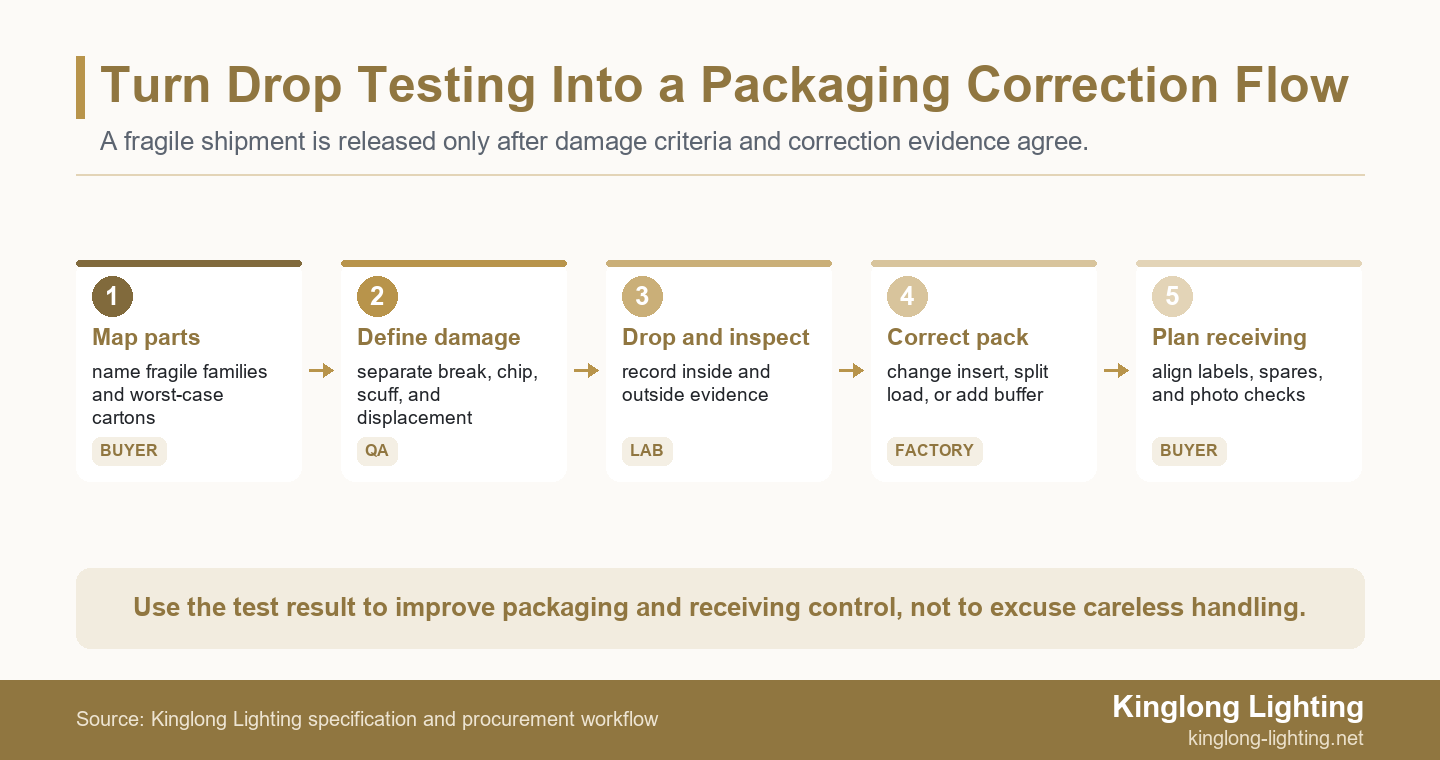
Map the fragile component family before testing
A drop test is successful when it teaches the package how to protect the chandelier shipment.
A chandelier shipment may include crystal prisms, glass shades, metal arms, LED modules, acrylic forms, leather parts, and hardware. One carton result cannot automatically cover every fragile family.
According to ISTA 3A test procedure page, packing evidence should be selected around the distribution environment and package profile. For project buyers, the practical action is to tie the test to the actual package type, distribution path, and damage criteria.
Crystal shape changes packaging behavior
Long tubes, prisms, balls, flat pendants, and drilled drops fail in different ways. A divider that protects one shape may allow another shape to rub, chip, or rotate during impact.
The buyer should ask which crystal family was represented in the test carton and whether the heaviest, most fragile, or most awkward part was included.
In practice, make this a ISTA 3A packing evidence visibility gate: judge the sample under the room light, normal viewing distance, and cleaning condition. The decision rule is to document the threshold before release, then review any mismatch within 7 days if the owner-visible effect or maintenance cost changes.
Part mix can hide the real risk
A test carton with ideal packing may pass while a mixed production carton with hardware, spare parts, or different weight distribution performs differently.
The packing bill of materials should match the test sample closely enough for the report to support shipment release.
If the production carton changes after testing, the buyer should record the difference and decide whether a bridge note, photo review, or retest is needed before final loading.
In practice, make this a ISTA 3A packing evidence visibility gate: judge the sample under the room light, normal viewing distance, and cleaning condition. The decision rule is to document the threshold before release, then review any mismatch within 7 days if the owner-visible effect or maintenance cost changes.
Define damage before the carton is dropped
Drop-test evidence becomes weak when the team decides after the test what counts as damage. The buyer should define acceptance criteria before the test starts.
According to ISO/IEC 17025 overview, laboratory competence, valid results, and report acceptance depend on method and scope. For project buyers, the practical action is to check whether a material report identifies the sample, method, date, scope, and claim it actually supports.
Broken, chipped, scuffed, and displaced are different outcomes
A package may prevent breakage but still allow visible scratches, loose parts, or carton deformation. For luxury chandelier parts, cosmetic damage can be a failure even when the component remains usable.
The acceptance rule should match the project. A hidden bracket has different cosmetic tolerance from a close-view crystal drop.
In practice, make this a ISTA 3A packing evidence visibility gate: judge the sample under the room light, normal viewing distance, and cleaning condition. The decision rule is to document the threshold before release, then review any mismatch within 7 days if the owner-visible effect or maintenance cost changes.
Evidence should show inside and outside
Photos should document carton condition, inner protection, part location, and post-test inspection. A pass statement without photos is less useful for the buyer and installer.
According to CNAS English site, accreditation is a signal that a laboratory or inspection body has been assessed against recognized competence requirements. For project buyers, the practical action is to treat accredited test context as confidence while checking the exact package sample and claim.
In practice, treat this as a ISTA 3A packing evidence evidence gate: keep the report, sample ID, method, date, and claim boundary together. The decision rule is to accept only what the document actually proves, then flag any missing proof within 7 days before the buyer signs production release.
Use failure as packaging design feedback
The best drop-test program is not only pass or fail. It explains what changed after failure: tray thickness, foam density, divider shape, carton grade, label position, or pallet loading.
According to UL 1598 standard page, decorative chandeliers are still luminaires that need product evidence and qualified installation review. For project buyers, the practical action is to keep packaging evidence connected to the complete luminaire file and service path.
Corrective action should be specific
A vague note such as improve packaging is not enough. The buyer needs to know which layer changed and how the revised package will be checked.
If a crystal breaks at a drilled hole, the package may need different support. If parts rub, the divider geometry may matter more than outer carton strength.
In practice, make this a ISTA 3A packing evidence visibility gate: judge the sample under the room light, normal viewing distance, and cleaning condition. The decision rule is to document the threshold before release, then review any mismatch within 7 days if the owner-visible effect or maintenance cost changes.
Retest logic should be practical
Not every minor change requires the same retest, but major changes to carton, inner tray, weight, or distribution path should trigger review.
The buyer should ask whether the tested configuration is still the configuration being shipped.
A practical rule is to retest when the change could alter drop energy, contact points, compression behavior, or how fragile components move inside the carton.
In practice, treat this as a ISTA 3A packing evidence evidence gate: keep the report, sample ID, method, date, and claim boundary together. The decision rule is to accept only what the document actually proves, then flag any missing proof within 7 days before the buyer signs production release.
Do not confuse test passing with careless handling permission
Drop testing simulates defined distribution stresses. It does not permit rough loading, poor stacking, moisture exposure, or ignoring fragile labels.
According to DOE LED lighting page, LED products differ in direction, color behavior, heat, lifetime, and application fit. For project buyers, the practical action is to review decorative materials under the specified light source and room condition, not as isolated samples.
The shipment still needs handling instructions
Luxury chandelier components may pass a package test and still be damaged by forklift puncture, water exposure, upside-down storage, or aggressive unpacking on site.
The handover should include package orientation, carton numbering, unpacking sequence, and inspection checklist.
Those instructions should travel with the shipment file, not only with the factory team, because the highest-risk handling often happens after the cartons leave production control.
In practice, make this a ISTA 3A packing evidence visibility gate: judge the sample under the room light, normal viewing distance, and cleaning condition. The decision rule is to document the threshold before release, then review any mismatch within 7 days if the owner-visible effect or maintenance cost changes.
Spare strategy reduces installation risk
Some fragile parts should ship with planned spares. Spares are not a substitute for good packaging, but they reduce the chance that one broken piece delays installation.
Kinglong Lighting can connect spares, carton labels, and project shipping records to the project delivery file.
The spare rule should name part codes, quantities, and replacement tolerances so the installer can resolve a small breakage without changing the approved chandelier appearance.
In practice, make this a ISTA 3A packing evidence service gate with 3 records: part code, spare quantity, and replacement match rule. The decision rule is to confirm the future repair path before shipment so a small breakage does not become a cost, delay, or owner trust problem.
Build a shipment evidence file before release
The buyer should not wait for damage to ask how the shipment was protected. The evidence file should be built before dispatch.
According to ILAC MRA and signatories page, international recognition of accredited test results depends on the accreditation body and recognition relationship. For project buyers, the practical action is to confirm recognition and evidence expectations if packaging reports must satisfy a receiving party.
The file should include report and production photos
A useful file includes package test report, packing drawings, production carton photos, labels, carton count, spare list, and unpacking guidance.
This makes receiving inspection faster and gives the project team a baseline if damage occurs in transit.
The same file should also show which carton photos match the final loading batch, because old pilot photos can overstate what the production shipment actually used.
In practice, treat this as a ISTA 3A packing evidence evidence gate: keep the report, sample ID, method, date, and claim boundary together. The decision rule is to accept only what the document actually proves, then flag any missing proof within 7 days before the buyer signs production release.
Evidence should not overstate material compliance
Packaging evidence does not prove restricted-substance status, finish durability, or optical quality. Those claims need their own files.
According to European Commission RoHS Directive page, restricted substance rules make material declarations and supply-chain evidence relevant for electrical lighting products. For project buyers, the practical action is to separate package testing from restricted-substance declarations and product-market scope.
In practice, treat this as a ISTA 3A packing evidence evidence gate: keep the report, sample ID, method, date, and claim boundary together. The decision rule is to accept only what the document actually proves, then flag any missing proof within 7 days before the buyer signs production release.
Drop-test evidence decision table
Use this table to turn packaging tests into shipment decisions.
| Decision area | Owner risk if vague | Evidence to request | Acceptance action |
|---|---|---|---|
| Component family | Test carton does not represent fragile parts | Part map, worst-case sample, weight | Confirm sample relevance |
| Damage criteria | Pass is defined too late | Break, chip, scuff, movement, carton failure | Write acceptance before test |
| Corrective action | Failure leads to vague changes | Tray, divider, foam, carton, label revision | Document what changed |
| Shipment handling | Pass implies careless handling allowed | Orientation, labels, stacking, unpacking note | Protect during logistics |
| Evidence file | Installer lacks packing history | Report, photos, carton list, spare list | Store before dispatch |
A crystal drop-test correction scenario
Imagine a test carton passes outer carton inspection but two drilled crystal drops show edge chips. The weak response is to say the carton mostly passed. The stronger response is to identify the failure mode and redesign support around the drilled area.
A second scenario is rubbing rather than breakage. In that case, more foam may not solve the issue if the parts can still move against each other. A divider or individual sleeve may be the real correction.
The decision estimate is to track three outcomes: breakage, cosmetic damage, and displacement. If any outcome appears in a visible component, the package needs a targeted change before shipment release.
The limitation is that a test is only one distribution model. The buyer should still require sensible loading, storage, and receiving inspection.
A packaging acceptance worksheet for fragile chandeliers
Drop-test evidence is strongest when it leads to a packaging acceptance worksheet. The worksheet should show what was packed, how it was protected, what damage criteria applied, and what changed after any failure.
According to ISTA 3A test procedure page, packing evidence should be selected around the distribution environment and package profile. For project buyers, the practical action is to connect the worksheet to package type, distribution path, sequence, and defined damage criteria.
Record the worst-case carton, not only the average carton
A shipment may include cartons that are heavier, taller, more fragile, or more mixed than the typical box. The worksheet should identify which carton represents the highest risk and why that carton was selected for test or review.
If the tested carton protects small prisms but the shipment includes long glass tubes or heavy metal assemblies, the buyer should not treat the pass as universal.
In practice, make this a ISTA 3A packing evidence visibility gate: judge the sample under the room light, normal viewing distance, and cleaning condition. The decision rule is to document the threshold before release, then review any mismatch within 7 days if the owner-visible effect or maintenance cost changes.
Damage criteria should match visible importance
A hidden bracket can tolerate cosmetic marks that a crystal pendant cannot. The worksheet should define separate thresholds for breakage, chip, scratch, scuff, displacement, moisture, and carton deformation.
This lets the team distinguish a package that protects function from a package that protects luxury appearance. For decorative lighting, both can matter.
In practice, make this a ISTA 3A packing evidence visibility gate: judge the sample under the room light, normal viewing distance, and cleaning condition. The decision rule is to document the threshold before release, then review any mismatch within 7 days if the owner-visible effect or maintenance cost changes.
Receiving inspection closes the packaging loop
The packaging story does not end when the carton leaves the factory. The receiving team needs enough information to inspect, report, and unpack without damaging the parts the package protected.
According to UL 1598 standard page, decorative chandeliers are still luminaires that need product evidence and qualified installation review. For project buyers, the practical action is to connect packaging evidence to the full luminaire file and installation handover.
Carton numbering should match the installation sequence
A large chandelier shipment can become risky when installers open boxes randomly, mix crystal families, or remove protective sleeves too early. Carton labels should match the part map, room location, and unpacking order.
This reduces handling damage and helps the team detect whether a missing or broken part belongs to shipping, receiving, or installation.
In practice, make this a ISTA 3A packing evidence visibility gate: judge the sample under the room light, normal viewing distance, and cleaning condition. The decision rule is to document the threshold before release, then review any mismatch within 7 days if the owner-visible effect or maintenance cost changes.
Photos should make claims easier to resolve
Pre-shipment photos, pallet photos, carton photos, and post-test photos create a baseline. If damage is found later, the team can compare evidence instead of relying on memory.
The goal is not to assign blame faster. The goal is to restore the installation path quickly with spare parts, corrective packing, or logistics action.
In practice, make this a ISTA 3A packing evidence visibility gate: judge the sample under the room light, normal viewing distance, and cleaning condition. The decision rule is to document the threshold before release, then review any mismatch within 7 days if the owner-visible effect or maintenance cost changes.
When packaging evidence should change the shipment plan
Drop-test findings should influence not only the carton design, but also how the shipment is split, labeled, insured, inspected, and staged for installation.
According to ISTA 3A test procedure page, packing evidence should be selected around the distribution environment and package profile. For project buyers, the practical action is to use package evidence to adjust the distribution and handling plan, not only the carton specification.
According to ICC Incoterms 2020, trade terms help define delivery responsibilities, but they do not replace product-specific packing evidence. For project buyers, the practical action is to keep commercial risk allocation separate from the physical proof that fragile chandelier cartons can survive the chosen route.
Split high-risk parts when mixed cartons create damage
If heavy hardware sits beside crystal, or long glass pieces share space with small pendants, the buyer should ask whether separate cartons reduce rubbing, point loading, and unpacking confusion.
A slightly higher carton count may be cheaper than remaking damaged crystal or delaying a hotel opening while replacement parts are produced.
In practice, make this a ISTA 3A packing evidence visibility gate: judge the sample under the room light, normal viewing distance, and cleaning condition. The decision rule is to document the threshold before release, then review any mismatch within 7 days if the owner-visible effect or maintenance cost changes.
Use the test result to plan receiving inspection
The receiving checklist should name which cartons are opened first, what damage is inspected, how photos are taken, and how quickly problems must be reported.
This makes the test useful at the jobsite, where the real pressure is not proving a package theory but keeping installation moving.
In practice, treat this as a ISTA 3A packing evidence evidence gate: keep the report, sample ID, method, date, and claim boundary together. The decision rule is to accept only what the document actually proves, then flag any missing proof within 7 days before the buyer signs production release.
How Kinglong Lighting supports shipment protection evidence
Kinglong Lighting can support drop-test decisions by connecting packing drawings, carton photos, spare plans, and fragile-part maps inside the custom chandelier workflow.
If a buyer is preparing a fragile chandelier shipment, the useful next action is to send the packaging evidence brief with component list, destination, logistics path, spare policy, and damage concerns.
Before relying on a chandelier drop test
Use this short action list before the next approval meeting. It is intentionally practical, because vague approval language is the usual source of later rework.
- Confirm the package sample matches the shipment.
- Define damage criteria before testing.
- Use failures to revise trays, dividers, foam, or cartons.
- Keep handling and unpacking rules in the file.
- Attach photos and reports to shipment release.
For a project-specific shipment protection check, Kinglong Lighting can review the component list, destination, logistics path, spare policy, and damage concerns before the buyer releases fragile chandelier cartons.
FAQ
What does ISTA 3A mean for chandelier shipments?
It can support packaged-product distribution testing, but buyers must check the sample, package configuration, sequence, and damage criteria.
Does passing a drop test mean crystal will not break?
No. It means the tested package met defined criteria under defined conditions; poor handling or different packaging can still cause damage.
What should buyers request after a failed drop test?
Request a specific corrective action, revised package photos, and a clear decision on whether retesting or inspection is needed.
Should chandelier shipments include spare crystals?
Often yes. Spares reduce installation delay risk, but they should complement good packaging rather than replace it.