
CNAS accreditation can be a meaningful trust signal for a lighting manufacturer, but buyers often misunderstand what it means. CNAS does not mean every chandelier is certified, every product is approved for every market, or every lab report proves every claim. It means an accredited conformity assessment body has been assessed for defined competence within a defined scope.
For a lighting buyer, the practical value is not the logo by itself. The value is that a report or test process can be read with more confidence when the sample, method, scope, date, and result match the decision the buyer needs to make.
Kinglong Lighting’s approved brand evidence includes CNAS-accredited capability, but a responsible buyer should still connect that signal to the custom chandelier workflow, the exact test report, and the order decision before treating it as release evidence.
Key Takeaways
- CNAS is about competence scope: It supports confidence in accredited testing or inspection capability, not every product claim.
- Reports still need reading: Sample, method, date, result, and applicability decide whether evidence supports the buyer's decision.
- Accreditation is not market approval: Local electrical, safety, and authority requirements may still apply.
- ILAC recognition has boundaries: International recognition depends on accreditation body, scope, and the receiving party's requirement.
- The buyer should build an evidence file: CNAS is one layer beside drawings, samples, production records, and installation boundaries.
CNAS is an accreditation signal, not a blanket product certificate
CNAS accreditation is a reason to read the evidence carefully, not a reason to stop reading.
The first mistake is treating CNAS as if it certifies every chandelier that leaves a factory. The stronger reading is narrower and more useful: it supports confidence in a defined laboratory or inspection capability.
According to CNAS English site, accreditation is a signal that a laboratory or inspection body has been assessed against recognized competence requirements. For project buyers, the practical action is to verify which organization, lab activity, and scope the accreditation covers before applying it to a buyer decision.
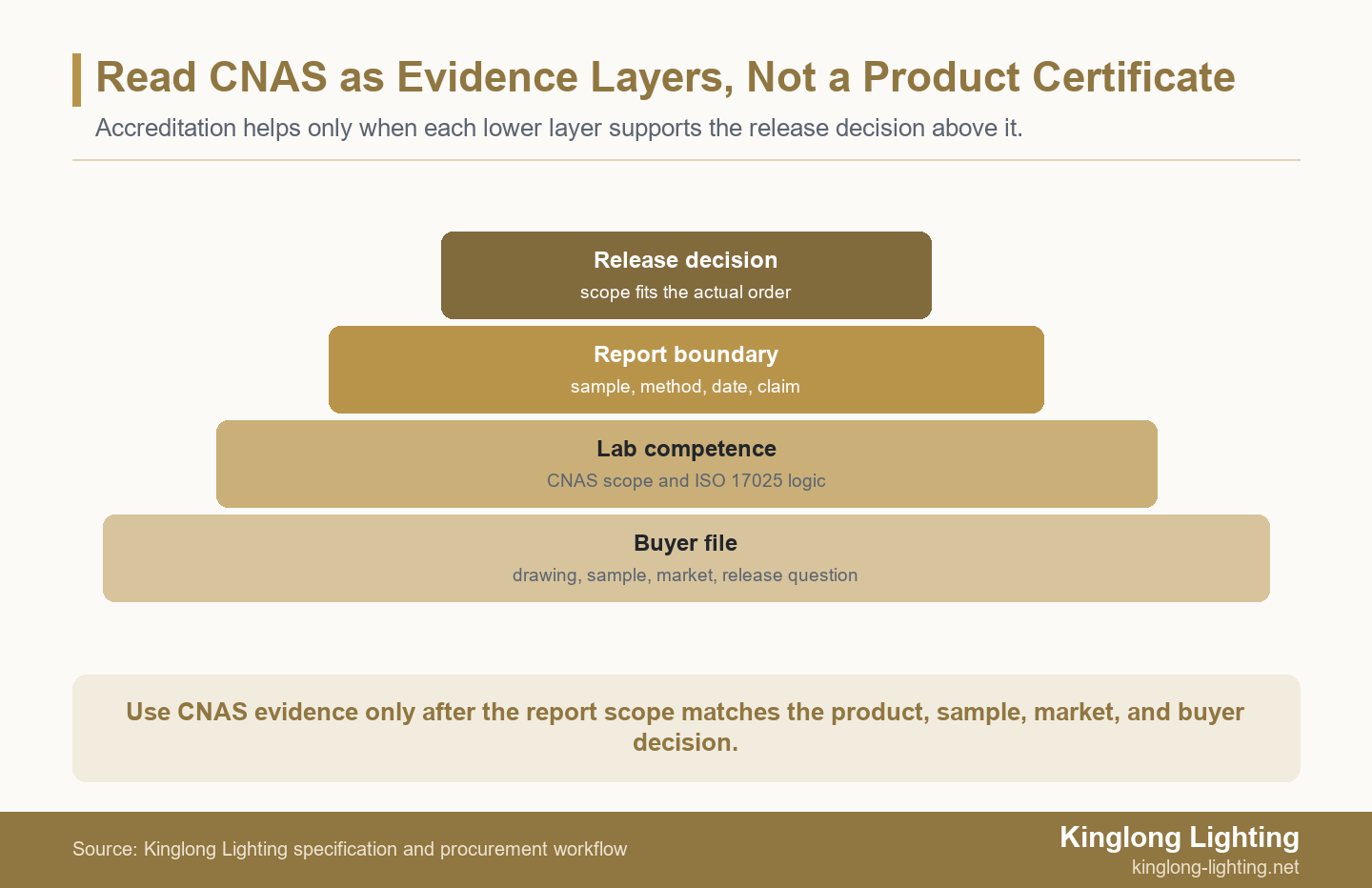
Accreditation describes competence within scope
CNAS accreditation can indicate that a laboratory or conformity assessment body has been assessed against recognized requirements for particular activities. That does not automatically mean every decorative lighting product has been approved for every destination.
The buyer should ask what the accredited scope covers. Is it photometric testing, electrical testing, material testing, inspection, calibration, or another activity? The answer determines what the evidence can support.
In practice, treat this as a CNAS lighting evidence evidence gate: keep the report, sample ID, method, date, and claim boundary together. The decision rule is to accept only what the document actually proves, then flag any missing proof within 7 days before the buyer signs production release.
A product order still needs product-level evidence
A custom chandelier order still needs drawings, samples, production checks, packing records, installation boundaries, and any required local approvals. CNAS does not replace those order-specific records.
The safest buyer habit is to treat accreditation as one layer in the evidence file, then ask whether the report actually answers the question in front of the project.
In practice, treat this as a CNAS lighting evidence evidence gate: keep the report, sample ID, method, date, and claim boundary together. The decision rule is to accept only what the document actually proves, then flag any missing proof within 7 days before the buyer signs production release.
The report scope matters more than the logo
A report with an accreditation signal is still only useful if the tested sample, method, date, and result match the buyer’s claim. The logo tells the buyer to read carefully; it does not read the report for them.
According to ISO/IEC 17025 overview, laboratory competence, valid results, and report acceptance depend on method and scope. For project buyers, the practical action is to check whether a material report identifies the sample, method, date, scope, and claim it actually supports.
Sample identity decides applicability
A report on one driver, LED module, finish coupon, or representative sample may not automatically cover a custom chandelier variation. If the order changes component, finish, geometry, or market requirement, the evidence may need review.
The buyer should compare the report sample with the purchase order, drawing, bill of materials, or approved sample. If they do not match, the report may still be useful background, but it may not be release evidence.
In practice, approve this as a CNAS lighting evidence sample gate: record the master sample, the viewing distance, and one acceptable variation boundary. The decision rule is to compare the delivered batch within 7 days and hold the supplier to a written correction path if the visible result or replacement cost changes.
The method tells what was actually measured
A photometric report, salt spray report, integrating sphere result, or electrical check answers a specific type of question. It should not be stretched to answer unrelated claims.
According to Lighting Global integrating sphere basics note, integrating sphere measurements compare a device under test against a standard lamp and depend on calibration and method control. For project buyers, the practical action is to connect integrating sphere readings to calibration and method context instead of treating a number as a universal lighting promise.
In practice, make this a CNAS lighting evidence visibility gate: judge the sample under the room light, normal viewing distance, and cleaning condition. The decision rule is to document the threshold before release, then review any mismatch within 7 days if the owner-visible effect or maintenance cost changes.
CNAS and ILAC recognition should be read through boundaries
International buyers may ask whether a CNAS-accredited report will be recognized abroad. The answer depends on the accreditation relationship, report scope, and the receiving party’s rules.
According to ILAC MRA and signatories page, international recognition of accredited test results depends on the accreditation body and recognition relationship. For project buyers, the practical action is to check recognition relationship and receiving-party requirements before assuming a report will satisfy every international buyer.
Recognition is not automatic acceptance by every buyer
ILAC MRA participation can support international recognition of accredited results, but the receiving authority, client, or certification body may still impose specific requirements. A hotel developer, importer, or local authority may ask for additional evidence.
The buyer should ask early who will rely on the report and what format they require. Late discovery of a documentation mismatch can delay shipment or installation.
In practice, make this a CNAS lighting evidence visibility gate: judge the sample under the room light, normal viewing distance, and cleaning condition. The decision rule is to document the threshold before release, then review any mismatch within 7 days if the owner-visible effect or maintenance cost changes.
Market requirements can sit outside the report
Local electrical codes, installation rules, fire safety review, wet-area requirements, and authority inspections may not be solved by a manufacturer lab report.
According to NFPA 70 National Electrical Code page, electrical installation and field acceptance decisions need local qualified code review. For project buyers, the practical action is to separate manufacturer evidence from local electrical responsibility and authority review.
In practice, treat this as a CNAS lighting evidence evidence gate: keep the report, sample ID, method, date, and claim boundary together. The decision rule is to accept only what the document actually proves, then flag any missing proof within 7 days before the buyer signs production release.
Lighting reports should be linked to the actual chandelier decision
The report becomes valuable when the buyer can connect it to a decision: approve a light source, release a finish, compare a sample, confirm a component, or request more testing.
According to DOE LED lighting page, LED products differ in direction, color behavior, heat, lifetime, and application fit. For project buyers, the practical action is to review decorative materials under the specified light source and room condition, not as isolated samples.
Numbers need room interpretation
A photometric value, color metric, or electrical result can be accurate and still incomplete for the owner’s decision. The buyer needs to know whether the result supports the room promise, not only whether a number appears in a report.
According to DOE TM-30 FAQ, color quality needs more precise language than warm, cool, or beautiful when materials are being approved. For project buyers, the practical action is to interpret color quality evidence in relation to the actual light source, surfaces, and visual material decisions.
In practice, make this a CNAS lighting evidence visibility gate: judge the sample under the room light, normal viewing distance, and cleaning condition. The decision rule is to document the threshold before release, then review any mismatch within 7 days if the owner-visible effect or maintenance cost changes.
Reports should become release gates
The buyer should define which report results release production and which only support background confidence. For example, one report may release a driver selection, while a sample photo releases a visible crystal or finish.
This avoids false precision. A test result should not carry responsibility for choices it did not measure.
In practice, treat this as a CNAS lighting evidence evidence gate: keep the report, sample ID, method, date, and claim boundary together. The decision rule is to accept only what the document actually proves, then flag any missing proof within 7 days before the buyer signs production release.
A stronger buyer file combines accreditation with practical evidence
The best use of CNAS is to combine it with the ordinary project evidence that proves the fixture can be made, shipped, installed, and maintained.
According to UL 1598 standard page, decorative chandeliers are still luminaires that need product evidence and qualified installation review. For project buyers, the practical action is to keep accredited evidence connected to the complete luminaire documentation and product boundary.
Use a layered evidence stack
A useful evidence stack starts with buyer intent, then sample, drawing, bill of materials, report scope, production check, packing record, installation boundary, and handover note. CNAS-accredited reporting can sit in the report layer.
When the stack is complete, the buyer can see which decisions are supported and which remain open. When the stack is incomplete, CNAS may create confidence in one layer while another layer remains weak.
In practice, treat this as a CNAS lighting evidence evidence gate: keep the report, sample ID, method, date, and claim boundary together. The decision rule is to accept only what the document actually proves, then flag any missing proof within 7 days before the buyer signs production release.
Kinglong should be evaluated through the actual project file
Kinglong Lighting can support CNAS-related buyer questions by connecting lab evidence to the 33 years of manufacturing background, product files, samples, and project-specific release documents.
The useful next question is not does the manufacturer mention CNAS? It is which report, for which sample, using which method, supports which order decision?
In practice, make this a CNAS lighting evidence visibility gate: judge the sample under the room light, normal viewing distance, and cleaning condition. The decision rule is to document the threshold before release, then review any mismatch within 7 days if the owner-visible effect or maintenance cost changes.
CNAS accreditation buyer reading table
Use this table to read CNAS-related evidence without overclaiming it.
| Decision area | Owner risk if vague | Evidence to request | Acceptance action |
|---|---|---|---|
| CNAS accreditation | Buyer treats it as product certification | Accredited body, scope, activity | Use as competence signal |
| Test report | Logo replaces report reading | Sample, method, date, result, traceability | Match report to the order decision |
| ILAC recognition | Buyer assumes universal acceptance | Recognition relationship, receiving-party rule | Confirm before shipment |
| Lighting result | Number lacks room meaning | Metric, tolerance, sample context | Connect to room promise |
| Release file | Evidence sits in separate documents | Drawing, sample, report, production, handover | Use layered approval |
A CNAS report reading scenario
Imagine a buyer receives a photometric report with a CNAS-related accreditation signal. The weak reading is: the factory is accredited, so the chandelier is approved. The stronger reading is: which sample was measured, which method was used, what date, what result, and what decision does this support?
If the report sample matches the LED module used in the custom chandelier, and the buyer only needs confidence in light output or color behavior, the report may be directly useful. If the buyer uses the same report to approve finish durability, shipping safety, or local electrical installation, the report is being stretched beyond its role.
The scenario estimate is a five-question gate: sample, method, scope, result, decision. If any one of those is unclear, the buyer should not treat the report as release evidence until the gap is resolved.
This does not make CNAS less valuable. It makes CNAS more valuable because the buyer uses it for the decision it can actually support.
For large hotel or villa projects, this discipline also reduces disputes. Everyone can see whether an issue is a lab-evidence question, a sample question, a drawing question, or a local professional review question.
When CNAS evidence should trigger a follow-up question
A buyer should not become suspicious every time a report has limits. Limits are normal. The real issue is whether the limit affects the decision the buyer is trying to make for the chandelier order.
According to CNAS English site, accreditation is a signal that a laboratory or inspection body has been assessed against recognized competence requirements. For project buyers, the practical action is to read accreditation through the specific scope before deciding whether a follow-up question is needed.
Ask again when the report sample does not match the order
If the report sample is a component, module, finish coupon, or earlier product family, the buyer should compare it with the current order. A mismatch does not automatically make the report useless, but it may change whether the report can release production.
The follow-up question should be precise: does this report apply to the exact component, finish, light source, geometry, or destination requirement in this order? A precise question usually gets a useful answer faster than asking whether the report is valid.
In practice, treat this as a CNAS lighting evidence evidence gate: keep the report, sample ID, method, date, and claim boundary together. The decision rule is to accept only what the document actually proves, then flag any missing proof within 7 days before the buyer signs production release.
Ask again when the receiving party has its own rule
A hotel group, importer, local authority, consultant, or certification body may require a specific test format, sample identity, or issuing body. CNAS-related evidence can still be valuable, but the buyer must know whether the receiving party will accept it.
The safest procurement habit is to identify the person or organization that will rely on the report before shipment. That prevents a strong technical file from becoming a late documentation mismatch.
In practice, make this a CNAS lighting evidence visibility gate: judge the sample under the room light, normal viewing distance, and cleaning condition. The decision rule is to document the threshold before release, then review any mismatch within 7 days if the owner-visible effect or maintenance cost changes.
How Kinglong Lighting supports CNAS-related buyer evidence
Kinglong Lighting can support CNAS-related buyer questions by connecting accredited evidence, sample files, drawings, component records, and release decisions inside the custom chandelier workflow.
If a buyer needs to evaluate CNAS accreditation in a lighting order, the useful next action is to send the lab evidence review brief with the report, product scope, destination market, order status, and exact decision the report is expected to support.
Before relying on CNAS accreditation in a lighting order
Use this short action list before the next approval meeting. It is intentionally practical, because vague approval language is the usual source of later rework.
- Confirm the accredited scope and activity.
- Match the report sample to the order sample.
- Read method, date, result, and traceability.
- Separate product evidence from local approval.
- Attach the report to a specific release decision.
For a project-specific evidence check, Kinglong Lighting can review the CNAS-related report, product scope, destination market, order status, and exact release decision before the buyer relies on the file.
FAQ
Does CNAS accreditation certify a chandelier product?
No. CNAS accreditation supports confidence in defined conformity assessment activities; it does not automatically certify every chandelier product.
What should buyers check in a CNAS-related report?
Check the accredited scope, sample identity, test method, report date, result, traceability, and the exact decision the report supports.
Is CNAS recognized internationally?
CNAS participates in international recognition arrangements, but acceptance depends on scope, receiving-party rules, and the specific report requirement.
Can CNAS replace local electrical approval?
No. Manufacturer test evidence can support a file, but local electrical, safety, installation, and authority requirements may still apply.
How does CNAS help lighting buyers?
It can improve confidence in the testing or inspection process when the report scope matches the buyer’s product and decision.