
Salt spray testing for chandelier metalwork is useful, but it is often overclaimed. A controlled salt fog exposure can compare coatings, substrates, and process choices. It cannot predict exact coastal lifespan for every lobby, villa, spa, balcony, or seaside restaurant.
The buyer’s job is to read the test as a comparison tool. What metal stack was tested? Was it brass, stainless steel, plated steel, aluminum, or a coated sample coupon? What finish was used? What failure was counted? What cleaning and exposure will the real project face?
Kinglong Lighting can help buyers connect salt spray evidence to samples, finish notes, coastal-use warnings, and the custom chandelier workflow before metalwork approval.
Key Takeaways
- Salt spray is controlled exposure: It compares resistance under a method, not exact field life.
- The metal stack decides meaning: Substrate, plating, PVD, lacquer, and edge geometry change risk.
- Hours are not service years: Exposure, humidity, cleaning, scratches, and location change real outcomes.
- Acceptance criteria matter: Rust, blistering, discoloration, or creep must be defined before testing.
- Coastal projects need maintenance language: Cleaning and inspection rules are part of the finish decision.
Start with the metal stack before reading the hours
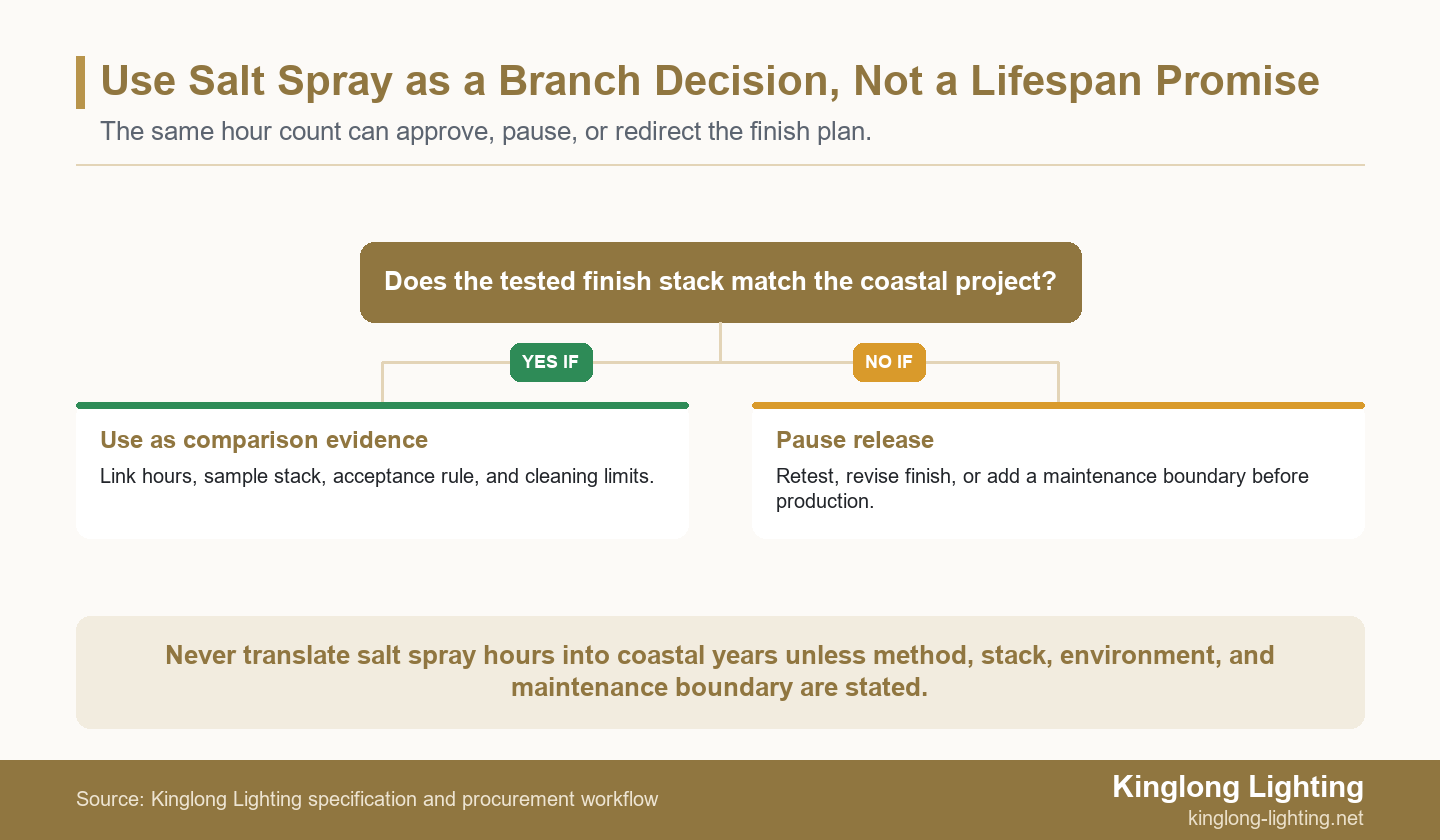
A salt spray report is a corrosion comparison, not a coastline warranty.
The same salt spray duration can mean different things depending on substrate, coating, geometry, edge finishing, and assembly method. Buyers should identify the stack before reacting to the number.
According to ASTM B117 salt spray standard page, salt spray testing is a controlled corrosion exposure method and should not be treated as a direct lifetime promise. For project buyers, the practical action is to use salt spray as a controlled corrosion exposure method with defined acceptance criteria.
Substrate and coating work together
A PVD tone on stainless steel, electroplated finish on steel, lacquered brass, or painted aluminum will not fail the same way. The buyer should ask what exact stack was tested and whether it matches the approved chandelier part.
If the test used a flat coupon but the fixture has sharp bends, welds, drilled holes, or threaded details, the buyer should ask how those features are protected.
In practice, make this a salt spray finish evidence visibility gate: judge the sample under the room light, normal viewing distance, and cleaning condition. The decision rule is to document the threshold before release, then review any mismatch within 7 days if the owner-visible effect or maintenance cost changes.
Failure definition should be written first
Before testing, the team should define what counts as failure: red rust, white corrosion, blistering, color change, pitting, creep from scribe, or visible stain. Different definitions produce different buyer decisions.
A finish that passes one visible criterion may still be unacceptable for a luxury close-view chandelier.
In practice, make this a salt spray finish evidence visibility gate: judge the sample under the room light, normal viewing distance, and cleaning condition. The decision rule is to document the threshold before release, then review any mismatch within 7 days if the owner-visible effect or maintenance cost changes.
Salt spray hours should not be converted into coastal years
A common mistake is treating 240, 500, or 1000 hours as a simple forecast of outdoor life. Real coastal exposure is affected by wet-dry cycles, cleaning, pollution, ultraviolet light, scratches, and installation position.
According to ISO/IEC 17025 overview, laboratory competence, valid results, and report acceptance depend on method and scope. For project buyers, the practical action is to check whether a material report identifies the sample, method, date, scope, and claim it actually supports.
Controlled exposure creates comparison value
The test can show whether one finish performs better than another under a defined condition. That is useful for supplier comparison and process improvement.
It becomes risky when the buyer turns the result into a calendar guarantee without knowing the actual environment.
In practice, make this a salt spray finish evidence visibility gate: judge the sample under the room light, normal viewing distance, and cleaning condition. The decision rule is to document the threshold before release, then review any mismatch within 7 days if the owner-visible effect or maintenance cost changes.
Accredited evidence still needs field interpretation
According to CNAS English site, accreditation is a signal that a laboratory or inspection body has been assessed against recognized competence requirements. For project buyers, the practical action is to treat accredited testing as process confidence while reading the exact tested sample and finish boundary.
A strong report tells the buyer what was tested; the project team still needs to decide whether the real location is mild indoor, humid indoor, covered coastal, or direct exterior exposure.
In practice, treat this as a salt spray finish evidence evidence gate: keep the report, sample ID, method, date, and claim boundary together. The decision rule is to accept only what the document actually proves, then flag any missing proof within 7 days before the buyer signs production release.
Coastal installation adds design and maintenance variables
Metalwork close to sea air can face salt, humidity, cleaning chemicals, and frequent handling. The finish decision should include where the chandelier sits and how it will be maintained.
According to NFPA 70 National Electrical Code page, electrical installation and field acceptance decisions need local qualified code review. For project buyers, the practical action is to separate manufacturer finish evidence from local installation responsibility and authority review.
Indoor coastal is not the same as outdoor exposure
A hotel lobby near the sea may be less severe than an open terrace, but it can still face humidity and cleaning risk. A spa, pool, or covered entry has a different risk pattern again.
The buyer should not use the same finish language for every coastal project. The environment should be named in the specification.
In practice, make this a salt spray finish evidence visibility gate: judge the sample under the room light, normal viewing distance, and cleaning condition. The decision rule is to document the threshold before release, then review any mismatch within 7 days if the owner-visible effect or maintenance cost changes.
Cleaning can protect or destroy the finish
A finish that survives the test can still be damaged by abrasive cleaning, chloride residue, or incompatible chemicals. Maintenance language is therefore part of the corrosion strategy.
The handover file should say what to clean with, what to avoid, and how often visible checks should occur.
According to OSHA hexavalent chromium exposure controls, surface treatment and plating discussions also sit inside worker-safety and process-control boundaries. For project buyers, the practical action is to ask for finish evidence that respects both visible performance and responsible production controls.
In practice, make this a salt spray finish evidence visibility gate: judge the sample under the room light, normal viewing distance, and cleaning condition. The decision rule is to document the threshold before release, then review any mismatch within 7 days if the owner-visible effect or maintenance cost changes.
Salt spray should be paired with visual sample review
Corrosion resistance is not the only finish decision. Luxury metalwork also needs color, sheen, texture, and match across parts.
According to DOE LED lighting page, LED products differ in direction, color behavior, heat, lifetime, and application fit. For project buyers, the practical action is to review decorative materials under the specified light source and room condition, not as isolated samples.
A durable finish can still look wrong
A finish may perform well in exposure but miss the approved brass, bronze, black, or champagne tone. Buyers should review first-day appearance and exposure evidence separately.
This prevents the test from overpowering the design intent. Durability is necessary, but the room still has to look right.
In practice, make this a salt spray finish evidence visibility gate: judge the sample under the room light, normal viewing distance, and cleaning condition. The decision rule is to document the threshold before release, then review any mismatch within 7 days if the owner-visible effect or maintenance cost changes.
Accelerated aging may answer a different question
According to ASTM G154 accelerated weathering standard page, accelerated weathering tests expose materials to controlled UV and moisture cycles that need careful interpretation. For project buyers, the practical action is to read UV or weathering evidence as a separate stress method rather than mixing it with salt spray results.
If the project faces sunlight as well as salt, the buyer may need multiple evidence layers. One test rarely proves every finish risk.
In practice, make this a salt spray finish evidence visibility gate: judge the sample under the room light, normal viewing distance, and cleaning condition. The decision rule is to document the threshold before release, then review any mismatch within 7 days if the owner-visible effect or maintenance cost changes.
The release file should name the finish boundary
The final approval should make the salt spray result usable. It should connect sample, finish stack, result, acceptance criterion, environment, cleaning note, and replacement path.
According to UL 1598 standard page, decorative chandeliers are still luminaires that need product evidence and qualified installation review. For project buyers, the practical action is to keep finish evidence connected to the complete luminaire file and service boundary.
Record what is approved and what is excluded
A clear release note might approve a specific finish stack for indoor humid coastal lobby use with defined cleaning rules and a stated salt spray report. It should not imply direct exterior performance if that was never tested.
This protects the owner from overclaiming and protects the manufacturer from defending a use case the evidence did not cover.
In practice, approve this as a salt spray finish evidence sample gate: record the master sample, the viewing distance, and one acceptable variation boundary. The decision rule is to compare the delivered batch within 7 days and hold the supplier to a written correction path if the visible result or replacement cost changes.
Replacement metalwork should match the same boundary
Kinglong Lighting can store finish samples, salt spray evidence, and replacement notes with the decorative lighting collections so later repairs do not silently change the finish system.
A spare arm or decorative cap should match both appearance and evidence expectation when the project requires coastal resistance.
In practice, make this a salt spray finish evidence service gate with 3 records: part code, spare quantity, and replacement match rule. The decision rule is to confirm the future repair path before shipment so a small breakage does not become a cost, delay, or owner trust problem.
Salt spray test interpretation table
Use this table to keep salt spray evidence inside a useful decision boundary.
| Decision area | Owner risk if vague | Evidence to request | Acceptance action |
|---|---|---|---|
| Metal stack | Buyer reads hours without material context | Substrate, coating, edge geometry | Confirm what was tested |
| Test hours | Hours become service years | Method, duration, acceptance rule | Use as comparison evidence |
| Environment | Coastal risk is described too broadly | Indoor humid, covered, exterior, spa | Name the exposure condition |
| Appearance | Durability overrides design tone | Sample, lighting, finish board | Approve visual and corrosion separately |
| Maintenance | Cleaning damages the finish | Cleaning rule, inspection interval | Store in handover |
A coastal finish decision scenario
Imagine two finish options for a seaside hotel lobby chandelier. Option A has the exact desired tone but weak corrosion evidence. Option B has a slightly different tone but stronger salt spray comparison and clearer cleaning instructions.
If the chandelier is in a humid lobby with close guest visibility, the buyer may ask the supplier to adjust Option B’s tone rather than accept Option A’s risk. If the fixture is in a dry inland villa, the visual tone may carry more weight.
The scenario rule is to rank environment, visible tone, report scope, and maintenance together. Salt spray evidence is important, but it should not be read outside the exposure and ownership plan.
The limitation is that no salt spray number proves exact coastal lifespan. The buyer should approve a controlled finish boundary, not a promise of years.
A coastal finish worksheet for buyers
A salt spray report should feed a coastal finish worksheet. The worksheet connects the controlled exposure result with the actual project environment, the approved finish sample, and the maintenance plan.
According to ASTM B117 salt spray standard page, salt spray testing is a controlled corrosion exposure method and should not be treated as a direct lifetime promise. For project buyers, the practical action is to keep the worksheet tied to method, exposure duration, sample type, and acceptance definition.
Describe the real coastal condition before selecting the finish
A covered seaside lobby, open-air terrace, spa corridor, and poolside restaurant each expose metalwork differently. The worksheet should name humidity, salt air, direct rain, cleaning frequency, guest contact, and whether the fixture sits near open doors or mechanical ventilation.
This matters because the same finish may be acceptable in a mild indoor coastal lobby and inappropriate in a direct exterior canopy. Without a location description, the salt spray result floats without meaning.
In practice, make this a salt spray finish evidence visibility gate: judge the sample under the room light, normal viewing distance, and cleaning condition. The decision rule is to document the threshold before release, then review any mismatch within 7 days if the owner-visible effect or maintenance cost changes.
Link finish sample approval to the report
The buyer should not approve corrosion evidence and finish tone in separate conversations. The report should connect to the exact finish sample, substrate, coating process, and acceptable color range used for the order.
If the tested sample is a flat coupon and the chandelier uses bent arms, screw holes, welded joints, or decorative caps, the worksheet should mark that geometry gap for review.
In practice, treat this as a salt spray finish evidence evidence gate: keep the report, sample ID, method, date, and claim boundary together. The decision rule is to accept only what the document actually proves, then flag any missing proof within 7 days before the buyer signs production release.
Maintenance is part of the corrosion decision
Coastal durability is not only a factory question. The owner can shorten or extend visible life through cleaning method, inspection rhythm, and how quickly damaged surfaces are repaired.
According to UL 1598 standard page, decorative chandeliers are still luminaires that need product evidence and qualified installation review. For project buyers, the practical action is to store finish evidence and maintenance boundaries in the complete luminaire file.
Cleaning rules should be written before handover
A finish can be damaged by chloride residue, abrasive cloths, strong chemicals, or repeated wet wiping. The handover file should state cleaning materials, prohibited chemicals, inspection interval, and how to respond to early staining or scratches.
This is not extra paperwork. It is the owner’s practical defense against turning a controlled finish into an uncontrolled maintenance experiment.
In practice, make this a salt spray finish evidence service gate with 3 records: part code, spare quantity, and replacement match rule. The decision rule is to confirm the future repair path before shipment so a small breakage does not become a cost, delay, or owner trust problem.
Spare and repair rules should match the original finish stack
If a coastal chandelier needs replacement arms, caps, screws, or decorative plates, the replacement parts should match both appearance and corrosion expectation. A similar color from a different process may create future mismatch.
The release file should keep finish formula, sample photos, report reference, and spare part codes together. That helps the project avoid a second corrosion decision during repair.
In practice, make this a salt spray finish evidence service gate with 3 records: part code, spare quantity, and replacement match rule. The decision rule is to confirm the future repair path before shipment so a small breakage does not become a cost, delay, or owner trust problem.
When salt spray evidence should pause production
A salt spray concern does not always mean the order should stop, but some findings should pause production until the finish boundary is clarified.
According to ISO/IEC 17025 overview, laboratory competence, valid results, and report acceptance depend on method and scope. For project buyers, the practical action is to check whether a material report identifies the sample, method, date, scope, and claim it actually supports.
Pause when the tested sample is not the production stack
If the report covers a coupon but production uses a different substrate, plating sequence, lacquer, edge treatment, or supplier batch, the buyer should ask for a bridge explanation before release.
This is not bureaucracy. A small process difference can become a visible corrosion difference once the chandelier is installed in humid or coastal air.
In practice, treat this as a salt spray finish evidence evidence gate: keep the report, sample ID, method, date, and claim boundary together. The decision rule is to accept only what the document actually proves, then flag any missing proof within 7 days before the buyer signs production release.
Pause when the acceptance rule is missing
If the report states hours but does not define the visible failure threshold, the buyer cannot know whether discoloration, blistering, pitting, or edge corrosion was acceptable.
A short clarification can prevent a finish from being approved on a number that nobody has connected to luxury appearance.
In practice, make this a salt spray finish evidence visibility gate: judge the sample under the room light, normal viewing distance, and cleaning condition. The decision rule is to document the threshold before release, then review any mismatch within 7 days if the owner-visible effect or maintenance cost changes.
How Kinglong Lighting supports coastal finish evidence
Kinglong Lighting can support salt spray evidence by linking finish samples, metal stack notes, report boundaries, cleaning rules, and replacement records inside the custom chandelier workflow.
If a buyer is reviewing coastal metalwork, the useful next action is to send the coastal finish evidence brief with destination environment, finish sample, exposure concern, and maintenance expectation.
Before using salt spray evidence for chandelier metalwork
Use this short action list before the next approval meeting. It is intentionally practical, because vague approval language is the usual source of later rework.
- Confirm the tested substrate and finish stack.
- Define the visible failure criterion.
- Avoid converting hours into years.
- Name the real exposure and cleaning condition.
- Attach the report to a specific finish release note.
For a project-specific coastal finish check, Kinglong Lighting can review the destination environment, finish sample, exposure concern, maintenance expectation, and release boundary before the buyer approves the metalwork.
FAQ
What does a salt spray test prove for chandeliers?
It supports corrosion comparison under controlled exposure, but it does not prove exact coastal service life.
Can salt spray hours predict lifespan?
Not directly. Real lifespan depends on exposure, cleaning, scratches, humidity, substrate, coating, and maintenance.
What should buyers ask before relying on a report?
Ask what metal stack was tested, what method was used, what counted as failure, and whether the sample matches the chandelier part.
Do coastal chandeliers need special maintenance?
Yes. Cleaning method, inspection interval, and chemical restrictions should be part of the handover file.