
A lighting design intent purchase order handover should make every ordered line traceable to the approved fixture, finish, quantity, performance requirement and revision. A purchase order that says only “custom chandelier, 12 pcs” may be commercially valid, yet still omit the information that made the design acceptable. The safest handover is therefore not a folder transfer. It is a controlled comparison between the approved design baseline, the supplier’s final offer and the actual PO lines.
Interior and lighting designers, hotel owner or developer representatives, and procurement teams need the same controlled record when buying begins: a traceability table, release sequence and escalation rules. The project contract and appointments remain authoritative; this working method does not reassign contractual responsibility.
The short answer: issue a design-to-PO release pack
- Freeze one approved baseline before the buyer raises the PO.
- Map every PO line to a fixture ID, approved revision and finish code.
- List deviations and exclusions explicitly; silence is not equivalence.
- Separate design acceptance, technical review and commercial authorization.
- Require reapproval when a change crosses a defined design threshold.
The result can be a single register with linked documents. Its purpose is to let a reviewer answer three questions quickly: What was approved? What is being bought? Where do the two differ?
Why approved lighting scope disappears during buying
Design approval and purchasing control are different decisions. A designer may accept proportions, visible materials, light effect and finish. Procurement must also control price, quantity, Incoterms, payment, delivery and contractual inclusions. Scope loss occurs when those systems are joined by a title or thumbnail instead of shared identifiers and controlled fields.
The risk is especially high for decorative lighting because a fixture name does not describe the complete deliverable. Canopy dimensions, suspension length, cable colour, lamp or LED specification, driver location, dimming protocol, mounting detail, crystal grade, finish sample and packaging may each sit in a different document. A quotation can also contain exclusions that never appear in the PO.
An article published in AIA’s Community Hub describes logging submittals and recording review actions such as approved, approved as noted, revise and resubmit, or rejected. That supports disciplined revision and status control, but an approval stamp is not a substitute for checking the commercial document that follows.
For teams defining a broader approval chain, Kinglong Lighting’s hospitality lighting overview provides package context for owner, designer, contractor and supplier coordination. The decision boundary here remains specific: translating accepted deliverables into the buying instruction.
What belongs in the approved baseline?
The baseline should contain only the information needed to identify the approved solution and test a proposed change. More files do not necessarily create better control. A compact baseline normally includes the final fixture schedule, approved drawings, finish references, accepted samples or mock-up record, technical requirements, current deviation log and approval record.
The fixture schedule is the index. Use stable fixture IDs and revision numbers rather than room names alone, because room names and quantities can change. The schedule should point to the document that governs each attribute instead of duplicating values inconsistently.
NBS describes schedules as structured project documents created from specification information and notes that they can capture requirements, responsibilities, materials and equipment in priceable lists; see the NBS schedules overview. The practical lesson is to maintain structured fields that can travel into tender and procurement, while recognizing that each project decides which document is contractually controlling. Published project imagery can prompt room, mounting and finish questions, but it does not prove that another project’s solution applies.
Use this design-to-PO traceability table
Build one row for each purchasable fixture line and make exceptions visible in the same row. Do not hide a deviation in an email that the buyer cannot see.
| Control field | What to record | Release test |
|---|---|---|
| Fixture identity | Fixture ID, area and PO line number | One PO line maps to one controlled ID |
| Approved basis | Schedule, drawing and approval revision/date | Reviewer can open the exact accepted version |
| Visual attributes | Dimensions, visible material, finish code, diffuser and suspension | Values match approved references or carry a deviation |
| Lighting and controls | Source, CCT, CRI requirement, output basis, driver and dimming protocol | Offer and PO do not replace a requirement with “standard” |
| Mounting interface | Canopy, fixing, load information, access and coordination reference | Responsibility and required site inputs are named |
| Commercial scope | Quantity, unit, spares, inclusions, exclusions and delivery split | Quoted exclusions are resolved or repeated visibly |
| Change status | Deviation ID, impact, approver and closure date | No open material deviation at release |
The table is not intended to reproduce every specification clause. It is a cross-reference that exposes mismatches. A finish code such as “BR-02” should lead to an approved physical or documented reference; a PO description should not silently redefine it as “antique brass.”
Controlled identifiers, status codes and revision references make the handover auditable across organizations. The Centre for Digital Built Britain’s ISO 19650 guidance explains information containers, status and revision concepts for collaborative information management. The table above applies those ideas pragmatically to a lighting package; it is not a claim that the guidance prescribes these exact columns.
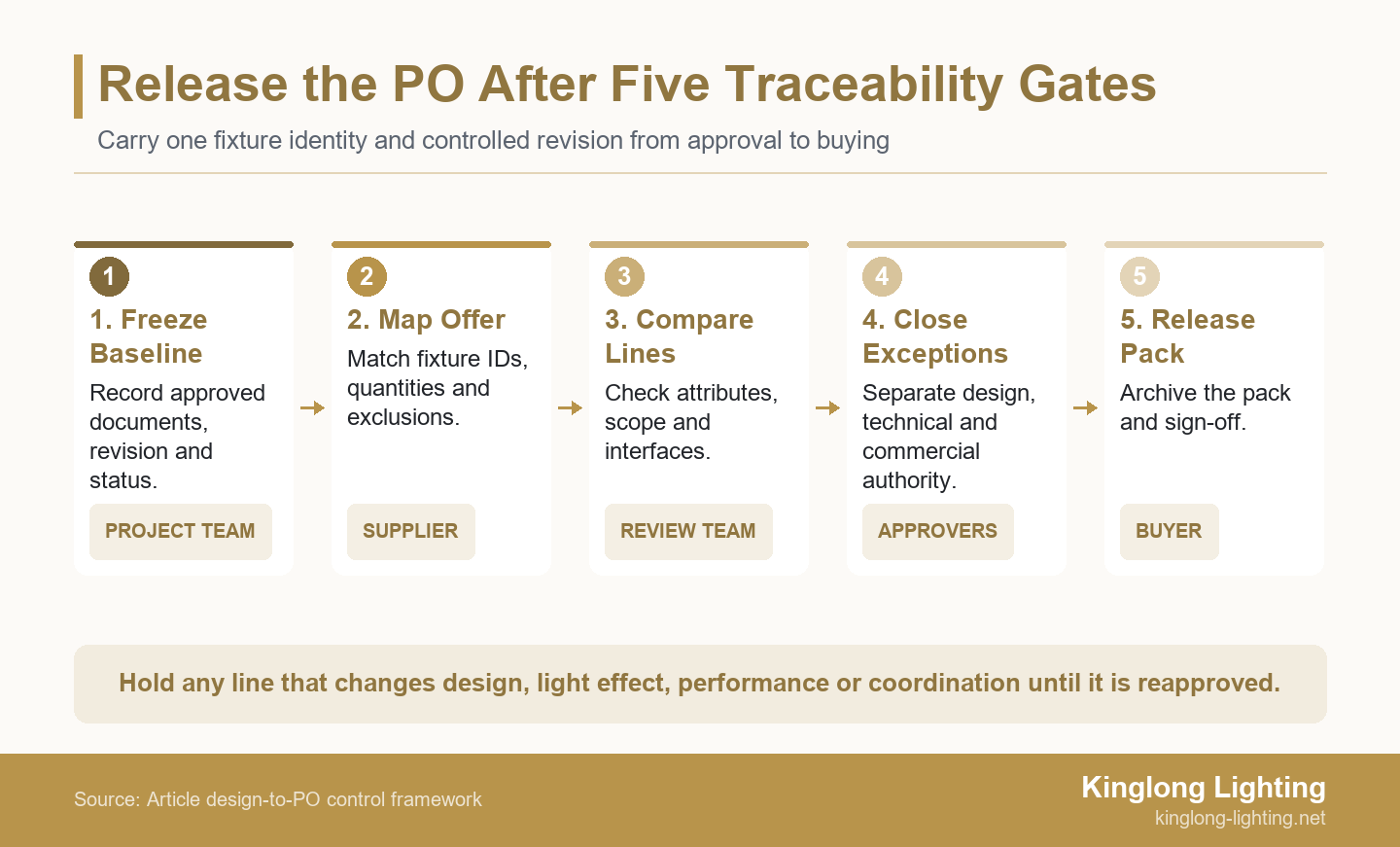
A five-step handover from design approval to PO release
Prepare and compare the controlled package
- Freeze the reference set. Mark the accepted schedule, drawings and finish references with revision and status. Remove superseded files from the release folder or mark them clearly.
- Normalize the supplier offer. Require the final quotation to use the same fixture IDs and quantities. Attach a consolidated deviation and exclusion list.
- Run the line-by-line comparison. Populate the traceability register. Do not compare only totals; check attributes and interfaces that affect appearance, operation and installation.
- Close exceptions with the right authority. Design changes return to the design approver; technical changes go to the responsible consultant; commercial changes go to the commercial authority. One approval does not imply the others.
- Issue the release pack with the PO. Reference the controlled register and attachments in the PO, then archive the issued set and acknowledgement.
Keep the release logic tied to project controls
NBS explains that specification information develops from concept through tender and potentially into the record at handover. Its guidance on summary schedules also highlights sharing specification intent across design disciplines for coordination. It does not prescribe a universal lighting purchase-order workflow; teams should adapt the sequence to their procurement route and agreements.
When custom fixtures are involved, review the handover alongside Kinglong Lighting’s custom lighting development path. The useful discussion is not “can this be made?” alone, but which approved attributes are fixed, which remain developable and what evidence is required before production release.
Which changes require designer reapproval?
Define reapproval thresholds before procurement begins. Escalate any change that can alter the visible concept, light effect, spatial relationship, user experience or coordination assumption. Typical triggers include changed overall dimensions, proportion, suspension height, visible material, finish, diffuser appearance, source location, CCT, optics, dimming behavior, canopy geometry or grouping.
Do not treat every administrative correction as a redesign. A corrected company address or a purchase-line split may need commercial confirmation but not design reapproval. Conversely, “no cost impact” does not mean “no design impact.” Classify the change by consequence, not by price.
A proposed substitution should be declared and assessed rather than routed as an ordinary clarification. AIA’s paper on substitutions disguised as RFIs or submittals distinguishes these processes and warns that substitutions can change design intent. A substitution or value-engineering request does not grant permission to copy a protected design; any alternative must be original or properly authorized.
Worked example: an approved lobby pendant becomes a shorter PO description
Why the L-201 line must be held
A hotel team is ordering 1 illustrative lobby pendant identified as L-201. The affected scope is 1 fixture line for 1 hotel lobby. The draft PO description omits an exclusion and changes the driver arrangement.
Approved diameter, finish and remote driver are documented. The final quotation excludes the support frame and proposes an integral driver. The draft PO carries only the fixture ID, generic finish and quantity. The title-only match conceals design, interface and scope differences. Hold L-201 until the named design, technical and commercial authorities close the declared exceptions.
Reissue the line with the final drawing revision, approved finish, accepted driver arrangement, included support frame and closed deviation IDs. Before release, reconcile the register, PO attachments and supplier acknowledgement. This is an illustrative scenario, not a real Kinglong project or measured result. Review comparable application context in the project references.
Final release audit for the designer and buyer
- Every PO line has a fixture ID and approved revision reference.
- Quantities and delivery splits reconcile with the current schedule.
- Finish names point to controlled codes or approved samples.
- Supplier exclusions have an owner and recorded disposition.
- Open deviations are blocked from release or explicitly authorized under the project procedure.
- Drawings, technical data and mock-up outcomes referenced by the PO are accessible.
- Design, technical and commercial approvals are distinguishable.
- The issued pack and supplier acknowledgement are archived.
What should the PO annex say?
A practical annex begins with a document register: fixture schedule revision, supplier quotation revision, accepted drawings, finish approvals, deviation register and any project-specific technical schedules. State whether each item is incorporated into the order or supplied only for reference. The project’s contract administrator or legal adviser should confirm precedence language; a blog template cannot decide which document overrides another.
Then state the release condition in operational terms. For example: production may start only for fixture lines marked “released” in the attached register; lines marked “hold” require a later written instruction. This is clearer than a general note saying “subject to design approval,” because it identifies which lines are affected and what event removes the hold.
The annex should also preserve accepted qualifications. If the designer accepted a finish subject to a larger control sample, or the consultant requested revised driver data before manufacture, carry that condition forward. An “approved as noted” response loses value when the note is missing.
Control changes after the purchase order is issued
Traceability should continue after award. Give every post-PO change a unique identifier and record the affected fixture IDs, originator, reason, design impact, technical impact, cost or programme implication, required approvals and incorporated document revisions. Update the register only after the required authorities respond; do not overwrite the original ordered baseline. When alternatives arise, consult the decorative lighting value-engineering guide without treating value engineering as automatic approval.
For a custom fixture, a development drawing may legitimately refine internal construction without changing the visible concept. The supplier should still declare any movement outside the approved envelope. A useful review distinguishes three outcomes: no design-impact confirmation, acceptance of a declared design change, or rejection with required correction. Avoid ambiguous responses such as “looks fine” when production release depends on them.
At inspection, compare the fixture with the latest released baseline—not with an early rendering or a buyer’s memory. The same IDs and revisions used at PO stage should appear in the pre-production review, inspection record and packing list. That continuity makes it easier to isolate a discrepancy and decide whether it is a manufacturing nonconformance, an unincorporated approved change or a document-control error.
The U.S. Whole Building Design Guide describes commissioning documents as evolving records and assigns preparation, review, approval and use roles across the project team in its commissioning-document guidance. That guidance concerns whole-building commissioning rather than decorative-lighting procurement. The transferable lesson is to retain named roles and current records through later verification instead of ending control when the PO is signed.
Keep the commercial instruction connected to the approved design
A reliable lighting design intent purchase order handover depends on traceability, not memory. Freeze the accepted baseline, require supplier offers to use the same identifiers, compare each purchasable line, expose deviations and route changes to the correct authority. The resulting register gives designers a practical way to protect intent and gives procurement a clear basis for buying and later verification.
If the project includes bespoke decorative fixtures, send the approved schedule, current drawings, finish references, quantities and deviation list when requesting an engineering review. Kinglong Lighting can use that controlled input set to discuss development scope and identify information still needed before quotation or production release; final approvals remain with the project’s appointed authorities.
For adjacent questions about samples, compliance evidence and procurement controls, use the material to sharpen the next information request; fixture-specific evidence and approval still govern. Review Kinglong Lighting’s decorative-lighting procurement guidance.
Frequently asked questions
Is an approved shop drawing enough to raise the purchase order?
No, an approved shop drawing alone does not reconcile commercial scope, quantities, exclusions and the purchase instruction. The team should also reconcile finish references, technical conditions and the exact approved revision with the PO. Check whether the drawing review excluded controls or installation interfaces, then record any remaining conditions in the release register. The governing contract determines the legal effect and precedence of each document.
Should the full specification be copied into the PO?
Usually the cleaner approach is to reference controlled documents and use the PO line for identity, quantity and commercial scope. Copying fragments can create conflicting versions when the specification changes but the PO text does not. State the referenced document, revision and status, confirm that recipients can access it, and follow the project’s document-precedence and incorporation requirements.
Who owns the design-to-PO traceability register for the project?
Name one coordinator, often within procurement or the contractor’s package team, but keep approval authority with the roles defined by the contract and responsibility matrix. The coordinator should maintain identifiers, revisions, exceptions and decision records, then route each open item to the appointed authority. Ownership of the register does not transfer design responsibility, technical review duties or commercial authorization.
What if the supplier cannot confirm a detail before ordering?
Record the unresolved detail as an open item with an owner, due date, impact and release condition before any order is released. If the uncertainty can alter design intent, compliance, interface or price, do not conceal it behind “TBC”; use the project’s conditional-release or hold procedure. State what may proceed, what remains blocked and who must verify the missing detail before the hold is removed.