A production slot is an agreed window for specified manufacturing work, subject to the scope and conditions confirmed by the buyer and supplier. For an owner representative planning a hotel handover, the useful question is not simply whether the factory has space. It is what work that space covers, what keeps it available, and which date the supplier is actually committing to. Separate those questions before relying on a promised window.
Ask What Is Held, Until When, and on Which Conditions
Treat a capacity hold and authorization to begin production as separate decisions; a paid deposit does not by itself demonstrate that the design, materials and constrained resources are ready. A useful custom lighting capacity reservation connects an identified scope to available work time and states what the buyer and supplier still need to complete. Neither a calendar entry nor an approved drawing answers all of those questions alone.
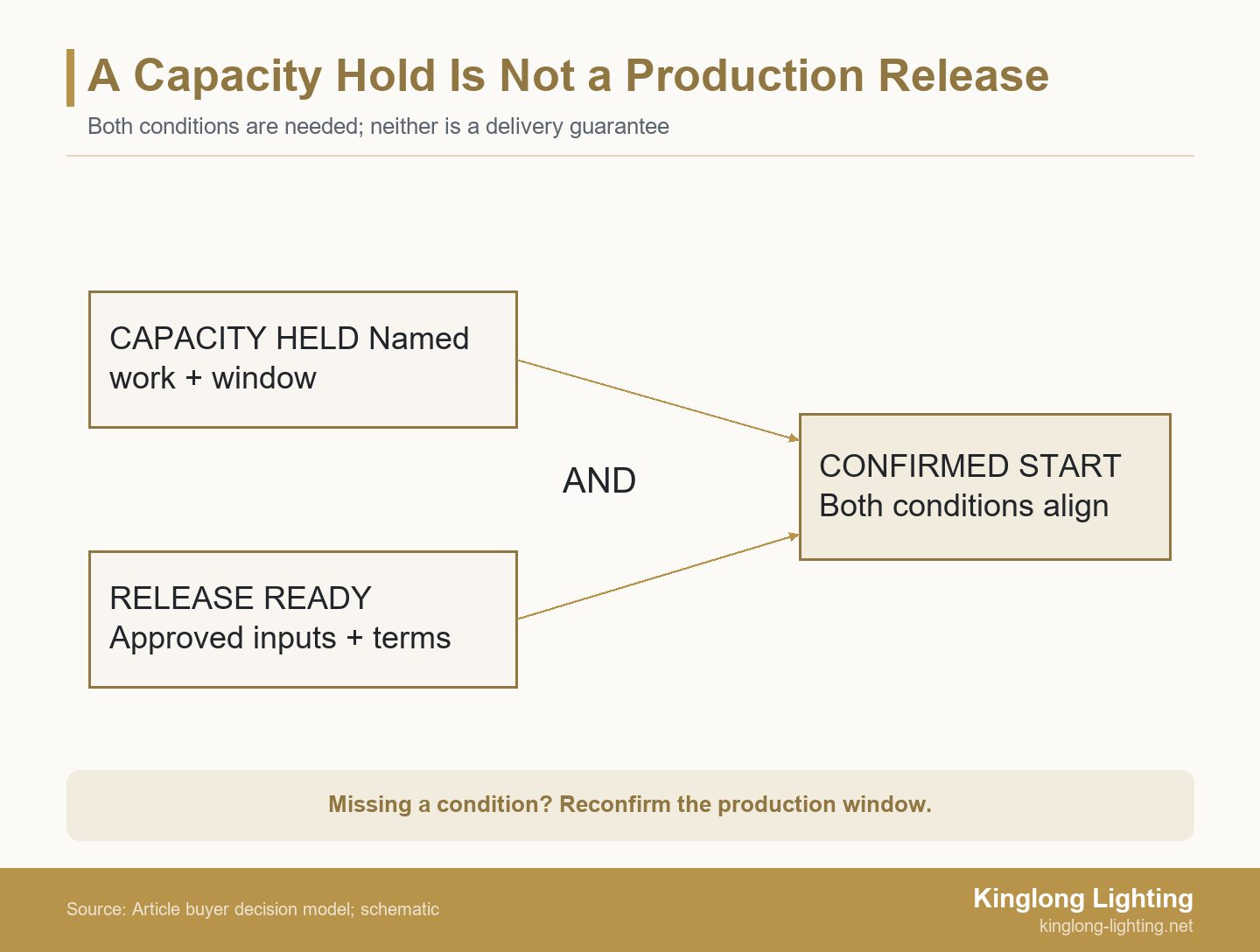
- Identify the work: fixture types, quantities and manufacturing operations covered by the hold.
- Name the conditions: approvals, commercial prerequisites and material availability, with responsible people and deadlines.
- Set the validity: when the hold expires and how the supplier will respond if an input arrives late or changes.
- Define the milestone: production start, factory completion and site arrival are different promises.
The distinction matters before the design is final. You may want to protect a possible production window while retaining the freedom to develop the fixture. Ask what flexibility the supplier has actually allowed, rather than assuming that either an early payment or a preliminary design freezes the complete programme.
Distinguish a Forecast, a Capacity Hold, and a Released Order
Ask whether the supplier is forecasting availability, holding resource time conditionally, or confirming a released production order. These are useful buyer-facing distinctions, not universal factory status names. Have the supplier translate its terminology into what it will do for the identified project and what evidence supports that position.
A forecast says work might fit within the current plan. A conditional hold adds a defined commitment to retain specified time until stated conditions or an expiry point. A released order authorizes the agreed manufacturing scope under the project’s actual approval process. A purchase order can exist while technical release remains outstanding; conversely, technical approval does not prove that commercial booking conditions have been met.
Use the lighting procurement and specification resources to prepare the fixture and approval information behind the request. An enquiry describing only a hotel opening month leaves the supplier to guess the manufacturing scope and the buyer to guess what has been reserved.
In Microsoft Dynamics 365 finite-capacity scheduling, existing resource reservations are considered, and insufficient capacity can push the delivery date later. The finite-capacity documentation describes software planning behavior, not the booking system of any particular lighting supplier.
The buyer implication is to ask what current workload was considered, not to insist on a software screenshot. A dated project confirmation may be more useful than an impressive but unexplained chart. Identify who accepted the reservation and when the planner last checked the relevant work time.
Tie the Hold to Drawings, Payment and Material Readiness
Record the exact drawing revision, finish reference, component approvals, commercial conditions and release cutoff needed for the promised window. Turn “subject to approval” into an identifiable deliverable and responsible reviewer. Otherwise, the owner and factory can believe the same condition has been met while relying on different documents.
For drawings, distinguish approval to develop a sample from approval to manufacture the full quantity. Check the dimensions, suspension arrangement, mounting interfaces and electrical configuration relevant to the work being released. A finish reference also needs an identity: an accepted sample or documented specification, not an unresolved colour description in an email.
Payment is a separate commercial condition. Ask what the proposed deposit or reservation charge pays for: development, material purchasing, retained resource time, or another identified obligation. Have the parties confirm treatment of cancellation, changes, expiry and any credit against the eventual order. Confirm any deposit percentage and refund conditions in the agreed terms rather than assuming a standard arrangement.
Material readiness deserves its own confirmation. “Available from our supplier” can mean something different from stock assigned to your order. Ask which components depend on an approved selection, which have been ordered and which are still awaiting a reliable availability date. Do not solve a deadline by allowing an unapproved component substitution to pass unnoticed.
Protolabs ties eligible injection-molding lead times to conditions including design features and customer-supplied material arrival, as its quick-turn manufacturing guidelines show. Those are conditions for its own service, not cutoffs or production methods to apply to a decorative-lighting order.
Kinglong describes blueprint review for feasibility, material selection and structural optimisation in its custom lighting drawing-review process. That is a relevant place to clarify unresolved manufacturing inputs. It is not evidence that a particular production window has already been reserved.
Set a final release cutoff with a date, time and time zone. List anything still open beside that cutoff and ask the planner what happens if it is missed. An extension needs confirmation; do not quietly move the buyer’s approval date while leaving the supplier’s completion date unchanged.
Reserve the Constrained Operations, Not an Abstract Factory Week
A useful reservation identifies the constrained work and the load assigned to it, rather than presenting total factory capacity as free time for this order. A project may need different windows for metalwork, finishing, decorative components, assembly and final checks. The supplier should explain which operations determine the offered dates.
Ask about the specific fixture mix. Repeated wall lights and a large custom chandelier may require different handling, assembly arrangements and approval inputs. A statement about monthly output does not tell you whether the necessary people, workstations or finishing route are free when this package reaches them. Request the relevant operation or resource group and the scope allocated to it; a commercially sensitive full order book is not necessary.
In the documented Oracle process-work-definition flow, Promising checks availability and consumes supply for required manufacturing components and resources. Its bill-of-resources explanation makes those separate checks explicit within that software flow. It does not establish how Kinglong or another supplier plans a particular order.
For an outsourced operation, ask whether the external window is included or still needs confirmation. For shared processes, identify whether another part of your package has to be ready at the same time. You can then distinguish a genuinely independent release from one that would force a repeat setup or a separate finish run.
Review the published lighting project portfolio to identify comparable installation contexts and ask better scope questions. Completed-project photographs can illustrate the type of work involved; they cannot prove spare capacity in the supplier’s current schedule.
Connect Factory Milestones to the Site-Required Date
Separate production start, factory completion, inspection and packing, dispatch, arrival and installation readiness when testing a site-required date. A factory window can be credible while the overall handover programme remains unachievable. The owner representative needs the linked sequence, including who owns the work outside the factory.
The Lean Enterprise Institute distinguishes production lead time from order lead time, which also includes downstream time getting the product to the customer and order-entry delays. Its cycle-time and lead-time definitions help explain why a production duration should not be treated as the customer’s complete waiting time.
Work backwards from the point at which the installer needs the identified fixtures. Ask the appointed logistics and site teams to confirm their own dependencies, including receipt, access and installation sequencing. Keep the supplier’s scope separate: factory completion is not automatically dispatch, and dispatch is not arrival or readiness to install.
Show contingency separately from planned work. If a late finish approval consumes the available allowance, update the risk rather than presenting the original target as equally secure. Where recovery is proposed, identify which activity changes, who accepts it and what evidence makes the revised sequence feasible. An earlier target typed into a programme is not itself a recovery plan.
A Capacity Reservation Record You Can Send to the Supplier
Use the reservation record to assign each unresolved condition to an owner and a latest decision point, then ask how a missed condition changes the reserved window. Copy the fields below into the project correspondence and request explicit responses. This is a proposed buyer tool, not a Kinglong policy or a substitute for the parties’ agreement.
| Confirmation field | Entry to complete with the supplier | Question to resolve |
|---|---|---|
| Covered work | Fixture references, quantities, drawing revisions and included operations: ______ | What is held, and what is excluded? |
| Reservation status | Forecast / conditional hold / released order; supplier’s own status: ______ | What action does that status authorize? |
| Resource window | Relevant operation or group, proposed start and finish, calendar basis: ______ | Has existing workload been considered? |
| Release inputs | Approved drawings, finish and component references; open comments: ______ | Which item still prevents release? |
| Material position | Allocated stock, confirmed purchases, unconfirmed availability: ______ | Does material timing support the operation? |
| Commercial conditions | Payment trigger, purpose of charge, change/cancellation treatment: ______ | What has each party actually accepted? |
| Cutoff and expiry | Required input, owner, date/time/time zone; hold expiry: ______ | Who confirms extension or a replacement window? |
| Milestones and change response | Factory completion, checks/packing, dispatch and site dates; update owner: ______ | What changes if a dependency moves? |
An unanswered entry is an open dependency, not an implied acceptance. Circulate the completed record to the buyer’s approval coordinator and the supplier’s responsible planner. Date the confirmation so that a later change can be compared with an identifiable baseline.
Microsoft describes scheduling jobs forward from a material availability date and reports that a job left outside the loaded chart period remains unscheduled. That behavior in its Gantt job-scheduling documentation is a concrete software example of why changing a date is not the same as finding a feasible place for the work.
If the proposed solution changes the fixture rather than the calendar, review it as a design and procurement decision. The decorative-lighting value engineering guide can help structure that comparison; do not approve an undeclared material or construction change simply to preserve the original date.
Illustrative Project: Release the Ready Rooms, Reconfirm the Lobby
In this illustrative project, 120 guestroom wall lights and two lobby chandeliers share a proposed finish window, but only the guestroom drawings and finish reference have been approved. The buyer has paid an agreed deposit and believes the entire package is secured. These are hypothetical project conditions, not a Kinglong order or an achievable production promise.
The planner identifies a missing lobby suspension detail and confirms that the held finish run assumed both groups would be available together. That does not prove the guestrooms have to wait. It establishes the question that needs an answer: can the ready wall lights proceed independently without an unapproved finish difference or an unsupported new completion date?
The owner representative requests separate release positions. The guestroom group may proceed only if its full release conditions and independent resource window are confirmed. The lobby group stays outside production release while the designer resolves the detail. The supplier then needs to explain whether a later lobby run changes finish verification, workload, cost or completion. Splitting the package is an option to evaluate, not an automatic recovery.
The decision is closed with revised group-specific confirmations and a checked delivery sequence. If the supplier cannot support independent release, the owner revises the programme or considers another approved option. The useful result is a decision based on the actual dependency, rather than a package-wide “reserved” label that conceals it.
Prepare a Project-Specific Capacity Discussion
Submit fixture quantities, current drawings, finish and component references, approval dates and the site-required date for a project-specific feasibility discussion. Mark approved items separately from assumptions, and identify the people able to close outstanding design or commercial decisions.
To discuss the project requirements with Kinglong, include that information with the reservation questions still unresolved. The published drawing-review scope supports a discussion of feasibility and material selection; use that discussion to clarify the inputs for a project-specific proposal. Ask for the actual scheduling and commercial conditions separately, without assuming that an enquiry itself creates a capacity hold.
Frequently Asked Questions
Should I reserve capacity before the supplier is finally appointed?
A preliminary hold can support planning, but it should not be described as a confirmed order unless the parties have agreed the appointment and reservation conditions. State who may accept the hold and whether procurement approval is still pending. Before authorizing any irreversible work, resolve the relevant commercial obligations and technical release boundaries through the project’s actual approval procedure.
Does priority status mean exclusive use of a production line?
No; priority and exclusive resource use are different commitments, so ask exactly what allocation the supplier is offering. Priority might affect sequencing without making every needed resource exclusive to your package. Have the supplier explain the promised work window and how conflicts will be managed. Evaluate that specific commitment rather than treating the word “priority” as proof of dedicated capacity.
Can a reservation be transferred to another fixture design?
Only if the supplier confirms the revised workload, materials and process still fit the held window and agrees the change. An unchanged fixture count does not demonstrate an unchanged manufacturing requirement. Identify the replacement design and revision, ask what needs to be rechecked, and retain written confirmation of the resulting scope and dates rather than carrying the old reservation forward by assumption.
What can I request if the factory cannot disclose its full order book?
Ask for a project-specific, dated confirmation of the relevant resource window, assumptions and unresolved constraints rather than other customers’ confidential orders. A redacted resource summary or planner confirmation may support that discussion if it clearly identifies your scope. Ask when the position was checked and who can reconfirm it after a change; confidentiality does not explain an undefined commitment.