Choosing the lighting supplier does not necessarily give an owner control over what arrives on site, how it is installed or who resolves a failure. Supplier nomination protects a selection; contractor procurement can consolidate buying and execution. The useful comparison is not which label sounds more owner-friendly, but which decisions you retain—and which responsibilities another party has actually accepted.
Which procurement model gives owners more control?
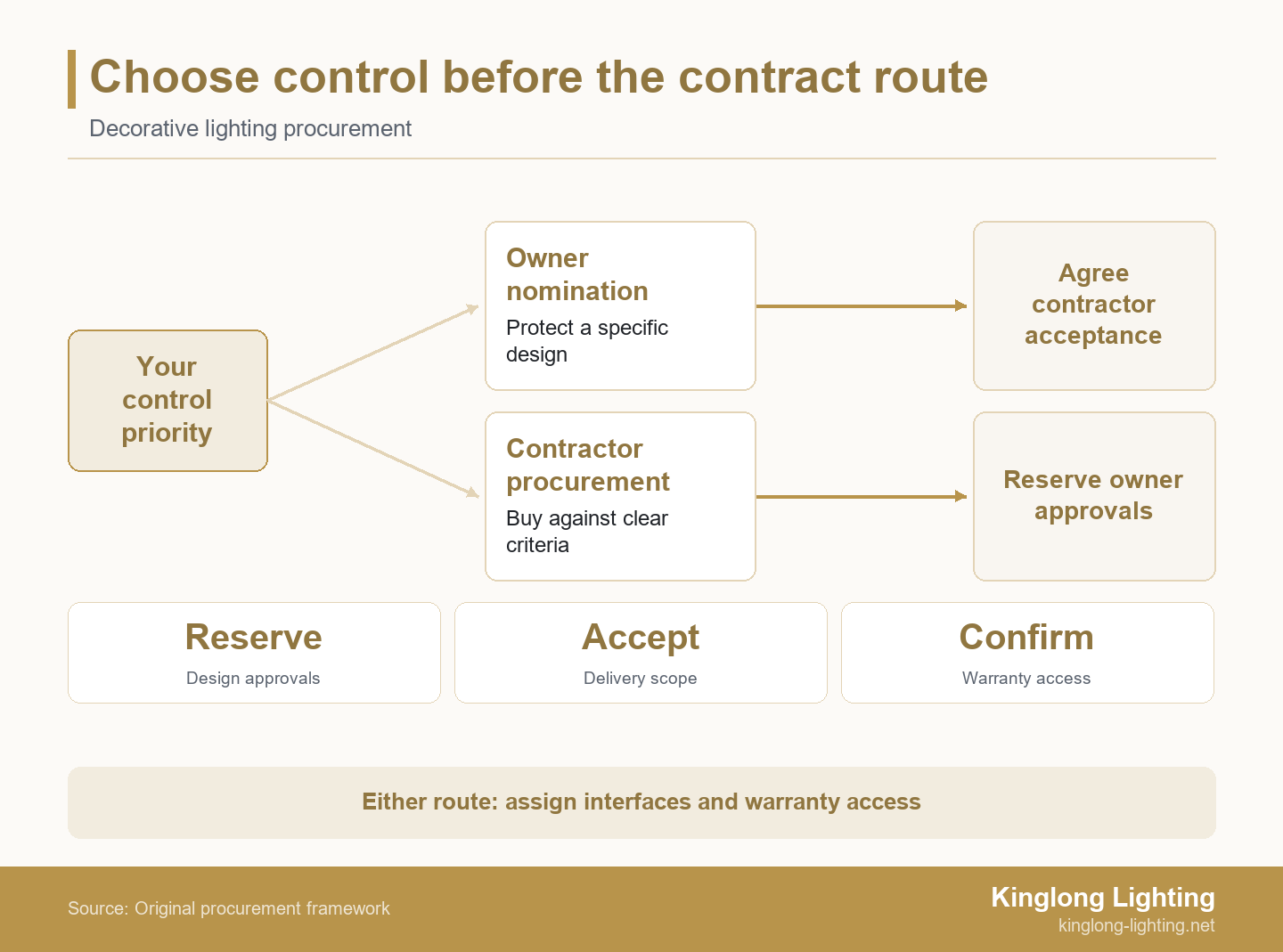
Supplier nomination gives an owner stronger selection control; contractor procurement can give stronger execution coordination. Neither guarantees both without agreed approval rights and delivery responsibilities. For decorative lighting, nominate when losing a particular design would be difficult to repair. Favor contractor procurement when the package can be described with testable requirements and the contractor accepts its coordination scope.
Consider a statement chandelier selected around a lobby interior versus a repeatable guestroom wall light. The first may depend on a specific silhouette, material treatment and approved sample. The second may offer more sourcing flexibility if appearance, output, controls and installation requirements are clear. Treating both as identical purchasing decisions can either weaken design protection or create unnecessary owner administration.
Start by identifying the choice you cannot easily recover later. Then check who can approve a change, who coordinates the interfaces and who can obtain a remedy. The contract examples below illustrate these distinctions; they do not establish rights for every project or replace advice on your adopted contract and applicable law.
- Reserve approval for changes that could undermine the selected design or performance.
- Price the contractor’s coordination and installation scope alongside the fixture offer.
- Check the usable warranty path before committing to either purchasing arrangement.
What supplier nomination and contractor procurement actually mean
Supplier nomination means the owner names a supplier for the contractor to engage. Contractor procurement means the contractor selects and buys against agreed requirements. In this comparison, both routes sit within a contractor-managed package. An owner purchasing directly from a manufacturer creates a different supply relationship, even if the contractor installs the fixtures.
Supplier nomination: owner selection, contractor engagement
Supplier nomination is useful when the owner has already investigated a source and wants to preserve that selection through tender and procurement. It can maintain continuity between design development, sample approval and manufacture. However, placing a name in the specification does not itself settle the engagement terms, payment route or allocation of installation risk.
FIDIC provides a relevant, but specific, contractual example. The FIDIC MDB Harmonised construction conditions provide a nominated subcontractor mechanism with qualified grounds for a contractor’s reasonable objection, not a universal rule for lighting suppliers. This reference is the May 2005 edition, clauses 5.1–5.3; a project using another form needs its own review.
Before naming the lighting source, ask the contractor to identify any concerns about capability, scope, proposed commercial terms or coordination obligations. Resolve those concerns through the project’s contractual process. A nomination that preserves the desired finish but leaves the contractor unwilling to accept the installation interface is not a complete procurement arrangement.
Contractor procurement: managed buying with reserved owner approvals
Contractor procurement is strongest when the contractor can source a defined package, coordinate it with the works and manage delivery through its purchasing chain. Owner control then depends on the specification and reserved approvals—not on choosing every manufacturer personally. A weak description such as “similar decorative light” gives the owner much less to evaluate than an approved sample and a complete fixture schedule.
AIA’s G705–2001 instructions, discussing A201–2007, describe written owner or architect objections on reasonable grounds to proposed entities, including sources of specially fabricated materials or equipment. Contractor purchasing therefore need not mean unrestricted supplier choice. That example is limited to the named contract context, rather than an automatic approval right on any lighting project.
Prepare the fixture schedule, sample requirements and submission process before tender so bidders price the same approval obligations. For further specification preparation, use the lighting procurement resources to identify the technical questions still unanswered. Confirm the actual objection procedure, review deadlines and commercial consequences with the project contract team; do not assume an owner can reject a compliant source without consequences.
Compare the controls that matter in a lighting package
Compare supplier nomination and contractor procurement against design selection, substitution approval, price transparency, interface coordination, programme control and usable warranty remedies. The table describes practical tendencies and checks, not guaranteed legal allocations or a price ranking.
| Control | Supplier nomination | Contractor procurement |
|---|---|---|
| Design selection | Preserves a specific source and approved design; define the precise selected scope. | Preserves requirements rather than a source; measurable criteria and samples matter. |
| Substitution approval | Set who may replace the nominee or change its product, and on what grounds. | Set submission evidence, approval authority and conditions for alternatives. |
| Price transparency | Ask how supplier pricing, contractor attendance and coordination costs are treated. | Compare the complete offered package; supplier discounts may not be separately visible. |
| Interface coordination | Check contractor acceptance of supports, wiring, drivers and installation boundaries. | Package coordination may be consolidated, but exclusions can still leave gaps. |
| Programme control | Owner approvals and nominee availability need an agreed place in the delivery schedule. | Contractor sequences purchasing with the works; owner review windows still need planning. |
| Warranty access | A selected source is not automatically a directly enforceable owner warranty. | A purchasing chain is not automatically a complete product-and-installation remedy. |
Nomination is the better fit where preserving a specific decorative design is the dominant concern and contractor acceptance can be secured. Contractor procurement is the better fit where requirements permit genuine alternatives and the contractor accepts the whole coordination package. If different fixture groups have different priorities, consider a hybrid—but price and document each boundary rather than expecting one label to cover everything.
Control substitutions before the tender price becomes the baseline
Substitution control starts with a baseline that both parties can identify. Record the selected fixture or approved sample, dimensions, materials, finish, light characteristics, control compatibility and installation assumptions. Without that baseline, a debate about “equivalence” can become a negotiation over what the owner intended rather than an assessment of a proposed change.
AIA’s A503–2019 guide offers a useful drafting example. The AIA optional supplementary substitution wording addresses investigation of the alternative, warranty, related changes, cost and coordination. These are model provisions to consider adopting, not obligations automatically present in every contract. The lesson for a lighting buyer is to ask for a complete change proposal, not simply another catalogue sheet.
Evaluate a substitution against the approved baseline and its effects on installation, controls, maintenance and warranty—not merely a lower fixture price. A lighter fitting may require a different mounting detail; a different driver may affect dimming behavior or access for maintenance. Have the proposal identify what changes, who checks it, who carries each consequential cost and what evidence supports approval.
Use the decorative lighting value-engineering guide to prepare the design and commercial review before requesting alternatives. A material or construction change can be worthwhile when the desired result remains demonstrable. Keep the approval separate from permission to manufacture: the team should know which sample or drawing revision is current, whether downstream details have changed and whether the revised offer includes those changes.
Also agree when alternatives can be proposed. A comparison before award is different from a change after fabrication or site work has begun. Set review windows around the actual dependencies, and identify the escalation route if a late proposal threatens installation. Otherwise the owner may retain a nominal approval right while facing a schedule that makes rejection impractical.
Assign interfaces and warranty access, not just the supplier name
Lighting coordination needs an accountable party at each interface, whichever procurement route is selected. For a bespoke chandelier, distinguish the fixture’s own construction from the building support, electrical connection, control system and access equipment. “Supplier to coordinate” is too vague if nobody has defined the information it receives or the work it can approve.
The RIBA Plan of Work 2020 offers a process tool rather than a procurement-law rule. The RIBA responsibility matrix guidance identifies responsibility for tasks and design, with refinement as the design develops. Applied to lighting, this means naming who provides fixture loads, who designs and approves the building support, who checks driver compatibility and who coordinates installation.
Give each assignment a concrete output and recipient. The supplier might provide fixture weight and suspension information; the appropriate project designer checks the support against the building design; the contractor coordinates the accepted detail with installation. The exact roles vary by appointment. Confirm both the technical interface and the commercial scope, including attendance, handling, storage, protection and the costs of specialist access.
Kinglong Lighting’s custom lighting manufacturing process describes drawing feasibility review and sample approval. Those steps can help establish what is being made before the buying route is finalized. Ask which drawings, samples and coordination inputs the quotation includes; a manufacturer’s feasibility discussion is not approval of the building structure or acceptance of another party’s contractual duties.
Warranty access deserves the same precision. AIA’s multiple-work-order agreement summary addresses special material and equipment warranties being in the owner’s name or transferable to the owner. That example comes from A121–2018; it is not a blanket entitlement under every purchasing arrangement.
For your package, check the actual beneficiary, coverage, exclusions and claims process. Separate product defects from installation defects, transit damage and control-system problems. Identify who diagnoses a failure, who supplies a replacement and who pays for removal and reinstallation where covered. A manufacturer offering a replacement component does not, by itself, answer who obtains access to a high lobby ceiling or restores the installation.
A hotel package with two different control priorities
The following illustrative example separates visually critical bespoke fixtures from repeatable room lighting. It shows a procurement decision and the evidence needed before ordering, not a reported client project or a promise of cost savings.
Example: nominate lobby chandeliers, competitively procure room sconces
A hotel owner is defining a 62-fixture package: 2 bespoke lobby chandeliers and 60 guestroom sconces. The interior designer has selected the chandeliers’ appearance and source, while the room sconces can be evaluated against an approved sample and performance criteria. Supplier selection is progressing, but the chandelier installation information is not yet complete.
The chandelier quotation excludes building supports, and the tender package does not identify who supplies the drivers or checks the control interface. These gaps affect the 2 bespoke fixtures, not automatically all 62 lights. The owner has protected visual selection, but has no basis yet to conclude that the contractor’s price covers a working installation. The repeatable sconces present a different problem: their sourcing flexibility needs a firm sample baseline rather than a named-source instruction.
The illustrative 62-fixture package therefore keeps two lobby chandeliers nominated and 60 room sconces contractor-procured against an approved sample. The two chandeliers remain on hold for ordering until structural, driver and warranty interfaces are accepted. The owner, contractor and supplier revise the chandelier scope: fixture loads go to the responsible structural designer, driver and control duties are assigned, and the parties identify the installation and product-warranty contacts. Room-light alternatives follow the agreed submission procedure.
Before the chandelier purchase order, the project team reviews the revised suspension and electrical details, checks the sample/drawing revision against the offer and obtains written acceptance of the coordinated scope. A signed allocation alone is not verification that the details work. Any unresolved interface keeps the affected fixtures on hold. This conditional hybrid is only an example; it depends on the adopted contract, project appointments and contractor acceptance. For visual fit, the Kinglong Lighting project gallery can support an aesthetic discussion, but project images cannot establish those contractual responsibilities.
Choose the route before award—and check that it can work
Choose supplier nomination when a specific design is difficult to replace and the owner can manage timely approvals. Choose contractor procurement when requirements are testable and the contractor accepts the coordination scope. Divide a package only with explicit interfaces; a hybrid is not an escape from assigning responsibility.
Test the owner’s capacity as well as the contractor’s. If the design team cannot review samples or changes within the agreed windows, extensive reserved approvals can become a bottleneck. Delegate routine checks to a named competent reviewer, keep owner approval for consequential changes and identify who can decide when a technical or commercial disagreement occurs.
Before award, use one fixture from each package group to walk through the proposed arrangement. Ask: who engages the source; what constitutes acceptance; who may approve a substitute; what installation work is included; when approval and delivery are due; and how a covered failure reaches the party able to fix it. Record exceptions in the tender clarifications and scope documents rather than leaving them in informal supplier emails.
Then reconcile the price against those answers. Compare like-for-like scope, including coordination, attendance and any stated exclusions. A lower fixture quotation is not a lower installed-package cost if another party must later price essential work. If responsibility for a critical interface remains disputed, resolve the appointment and contract issue before authorizing manufacture—not after the decorative design is already committed.
Review payment milestones alongside the buying route. Establish who issues the supplier order, who funds any agreed deposit and what authorizes a production payment. If the owner’s nomination expects one commercial sequence while the contractor’s offer assumes another, resolve that mismatch before award. Supplier selection alone does not create an agreed payment mechanism.
To discuss your lighting package with Kinglong Lighting, share the fixture schedule, current drawings and proposed buying arrangement. Ask about drawing feasibility, sample-approval steps and the scope available for quotation, so your project team can compare that offer with its responsibility allocation. Keep contractual approval with the appointed project advisers.
Frequently Asked Questions
Can an owner buy directly and leave installation with the contractor?
Yes, but direct purchase creates a separate supply arrangement whose delivery, storage, installation and remedy interfaces should be agreed explicitly. Identify who receives and inspects the shipment, who protects stored fixtures and what the installation contractor accepts. Also check payment, insurance and warranty access under the actual agreements. Do not describe an owner-issued purchase order as contractor-engaged nomination merely because the same manufacturer is preferred.
Does a nominated supplier have to offer the lowest price?
No procurement label establishes the lowest price; evaluate comparable scope, disclosed commercial terms and the costs of managing the chosen arrangement. Ask how supplier pricing, contractor additions and attendance are treated, and whether the competing offers include equivalent work. An owner’s reason for nomination may be design continuity rather than price leadership. Avoid claiming savings unless the same scope and consequential costs have actually been compared.
What if the contractor refuses the owner’s preferred lighting supplier?
Ask for the specific contractual and technical grounds before deciding whether to replace the source, resolve the concern or obtain project-specific advice. Distinguish a documented capability or coordination concern from a preference for another purchasing arrangement. Check the adopted nomination and objection provisions rather than relying on industry shorthand. If the issue affects indemnities, liability or available remedies, involve the project’s contract adviser before giving a procurement instruction.
Should the owner’s designer approve every replacement component?
Reserve approval for components that change the agreed design, performance, installation interface or maintenance strategy, with a clear delegation for routine replacements. Define categories and evidence requirements before procurement rather than treating every adjustment as identical. A change to visible finish or dimming behavior may need design review; an unchanged approved replacement part may follow an agreed maintenance process. In both cases, keep the installed configuration traceable.