
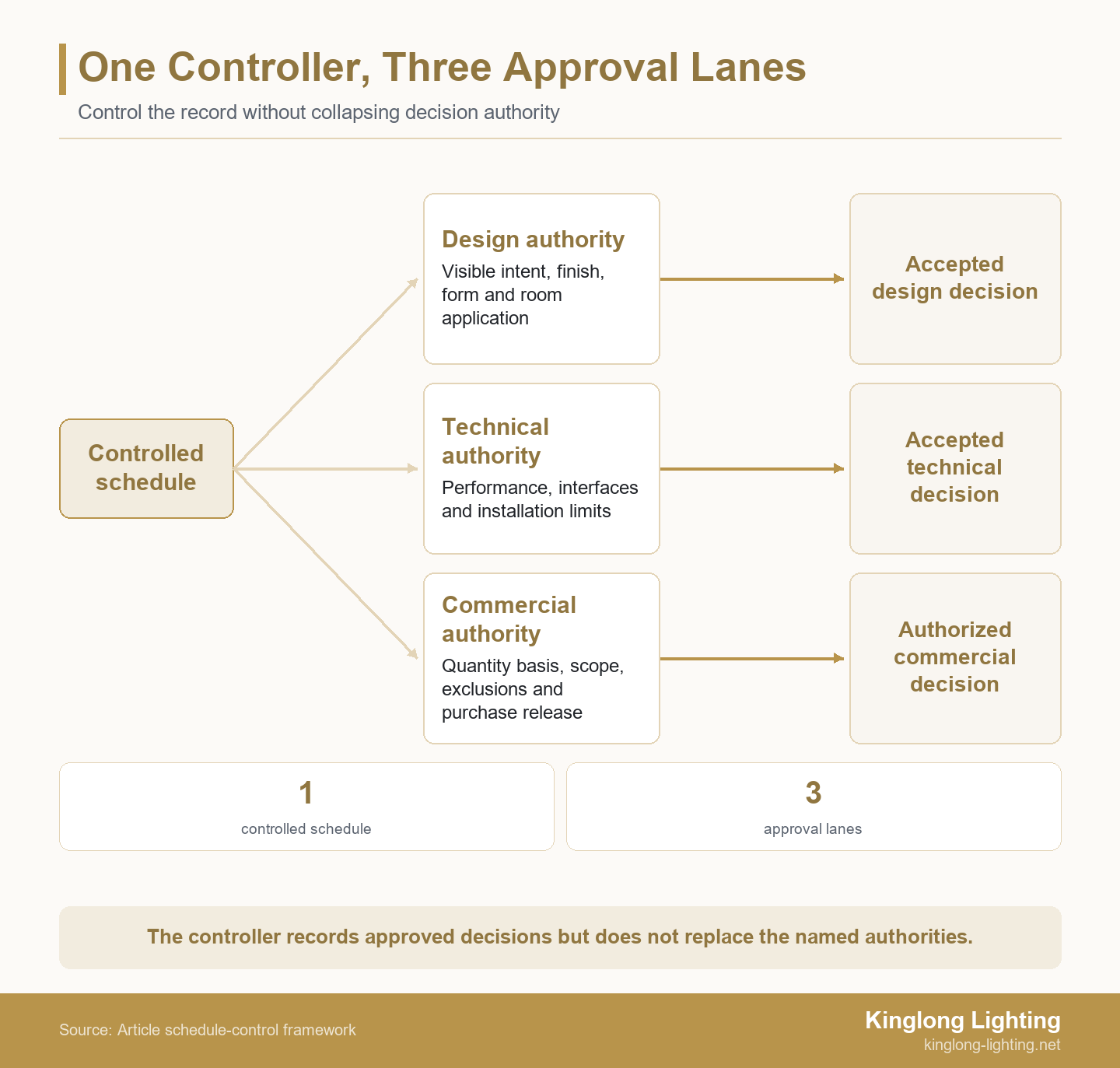
A final lighting schedule needs one accountable record controller. That person maintains fixture identities, reconciles inputs, records decisions, issues the dated revision, and prevents superseded copies from returning to use. The controller does not automatically gain design, technical, or commercial approval authority. Those decisions remain with the people named in the project’s appointments, contracts, and approval matrix.
This distinction matters when an owner, designer, consultant, contractor, buyer, and supplier each hold a different spreadsheet. “Final” should describe a controlled issue with a stated purpose and status—not the file that happened to arrive last.
Who owns the final lighting schedule?
- Name one schedule controller before final reconciliation begins.
- Keep record control separate from design, technical, and commercial authority.
- Control both fixture-line data and issue-level metadata.
- Do not call the schedule final while decision-changing exceptions remain open.
- Archive superseded issues and reissue after approved changes.
One person or organization should be accountable for maintaining and issuing the final lighting schedule, while approval rights remain distributed. On a design-and-build project, the controller might sit with the main contractor or design manager. On an owner-led procurement route, the owner’s project manager or lighting consultant may control it. A supplier may maintain a manufacturing-facing version when the team expressly assigns that duty.
The job title is less important than the mandate. The appointment should state what the controller receives, what can be edited, who decides conflicts, what status counts as issued, and where the master record lives. If the controller can change a quantity but cannot approve a finish, the workflow must route the finish decision instead of hiding it inside a spreadsheet update.
Working rule: one controller owns the integrity of the record; named authorities own the decisions recorded in it.
Why multiple lighting schedules survive
Competing schedules often exist for legitimate reasons. The designer needs fixture intent and room application. The electrical consultant tracks load, control, emergency, and interface data. The contractor plans quantities, packages, dates, and installation. The supplier manages model, finish, light source, driver, lead time, and production status. A buyer may need price, currency, exclusions, and purchase status.
NBS describes schedules as structured outputs built from shared specification data and used to capture requirements, responsibilities, materials, and equipment. This supports a useful principle: different views can come from common controlled information. Trouble begins when teams copy that information into disconnected files and each file evolves independently.
NBS guidance on coordinated specification stresses coordination across specifications, schedules, drawings, models, and databases. That means the final schedule cannot be reconciled by comparing spreadsheets alone; the controller must trace disputed values back to approved sources. This matters in hospitality lighting coordination, where repeated room types can multiply one mistaken code or quantity across many locations.
Schedule ownership is not approval authority
What the schedule controller owns
The controller owns reconciliation, issue metadata, distribution, and supersession—not every embedded approval. Typical duties include maintaining the fixture-ID dictionary, mapping room codes, checking quantity bases, logging unresolved differences, recording decision references, applying the revision, issuing the approved file, and maintaining the archive. The controller should be able to answer: Which issue is current? Why did this value change? Who accepted it? Who received the issue?
The controller also protects structure. Units, status values, date formats, and controlled vocabularies should not change from tab to tab. Consistent fields let reviewers compare revisions without reinterpreting the record each time. Free-text notes can explain an exception, but they should not replace a decision status, owner, due date, or source reference.
For Kinglong Lighting supplier review, a named controller also creates one reliable route for fixture questions, open development inputs, and accepted answers.
What designers, technical reviewers and buyers still own
Design authority usually covers visible intent: form, scale, material, finish, distribution, mounting expression, and room application. Technical authority covers performance, electrical and control interfaces, installation constraints, and required evidence. Commercial authority covers quantity basis, scope, exclusions, budget authorization, and purchase release. The exact boundaries depend on the project.
Within its contract context, AIA A201 assigns the contractor review and coordination duties for submittals and requires written notice of deviations. This is not a global rule, but it shows why preparation, coordination, deviation disclosure, and design review are different acts. An author article on the AIA Community Hub also distinguishes submittals from contract documents and describes different preparation and review roles.
The published decorative-lighting resources provide adjacent guidance for teams defining who prepares, reviews, approves, and receives project deliverables without implying that the schedule controller holds all four roles.
Minimum fields for a controlled final schedule
CDBB National Annex guidance uses metadata, status, and revision concepts to control information containers. It concerns a broader information-management context, but the principle applies: information is not reliably usable without knowing its identity, status, and revision.
A usable final lighting schedule therefore needs both line-level fields and issue-level controls. The exact columns can vary, but removing any of the functions below should be a conscious project decision.
| Control group | Minimum fields | Question answered |
|---|---|---|
| Fixture identity | Unique fixture ID, description, room or area code, type reference | Are all teams discussing the same item? |
| Quantity basis | Quantity, unit, drawing or room-basis reference, allowance status | What does the total include? |
| Approved attributes | Dimensions, material, finish, light source, driver or control, mounting | What characteristics are protected? |
| Supplier position | Proposed model, supplier status, quotation reference, qualification or exclusion | What can the supplier provide? |
| Decision trail | Design, technical and commercial status; decision owner, date, reference | Who accepted each decision? |
| Issue control | Schedule number, revision, purpose, issue date, issuer, distribution, superseded issue | Which schedule may the team use? |
A status such as “approved” is too vague on its own. Approved for appearance may not mean approved for technical compliance, budget, purchase, or production. Separate those states or define a composite release status whose prerequisites are explicit.
A six-step lighting schedule handover protocol
An author article on the AIA Community Hub presents bid handoff as structured knowledge transfer and discusses the submittal schedule. This reinforces why an informal attachment is not enough. For lighting, the handover should reconcile inputs, route exceptions, freeze the issue, and obtain acknowledgement before the schedule is declared final.
Freeze the source set and reconcile fixture identities
- Name the controller and authority lanes. Record who controls the schedule and who decides design, technical, commercial, and purchase questions.
- Freeze the source set. List the drawings, specifications, room data, approval records, quotations, deviation logs, and existing schedules included in reconciliation.
- Map fixture identities. Match every competing code to one controlled fixture identity before comparing values. Do not merge similar names until location and source references confirm they are the same item.
- Reconcile line by line. Compare quantity basis, location, approved attributes, supplier position, exclusions, and status. Record the winning source or open an exception; never silently choose the most convenient value.
Custom fixtures need an explicit open-item boundary. Kinglong Lighting’s custom lighting development context is relevant when dimensions, finish samples, internal components, mounting details, or production information remain open. The final schedule should say what is fixed, what remains subject to submittal or sample review, and what event closes each item.
Close exceptions, issue the record and supersede old versions
- Route and close exceptions. Send each conflict to the authority able to decide it. Record the decision, date, evidence, affected lines, and downstream documents that must change.
- Issue and acknowledge. Apply a unique revision and purpose, export a protected issue format if appropriate, distribute it through the agreed channel, mark older files superseded, and obtain acknowledgement from intended users.
NBS guidance on specification development explains that information develops through project stages, so a final issue must distinguish fixed decisions from controlled open items. “Final for tender,” “final for purchase,” and “final for production” are not interchangeable unless the project defines them that way. A release should name its purpose and prohibited uses.
Worked example: three schedules for one hotel guestroom package
How the controller resolves six mismatched lines
A design-and-build team is preparing an illustrative hotel guestroom decorative-lighting package, not a real Kinglong project or industry benchmark. It has 24 illustrative fixture lines across a designer’s schedule, a contractor’s quantity sheet, and a supplier’s offer. The team wants to release the package, although its readiness has not been established.
In an illustrative 24-line guestroom package, six mismatches require routing before one schedule can be reissued. Three schedules use overlapping but inconsistent fixture IDs. No issued record identifies the latest approved decision. The affected scope is 6 mismatched lines: four affect visible or technical attributes and two affect quantity or room allocation. The controller does not average quantities or copy the newest supplier text. Quantity conflicts go to the contractor and procurement lead; finishes go to design authority; the driver location goes to technical review. Hold the six affected lines, or the whole package when partial release is not allowed, until the named authorities close the exceptions.
After decisions return, the controller updates the six lines, records references, issues a revision, marks all three inputs as source records rather than current instructions, and secures acknowledgement. Reconcile the released schedule against the approval register and supplier acknowledgement. This is an illustrative scenario, not a measured result; comparable application context appears in Kinglong Lighting’s hospitality lighting projects.
The partial-release decision needs its own boundary. It should also name the person authorized to lift each hold, the evidence required for closure, and any shared interface that remains blocked. The issue header should name released lines, held lines, intended use, and next revision. The PDF and working spreadsheet should carry the same status. The transmittal must not describe the whole guestroom package as released while six lines remain open. The room-type summary, quantity total, and procurement reference should disclose excluded lines. The controller should also identify whether held lines affect shared drivers, controls, mounting supports, room templates, or shipping packages; an apparently isolated hold may block released items through a common interface. Record that dependency before the buyer treats the remaining 18 lines as independently executable. If one party cannot isolate held scope in its purchasing or production system, hold the package until the record can be used without ambiguity.
Final issue checklist
Before issue, test completeness, authority, traceability, exceptions, and distribution. The controller and project lead should answer yes to the following questions:
- Does every line have one unique fixture ID and a usable room or area reference?
- Is the quantity basis stated and reconciled to current project information?
- Are protected design and technical attributes visible rather than buried in email?
- Are supplier proposals, exclusions, and open development items explicit?
- Does every accepted exception show the decision owner, date, and evidence reference?
- Are design, technical, commercial, purchase, and production statuses distinguishable?
- Does the issue show revision, date, purpose, issuer, and distribution?
- Have superseded files been removed from active shared locations and clearly marked?
- Have intended users acknowledged the issue or received it through the controlled system?
If any “no” can change quantity, visible intent, performance, scope, price authorization, or readiness, the schedule is not final for that purpose. Record the hold rather than masking it with a general note. The decorative-lighting value-engineering guide explains how alternatives can be assessed without silently losing accepted design intent.
How to control changes after final issue
Every post-issue change should preserve the change identifier, fixture identity, reason, decision owner, affected records, inspection impact, approved baseline, and new revision. A supplier development drawing, site condition, value-engineering proposal, room-count change, or component substitution may reopen one or more approval lanes. Any value-engineered alternative must also use an original design or appropriately authorized design; schedule approval does not cure intellectual-property or authorization problems. The controller records the request, identifies affected lines, routes the impact, and prevents an approved change from living only in a drawing or email.
When a change affects an issued purchase order, the controller must update its schedule reference, identify which commercial lines are affected, and obtain supplier acknowledgement against the same new revision before production or delivery continues.
Do not delete the history. Archive it with controlled access and an unmistakable superseded status. The audit trail explains why the current value changed and prevents an older attachment from appearing equally valid.
Distribution control continues after reissue. List the recipients who must replace their active copy, set a response date where the project process allows it, and follow up on missing acknowledgements. A revised schedule is not operational merely because it exists in the master folder; the teams pricing, purchasing, making, delivering, and installing the fixtures must be working from the same authorized issue.
Issue one record, keep several authorities visible
One controlled schedule can preserve a shared project record without collapsing distinct approval authorities. Name the controller, expose authority lanes, reconcile source records, close decision-changing exceptions, and issue a dated revision for a stated purpose. That turns a collection of correct-looking cells into a usable final lighting schedule.
For supplier review, Kinglong Lighting can work from the controlling schedule, latest drawings, approval references, deviation list, and target release stage. Formal authority and document precedence remain governed by the project’s appointments and contracts. To identify missing fixture information and supplier questions before quotation or production release, send the controlled lighting package.
Frequently asked questions
Can the lighting supplier own the final schedule?
Yes, a supplier can maintain and issue the record when the project expressly assigns that duty. The supplier should not approve its own design, technical, or commercial deviations unless the project grants that authority. Keep approval references visible, define which issue is contractual or informational, and make the project-side controller or lead responsible for accepting the handover arrangement.
Is the architect’s schedule always the controlling schedule?
No. The controlling schedule is the issue designated by the project’s appointments, contracts, information protocol, and release process—not by job title alone. The architect’s schedule may be a design source while a contractor-controlled record governs coordinated construction information. The final schedule should preserve the architect’s approved decisions and cite their source rather than silently replacing them.
What if quantities change after the schedule is issued?
Treat the quantity change as a controlled revision. State the reason and basis, identify affected rooms and purchase lines, check technical and commercial impacts, obtain required decisions, and issue a new revision. Do not overwrite the old quantity without a trail. If purchasing or production has started, notify those parties and obtain acknowledgement against the revised fixture identity.
Should superseded lighting schedule versions be deleted?
No. Retain superseded issues in a controlled archive, restrict accidental use, and mark them clearly with their status and replacement revision. Removing old copies from active folders is sensible; destroying the record is different. A retained history supports audit and change explanation, while the active project location should present only the current authorized issue.