A shop drawing for a custom villa chandelier should be read differently from a design rendering. A rendering sells the idea. A shop drawing tests whether the idea can be built, supported, wired, installed, serviced, packed, and approved without relying on memory.
Owners and designers do not need to become engineers, but they do need to know what a drawing should reveal. The drawing should make visible the decisions that affect risk: dimensions, drop, canopy, suspension, weight, driver location, module split, finish reference, route, access, and open assumptions.
Kinglong Lighting can support drawing review when the design team uses the custom chandelier manufacturing workflow to connect the visual intent to buildable evidence. The useful question is not whether the drawing looks professional; it is whether the drawing leaves fewer dangerous unknowns.
Key Takeaways
- Read the drawing by layers: Geometry, support, electrical, access, finish, and packing questions should each be visible.
- Do not approve hidden assumptions: If weight, suspension, driver, canopy, or route data is missing, the approval should name the open item.
- Local review remains local: Manufacturer drawings support the project but do not replace local engineering, electrical, or authority review.
- Samples and drawings should agree: The shop drawing should reference the finish or material master when visible components are approved.
- Approval should be narrow: A drawing approval can accept geometry while leaving other items open only if the record says so.
A shop drawing is not a rendering with dimensions
A villa chandelier shop drawing is successful when it tells the owner what can now be approved and what still needs qualified review.
The drawing should translate the chandelier from visual promise into project responsibility. It should show how the design sits in the room, how it is suspended, how it relates to the ceiling, how it is powered, and how future service can happen.
The UL 1598 standard page gives a useful boundary because decorative chandeliers are still luminaires that need product evidence and qualified installation review. For project buyers, the practical action is to keep product evidence, luminaire boundaries, and installation assumptions visible during drawing approval.
Start with geometry, drop, and viewing angles
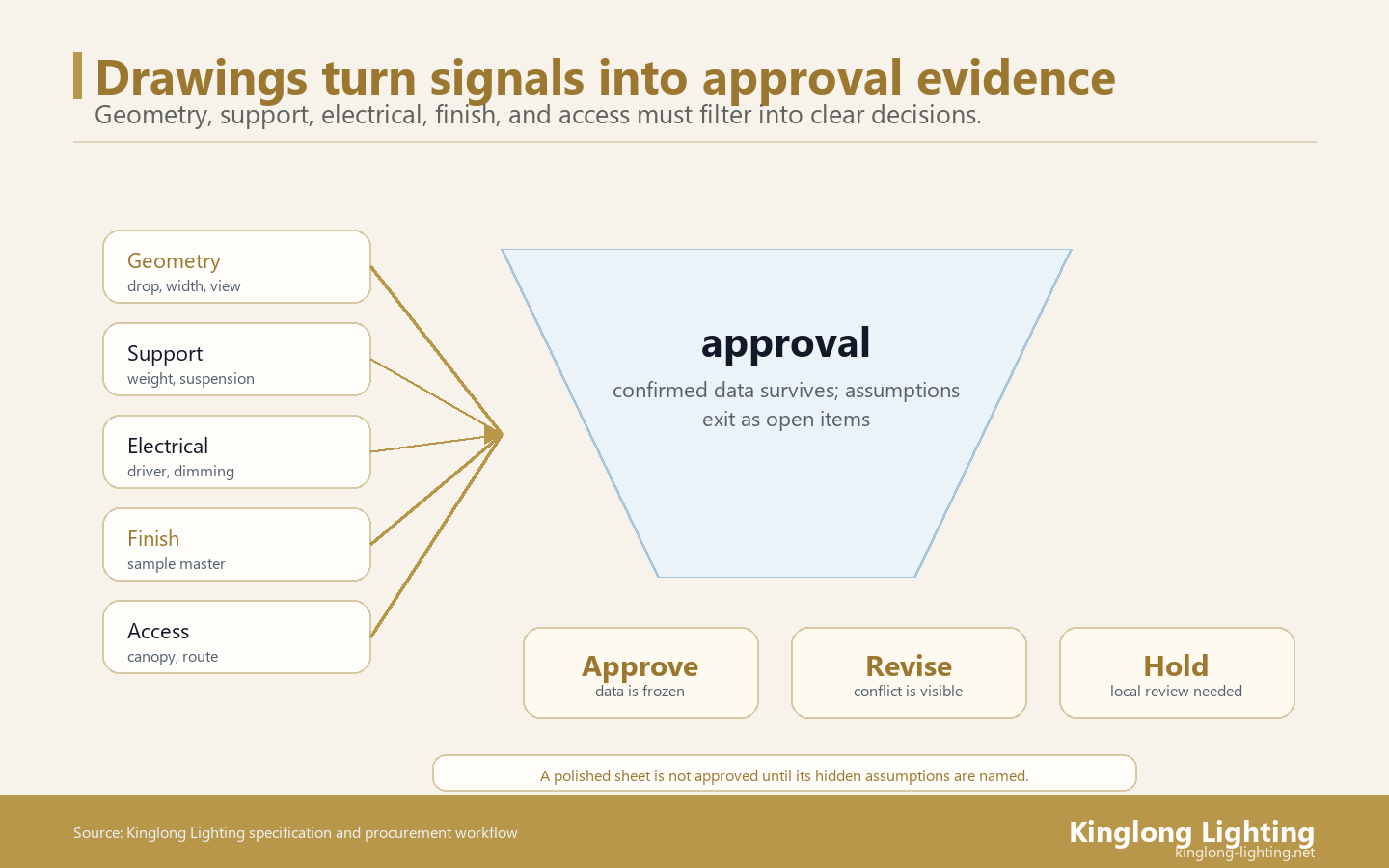
The first reading should check the basics: overall width, height, drop, canopy size, module dimensions, lowest point, relationship to furniture, and primary viewing angles. A drawing can be technically detailed and still fail the room if the visible proportion is wrong.
The Mofun Design Platform can support this by testing visual mass before drawing approval. The digital model does not replace the drawing, but it helps the owner understand whether the numbers create the intended room effect.
Look for the open assumptions
A good drawing should mark assumptions rather than hide them. If ceiling support is by others, say so. If driver location is pending, say so. If route, lift access, control protocol, or local electrical review is not included, the drawing should not imply that those issues are solved.
Owners should ask the supplier to separate confirmed data from assumed data. That simple separation prevents a later argument where a project team treats a note as approval, while another team remembers it as a placeholder.
Weight and suspension need qualified boundaries
A custom chandelier may be visually delicate but structurally consequential. The drawing should show approximate weight, suspension points, load path assumptions, canopy relation, and which local professional must verify the building-side support.
The ASCE Hazard Tool gives a useful boundary because site-specific structural and environmental assumptions belong with qualified engineering review. For project buyers, the practical action is to keep site-specific structural assumptions with qualified local engineering review rather than manufacturer guesswork.
Suspension is a system, not a single hook
The drawing should explain how the chandelier is suspended, how the canopy relates to the ceiling, how modules connect, and how adjustment is handled. A single decorative ceiling symbol is not enough for a large custom chandelier.
The owner should not ask the manufacturer to certify the villa structure unless that is a documented professional service. The better approach is to use the manufacturer drawing to inform local structural review, then record what the local reviewer accepts or changes.
Canopy design should include service logic
Canopy design is often treated as a cover. It is also a service object. The drawing should show whether the canopy hides drivers, terminals, suspension adjustments, access panels, or decorative seams. If it cannot be opened without damage, future maintenance risk rises.
For villas, canopy appearance matters because it is often close to finished plaster, stone, or timber ceilings. The shop drawing should therefore show both visible finish relationship and service access. Approving one without the other is an incomplete decision.
Electrical and controls should be visible without overclaiming
The shop drawing should expose electrical assumptions enough for responsible coordination, while making clear what remains under local electrical responsibility. This protects the owner, designer, manufacturer, and installer from false certainty.
The NFPA 70 National Electrical Code page gives a useful boundary because electrical installation and field acceptance decisions need local qualified code review. For project buyers, the practical action is to separate manufacturer information from local electrical code and installation responsibility.
Driver location changes service risk
Drivers and control components should not disappear from the drawing. If drivers are remote, the drawing should show the expected location and wiring assumption. If they sit in the canopy, the drawing should show access and heat considerations. If the driver choice is by local team, that boundary should be written.
This matters because a villa owner may accept a beautiful chandelier but later discover that a service part is trapped above a finished ceiling. Drawing review is the moment to prevent that mismatch.
Dimming assumptions should be named early
The drawing package should state known voltage, control, and dimming assumptions where available. If the protocol is unknown, mark it unknown. If compatibility must be tested or coordinated locally, say so. Silence is worse than a clear open item.
The DOE LED lighting page gives a useful boundary because LED performance, heat, service life, and operating behavior need to be part of luminaire decisions. For project buyers, the practical action is to include LED behavior, driver compatibility, dimming expectations, heat, and service path in the drawing review.
Samples, finishes, and drawings must reference each other
A shop drawing can approve shape while the sample approves visible quality. Those two records should be linked. If the drawing shows brass, glass, crystal, leather, resin, or acrylic, the drawing should identify the approved sample or the sample still pending.
The DOE TM-30 FAQ gives a useful boundary because color quality needs more precise language than warm, cool, or beautiful when materials are being approved. For project buyers, the practical action is to use precise color and material language when the drawing depends on visible finish approval.
Finish notes should not be decorative labels
Words such as brushed brass, champagne gold, smoked glass, or warm white can mean different things to different teams. The drawing should connect visible terms to sample codes, finish boards, approved photos with limitations, or physical references.
If the finish is not yet approved, the drawing should say pending. That allows geometry approval to proceed without pretending the visual master is complete. It also helps the owner understand what can still change without affecting the whole drawing.
Component maps prevent future confusion
For complex chandeliers, the drawing should include a component map or piece logic: crystal strings, glass pieces, arms, modules, rings, canopy parts, suspension points, drivers, or decorative accessories. The map helps production, packing, installation, and later spare part support.
A component map is especially useful when a villa has multiple related fixtures. It prevents the owner from treating similar pieces as interchangeable when they have different sizes, finishes, or installation positions.
Drawing approval should state what is approved
The most dangerous drawing approval is a broad yes. Owners should approve the drawing with a scope statement: which layers are accepted, which layers remain open, who reviews local matters, and which changes would require a revised drawing.
The WBDG building commissioning page gives a useful boundary because commissioning connects design intent, installation quality, operation, and owner handover. For project buyers, the practical action is to connect drawing approval to later installation, commissioning, and owner handover evidence.
Use narrow approval language
A narrow approval might say: geometry and visible proportion approved; finish sample pending; local structural support by others; driver location to be coordinated with electrician; packing method to be reviewed before shipment. That sentence is much safer than approved.
Narrow language does not slow the project. It lets the manufacturer proceed on the approved layers while keeping unresolved layers visible. The owner gains control because later changes can be traced to the specific open item instead of reopening the whole drawing.
Route and packing should be connected to drawing size
Module dimensions in the drawing should be compared with doorways, lifts, stairs, corridors, and unpacking space. If a chandelier is drawn as one large assembly but must enter through a narrow route, the drawing should be revised before production.
The ICC Incoterms 2020 page gives a useful boundary because international delivery responsibility should be named before goods, crates, and spare parts move. For project buyers, the practical action is to connect drawing size, packing sequence, delivery responsibility, and destination handoff before the fixture is released.
Villa chandelier shop drawing review table
Use this table to read the drawing layer by layer. The goal is to approve the right evidence, not to turn the owner into the engineer.
| Decision area | Owner risk if vague | Evidence to request | Acceptance action |
|---|---|---|---|
| Geometry | The fixture fits the drawing but not the room | Width, height, drop, module size, viewing angles | Approve proportion or request scale revision |
| Support | Load path is assumed rather than reviewed | Weight, suspension points, canopy, local review note | Send to qualified local reviewer |
| Electrical | Driver or dimming issue appears after ceiling close | Driver location, voltage/control assumptions, access | Mark local electrical responsibility |
| Finish | Production finish drifts from owner expectation | Sample master, finish code, acceptable variation | Link drawing to approved sample |
| Route and service | Fixture cannot enter or be maintained | Module map, packing size, lift/access path | Revise before production if route fails |
The drawing approval trap to avoid
The trap is approving a drawing because it contains many lines. Detail is not the same as decision clarity. A drawing can show beautiful dimensions and still omit driver access, structural boundary, route limits, finish master, or installation assumptions.
A practical owner review should ask one question at the end of every drawing page: what decision can now be made from this page? If the answer is only the chandelier looks right, the drawing may still be a concept document. If the answer names geometry, support, electrical boundary, finish reference, or route decision, the drawing is doing approval work.
This distinction helps designers as well. They can protect the visual intent while asking the manufacturer to expose the buildability layers that a rendering cannot answer.
A useful review meeting can therefore be organized page by page. Page one answers room geometry. Page two answers suspension and canopy logic. Page three answers components and finish references. Page four answers electrical assumptions and service access. Page five answers route, packing, and open items. If any page cannot answer its purpose, the approval should be narrowed or held.
This method also prevents overcorrection. The owner does not need to reject the entire drawing because one layer is pending. The team can approve the geometry, hold finish, ask for driver clarification, and send the support note to a local reviewer. That is faster and safer than treating the drawing as one all-or-nothing decision.
How Kinglong Lighting supports shop drawing review
Kinglong Lighting can support villa chandelier shop drawing review by linking design intent, component maps, sample references, installation assumptions, and packing logic inside the custom chandelier workflow. A stronger drawing lets the owner approve the right layer instead of giving a broad yes.
If a drawing is already in review, the next step is to send the villa chandelier shop drawing file with room photos, dimensions, ceiling notes, finish references, and open questions. Kinglong Lighting can then identify which drawing layers are ready and which need local professional review or sample proof.
Before you approve a villa chandelier shop drawing
Use this short action list before the next approval meeting. It is intentionally practical, because vague approval language is the usual source of later rework.
- Read geometry, support, electrical, finish, route, and service as separate layers.
- Ask which assumptions are confirmed and which are still open.
- Use local qualified review for structure, electrical work, and authority-controlled items.
- Link visible finish terms to sample masters or pending sample decisions.
- Approve narrowly so later changes do not reopen the whole drawing.
FAQ
What is a custom chandelier shop drawing?
It is a technical drawing package that translates the chandelier concept into dimensions, components, support assumptions, electrical notes, finish references, and installation information.
Can owners approve shop drawings without an engineer?
Owners can approve visual and commercial layers, but structural, electrical, safety, and authority-controlled questions should be reviewed by qualified local professionals.
What should be checked first in a chandelier drawing?
Check geometry, drop, room relationship, weight, suspension, canopy, driver location, finish reference, route, and which assumptions remain open.
Is a rendering enough for chandelier production?
No. A rendering communicates appearance. Production needs drawings, samples, component details, engineering assumptions, packing logic, and approval boundaries.