Choose a finish chip for surface appearance, a mock-up for the conditions it reproduces, and a golden sample for the explicitly approved product configuration. For custom decorative lighting, the useful question is not “Which sample is best?” It is “What decision are we unable to make from the drawing?” A metal coupon cannot show whether a chandelier feels too heavy in a lobby; an unpowered full-size model cannot settle how its diffuser looks when illuminated.
Start with the unresolved question, then specify what the physical object has to reproduce. Compare the options against the same approval tasks and record the required conditions before commissioning a sample. That turns approval into a defined decision, rather than a general endorsement of everything shown.
Match Finish, Scale and Function to Different Evidence
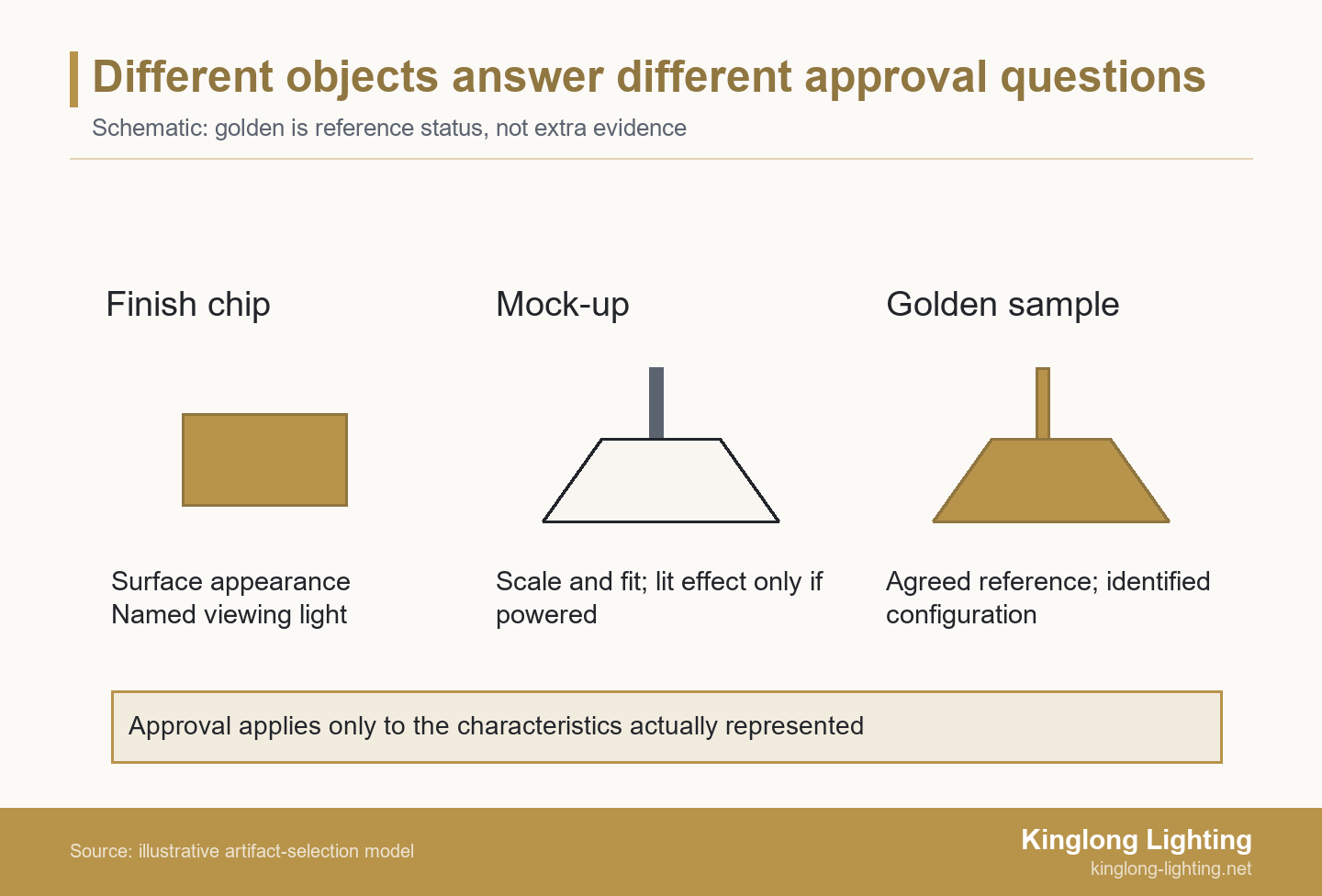
A finish chip is an artifact type, a mock-up is a representation built for a decision, and a golden sample is an agreed reference status; the same object can carry more than one role. A signed chip can become the reference for a finish without becoming a reference for the complete light. Likewise, a powered prototype can become the accepted fixture reference once its configuration and approval scope are agreed.
- Colour, sheen or texture: begin with a representative physical finish sample, reviewed beside the relevant materials under named lighting conditions.
- Proportion, suspension or installation access: request a model or assembly that reproduces the relevant dimensions and interfaces.
- Illuminated appearance or controls: specify a powered mock-up with the components and viewing conditions needed for that question.
- Production comparison: retain an identified accepted reference, linked to the agreed drawings, components and exceptions.
The largest artifact is not automatically the most informative. A full fixture fitted with provisional glass may provide less useful colour evidence than a correctly made glass sample. Spend the sample-development effort on reproducing the uncertainty, rather than making a presentation object that leaves it unresolved.
What a Finish Chip, Mock-Up and Golden Sample Mean
These terms describe different things: a surface specimen, a representation for review, and a reference accepted for a stated purpose. Use the distinctions below when discussing samples with a manufacturer. For related specification and procurement guidance, browse the lighting project resources.
A finish chip is a small physical surface sample; its useful approval scope is the represented material, process and appearance under agreed viewing conditions. It might be a coated metal coupon, a brushed plate or a piece of glass. Identify its substrate and treatment: “champagne gold” alone does not explain whether the proposed fixture uses the same base material, brushing direction or protective coating.
A mock-up reproduces selected features or conditions for review; state whether it is full-size or partial and powered or unpowered. A room-scale silhouette can answer a proportion question even if it is not made from production materials. A joint assembly can answer a fitting question without reproducing the whole chandelier. Neither should be presented as evidence for features it omits.
Treat a golden sample as an identified physical reference accepted for a stated product configuration and approval scope, not a universal certification category. Some teams use the term for a complete accepted fixture; others use it for a retained surface standard. Agree what it means on the project instead of relying on the name. A golden finish reference and a golden complete-product reference are not interchangeable.
Appearance also has several dimensions. Matching the nominal colour does not establish that the surface has the desired texture or reflected-image quality.
ASTM D523 addresses specular gloss of nonmetallic specimens and notes that texture, reflection haze and reflected-image clarity also influence appearance assessment.
For a project review, describe the visible characteristics that matter and agree how to compare them. Do not turn a gloss reading into a universal pass value for decorative metal finishes; the cited method has its own specimen scope.
An Approval-Artifact Matrix for Custom Lighting
Compare the artifacts against the decision—not against an assumed quality hierarchy. This matrix is a selection aid for project teams, not a standardized acceptance procedure. Its conditional entries matter: a powered model and an unpowered silhouette are both mock-ups, but they answer different questions.
| Approval question | Finish chip | Mock-up | Golden sample |
|---|---|---|---|
| Surface colour, sheen and texture | Useful if the substrate, process and viewing conditions are representative. | Useful only where its surfaces reproduce the proposed finish. | Reference for the specific surface characteristics accepted; identify their scope. |
| Scale, suspension and room relationship | Does not show fixture proportions or installed position. | Useful when dimensions, drop and viewing positions reproduce the question. | Useful only if its size and configuration represent the intended installation. |
| Light effect and controls | Does not establish illuminated fixture behaviour. | Needs the relevant source, diffuser or optic, driver and control setup. | Reference only for the powered configuration actually assessed and accepted. |
| Assembly and service access | Does not show the assembly. | A representative joint or complete assembly can reveal fit and access issues. | Comparison reference where construction and access were included in approval. |
| Production comparison | Can be the retained finish reference, not the whole-product reference. | Can become an accepted reference; provisional features remain excluded. | Useful when identity, configuration, acceptance scope and exceptions are controlled. |
Use the matrix to select the smallest representative artifact that resolves the open decision, and add another artifact where its scope stops. If the issue is a visible seam, review the actual joint detail. If it is a chandelier’s presence in the room, a joint sample is the wrong evidence even when its workmanship is excellent.
Translate that choice into a development request before discussing delivery arrangements. Ask what will be production-representative, what remains provisional and whether another review is needed after the provisional parts change. This prevents a sample quotation from being accepted merely because it uses a familiar label.
Kinglong describes blueprint review, physical prototyping and sample approval in its custom lighting development process. Use that discussion to confirm the artifact and review scope for the actual fixture, rather than assuming a standard sample package.
When a Finish Chip Is Enough—and When It Is Not
A chip is a sensible starting point when the open decision concerns the represented surface. It is insufficient when the decision depends on curvature, neighbouring materials, transmitted light or differences between assembled parts. Before approving it, compare what was made with what the fixture specification actually calls for.
ASTM D1729 covers visual colour appraisal of diffusely illuminated opaque materials; critical appraisal of metallic and pearlescent paints is outside that practice.
That scope distinction is useful for a designer choosing a review method. A directional metallic finish deserves assessment that reveals its angular appearance, not a claim that every finish can be judged by the same diffuse-light arrangement. Agree the applicable material and viewing method with the supplier rather than copying an unrelated acceptance instruction.
X-Rite defines metamerism as a colour match under one lighting condition that fails when the light changes.
Compare the proposed finish and its target together under the review lighting and the relevant installed lighting. Record the conditions, especially when the fixture sits beside door hardware, wall panels or furniture metalwork. A difference seen under another source calls for a closer comparison; it is not automatically proof of a coating defect or a diagnosis of metamerism.
A flat coupon also lacks the highlights and shadows of a curved arm or spun shade. If those reflections determine the design decision, request a representative curved part or assembled detail. For transparent or translucent glass, consider thickness and the intended lit or unlit state as well as colour. An opaque colour chip does not establish how that glass will transmit light.
Record the chip identifier, substrate, surface process, represented fixture parts, comparison reference and agreed viewing conditions. Where natural or handmade variation matters, agree a representative range rather than silently treating a single attractive piece as the only acceptable appearance. No numerical tolerance follows automatically from a sample photograph or a finish name.
Specify What the Mock-Up Has to Reproduce
A light-effect mock-up needs the relevant source, optic or diffuser, controls and viewing positions; an unpowered model only answers the physical questions it represents. Define the purpose before choosing full-size, partial or room-based construction. Otherwise, a successful presentation can conceal the fact that the difficult question was never reproduced.
For proportion, identify the dimensions and suspension arrangement to be reproduced, then review from the places where people will actually see the fixture. A tabletop view of a pendant cannot reproduce its relationship with a tall ceiling or a seated eye line. A full-size silhouette can help answer scale questions, but note substitute materials and weight so the team does not infer installation suitability from visual fit.
For illuminated appearance, record the light source, diffuser or optic, driver and intended control arrangement. Review the actual settings relevant to the design: bright scenes may hide concerns that appear when dimmed, while a convincing glow on a workbench may not reproduce the room background. Where performance values determine acceptance, use appropriate measurements and applicable test evidence alongside visual review.
The DALI Alliance database ties certification to the tested component identity, including matching brand, GTIN, firmware and hardware versions; luminaires are not listed in that database.
If the project specifies DALI, capture the installed component identities rather than recording only “DALI driver.” A component entry is not evidence that every project scene or complete fixture configuration has been demonstrated. The powered review and the documentary check answer related but separate questions.
For assembly or maintenance, include the relevant connections and access route. Ask the installer or maintenance representative to inspect how the diffuser, lamp or replaceable module can be reached. Visual agreement by a designer need not settle the installer’s handling question; assign each decision to the reviewer who can judge it.
Completed settings can help a team communicate the scale and appearance it wants, without proving that a new fixture’s proposed mock-up is representative. Use published imagery as design context rather than sample-approval evidence when reviewing the project portfolio.
Make the Golden Sample a Usable Production Reference
Identify the golden sample, the matching drawing and component configuration, the approved characteristics and the exceptions before using it for production comparison. The reference needs to be recoverable: an unlabeled fixture in a showroom is a poor comparison standard when several visually similar development versions exist.
Attach the fixture code, sample identifier and approval record to the retained object. Record what distinguishes it from earlier versions, including materials, surface treatment, dimensions and powered components where relevant. Photographs help locate the reference and show details, but they do not replace the physical surface when that is the property being judged.
Describe how production will be compared with the reference. A single sample may establish a target direction but not an acceptable range for patterned glass, antiquing or other variable finishes. If the project accepts variation, preserve the agreed range or boundary specimens with their interpretation. Do not invent tolerances from the word “golden.”
UL Solutions offers lighting safety testing and certification for lamps, fixtures, components and systems.
Keep that technical evidence separate from aesthetic acceptance. An accepted physical sample does not itself demonstrate safety compliance, structural adequacy or suitability for every market. Check the evidence required for the exact fixture configuration and intended application with the responsible project professionals; a designer’s finish sign-off is not a substitute.
If a material, driver, diffuser or assembly detail changes, identify which accepted characteristics might no longer be represented. Review the affected decision rather than declaring the previous sample either wholly valid or wholly useless. The unchanged finish reference may remain useful while the revised powered assembly needs another review.
Sample development also has commercial consequences: a partial assembly can be appropriate for an access question, while a full powered installation may need a different scope. Keep those choices tied to the design decision when using the decorative lighting value-engineering guide.
Illustrative Example: A Hotel Pendant Approval
The following hotel pendant example is illustrative, not a Kinglong project or measured result. A designer needs a warm metal finish beside brushed door hardware, a shade that feels proportionate above a reception desk, and a softly illuminated diffuser. Those are separate questions, even though they concern the same pendant.
A representative metal coupon is compared with the hardware under the agreed daytime and evening lighting. It can settle the finish direction. A full-size unpowered silhouette then reveals that the shade obstructs the intended sightline; approving the coupon did not resolve that spatial problem. The designer revises the shade geometry and asks to review its installed relationship again.
After the geometry review, the diffuser is assessed in a powered assembly with the proposed source and controls. Any accepted result belongs to that configuration. The retained complete sample becomes the production reference only for the characteristics actually accepted, with remaining technical documents or open details recorded separately. The team gets a defensible decision from each object instead of sending one general “sample approved” message.
Write an Approval Request the Manufacturer Can Answer
An approval request should identify the fixture and pending decision, the conditions the artifact must reproduce, the responsible reviewers and what remains outside approval. Copy these fields into the enquiry or sample-review record; fill them with the actual project information before the artifact is commissioned.
| Field to complete | Record for this fixture |
|---|---|
| Identity | Project, fixture code, drawing or sketch revision, and sample identifier when available. |
| Pending decision | The exact appearance, proportion, light-effect, assembly or reference question to resolve. |
| Required representation | Material/process references, size or detail, room/viewing context, and powered components where relevant. |
| Reviewer and outcome | Who can accept the stated characteristic, the decision, and any comments needing another review. |
| Limits and next use | Provisional features, exclusions, remaining evidence, retained-reference arrangements and permitted next action. |
Share the drawing or sketch, finish references, room context and outstanding approval questions with Kinglong. Ask the team to discuss blueprint, prototype and sample-review requirements and confirm a feasible development scope for your project; timing, charges and deliverables remain subject to agreement. To begin that discussion, send a scoped sample-development enquiry.
Frequently Asked Questions
Can photographs replace sending a physical sample?
Photographs can support remote coordination, but they should not be treated as a reliable final colour or texture reference when those properties determine acceptance. Camera processing, exposure, display settings and viewing light can change what the recipient sees. Use photographs to identify the sample, show its construction and record review context. Where physical comparison is unavailable, explicitly leave the unverified appearance decision open rather than treating a persuasive image as a colour standard.
Who should keep the golden sample?
Agree a custodian and access arrangements before approval; buyer and manufacturer both need a dependable way to compare production with the same reference. Record where the object is stored, who can authorize its replacement and how it will be protected from damage or finish changes. If matching retained samples are used, confirm their equivalence and identify each one. Do not assume two visually similar development samples are interchangeable merely because both carry an approval label.
Does every fixture size need a separate sample?
Not necessarily; reuse is defensible only for the characteristics that remain representative across the size family. The same surface treatment may support a finish decision, while a larger shade can change proportion, assembly access or illuminated appearance. Identify those differences before extending an approval. Request an additional model, detail or powered review for the changed characteristic instead of automatically building every size—or approving every size from a single small fixture.
What if a sample is approved with comments?
State which characteristics are accepted and which remain open; a general approved-with-comments label does not explain whether the unresolved changes need another physical review. Attach the comments to the sample identifier and drawing configuration, name the person responsible for resolving them, and define the evidence needed to close them. A correction to a finish, geometry or powered component can require a different follow-up than a document correction. Make the permitted next action explicit.