
Before production, lock the fixture configuration, site interfaces, appearance references, electrical selections, quantities, document revisions, exceptions and release authority for the work being authorized. A signed elevation is not enough if the factory still has to guess which driver to buy, where a support plate will attach or which finish the owner accepted.
For a hotel owner representative or developer, the useful question is not simply whether the design looks finished. It is whether the manufacturer can carry out the requested work without making another decision that belongs to the project team. The checklist and completed release record below turn that question into a practical review.
Freeze the Buildable Configuration, Then Authorize the Work
A design freeze is an agreed baseline: an identified configuration that later changes have to be assessed against. Production release authorizes named work against that baseline. The distinction matters because approving the appearance does not automatically authorize purchasing, fabrication and assembly; the instruction should say which work may start and what remains excluded.
The RIBA Plan of Work 2020 puts completed manufacturing and construction design information at the end of Technical Design, while noting that Technical Design and Manufacturing and Construction overlap on most projects. This is a project framework, not a universal fixture-release contract. Its distinction is useful: overlapping schedules do not remove the need for usable manufacturing information.
A practical release therefore answers three questions: what configuration, which work and whose authority? If an answer is missing, narrow the instruction or hold the affected activity. Agree the actual responsibilities and acceptance criteria within the project’s procurement arrangements.
A Design-Freeze Checklist for Bespoke Lighting
Use the checklist to identify the agreed item, the evidence that closes it, the responsible reviewer and the manufacturing consequence if it remains open. A checked box without a reference is difficult to act on: “finish approved” should lead to an identifiable sample, not an attachment someone has to find again.
Gather the current drawings and schedules before the review. Kinglong’s lighting project resources provide a starting point for available project information; the actual freeze pack should contain the records agreed for your fixture.
| Check before release | Record the accepted evidence | Confirm with |
|---|---|---|
| Fixture and site interfaces | Overall dimensions, mounting/support arrangement, finished-ceiling level, supply entry and service access; identify verified site inputs and unresolved assumptions. | Fixture manufacturer and responsible site/engineering reviewers |
| Appearance | Named material, colour and sheen reference; approved shade/glass/sample identifier; viewing conditions and any agreed variation limits. | Design reviewer and delegated owner representative |
| Electrical configuration | Light-source and driver models, input supply, output settings, control arrangement, light characteristics and applicable compatibility evidence. | Manufacturer and responsible electrical/controls reviewer |
| Quantities and locations | Fixture codes, room/zone allocation, dimensional variants, handed versions, spares and accessory inclusion; reconcile totals. | Buyer and site/design coordinator |
| Document package | Drawing, component schedule and quantity-list identifiers with compatible revisions; identify withdrawn files. | Document coordinator and manufacturer |
| Exceptions | Each open decision, affected operation, responsible person, required evidence and condition for lifting the hold. | Reviewer responsible for the unresolved decision |
| Release instruction | Authorized operation and quantity, exclusions, commercial instruction, technical concurrence and supplier acknowledgment. | People with the agreed technical and commercial authority |
For each row, record closed, open or not applicable, with a reason. An open item is not automatically permission to proceed. Trace it to the work it could change, then decide whether that work is ready. A non-applicable control feature, for example, needs a clear fixed-output specification rather than an unexplained blank cell.
Resolve the Fixture-to-Building Interfaces First
Resolve support, attachment, finished-ceiling geometry, supply entry and maintenance access before authorizing operations that depend on them. These are the points where the manufactured fixture has to fit the building, connect to it or be serviced within it.
Start with the dimension references. Does the suspension drop run from the structural slab or the finished ceiling? Who confirms the available ceiling void? Can the canopy cover the agreed opening without obstructing another service? Record the answer against the relevant drawing detail. A beautiful room rendering cannot establish a concealed fixing arrangement or the space needed to remove a driver later.
Kinglong Lighting describes drawing review for feasibility, material selection and structural optimization in its custom lighting development process. Bring the site-side assumptions into that review rather than asking the manufacturer to infer them from an elevation. Manufacturer review does not replace the project’s responsible engineer confirming the building support.
For a large suspended fixture, identify who supplies the attachment hardware, who verifies the supporting structure and which load and installation information they need. A note saying “fix on site” leaves a consequential design question unanswered if it could change the canopy, suspension assembly or installation method.
UL’s 2016 luminaire application guide calls for installation instructions where specific mounting-surface sealing methods or supply-connection fittings are needed. The relevant lesson is concrete: an appearance approval does not settle those interface details. This historical guide is not evidence of a particular fixture’s current certification.
Confirm the intended environment and the applicable product markings, installation instructions and project requirements with the responsible specialists. Do not transfer a dry-interior fixture assumption to an exposed terrace. If the actual fixing or supply arrangement remains unresolved, hold the fabrication that depends on it; a commercial signature cannot substitute for missing structural or electrical evidence.
Lock the Light Source, Driver and Controls Together
For integrated LED fixtures, record the selected light source, driver, controls and relevant settings together; review a proposed substitution before treating it as equivalent. “Dimmable” describes an intention, not an adequately identified configuration.
Include the selected light characteristics, diffuser or optic, output setting, driver location and access arrangement. Have the responsible reviewer agree what functional evidence is needed, including low-level behaviour where it matters to the room. Otherwise, a replacement made for purchasing convenience may change light effect, wiring or the space required for servicing.
For a product-specific example, Lutron’s Hi-lume 1% 2-Wire LTE specification distinguishes compatible controls according to the driver’s UL marking. This concerns that driver family, not every LED installation. It shows why a generic control description cannot replace the selected product identity and the evidence applicable to it.
The room context also matters. Use a project portfolio to discuss the kind of space and decorative effect you are seeking, not as proof that an unlisted electrical combination has been tested. Translate the visual reference into the actual light source, diffuser, controls and review conditions in your package.
For DALI components, the DALI Alliance product database ties certification to matching component brand, GTIN, firmware and hardware, plus the specified valid ID condition; it does not list luminaires. The valid ID is a serial number unique in combination with the GTIN. A GTIN is the Global Trade Item Number used to identify the product.
Retain the relevant component record when that certification is part of the specification. Do not turn a component listing into a claim that the complete decorative fixture or installed control system is approved. If a component changes after freeze, ask what previous evidence remains applicable and what needs checking again before the substitution reaches assembly.
Release One Consistent Drawing and Quantity Package
A release package should name the compatible drawing, component schedule, quantity allocation, appearance reference and approved exceptions; matching document identifiers matter more than a shared email date. Different documents can have different revision labels, provided the package identifies the versions that belong together.
Check the interfaces between those records. A drawing can show the accepted canopy while an older component list still specifies a driver that no longer fits it. A revised room schedule can increase pendant quantities without adding the corresponding suspension kits. Reviewing each file separately may miss the inconsistency; read the package as an instruction to purchase and build.
ASME’s public description of Y14.35 covers revision practices for drawings and associated documents, including methods to identify and record revisions. That scope supports checking more than the drawing alone; it does not establish that your project has adopted the standard or prescribe the release form below.
Give each size or mounting variant an unambiguous fixture code and reconcile it with the room allocation. Separate ordered spares from installed quantities, and state whether lamps, drivers, mounting parts and installation accessories are included. Where accessories are supplied by another contractor, identify the interface rather than silently omitting the item.
Before accepting a cost-driven substitution, use the decorative lighting value-engineering guide to frame which visual and functional requirements should be protected. Put the accepted alternative into the release package; do not leave a cost-saving email as a competing instruction beside the original specification.
Finally, remove withdrawn versions from the active production set and obtain acknowledgment of the current package. Keep the superseded records for traceability, clearly marked as such. The factory should not have to choose between a signed older PDF and an unsigned newer attachment to work out which product the buyer intends to receive.
When an Open Item Blocks Production—and When Work Can Be Separated
A partial release is defensible only for specifically authorized work whose inputs are settled and whose independence from the unresolved item has been demonstrated. It is not enough to call the remaining issue minor; show why it cannot change the work you intend to release.
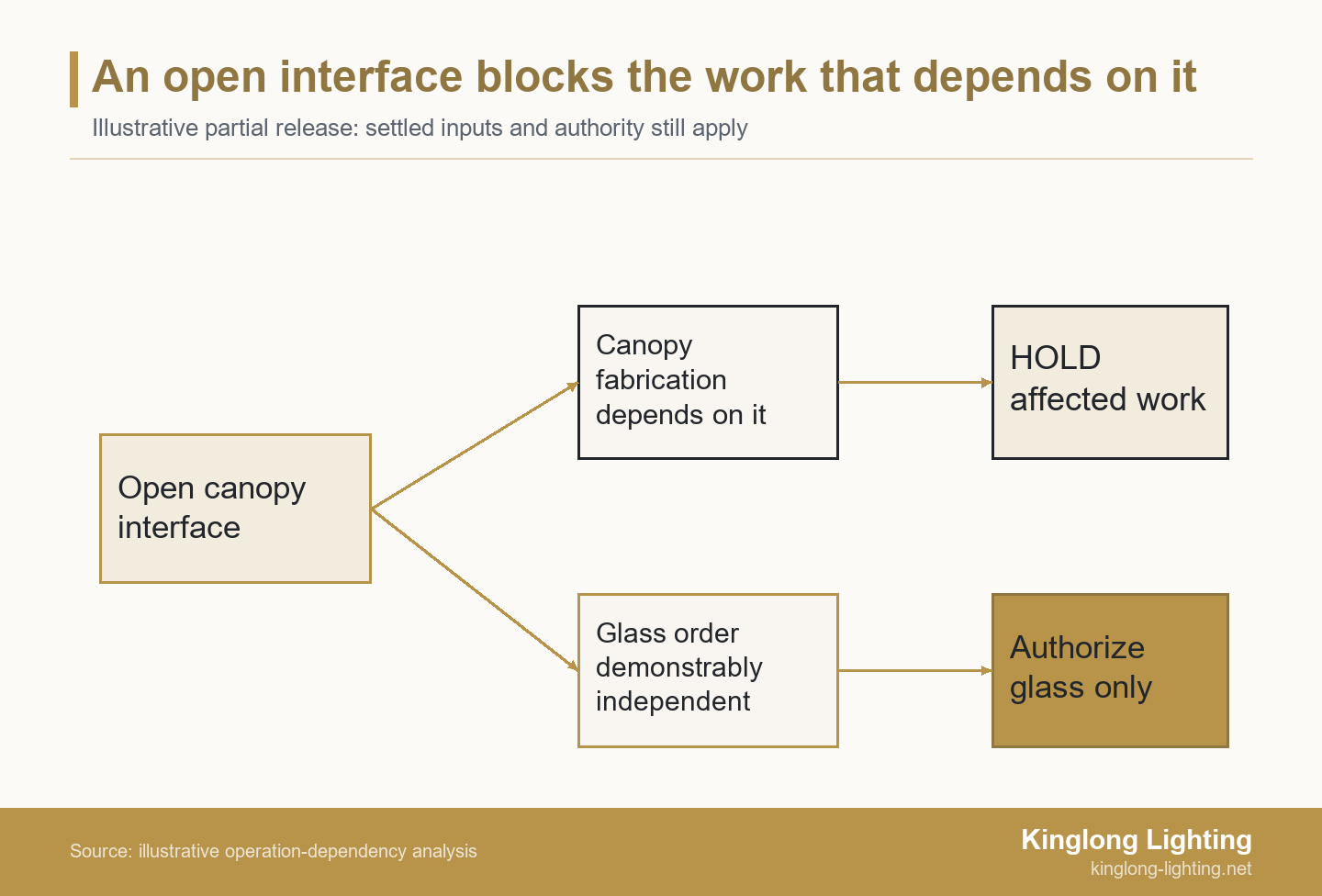
Ask the manufacturer to map the open decision to actual activities: material ordering, cutting, drilling, finishing, wiring, assembly and packing. An unresolved canopy attachment can affect metalwork and cable entry. It does not necessarily affect separately specified decorative glass, but that separation needs confirmation. The glass dimensions, connection, finish, quantity and acceptance reference still need to be settled.
The instruction should name both sides of the boundary. “Proceed with glass procurement only; canopy fabrication, suspension fabrication, wiring and assembly remain on hold” is more useful than “approved with comments.” Assign the unresolved interface to a responsible reviewer and specify the information needed before that hold can be lifted.
Then examine the cost and schedule consequences. Does the narrow order commit a non-cancellable purchase? Could storage, remobilization or a later design change create additional cost? Ask for the actual implications and record who is authorized to accept them. Do not assume that a partial release preserves the original completion date or makes an irreversible order risk-free.
Hold the proposed activity when independence cannot be established. If the final support arrangement might change the entire fixture geometry, the glass may no longer be separable either. Equally, unresolved safety or structural questions cannot be closed simply by recording that an owner accepts commercial risk. Partial release is a scoped instruction for ready work, not a substitute for the missing technical decision.
Production-Release Form: An Illustrative Completed Record
This illustrative production-release record concerns 30 corridor pendants with glass procurement separable from an unresolved canopy interface; it is not a Kinglong case or measured outcome.
Assume the manufacturer’s engineering review has confirmed that the accepted glass specification and its connection remain unchanged by the canopy decision. The owner representative wants to start that purchase, not authorize the complete fixtures. All reference codes below are illustrative.
| Release field | Illustrative entry |
|---|---|
| Instruction and fixture scope | Release GL-01; 30 corridor pendants, fixture code CP-A. Glass procurement only. |
| Approved procurement inputs | Glass detail GD-B; component schedule CS-C glass entry; appearance reference GS-A; corridor quantity list QL-B. These identified versions are compatible for this purchase. |
| Accepted appearance | Glass material, dimensions, connection and surface appearance as recorded against GS-A and GD-B; no approval of a different glass variant. |
| Independence evidence | Manufacturer’s engineering note EN-A confirms the glass dimensions and connection are unaffected by the pending canopy attachment. |
| Explicit hold | No canopy or suspension fabrication, wiring or fixture assembly under GL-01. No authorization for complete-fixture production. |
| Open item and closure condition | Site engineer to confirm the canopy attachment and supply-entry arrangement. Review the resulting detail before issuing a separate instruction for affected work. |
| Technical and commercial approvals | Design reviewer confirms glass appearance scope; manufacturer’s engineer confirms independence; delegated buyer authorizes the purchase on separately agreed commercial terms. |
| Acknowledgment and next instruction | Supplier acknowledges the named glass order and exclusions. Record actual names, authority, approval date and acknowledgment before use; a later instruction is needed to lift the hold. |
To adapt the form, replace the illustrative references with your actual records and attach the supporting evidence. If the engineering note cannot demonstrate independence, the example’s glass-only decision does not apply. The canopy hold remains until the required review and subsequent authorization are complete.
Bring the Unresolved Decisions to the Manufacturer
Bring the current fixture package, open decisions, site information and requested release scope to the manufacturer for project-specific review. Include the appearance reference, component schedule, fixture quantities and locations, and identify which inputs are confirmed rather than assumed.
You can send the project package for discussion with Kinglong. Ask the team to discuss feasibility, material selection and structural optimization, then agree the development scope and information still needed. This discussion is not an automatic production instruction or a promise of structural sign-off. Keep technical approval, commercial authority and the factory’s acknowledgment explicit before work starts.
Frequently Asked Questions
Does a design freeze mean nothing can change afterward?
No; a freeze establishes the reference against which later changes are evaluated. Identify the proposed change, affected fixture codes and work already committed, then review its technical, appearance, cost and schedule implications. Update the relevant records and obtain the agreed authorization before implementing it. A corrected file arriving in an inbox does not by itself explain whether the factory should stop, continue or replace an earlier instruction.
Can the owner approve the release remotely?
Yes, if the agreed approval procedure permits it and the authorization identifies the exact package and scope. Remote approval still needs the relevant evidence, an identifiable approver with the right authority, and supplier acknowledgment. Where acceptance depends on physical appearance or a functional demonstration, agree how representative evidence will be reviewed. A video call or photograph does not automatically resolve material appearance, concealed interfaces or the completeness of a test.
Can a manufacturer substitute a driver after approval?
Only through the agreed change process, with evidence addressing the effects of the proposed replacement. Ask the responsible reviewer to consider electrical ratings, control compatibility, output settings, dimensions, access and any applicable compliance evidence. The replacement may be acceptable, but a matching wattage or a “dimmable” label alone does not settle those questions. Update the component schedule and affected drawings so later inspection is not comparing production with an obsolete configuration.
Is design freeze the same as final inspection?
No; design freeze establishes what is to be built, while final inspection checks the completed supply against the applicable acceptance requirements. A clear freeze package gives inspection an identifiable reference, but does not prove that production conforms to it. Conversely, inspecting a completed fixture cannot resolve a design decision nobody agreed. Keep the release records, applicable test evidence and actual inspection results distinct, with each performing its own role.