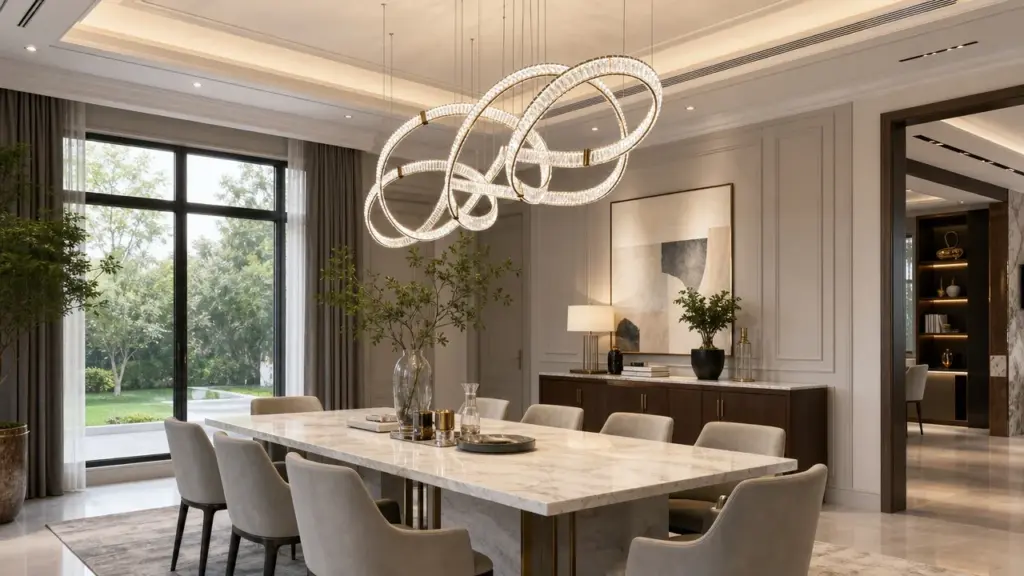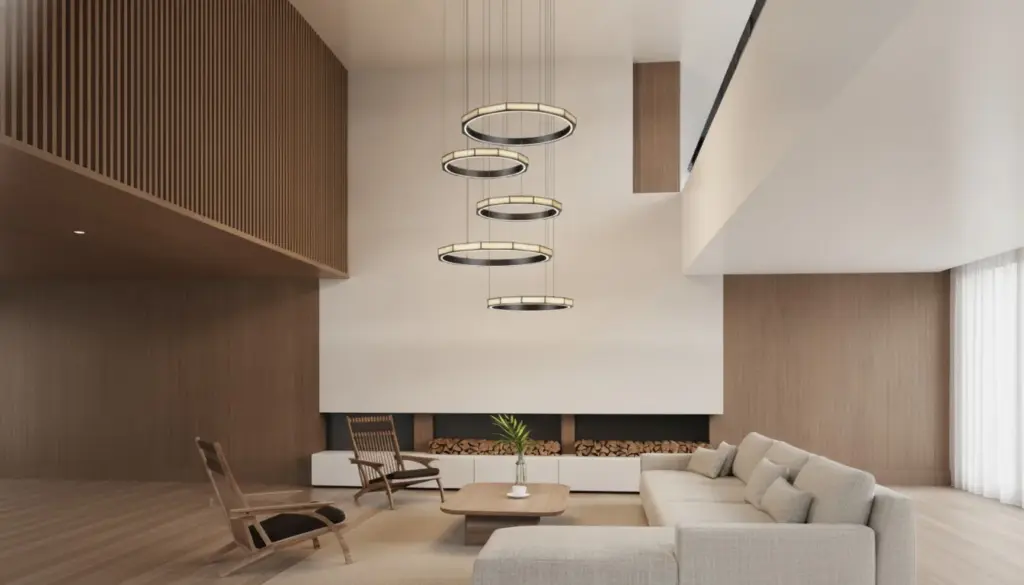
A staircase chandelier in a grand villa is not simply a tall pendant. It is a moving-view object that must read from the lower hall, the stair flight, the intermediate landing, the upper corridor, and sometimes the exterior window.
The strongest staircase chandeliers control vertical rhythm without crowding movement. They create a sense of lift, but they also protect clearance, glare, cleaning access, and structural support.
Kinglong Lighting can help villa owners and designers convert a dramatic staircase idea into a measured vertical composition with drawings, samples, suspension logic, and service planning.
Key Takeaways
- Moving-view design: Staircase chandeliers must work while people move, not just from a static render.
- Vertical rhythm: Height should be divided into readable zones rather than filled with random drops.
- Clearance first: Walking path, handrail, landing, and cleaning route define the safe envelope.
- Glare control: Upper-level eye height often creates the most uncomfortable sparkle risk.
- Release file: Suspension, wiring, replacement parts, and cleaning access must be approved before production.
Staircase chandeliers are judged in motion
A grand villa staircase chandelier succeeds when it looks intentional from every step, not only from the bottom of the stairs.
The IES Lighting for You residential reference emphasizes lighting methods, energy use, and code considerations. In a staircase, those practical concerns meet a decorative focal point that must shape atmosphere and still respect movement.
Walk the stair route on plan and mark the points where a person sees the fixture: entry floor, first turn, mid-flight, landing, upper hall, and any bridge or balcony. Then mark zones where the fixture cannot intrude, including head clearance, handrail field, window opening, door swing, cleaning lift path, and structural points.
Lower view asks for arrival drama
The lower entry view is usually the emotional view. A weak fixture can make the void feel empty; an oversized fixture can make the staircase feel like a showroom display rather than a residence. The lower view should show a clear silhouette, material character, and a lighting scene that supports the entry.
Mid-flight view asks for clearance and rhythm
People see the fixture from the side while moving. If spacing between glass drops is random, the form can collapse into visual noise. If the body is too wide, it may feel uncomfortably close even when it does not physically block the path. Rhythm converts height into structure.
Upper landing view asks for glare discipline
The upper landing is often closest to lamps, crystals, or glass shades. The DOE high performance residential lighting guide repeatedly treats glare control as a quality issue in residential lighting. In a stair void, glare is about direct view into luminous elements at eye level.
Choose a vertical composition type
Staircase style should follow the void shape. A tall fixture is not automatically a good staircase chandelier. The architecture decides which vertical logic can survive daily movement.
| Composition type | Best stair condition | Main risk | Evidence to request |
|---|---|---|---|
| Tapered cascade | Tall narrow void beside the stair | Looks thin from lower hall | Front and side elevation |
| Tiered chandelier | Formal villa with symmetrical stair | Too heavy near the landing | Drop and diameter envelope |
| Clustered pendants | Modern stairwell or bridge view | Random spacing feels messy | Coordinate map and suspension plan |
| Linear vertical spine | Narrow stair slot or wall-adjacent void | Weak lateral presence | Wall distance and view study |
The Lutron layered lighting guidance separates ambient, task, and accent lighting. Staircases need that discipline because a decorative chandelier is rarely the best tool for every function. Step lights, wall washers, concealed handrail glow, or upper landing lighting can support safe movement while the chandelier remains a controlled feature.
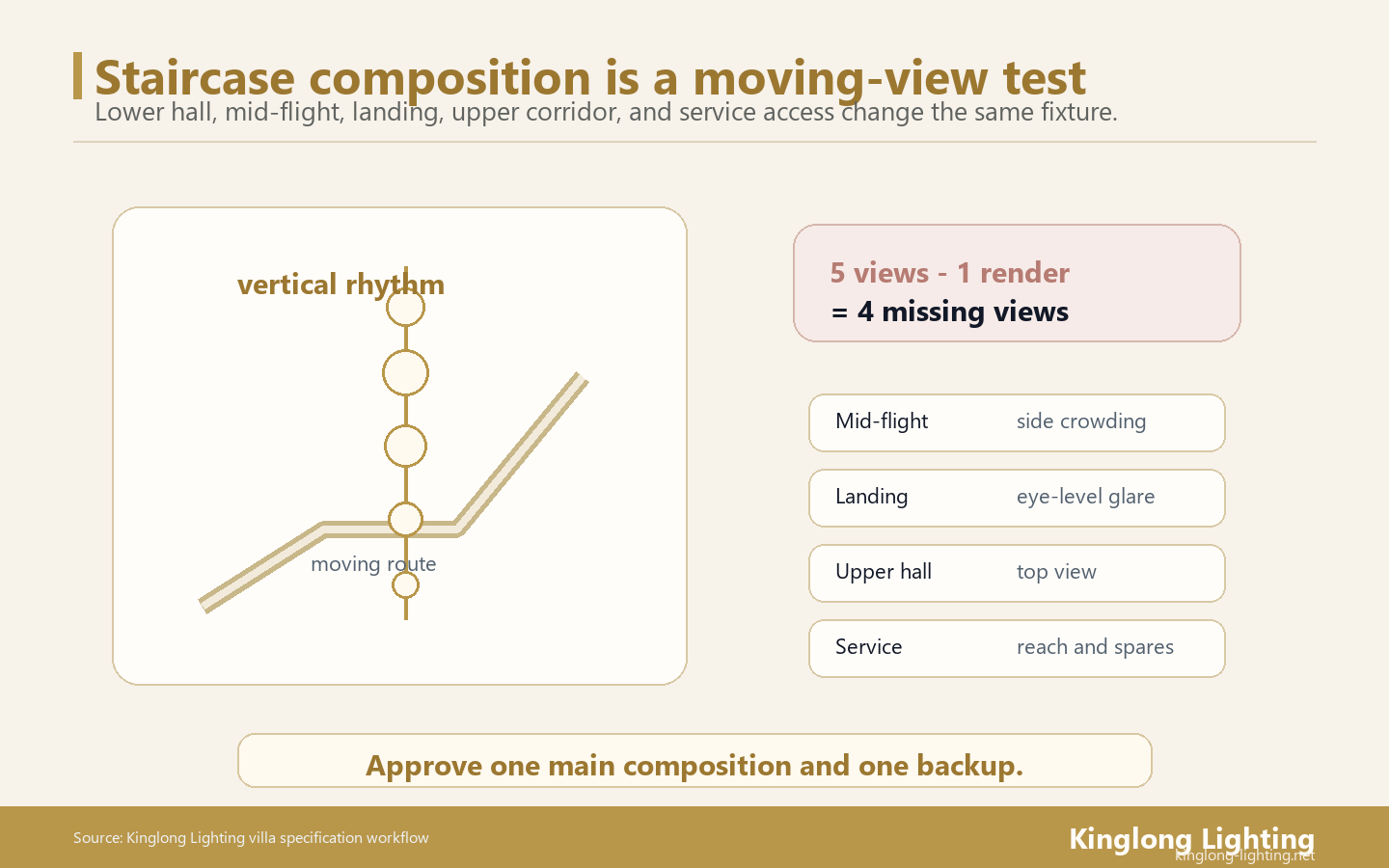
Calculated from a 3-level moving-view model, 5 approval views minus 1 front render equals 4 missing views, which means the lower hall, mid-flight, landing, upper corridor, and service access still need proof.
Manufacturing proof matters before the ceiling closes
Large staircase chandeliers need suspension and service planning early. UL Solutions notes that indoor decorative lighting is commonly tested to UL 1598 and UL 8750, which helps frame why custom luminaires need evidence as completed products.
The staircase release file should include fixture weight, canopy position, suspension points, driver location, dimming requirement, module numbering, spare glass or crystal list, cleaning route, and packing sequence.
How Kinglong Lighting should be briefed
Kinglong Lighting’s villa lighting and customization pages are relevant because staircase chandeliers usually need more than off-the-shelf selection. The buyer should send stair drawings, ceiling height, stair width, landing dimensions, railing finish, wall color, adjacent windows, preferred material, dimming system, and cleaning constraints.
The soft next step is to ask for a vertical composition review, not just a price. Through the villa staircase chandelier review, request two routes: one restrained and architectural, one more expressive and sculptural, both with the same suspension, sample, dimming, and service evidence.
Audit the staircase route as a daily-use object
The most useful staircase review is a slow walk, not a style meeting. Start at the lower entry, pause at the first step, stop at mid-flight, stand on the landing, and then look back from the upper hall. At each point, ask whether the chandelier helps the route feel clearer, more graceful, and more comfortable. If one position creates a hot spot, a blocked view, or a confusing silhouette, the design needs another pass.
This walk-through also exposes maintenance risk. A staircase chandelier may be reachable from the lower level during installation, but unreachable after furniture, railings, and finished flooring are protected. The release file should state how glass, crystal, bulbs, LED modules, or drivers will be cleaned and replaced. In a luxury villa, service access is part of quality because visible dust or mismatched replacement parts can make an expensive fixture feel neglected.
Kinglong Lighting should receive the route as a sequence, not only as dimensions. Photos from the lower hall, side of the stairs, landing, and upper corridor tell the factory where sparkle is welcome and where it becomes glare. That lets the manufacturer adjust drop lengths, lamp shielding, finish reflectance, and module spacing without weakening the designer’s concept.
The audit should also check what the handrail and balustrade do to perception. Glass railings can multiply sparkle and make a bright crystal body feel more active than intended. Dark metal railings can make a narrow chandelier disappear from the side. Stone treads, polished floors, and mirrored walls may push the design toward softer diffusion, warmer output, or a smaller number of exposed points.
Another useful test is the night path. A staircase chandelier is often photographed in full decorative mode, but residents experience it when moving between floors with lower ambient light. If the fixture needs to stay dimmed for comfort, it still has to read as a vertical marker. That may require layered stair lighting, a warm low scene, or a chandelier body with enough silhouette even when output is reduced.
The installation team should be part of this audit before production release. The safest-looking composition on paper may depend on a lift position that is not possible after cabinetry, marble, or railing work is complete. Recording the installation route early protects the finished interior and prevents last-minute changes to module size, packing order, or suspension method.
The final audit note should name one preferred composition and one backup composition. If the main cascade is rejected because the stair void becomes crowded, the project should already know whether the backup is a slimmer cluster, a shorter vertical body, or a paired wall-light strategy. That backup protects schedule without asking the designer to restart the concept under pressure.
The same audit should connect composition to packing and module labels. A staircase chandelier may look continuous after installation, but it often reaches the site as numbered drops, frames, cables, drivers, and spares. If those modules do not follow the approved vertical rhythm, the installer can assemble the correct parts in the wrong visual order. The release file should therefore pair the view study with a module map.
| Route point | Question to answer | Typical correction |
|---|---|---|
| Lower hall | Does the form create arrival? | increase silhouette or lower first tier |
| Mid-flight | Does the body crowd movement? | narrow width or shift to cascade |
| Landing | Is brightness comfortable at eye level? | add shielding or lower output |
| Service path | Can parts be reached safely? | revise module and cleaning plan |
Staircase chandelier action card
- Walk the stair path before choosing the fixture form.
- Check lower, side, landing, and upper views.
- Keep sparkle away from upper eye-level glare zones.
- Separate decorative scene from safe circulation lighting.
- Approve suspension and service access before production.
Related Guides
- Double-Height Foyer Chandelier Selection
- Luxury Villa Chandelier Guide
- Villa Chandelier Size Formula
Build the grand-villa staircase chandelier vertical-composition file before final approval
The useful starting point for staircase chandelier villa is application context rather than decorative preference. The practical question is whether villa owner, interior designer, staircase contractor, lighting supplier, and installer can agree on what must be proven before the chandelier is released. The answer is a short packet that turns design intent, operating risk, evidence, and responsibility into one approval conversation.
The main risk is a staircase fixture being made tall without resolving side views, landing glare, route clearance, and installation sequence. That risk is strongest when a beautiful fixture is separated from the evidence that makes it buildable, maintainable, and safe to release. Calculated from a 5-gate review, 2 unresolved gates out of 5 leave about 40 percent of the approval logic open, which is too much uncertainty for a custom decorative lighting order.
Design for movement rather than one static view
The first approval question should define the practical buying decision behind staircase chandelier villa. The decision is not whether a chandelier looks premium in isolation; it is whether the selected approach protects the room role, guest or owner experience, operating reality, and production handoff at the same time. The release note should name the decision owner, the proof expected, and the change that would force a redesign. That boundary lets the buyer reject a tempting option for a specific reason instead of relying on taste language.
Keep vertical rhythm readable from mid-flight
The first failure point usually appears where the visual promise meets daily use. Calculated from the 5-gate grand-villa staircase chandelier vertical-composition file, 1 weak gate times 3 downstream teams equals 3 review paths that can be delayed by one missed proof item. The review should include the view or operating condition that would be most expensive to fix later. Scene behavior and context should be tested before the fixture is treated as release-ready.
Protect landing comfort from close-range sparkle
Supplier evidence is useful only when it matches the risk being controlled. The request should convert that risk into proof such as route photos, vertical elevation, clearance map, eye-line review, module sequence, and service note. If the risk is scale, request a marked elevation and sightline view. If the risk is color, request a material sample under the target scene. If the risk is maintenance, request the cleaning route and spare-part logic. Evidence should change the release decision, not decorate the file.
Connect composition to installation modules
Kinglong Lighting’s project workflow moves custom hospitality and villa chandeliers through drawings, samples, manufacturing, packing, shipping, and site installation. The final handoff should state what is approved, what remains flexible, and who can reject a change. In practice, the release packet should include at least 5 named gates and one owner for each gate. That keeps a later suggestion from turning into a redesign after the fixture has already entered production.
Frequently Asked Questions
How long should a staircase chandelier be?
It should be long enough to connect the vertical void, but short enough to protect walking clearance, landing views, and cleaning access. Use elevation drawings and multiple viewpoints before approving drop length.
Where should a chandelier sit in a stairwell?
It should sit inside the visual void, not inside the walking path. The best position depends on stair width, landing location, railing height, windows, and the main viewing axis.
Are crystal chandeliers suitable for villa staircases?
Yes, crystal can work well if glare, cleaning, and replacement are planned. In upper landing views, direct sparkle can become uncomfortable, so request samples, scene brightness, suspension details, and a spare-part plan.
What drawings are needed before ordering a staircase chandelier?
At minimum, request plan, elevation, suspension point, drop schedule, material sample record, wiring or driver location, and service access notes. For custom fixtures, add module numbering and packing sequence.