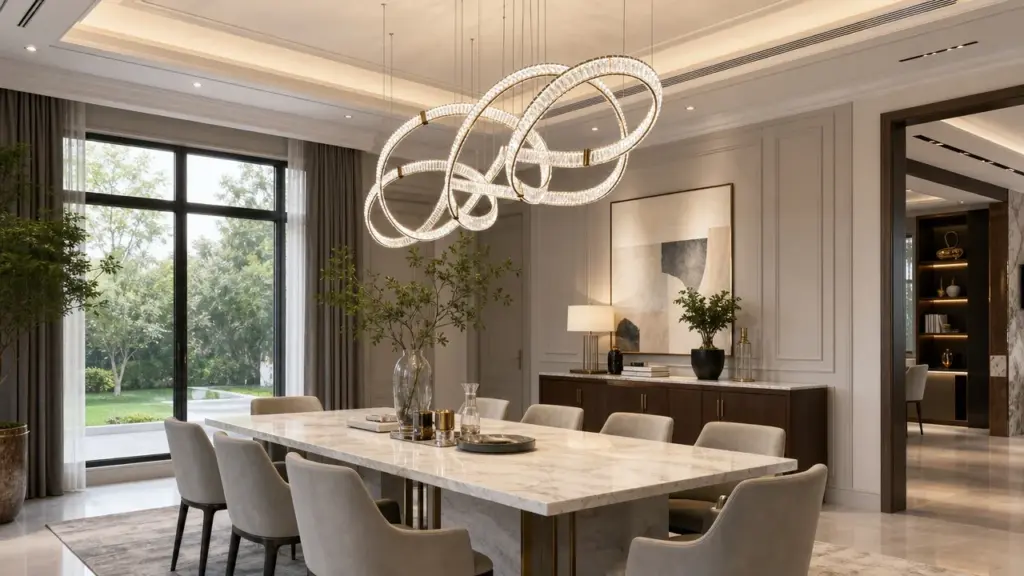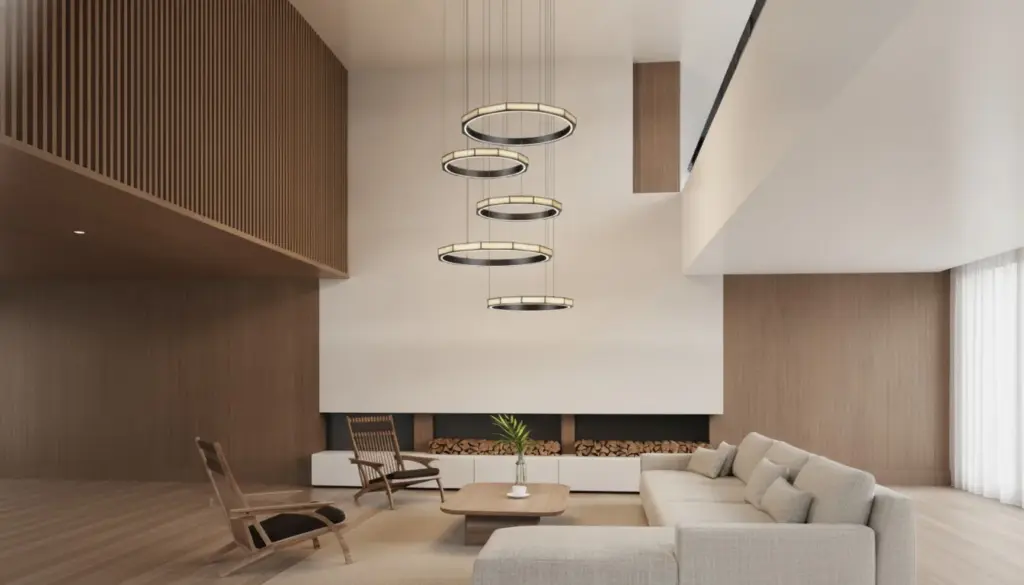
Villa chandelier sizing should begin with room volume because floor dimensions alone miss the effect of height. A 16 by 20 foot room with a 10 foot ceiling and a 16 by 20 foot foyer with a 20 foot ceiling do not need the same visual presence, even though their floor plans match.
The volume formula is not a final standard. It is a practical starting envelope that helps owners, interior designers, and manufacturers discuss diameter, drop, vertical fill, room role, and clearance before custom drawings are released.
Kinglong Lighting can use room dimensions, photos, and ceiling data to turn the formula into a project-specific chandelier size recommendation with visualization, material proof, and installation assumptions.
Key Takeaways
- Base formula: Start with length plus width in feet, read as inches of approximate diameter.
- Height adjustment: Add vertical presence for ceilings above 10 feet, but cap by clearance and room role.
- Role factor: Dining, foyer, stair, and living rooms need different correction factors.
- Final approval: Formula output must be checked against sightlines, glare, support, and cleaning access.
- Kinglong workflow: The formula becomes useful when paired with Mofun visualization and a release file.
The formula gives a starting envelope
The best villa chandelier size formula is a conversation starter, not a substitute for drawings and viewpoint checks.
The IES Illuminance Selector FAQ explains that lighting criteria are tied to application and task surface, which is a useful reminder for chandelier sizing. A formula can estimate visual scale, but the room’s activity and viewpoint still decide whether that size is comfortable.
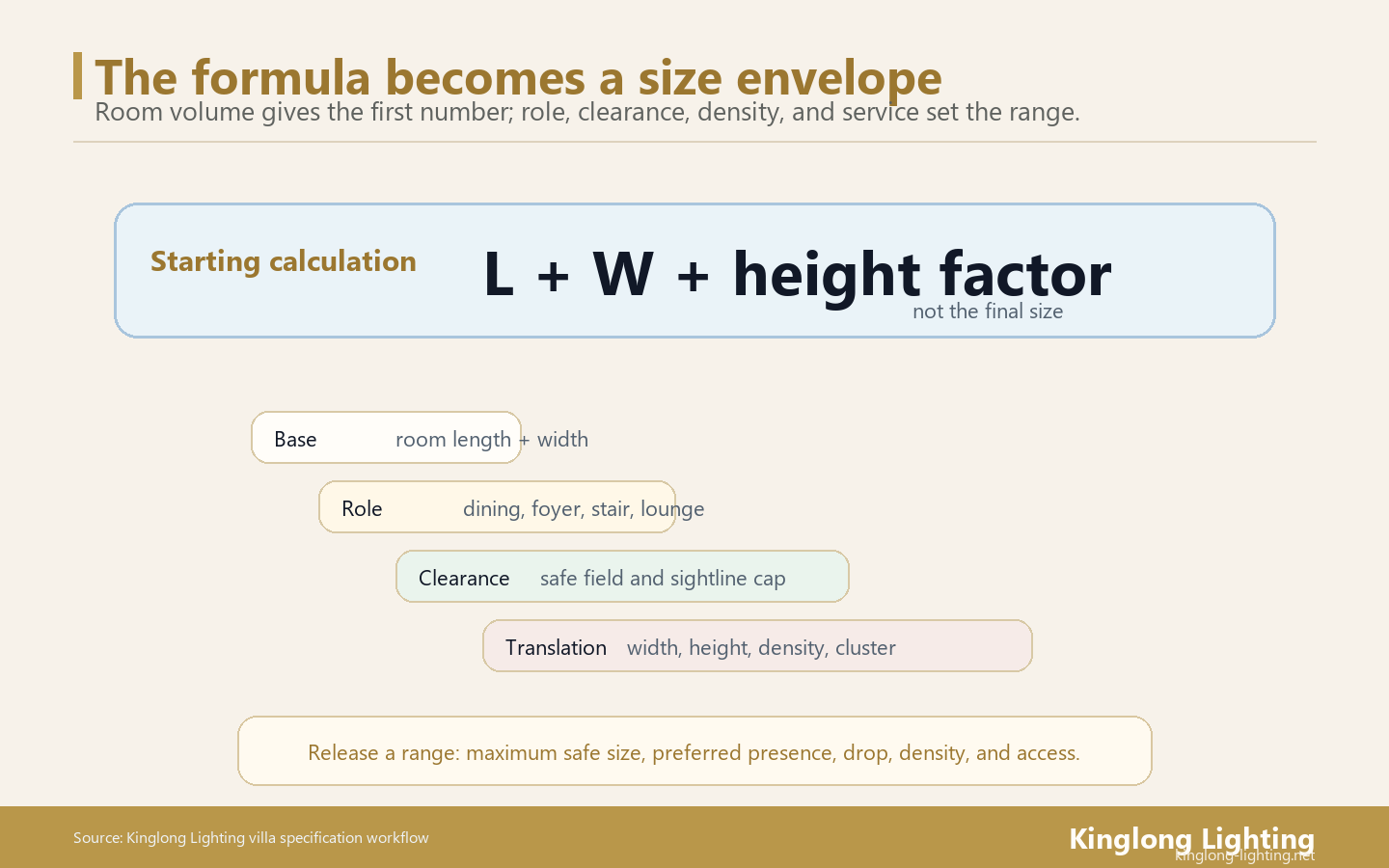
Use this scenario formula for early planning: starting diameter in inches equals room length in feet plus room width in feet plus two times the ceiling height above 10 feet. If the ceiling is 10 feet or lower, use only length plus width as the base. This is an illustrative planning method, not a building code or universal design rule.
Example 1: A 16 by 20 foot double-height foyer
Length plus width gives 36 inches. The ceiling is 20 feet, so the height adjustment is 2 x 10 = 20 inches. The starting diameter becomes 56 inches. That does not mean the chandelier must be 56 inches wide. It means the visual presence should feel like a 56 inch fixture before style and clearance corrections. For a sizing decision, keep the base number, correction factor, clearance cap, and design translation together so the final chandelier size is traceable rather than defended as a personal preference. In practice, the note should also show which constraint changed the formula result and why that correction is acceptable.
Example 2: A 14 by 18 foot dining room
Length plus width gives 32 inches. If the ceiling is 11 feet, the height adjustment adds 2 inches, creating a 34 inch starting point. But dining rooms should follow the table, not the room alone. A linear chandelier or paired composition may work better than one wide body. For a sizing decision, keep the base number, correction factor, clearance cap, and design translation together so the final chandelier size is traceable rather than defended as a personal preference. In practice, the note should also show which constraint changed the formula result and why that correction is acceptable.
Apply a room-role factor
The role factor prevents the formula from treating every villa room like a foyer. Height matters, but use matters more. A chandelier over a dining table should not become wide just because the ceiling is tall.
| Room type | Starting factor | Why it changes | Correction before approval |
|---|---|---|---|
| Dining room | 0.80-0.95x | Table and seated sightlines dominate | Check table edge and drop height |
| Double-height foyer | 1.00-1.15x | Arrival volume needs presence | Check entry, stair, and landing views |
| Stair void | 0.85-1.10x | Height matters more than width | Use vertical rhythm and clearance cap |
| Living room | 0.85-1.00x | Comfort and seating glare matter | Check screens, art, and reflected surfaces |
The formula output must be capped by real-world clearance. The IES Lighting Library includes residential and hospitality lighting practice references, but even strong design guidance still needs project-specific dimensions.
Common clearance caps include narrow room width, stair opening, table seating zone, low beams, window view, and cleaning lift access. If the formula violates a cap, shift visual presence into height, spacing, material density, or a multi-point composition.
Glare, color, and safety can override the formula
A chandelier can be mathematically correct and visually uncomfortable. High crystal density, exposed lamps, polished metal, mirrored walls, or a close upper landing can create glare. The DOE TM-30 FAQ is useful for color quality discussion, but comfort also depends on brightness, shielding, reflections, dimming, and view angle.
Safety evidence also belongs in the size conversation. UL Solutions notes that indoor and decorative lighting is commonly tested to UL 1598 and UL 8750. For custom chandeliers, the completed fixture, LED equipment, suspension, and installation assumptions matter more as the size increases.
The DOE residential lighting guide reinforces that lighting quality includes glare control, ambient strategy, dining use, and dimming. A chandelier formula should therefore be integrated into the broader lighting plan, not used as a standalone decorative rule.
How Kinglong Lighting can apply the formula
Kinglong Lighting can use the formula as an early sizing tool, then refine it through the Mofun Design Platform, material samples, drawings, and the custom lighting workflow. The buyer should provide room dimensions, ceiling height, photos, plan drawings, furniture layout, preferred style, material palette, and access restrictions.
The practical next step is to submit those dimensions through the villa chandelier size review. Ask Kinglong Lighting for a formula starting point, corrected size range, visual envelope, and release evidence checklist. That keeps the conversation specific while leaving room for design judgment.
The review should also identify the one constraint that has priority. In a foyer, the priority may be arrival volume. In a dining room, it may be the table field. In a stair void, it may be landing comfort. Naming the priority prevents the formula from being corrected in several directions at once.
Correct the formula with constraints before trusting the number
The formula becomes useful only after correction. First, calculate the starting diameter. Second, apply the room-role factor. Third, identify the narrowest safe field. Fourth, decide whether missing presence should be solved with width, height, density, or multiple points. This sequence prevents a common mistake: increasing diameter when the room actually needs vertical rhythm or better light distribution.
A villa foyer may need more height than width. A dining room may need more length than diameter. A stair void may need a slim cascade instead of a round body. A lounge may need a smaller fixture with warmer dimming and stronger ambient layers. The formula does not know any of that until the designer adds room role, furniture, view lines, and service constraints.
Kinglong Lighting can use the formula as the first pass in a project review, then test the result in Mofun or a drawing packet. The final recommendation should be a range rather than a single number: maximum safe diameter, preferred visual presence, drop range, material density, glare note, suspension assumption, and cleaning access. That range is what turns a sizing trick into a manufacturable chandelier brief.
The range should be written as a decision envelope. For example, a foyer may allow 900 to 1,100 mm of width, but the preferred visual presence may come from a 900 mm body with taller tiers rather than a 1,100 mm ring. A dining room may accept a long linear fixture, but the usable range changes when chairs, art, sideboards, and pendant drop are included. The formula gives the first number; the envelope explains why the final answer is different.
It is also important to separate apparent size from physical size. Clear glass, open metalwork, and slim arms can look lighter than their measured diameter. Dense crystal, dark finishes, and heavy shades can feel larger than the tape measure suggests. A villa chandelier size formula should therefore be corrected by visual density, finish contrast, and brightness, especially in rooms with strong daylight or reflective stone.
The strongest use of the formula is internal alignment. Owners, designers, and manufacturers can argue endlessly about whether a chandelier feels large enough. A documented range changes that conversation. The team can see the base calculation, the room-role correction, the clearance cap, and the chosen design translation. That makes the final fixture easier to approve, manufacture, ship, install, and defend.
| Correction step | Question | Output |
|---|---|---|
| Base formula | What does room volume suggest? | starting diameter |
| Role factor | What does the room ask the fixture to do? | adjusted range |
| Clearance cap | What can the room safely accept? | maximum width or drop |
| Design translation | How should presence be expressed? | width, height, density, or cluster |
Volume formula action card
- Measure length, width, ceiling height, and narrowest safe field.
- Calculate the starting diameter before style corrections.
- Apply room-role factor for dining, foyer, stair, or lounge use.
- Cap size by clearance, sightlines, and service access.
- Convert the final range into drawings and sample proof.
Related Guides
- Double-Height Foyer Chandelier Selection
- Dining Room Chandelier Specification
- Luxury Villa Chandelier Guide
Build the villa chandelier room-dimension sizing model before final approval
For a villa chandelier size formula, the useful starting point is application context rather than decorative preference. The practical question is whether villa owner, interior designer, custom chandelier supplier, and installer can agree on what must be proven before the chandelier is released. The answer is a short packet that turns design intent, operating risk, evidence, and responsibility into one approval conversation.
The main risk is a formula being used as decoration math while sightlines, ceiling height, furniture, glare, and service access change the result. That risk is strongest when a beautiful fixture is separated from the evidence that makes it buildable, maintainable, and safe to release. Calculated from a 6-gate review, 3 unresolved gates out of 6 leave about 50 percent of the approval logic open, which is too much uncertainty for a custom decorative lighting order.
Separate base formula from final visual size
The first approval question should define how the formula will be used. The decision is not whether a chandelier looks premium in isolation; it is whether the selected approach protects the room role, guest or owner experience, operating reality, and production handoff at the same time. The release note should name the decision owner, the proof expected, and the change that would force a redesign. That boundary lets the buyer reject a tempting option for a specific reason instead of relying on taste language.
Correct for ceiling height and furniture zone
The first failure point usually appears where the visual promise meets daily use. Calculated from the 6-gate villa chandelier room-dimension sizing model, 1 weak gate times 3 downstream teams equals 3 review paths that can be delayed by one missed proof item. The review should include the view or operating condition that would be most expensive to fix later. Scene behavior and context should be tested before the fixture is treated as release-ready.
Cap size when clearance or glare dominates
Supplier evidence is useful only when it matches the risk being controlled. The request should convert that risk into proof such as room measurements, visual envelope, correction factors, material density, clearance cap, and service note. If the risk is scale, request a marked elevation and sightline view. If the risk is color, request a material sample under the target scene. If the risk is maintenance, request the cleaning route and spare-part logic. Evidence should change the release decision, not decorate the file.
Write the correction factor into the release file
Kinglong Lighting’s project workflow moves custom hospitality and villa chandeliers through drawings, samples, manufacturing, packing, shipping, and site installation. The final handoff should state what is approved, what remains flexible, and who can reject a change. In practice, the release packet should include at least 6 named gates and one owner for each gate. That keeps a later suggestion from turning into a redesign after the fixture has already entered production.
Frequently Asked Questions
What is the easiest villa chandelier size formula?
The easiest starting formula is room length plus room width in feet, read as inches of approximate diameter. For ceilings above 10 feet, add a height adjustment, then correct the result by room role, clearance, furniture layout, and service access.
Does ceiling height change chandelier diameter?
Ceiling height changes visual presence, but not always physical diameter. A taller room may need a longer or denser vertical composition instead of a wider fixture. Use height adjustment as a starting point, then cap width by circulation and sightlines.
How do I size a chandelier for a dining room?
Start with room dimensions, but prioritize the table. Check table length, width, seating clearance, drop height, and eye contact. A dining chandelier should feel proportional to the table and comfortable for seated guests.
When should I stop using the formula and request drawings?
Request drawings when the room is double-height, the fixture is custom, the chandelier is heavy, the stair or table clearance is tight, or the owner needs exact material and dimming approval. The formula is for early sizing, not final production release.