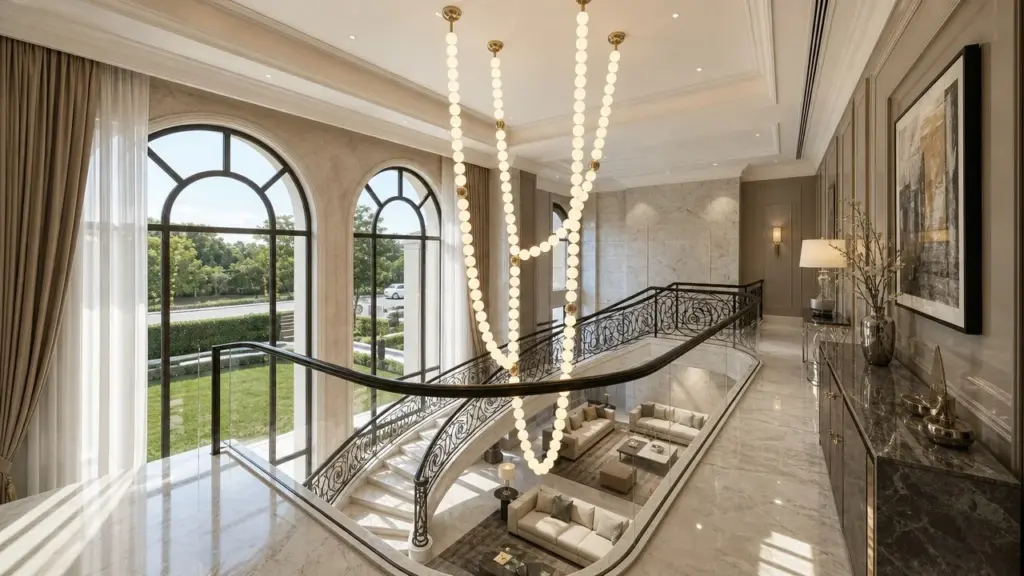
A double-height foyer chandelier is selected correctly when it resolves four viewing planes at once: the entry door, the main floor, the stair or bridge, and the upper landing. A fixture can pass a simple diameter rule and still fail if it looks flat from above, blocks a sightline from the stairs, or leaves the lower entry feeling empty.
The hard part is not choosing something dramatic. The hard part is controlling proportion inside a volume that people experience while moving. For luxury villas, the chandelier becomes a three-dimensional architectural marker rather than a ceiling accessory.
Kinglong Lighting can support this decision by turning the foyer void into a release envelope with drawings, material proof, suspension details, and visual checks before production starts.
Key Takeaways
- Four-view rule: Check the chandelier from entry, main floor, stairs, and upper landing.
- Composition before formula: Diameter is only useful after the visual envelope is defined.
- Vertical fill: Tall spaces need rhythm, not simply a longer drop.
- Comfort gate: Sparkle should not become glare at eye level or from above.
- Release evidence: A double-height foyer needs suspension, service access, and finish proof in one file.
Start with the foyer envelope, not the fixture catalog
A double-height foyer chandelier should be sized to the volume people see, not only to the ceiling it hangs from.
The IES Lighting Library frames lighting design as an application-specific decision rather than a decorative afterthought. For a villa foyer, the application is arrival, orientation, and transition. The chandelier must help the visitor understand the height of the house, the direction of movement, and the character of the interior.
The first working number is the visual envelope. Measure floor length, floor width, ceiling height, stair opening, bridge line, door height, and the nearest major wall plane. Then mark no-go zones: head clearance, door swing, artwork, lift path, window views, cleaning access, and any structural point that cannot support the intended load.
The diameter rule is a starting line
A common shortcut is to add room length and width in feet, then read the result as rough chandelier diameter in inches. In a double-height villa, that result is only a starting line because upper volume changes perceived scale. Enlarge visual presence before enlarging obstruction: add tiers, spacing, vertical rhythm, or light points before increasing width into the stairwell or door view. For a foyer decision, record the approved view, clearance boundary, finish sample, and service owner next to the drawing so scale cannot drift when the chandelier moves from mood image to production file. In practice, the note should also say which team member can reject a later change.
The upper landing is the neglected viewpoint
The IES Illuminance Selector FAQ is useful because it reminds teams that criteria depend on task surface and application context. In foyers, the task is not reading a tabletop. It is moving through a tall space comfortably and understanding the home. The upper landing should therefore expose a finished top, controlled brightness, and intentional suspension. For a foyer decision, record the approved view, clearance boundary, finish sample, and service owner next to the drawing so scale cannot drift when the chandelier moves from mood image to production file. In practice, the note should also say which team member can reject a later change.
Visual composition decides whether scale feels luxurious
Visual composition is not taste language. It is a control system for proportion, comfort, access, and manufacturing release. A tall void can use a tiered chandelier, a vertical pendant cluster, a sculptural cascade, or a slimmer linear body. The architecture decides which one can survive daily use.
| Composition test | What to check | Failure signal | Release evidence |
|---|---|---|---|
| Vertical thirds | Does the fixture occupy a deliberate zone? | Too high feels remote; too low feels heavy | Elevation with drop dimension |
| Negative space | Is there breathing room around the fixture? | The void feels stuffed or empty | Plan and elevation overlay |
| Movement view | Does it read while walking stairs? | Shape collapses from the side | Stair and landing renders |
| Material sparkle | Is reflection controlled near eye level? | Crystal produces glare or visual noise | Sample under target scene |
| Service route | Can the fixture be cleaned and repaired? | Beauty depends on inaccessible parts | Cleaning and spare plan |
The Lutron layered lighting guide separates ambient, task, and accent logic, and that matters in a foyer. A chandelier can provide identity and controlled glow, while wall washers, cove lighting, stair lighting, or art lighting support orientation and comfort.
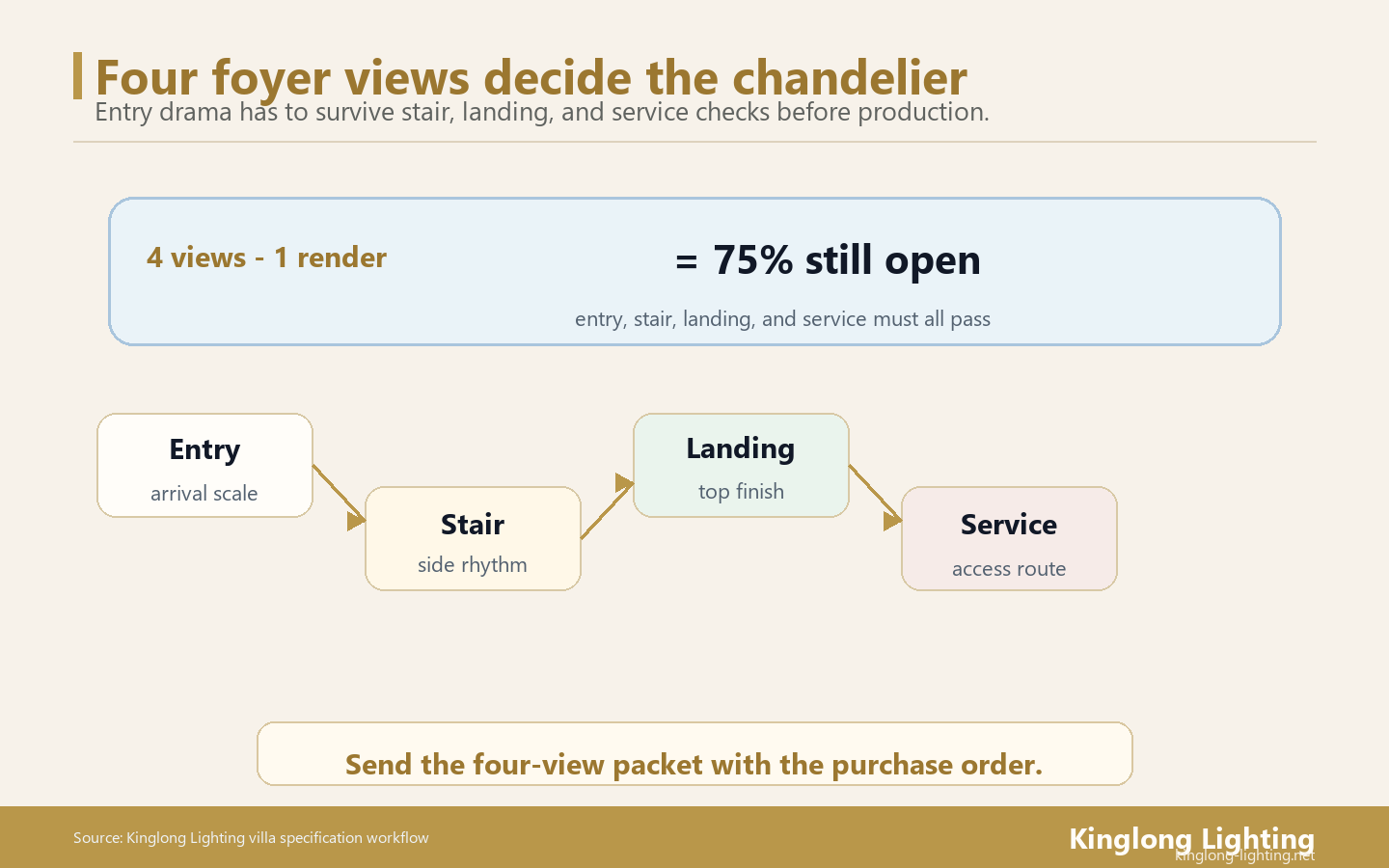
Calculated from a 4-view foyer approval model, 4 required gates minus 1 approved ground-floor render equals 3 unresolved gates, which means 75 percent of the viewing and service decision is still open.
Safety and service belong in the first design meeting
Double-height chandeliers are often custom, heavy, and difficult to access after installation. UL Solutions notes that indoor and decorative lighting is commonly tested to UL 1598 and UL 8750, which is a useful reminder that completed luminaire evidence matters.
For a villa foyer, the release file should name fixture weight, suspension method, canopy detail, driver access, dimming compatibility, cleaning route, packing assumptions, spare crystals or glass parts, and installation sequence. If the ceiling point is not ready, the lighting design is not ready.
How Kinglong Lighting can turn selection into a release file
Kinglong Lighting’s villa lighting work is most useful when the buyer provides dimensions, elevations, material references, ceiling structure notes, stair photos, and target mood. The customization workflow can then turn a visual preference into drawings, samples, finish decisions, and manufacturing handoff.
The practical next step is not to ask for a single chandelier quote. Send the foyer plan, ceiling height, stair route, landing photo, door view, preferred material, and any weight or access restriction. Then ask Kinglong Lighting for a four-view size recommendation through the project inquiry page.
Build a four-view review packet before production
A double-height foyer chandelier should not move from concept to production until the review packet shows the same fixture from the door, the stair, the upper landing, and the service position. These do not need to be photorealistic renderings at the first pass. A marked elevation, plan overlay, and two perspective sketches can already expose whether the body is too wide, too thin, too high, or too close to the upper eye line.
The review packet should also name what changes are still allowed. Diameter may still move by a few inches, tier spacing may still change, and glass density may still be adjusted. But suspension points, ceiling reinforcement, service access, and the largest shipping module should be treated as harder constraints. If the owner approves beauty while the installer later rejects support or access, the project has not saved time. It has merely delayed the real decision.
For Kinglong Lighting, this packet becomes a practical manufacturing conversation. The designer can protect the desired arrival mood, the owner can see the chandelier from the daily routes that matter, and the factory can define a release file instead of guessing from a single inspiration image. That is the difference between a foyer chandelier that looks impressive online and one that feels resolved inside the villa.
The packet should include at least one negative decision as well as approved decisions. For example, it may state that a wider ring was rejected because it narrowed the stair view, or that a denser crystal body was rejected because the upper landing became too bright. Those rejected options are useful because they stop the project from reopening the same debate when a new rendering, supplier suggestion, or family preference appears later.
A second practical detail is scale annotation. A beautiful render without a marked door height, human eye line, stair rail, and ceiling plane can flatter almost any chandelier. Marking those references makes the discussion less emotional and more useful. The owner still chooses the mood, but the team can see whether the fixture is actually carrying the volume or only looking large because the rendering angle is dramatic.
Finally, the four-view packet should travel with the purchase order. When production, packing, shipping, and installation teams see only the final fixture image, they lose the reason behind the dimensions. When they see the four-view logic, they understand why a suspension point, cable length, module order, or finish sample cannot be changed casually.
| Packet item | Decision it protects | Who should approve it |
|---|---|---|
| Plan overlay | safe width and stair clearance | designer and installer |
| Front elevation | vertical fill and drop height | owner and designer |
| Landing view | top finish and eye-level glare | owner and manufacturer |
| Service note | cleaning, spares, and access route | manufacturer and installer |
Foyer selection action card
- Map entry, stair, landing, and living-threshold views.
- Set a safe visual envelope before choosing diameter.
- Separate chandelier drama from navigation lighting.
- Request suspension, access, dimming, and spare-part evidence.
- Review samples under the intended warm scene.
Related Guides
- The Complete Luxury Villa Chandelier Guide
- Staircase Chandelier Design for Grand Villas
- Villa Chandelier Size Formula
Build the double-height foyer four-view release packet before final approval
The useful starting point for double-height foyer chandelier is application context rather than decorative preference. The practical question is whether villa owner, interior designer, custom lighting team, and installer can agree on what must be proven before the chandelier is released. The answer is a short packet that turns design intent, operating risk, evidence, and responsibility into one approval conversation.
The main risk is a foyer chandelier being approved from the entry render while stair, landing, glare, and service views remain unresolved. That risk is strongest when a beautiful fixture is separated from the evidence that makes it buildable, maintainable, and safe to release. Calculated from a 4-gate review, 2 unresolved gates out of 4 leave about 50 percent of the approval logic open, which is too much uncertainty for a custom decorative lighting order.
Make the stair view equal to the entry view
The first approval question should define the practical buying decision behind double-height foyer chandelier. The decision is not whether a chandelier looks premium in isolation; it is whether the selected approach protects the room role, guest or owner experience, operating reality, and production handoff at the same time. The release note should name the decision owner, the proof expected, and the change that would force a redesign. That boundary lets the buyer reject a tempting option for a specific reason instead of relying on taste language.
Check the top finish from the upper landing
The first failure point usually appears where the visual promise meets daily use. Calculated from the 4-gate double-height foyer four-view release packet, 1 weak gate times 2 downstream teams equals 2 review paths that can be delayed by one missed proof item. The review should include the view or operating condition that would be most expensive to fix later. Scene behavior and context should be tested before the fixture is treated as release-ready.
Use vertical rhythm before increasing diameter
Supplier evidence is useful only when it matches the risk being controlled. The request should convert that risk into proof such as entry view, stair view, landing view, service route, suspension note, and finish sample. If the risk is scale, request a marked elevation and sightline view. If the risk is color, request a material sample under the target scene. If the risk is maintenance, request the cleaning route and spare-part logic. Evidence should change the release decision, not decorate the file.
Send service access with the design approval
Kinglong Lighting’s project workflow moves custom hospitality and villa chandeliers through drawings, samples, manufacturing, packing, shipping, and site installation. The final handoff should state what is approved, what remains flexible, and who can reject a change. In practice, the release packet should include at least 4 named gates and one owner for each gate. That keeps a later suggestion from turning into a redesign after the fixture has already entered production.
Frequently Asked Questions
How large should a double-height foyer chandelier be?
Start with room length and width, then adjust for ceiling height, sightlines, stair clearance, and service access. The best size fills the foyer volume without blocking movement or looking unfinished from the upper landing.
Should the chandelier hang in the exact center of the foyer?
Not always. Centering works when the foyer is symmetrical and the main views align with the room center. In villas with curved stairs, bridges, or offset doors, the chandelier may need to align with the visual axis.
What is the biggest mistake in double-height foyer selection?
The biggest mistake is approving the chandelier from only one render. A double-height fixture must be judged from entry, stair, upper landing, and nearby living threshold, with service access and structural review included.
Can one chandelier provide all foyer lighting?
It can provide visual identity, but it should not be the only useful layer. Wall washers, stair lights, cove lighting, or concealed accent lighting can support orientation while the chandelier remains dimmed enough to feel luxurious.