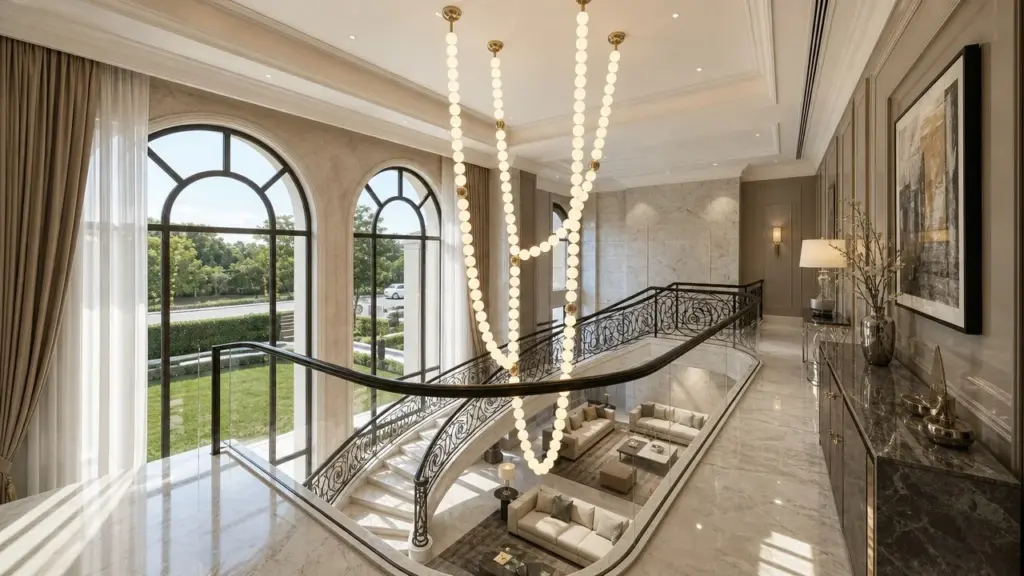
A smart luxury chandelier should not look like technology was added after design. The best integrations hide drivers, protect dimming smoothness, coordinate scenes, and keep the fixture’s material expression intact.
The risk is a split workflow: designers approve a beautiful chandelier, electricians select controls later, and the owner discovers flicker, poor dimming range, wrong scene grouping, or visible access panels after installation.
Kinglong Lighting can help avoid that split by treating smart lighting integration as a release-file issue, not a last-minute electrical note.
Key Takeaways
- Design first: Smart controls should support the chandelier’s visual intent, not rewrite it.
- Driver match matters: Dimming quality depends on LED, driver, control, and load compatibility.
- Scenes need ownership: Arrival, dining, evening, cleaning, and night scenes should be named early.
- Access stays hidden: Service access must be planned without damaging the ceiling or fixture look.
- Commissioning closes the loop: The final scene test should match the approved sample and room mood.
Smart integration starts before the chandelier is released
The control system should be part of the chandelier brief, not a separate decision after production.
The Lutron control guidance matters because lighting controls affect usability, flexibility, and energy behavior. For a villa chandelier, they also affect whether the fixture feels luxurious at low output.
A smart luxury chandelier needs the right driver, dimming protocol, load range, wiring route, control zone, and scene intent. If those are chosen after the decorative form is frozen, the technology may force visible compromises.
The decision rule is to approve beauty and control behavior together. A chandelier that looks perfect at full output but flickers or drops poorly at the owner’s evening scene is not release-ready.
Drivers can protect or damage the luxury effect
The driver is invisible when it works and painfully visible when it does not. Poor compatibility can create flicker, uneven dimming, buzz, limited low-end control, or scene mismatch. The release file should name driver type, control interface, load assumptions, access location, and test scene before production. That protects the chandelier from becoming a beautiful body with an uncomfortable behavior.
Scene ownership prevents late compromises
Smart lighting succeeds when each scene has an owner. The interior designer may own mood, the electrical consultant may own system compatibility, the manufacturer may own driver and lamp behavior, and the installer may own access. If nobody owns the dining, arrival, night, and cleaning scenes before production, the final commissioning becomes a negotiation instead of a verification.
Coordinate design intent with control zones
The Lutron layered lighting guide separates ambient, task, and accent layers. In a villa, the chandelier may be the identity layer while cove lighting, wall lights, art lighting, and stair lighting support function.
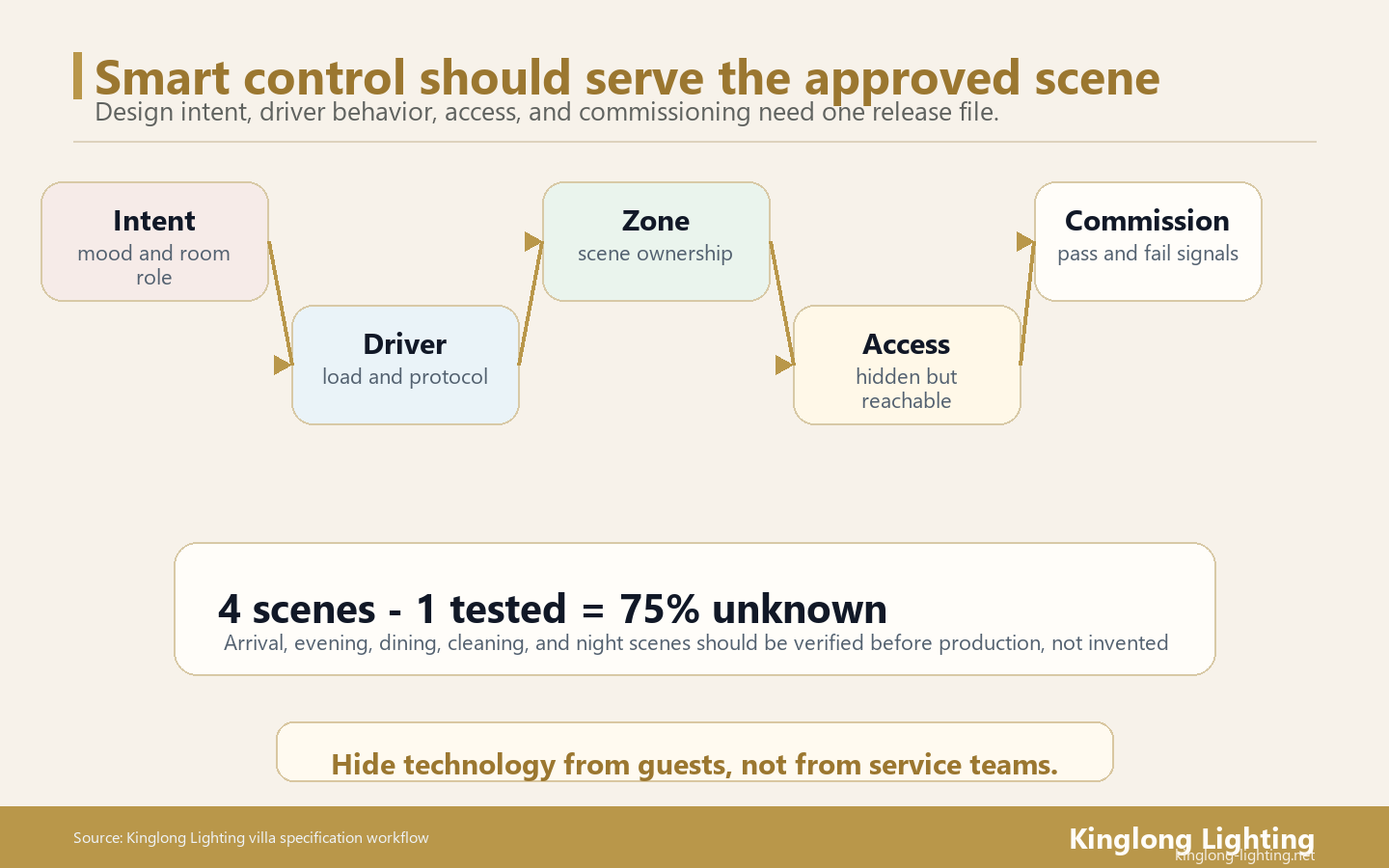
Calculated from a 4-scene villa control file, 4 named scenes minus 1 tested scene equals 3 unverified scenes, which means 75 percent of the owner’s actual use remains unknown before commissioning.
| Scene | Chandelier role | Control risk | Release evidence |
|---|---|---|---|
| Arrival | identity and sparkle | too bright at entry | preset level |
| Evening | warm atmosphere | flicker at low output | driver compatibility |
| Dining | conversation support | wrong zone grouping | scene schedule |
| Cleaning | full useful output | service mode forgotten | commissioning checklist |
| Night | soft orientation | chandelier overused | layered low scene |
The DOE residential lighting guide reinforces that residential lighting quality depends on more than fixture choice. Controls, glare, and layered lighting shape how the room works after installation.
The UL residential lighting guidance is useful because decorative lighting still needs product evidence. Smart integration should therefore include driver access, thermal assumptions, wiring, and replacement logic in the same file as the aesthetic approval.
Hide technology without hiding service access
A luxury chandelier can be visually compromised by visible drivers, awkward access panels, bulky canopies, cable clutter, or emergency changes at commissioning. Hiding technology is important, but hiding service access completely is a maintenance risk.
In practice, the design team should decide where drivers live, how they are reached, how heat is managed, how firmware or control settings are updated, and how replacement parts will be installed. These details should be invisible to guests and visible to the service team.
The best release file separates what the owner sees from what the installer needs. That separation keeps the chandelier elegant without turning future service into ceiling damage.
Aesthetic compromise usually appears when access is solved too late. If a driver, junction point, or service panel has to be invented after the decorative ceiling is finished, the cleanest design options are already gone. Early access planning gives the team more ways to keep technology quiet.
The file should also name what the chandelier should not do. In a villa with cove lighting, wall wash, and task layers, the chandelier may not need to provide every lumen. It may need to preserve identity at low output while other layers handle circulation, reading, cleaning, and art. That boundary is what keeps smart control from turning into over-bright programming.
How Kinglong Lighting can align chandelier and smart control teams
Kinglong Lighting’s customization workflow can support driver notes, sample review, finish decisions, drawings, and production handoff so the smart control requirements are not discovered too late.
The practical next step is to send desired scenes, control brand or protocol, room drawings, ceiling access, fixture style, and dimming expectations through the project inquiry page. Ask Kinglong Lighting to return a chandelier release file that includes design intent, driver compatibility, service access, and commissioning notes.
Write a control integration release file before production
A smart luxury chandelier needs one release file that both the decorative team and the control team can use. Without that shared file, design approval and electrical commissioning can drift apart until the compromise becomes visible in the finished villa.
The file should not be a technical appendix added after the chandelier is designed. It should be part of the main specification because driver behavior, dimming depth, scene grouping, and access location all affect how luxurious the fixture feels.
Before production, the release file should identify the first scene to test. For many villas, that is not cleaning mode; it is the evening scene where the owner expects luxury. If the fixture cannot dim smoothly or hold color quality there, the smart system has failed the most important daily use case.
List driver, load, and protocol before final quotation
Driver compatibility should be discussed before the final quote, not after production starts. The release file should name the LED type, driver family, dimming method, control protocol, load assumptions, minimum dimming level, access location, and any testing condition required by the control supplier. This protects both beauty and behavior. A chandelier can have perfect glass, metal, and proportion but still feel cheap if it flickers, buzzes, drops out at low level, or cannot reproduce the approved evening scene.
List scene ownership instead of only scene names
Scene names are not enough. Arrival, dining, evening, cleaning, art, and night scenes should each have an owner and a success condition. The designer may define mood, the control consultant may define programming, the manufacturer may define driver limits, and the installer may define access constraints. When ownership is missing, commissioning turns into a negotiation. When ownership is written, final programming can be judged against the approved design intent rather than against whatever preset happens to be convenient.
List access points without exposing the technology
Luxury integration means technology stays quiet, but quiet does not mean unreachable. Drivers, connectors, suspension points, and replaceable components need a service path that does not damage the ceiling or chandelier finish. The access note should explain where service happens, what can be replaced, what requires lift equipment, and which parts should be kept as spares. This prevents the common mistake of hiding the driver so well that future maintenance becomes a ceiling repair project.
List commissioning pass and fail signals
The commissioning checklist should tell the installer what success looks like. A pass might be smooth dimming to the approved low level, no visible flicker, no audible buzz, correct zone grouping, hidden access, and scenes that match the sample review. A fail might be a sudden step at low output, glare from the wrong viewpoint, a cleaning scene that cannot reach full output, or an access panel that interrupts the ceiling design. These signals make commissioning a verification step instead of a redesign meeting.
Commission the scene that was approved, not a new one
Smart integration fails when commissioning becomes the first time everyone sees the real scene. The approved chandelier sample, driver behavior, dimming level, and room mood should already be known before the installer starts programming.
The commissioning note should therefore reference the design file. If the owner approved a warm evening scene at low output, the control team should reproduce that scene, not invent a brighter version because it is easier to program. If the cleaning scene needs full output, that should be a separate service mode.
Kinglong Lighting can support this by keeping driver, sample, and scene notes in the same release file. The chandelier remains visually refined because the technology has already been asked to serve the design instead of interrupting it.
A practical handoff should name the people as well as the parts. The designer owns the visual mood, the control specialist owns protocol and load behavior, the manufacturer owns driver and lamp compatibility, and the installer owns access and final programming. When those roles are written into the release file, a smart luxury chandelier is less likely to suffer from late visible compromises.
For villas with several public rooms, the same logic should be repeated room by room. The foyer may need arrival drama, the dining room may need low warmth, the master suite may need privacy, and the living room may need screen-friendly softness. One smart system can serve all of those scenes, but only if the chandelier brief tells the system which luxury effect each room is supposed to protect.
The final commissioning record should stay with the product file. Future service teams need to know the approved low-end level, driver assumptions, zone grouping, and access route. Otherwise a later replacement or programming change can quietly undo the scene that made the chandelier feel premium.
That record is especially important when ownership changes or the villa is maintained by a separate facilities team. The chandelier may still look custom, but its luxury depends on repeatable settings, compatible replacement parts, and a service path that does not require rediscovering the original design logic.
A useful record includes photographs of the approved scene, the final dimming percentages, the control zone names, the driver access location, and the spare parts list. Those details help a future technician restore the intended atmosphere after maintenance instead of treating the chandelier as a generic load on the smart system.
The design team should also decide who is allowed to change scenes after handover. Owners may want seasonal adjustments, but a service technician should not rewrite the main evening scene without the designer or owner’s approval. A change-control note keeps everyday convenience from slowly eroding the original luxury effect.
| Commissioning item | What it verifies | Failure signal |
|---|---|---|
| Evening scene | low-end dimming | flicker or drop-out |
| Arrival scene | identity without glare | too bright at entry |
| Cleaning scene | service output | no useful full level |
| Access note | future maintenance | driver hidden too well |
Smart chandelier integration action card
- Name the scenes before approving the decorative form.
- Confirm driver, load, protocol, and dimming range.
- Separate identity lighting from task and orientation layers.
- Hide technology while preserving service access.
- Commission the final room against approved scenes.
Related Guides
- Master Bedroom Chandelier Guide
- Living Room Chandelier Sizing
- Working with Interior Designers on Villa Lighting
Frequently Asked Questions
Can a luxury chandelier work with smart lighting systems?
Yes, but the driver, dimming method, load range, control protocol, access location, and scene logic should be reviewed before production. Smart integration should not be added after the fixture is already frozen.
What causes smart chandelier flicker?
Flicker can come from driver incompatibility, low-end dimming limits, load mismatch, wiring problems, or control settings. The safest approach is to test the intended driver and control scene before release.
Should a chandelier be its own control zone?
Often yes, especially in villas where the chandelier carries identity while other layers support task, accent, or orientation lighting. Separate zoning gives the owner more control over mood and glare.
What should Kinglong Lighting receive for smart integration?
Send room drawings, desired scenes, preferred control system, dimming expectations, driver location constraints, ceiling access notes, fixture material, and installation sequence requirements.