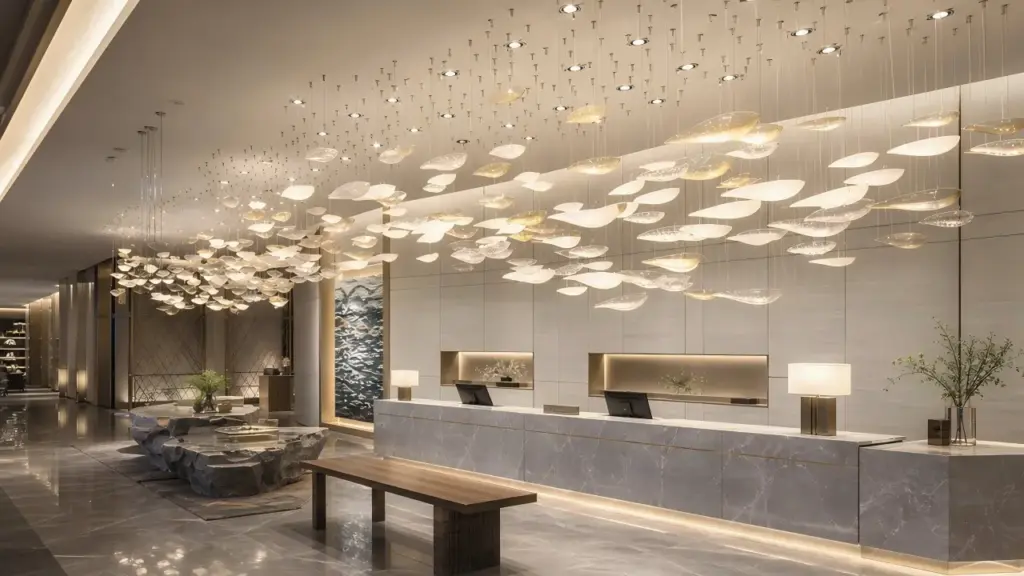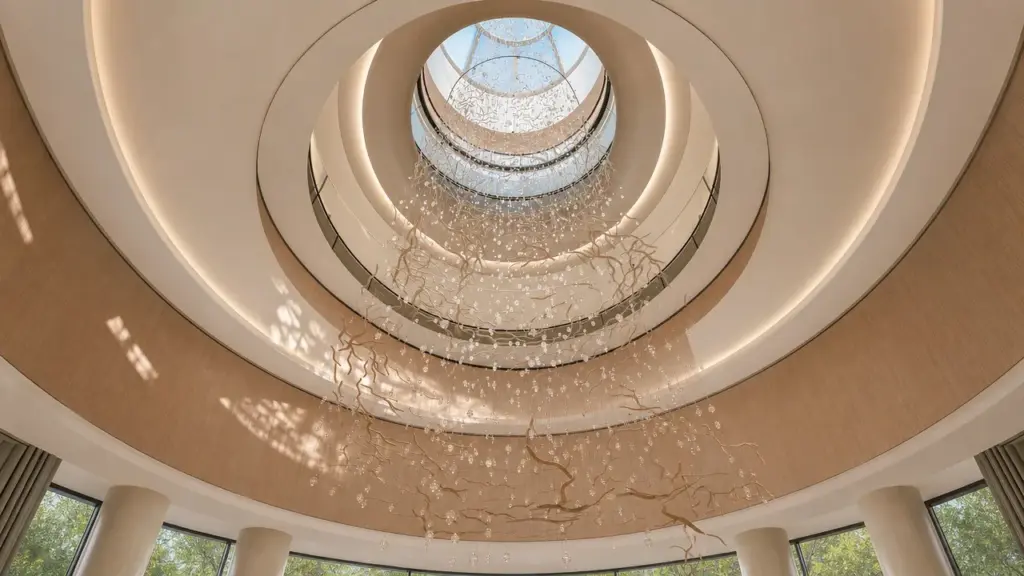
Un lustre de luxe compatible avec l’éclairage connecté ne doit pas donner l’impression que la technologie a été ajoutée après le design. Les meilleures intégrations rendent les alimentations LED discrètes, protègent la douceur de gradation, coordonnent les scènes et gardent intacte l’expression des matières : cristal, verre, métal, finition et proportions.
Le risque apparaît lorsque les équipes travaillent en deux temps : le concepteur approuve un beau lustre, puis l’électricien choisit le système de contrôle plus tard. Le propriétaire découvre alors un scintillement, une plage de gradation trop courte, des scènes mal groupées, une trappe visible ou un accès impossible une fois le plafond terminé.
Kinglong Lighting peut éviter cette rupture en traitant l’intégration connectée comme un sujet de dossier de libération, et non comme une note électrique ajoutée en fin de projet.
Points clés à retenir
- Le design reste prioritaire : les contrôles intelligents doivent soutenir l’intention visuelle du lustre, pas la réécrire.
- La compatibilité des alimentations LED est décisive : la qualité de gradation dépend de la LED, de l’alimentation, du protocole, de la charge et du contrôle.
- Chaque scène doit avoir un responsable : arrivée, dîner, soirée, nettoyage et nuit doivent être nommées avant production.
- L’accès service doit rester discret : les composants techniques doivent être atteignables sans abîmer le plafond ni l’apparence du lustre.
- La mise en service ferme la boucle : le test final doit reproduire l’échantillon approuvé et l’ambiance de la pièce.
L’intégration connectée commence avant la libération du lustre
Le système de contrôle doit faire partie du brief du lustre, pas devenir une décision séparée après fabrication.
Les ressources de Lutron sur les types de contrôle rappellent que les commandes influencent l’usage, la flexibilité et le comportement énergétique. Dans une villa, elles influencent aussi la sensation de luxe à faible intensité. Un lustre parfait à pleine puissance mais instable dans la scène du soir n’est pas prêt à être libéré.
Le dossier doit donc nommer l’alimentation LED, la méthode de gradation, le protocole de contrôle, les hypothèses de charge, la route de câblage, la zone de commande, l’accès service et la scène de référence. Si ces décisions arrivent après le gel de la forme décorative, la technologie peut forcer des compromis visibles.
Les alimentations LED peuvent protéger ou dégrader l’effet luxe
L’alimentation LED est invisible quand tout fonctionne, mais très visible quand elle échoue. Une mauvaise compatibilité peut créer du scintillement, un bourdonnement, une coupure à bas niveau, une variation par paliers ou une scène différente de celle validée. Le dossier de libération doit préciser le type d’alimentation, l’interface de contrôle, les limites de charge, l’emplacement d’accès et la scène à tester avant production.
La propriété des scènes évite les compromis tardifs
Une intégration réussie attribue chaque scène. Le concepteur peut être responsable de l’ambiance, le consultant contrôle de la compatibilité système, le fabricant du comportement LED et l’installateur de l’accès. Si personne ne possède les scènes dîner, arrivée, nuit et nettoyage avant production, la mise en service devient une négociation au lieu d’une vérification.
Coordonner intention décorative et zones de contrôle
Le guide Lutron sur l’éclairage en couches distingue lumière d’ambiance, lumière de tâche et accentuation. Dans une villa, le lustre peut porter l’identité de la pièce tandis que les gorges lumineuses, appliques, éclairages d’art ou lumières d’escalier prennent en charge la fonction.
À partir d’un fichier de contrôle de villa avec 4 scènes, si une seule scène est réellement testée, 3 scènes restent non vérifiées. Cela signifie que 75 % des usages réels du propriétaire sont encore inconnus au moment de la mise en service.
| Scène | Rôle du lustre | Risque de contrôle | Preuve de libération |
|---|---|---|---|
| Arrivée | identité et éclat | entrée trop lumineuse | niveau préréglé |
| Soirée | atmosphère chaude | scintillement à bas niveau | compatibilité de gradation |
| Dîner | soutien de conversation | mauvais groupement de zones | planning de scène |
| Nettoyage | puissance utile complète | mode service oublié | check-list de mise en service |
| Nuit | orientation douce | lustre trop sollicité | scène basse en couches |
Le guide résidentiel du DOE rappelle que la qualité de l’éclairage dépend de plus que du choix du luminaire. Les contrôles, l’éblouissement et les couches lumineuses déterminent l’usage réel après installation. Les ressources UL sur l’éclairage résidentiel soulignent également que le luminaire décoratif doit rester documenté comme un produit complet.
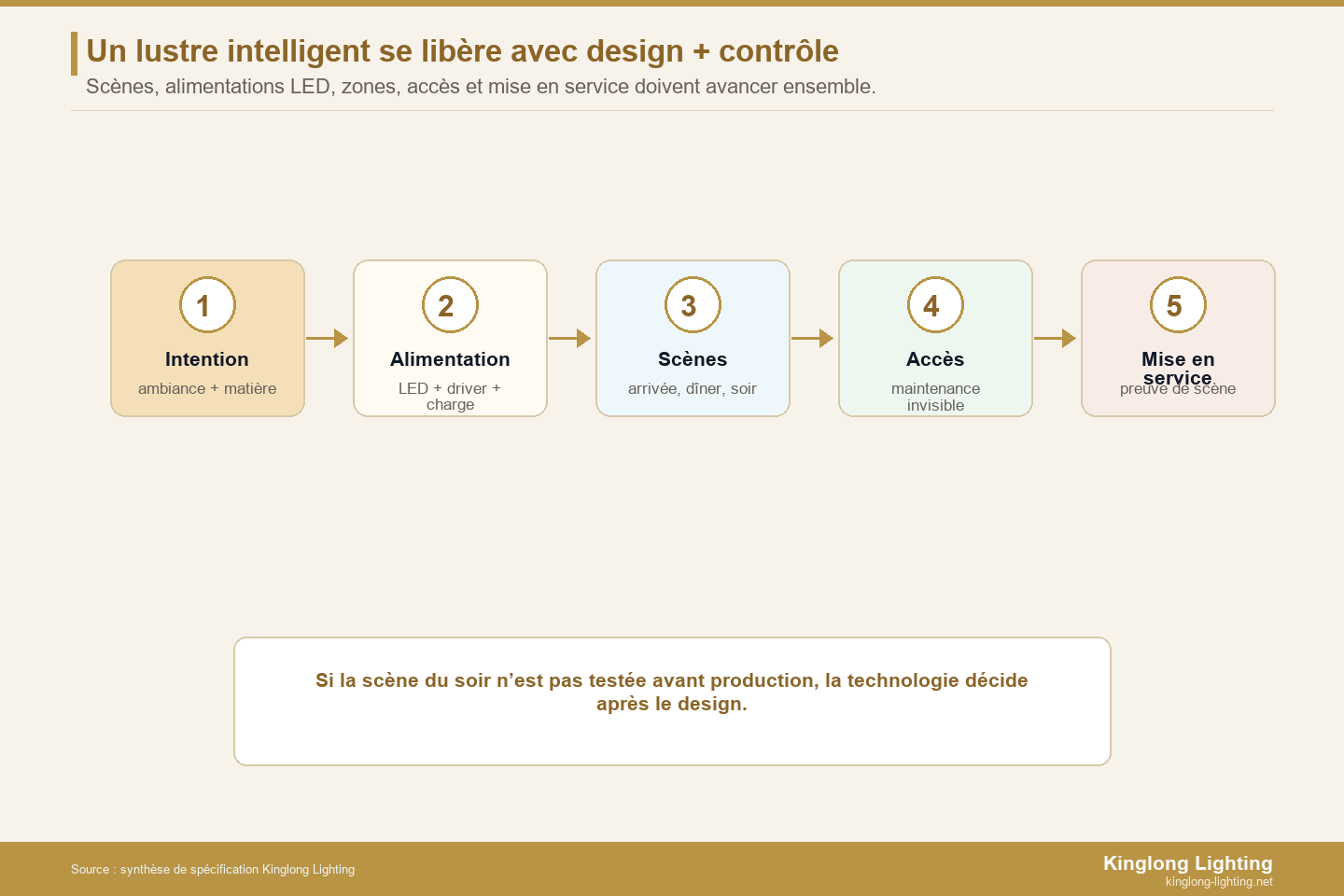
Cacher la technologie sans cacher l’accès service
Un lustre de luxe peut être compromis par des alimentations visibles, des trappes mal placées, un pavillon trop lourd, des câbles confus ou des décisions d’urgence à la mise en service. Cacher la technologie est important, mais cacher complètement l’accès crée un risque de maintenance.
L’équipe doit décider où se trouvent les alimentations LED, comment elles sont atteintes, comment la chaleur est gérée, comment les réglages peuvent être modifiés et comment les pièces remplaçables seront installées. Ces détails doivent rester invisibles pour les invités et visibles pour l’équipe de service.
Le meilleur dossier sépare ce que le propriétaire voit de ce que l’installateur doit atteindre. Cette séparation garde le lustre élégant sans transformer une intervention future en réparation de plafond.
Comment Kinglong Lighting aligne lustre et système connecté
Le processus de personnalisation Kinglong Lighting peut intégrer notes d’alimentation LED, revue d’échantillon, choix de finition, plans, exigences de contrôle et transfert production. Le but est que les contraintes du système connecté soient connues avant que la forme décorative ne soit figée.
L’étape pratique consiste à envoyer les scènes souhaitées, la marque ou le protocole de contrôle, les plans de pièce, l’accès plafond, le style de luminaire et les attentes de gradation via la page contact. Demandez un dossier de libération qui couvre intention design, compatibilité de gradation, accès service et critères de mise en service.
Définir la propriété des scènes avant le câblage
Un lustre connecté échoue souvent lorsque personne ne possède vraiment les scènes. Le designer choisit l’ambiance, l’intégrateur choisit le protocole, l’électricien choisit le câblage, le fabricant fournit les alimentations LED, et le propriétaire découvre le résultat après installation. La propriété des scènes doit être écrite avant le câblage : qui définit la scène d’accueil, la scène dîner, la scène nuit, la scène nettoyage et la scène maintenance ? Chaque scène doit avoir une intention, une plage de gradation, un comportement attendu et une personne responsable de l’approbation.
Le protocole ne doit pas dicter l’esthétique
Un système connecté peut être puissant tout en imposant des limites : type de driver, plage de gradation, nombre de zones, latence, compatibilité ou emplacement des composants. Ces limites doivent être connues avant de figer le lustre. Mais elles ne doivent pas devenir le langage visuel du projet. Le luminaire doit rester élégant ; la technologie doit soutenir l’effet, pas l’expliquer.
La scène nettoyage doit être séparée de la scène luxe
Une scène très brillante peut être nécessaire pour nettoyer, inspecter ou intervenir. Elle ne doit pas être confondue avec la scène d’accueil. Si l’équipe utilise la scène nettoyage pour juger le lustre, elle risque de le trouver trop froid ou trop fort. Le dossier doit donc inclure les deux : une scène fonctionnelle pour service et une scène émotionnelle pour usage quotidien.
Protéger l’accès service sans exposer la technologie
Le compromis esthétique apparaît souvent autour des alimentations LED, boîtiers, trappes et câbles. Les cacher complètement peut rendre le luminaire impossible à maintenir. Les exposer trop clairement peut dégrader l’effet luxe. La solution consiste à prévoir des accès discrets, des composants remplaçables, une carte de câblage et une documentation simple. Le propriétaire ne doit pas voir la technologie au quotidien, mais l’équipe de service doit pouvoir la trouver sans ouvrir un plafond décoratif.
Les drivers doivent être choisis avec le protocole réel
Un driver compatible sur fiche technique peut encore produire une gradation décevante si la charge, le protocole ou la courbe ne correspondent pas au projet. Le dossier doit indiquer charge, tension, protocole, plage de gradation, tests attendus et conditions de remplacement. Cette information doit circuler entre fabricant, intégrateur et électricien local avant expédition.
Le transfert à l’intégrateur doit être un fichier court
Le fabricant ne doit pas livrer seulement un luminaire ; il doit livrer les informations dont l’intégrateur a besoin. Le fichier peut rester court : zones, charge, driver, protocole, plage de gradation, scène approuvée, accès service et limites de remplacement. Ce document évite que l’intégrateur découvre les contraintes au moment de programmer le système. Il protège aussi le propriétaire lorsque l’équipe de maintenance change.
Créer une checklist de mise en service esthétique
La mise en service d’un lustre de luxe doit vérifier plus que l’allumage. La checklist doit regarder démarrage, bas niveau, transition de gradation, absence de scintillement visible, bruit éventuel, mémoire des scènes, confort depuis les sièges et cohérence avec les autres couches de lumière. Elle doit aussi comparer la scène finale aux photos ou notes approuvées. Si la technologie fonctionne mais que l’atmosphère a changé, la mise en service n’est pas terminée.
Cette checklist doit être conservée avec le dossier du luminaire. Lorsqu’un futur technicien remplace un driver ou modifie une scène, il peut revenir à l’intention approuvée au lieu de régler le lustre comme une simple charge électrique.
Elle doit aussi préciser qui peut modifier les scènes après remise. Sans règle, une équipe d’exploitation peut augmenter les niveaux pour résoudre un problème ponctuel et détruire l’ambiance validée. La scène luxe doit rester protégée comme une finition.
Mettre en service la scène approuvée, pas une nouvelle scène
L’intégration échoue lorsque la mise en service devient le premier moment où tout le monde voit la scène réelle. L’échantillon, le comportement de gradation, le niveau bas et l’ambiance de pièce doivent déjà être connus. Si le propriétaire a validé une scène chaude du soir, l’équipe de contrôle doit la reproduire, pas programmer une version plus brillante parce qu’elle est plus simple.
Un bon enregistrement final conserve les photos de la scène approuvée, les pourcentages de gradation, les noms de zones, l’emplacement d’accès aux alimentations LED et la liste des pièces de rechange. Ces informations permettent à une future équipe de maintenance de restaurer l’atmosphère prévue au lieu de traiter le lustre comme une charge électrique générique.
Carte d’action pour lustre connecté
- Nommer les scènes avant d’approuver la forme décorative.
- Confirmer alimentation LED, charge, protocole et plage de gradation.
- Séparer l’éclairage d’identité des couches de tâche et d’orientation.
- Cacher la technologie tout en gardant un accès service réel.
- Comparer la mise en service finale aux scènes approuvées.
Guides associés
- Lustres de chambre parentale : intimité, atmosphère et échelle
- Dimensionner un lustre de salon ouvert
- Achat de lustre de villa : feuille de route
Questions fréquentes
Un lustre de luxe peut-il fonctionner avec un système d’éclairage connecté ?
Oui, si l’alimentation LED, la méthode de gradation, la charge, le protocole de contrôle, l’accès service et la logique de scènes sont étudiés avant production.
Qu’est-ce qui provoque le scintillement d’un lustre connecté ?
Le scintillement peut venir d’une incompatibilité d’alimentation LED, d’une limite de gradation basse, d’une charge mal adaptée, du câblage ou d’un réglage de contrôle. Le test de scène doit précéder la libération.
Le lustre doit-il avoir sa propre zone de contrôle ?
Souvent oui, surtout dans les villas où le lustre porte l’identité pendant que les autres couches soutiennent lecture, circulation, art ou orientation nocturne.
Que faut-il transmettre à Kinglong Lighting ?
Envoyez plans de pièce, scènes souhaitées, système de contrôle préféré, attentes de gradation, contraintes d’accès, matériaux du luminaire et séquence d’installation.