A master bedroom chandelier has a different job from a foyer chandelier. It should not dominate the room like a public arrival object. It should support privacy, rest, dressing, bedside movement, and a warm evening atmosphere without creating glare when someone is seated or lying down.
The best master bedroom chandelier is usually not the largest fixture the ceiling can hold. It is the fixture whose scale, drop, material density, dimming behavior, and color quality make the bedroom feel composed rather than exposed.
Kinglong Lighting can support the decision by reviewing bed size, ceiling height, furniture layout, privacy zones, warm scenes, and material samples before a custom bedroom chandelier is released.
Key Takeaways
- Privacy first: Avoid chandelier positions that expose the bed or create glare from lying positions.
- Scale is quieter: Bedroom chandeliers need proportion, not lobby-level drama.
- Warm scenes matter: CCT, dimming, and material reflection should be tested at evening output.
- Bedside sightlines rule: Review from bed, doorway, dressing area, and seating zone.
- Service should be discreet: Driver access and cleaning should not disturb finished bedroom details.
A bedroom chandelier should feel private before it feels impressive
In a master bedroom, the chandelier is part of the privacy system.
The DOE high-performance residential lighting guide emphasizes residential lighting quality, glare control, and dimming. That matters in bedrooms because people use the room in lower light and from more vulnerable positions than in public areas.
A master bedroom chandelier should be checked from the doorway, bed, bedside seating, dressing area, and bathroom threshold. These viewpoints reveal whether the fixture supports rest or makes the room feel exposed.
The decision rule is to approve atmosphere before drama. A chandelier that looks impressive from the doorway can still fail if it shines into the eye line from the pillow or reflects harshly in mirrors near the dressing area.
The lying-down view is a real design view
Many bedroom chandelier mistakes happen because the team reviews the fixture only while standing. The lying-down view changes everything. A bottom diffuser, exposed lamp point, faceted crystal, or reflective metal underside can feel much brighter when viewed from the bed. The release review should include a pillow-height sightline, not only a reflected ceiling plan or doorway render.
Privacy zones should shape fixture placement
A master bedroom often contains zones: sleep, dressing, seating, circulation, and bathroom transition. The chandelier does not need to center every zone. It needs to support the main room identity while keeping the bed comfortable and the dressing area usable. If a single central fixture creates glare, the design may need a smaller chandelier plus layered cove, bedside, or wardrobe lighting.
Size the chandelier to furniture, not only room dimensions
Bedroom scale is controlled by the bed, nightstands, seating area, ceiling height, and the distance to wardrobes or mirrors. A formula can help, but furniture and privacy decide the final answer.
Calculated from a 4-view bedroom audit, 4 required views minus 1 doorway render equals 3 missing views, which means 75 percent of the comfort decision remains unresolved if the bed, bedside, and dressing views are skipped.
| Bedroom check | What it protects | Risk if ignored | Release evidence |
|---|---|---|---|
| Pillow sightline | lying comfort | exposed light hits the eyes | bed-height view |
| Bed width | visual proportion | fixture feels too small or wide | plan with furniture |
| Dressing mirror | reflection comfort | sparkle becomes glare | mirror-view test |
| Dimming scene | night atmosphere | too bright at low output | driver and control note |
| Service route | quiet maintenance | finished room disruption | access and spare plan |
The DOE TM-30 FAQ is useful because color rendition should not be reduced to a single generic promise. In a master bedroom, color quality affects skin tone, fabric, timber, bedding, and wardrobe finishes.
The PNNL TM-30 guidance helps frame color quality as a tradeoff, which is why the bedroom chandelier should be tested under the warm scene the owner will actually use at night.
Dimming and controls are part of the chandelier specification
The Lutron control guidance matters because control planning changes the way a space behaves. For a master bedroom chandelier, the control logic should include evening, reading, dressing, cleaning, and night movement scenes.
The Lutron layered lighting guide is useful because the chandelier should not carry every lighting job. Bedside lighting, wardrobe lighting, cove lighting, and task lighting can keep the chandelier dimmed enough to feel calm.
In practice, the release file should name CCT, driver type, dimming behavior, control zone, lamp shielding, bottom finish, and cleaning access. A bedroom chandelier that cannot dim smoothly is usually too public for the room.
How Kinglong Lighting can support a calmer bedroom chandelier
Kinglong Lighting’s villa lighting service can review bedroom plans, bed size, ceiling height, finish palette, mirror positions, and scene preferences before recommending scale or material.
The customization workflow can then turn the decision into drawings, samples, CCT targets, dimming notes, and a release file. The practical next step is to send room photos and furniture layout through the project inquiry page and ask for a privacy-first chandelier review.
Kinglong Lighting should also receive the owner’s comfort priorities in plain language: no visible lamp from bed, no mirror sparkle at dressing, low-output stability at night, or a softer material near the pillow view. Those priorities keep the custom review from becoming a generic scale exercise.
Use bedroom-specific approval views instead of public-room views
A master bedroom chandelier should not be approved with the same visual package used for a foyer. Public-room views reward drama, symmetry, and arrival impact. Bedroom views reward privacy, softness, low brightness, and comfort from positions where the person is not standing.
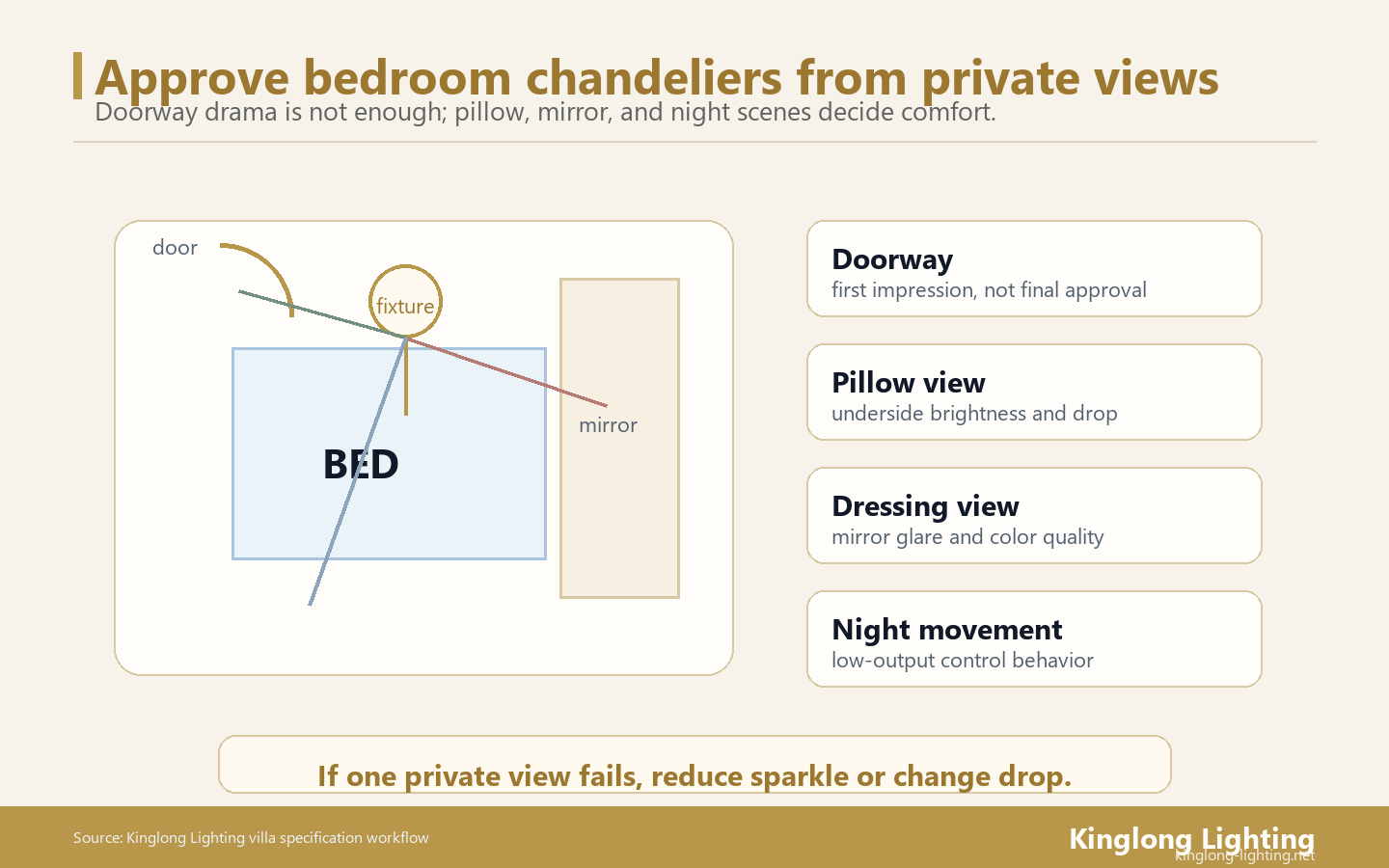
The approval packet should therefore show at least four bedroom-specific views. Each view answers a different question and prevents the chandelier from becoming too public for the most private room in the villa.
The team should also define who can veto the chandelier from each view. The owner may judge pillow comfort, the designer may judge atmosphere, and the installer may judge drop and access. Without that ownership, a bedroom chandelier can pass a dramatic render while still failing the room’s daily privacy.
A good bedroom packet also names the support layers. Bedside lamps, cove light, wardrobe light, and low-level night guidance can each take a job away from the chandelier. That lets the chandelier remain decorative and soft instead of becoming too bright because it is being asked to solve every bedroom task.
The doorway view checks first impression without overexposure
The doorway view still matters because it is the first impression of the bedroom. The chandelier should give the room a composed center and connect to the furniture plan, ceiling detail, and finish palette. But the doorway view should not be allowed to dominate the decision. A fixture that looks perfect from the entrance can still shine into the eyes from bed, reflect in a dressing mirror, or make the night scene too bright. Treat the doorway view as a welcome check, not the final approval.
The pillow view checks underside brightness and drop
The pillow view is the most often missed view. From this angle, exposed lamp points, open crystal clusters, polished metal undersides, and shallow diffusers can feel brighter than expected. The bottom of the chandelier becomes the fixture face. A bedroom approval should therefore include drop height, bottom finish, shielding, and dimming behavior from bed height. If the underside cannot be made comfortable, the team should reduce sparkle, shift placement, or move more light into layered bedside and cove sources.
The dressing view checks mirror reflection and color quality
Dressing zones introduce a different risk because the chandelier may appear twice: once directly and once in the mirror. Crystal that feels elegant in the room can become busy in reflection. Warm glass that flatters the bed area may not support wardrobe color decisions. The dressing view should test skin tone, fabric, timber, metal, and mirror glare under the intended CCT and dimmed level. The chandelier does not need to solve dressing light alone, but it should not damage that function.
The night-movement view checks low-output control
A master bedroom needs a different scene after midnight than it needs during cleaning or dressing. The chandelier may be off, very low, or part of a gentle orientation scene. The control note should define whether the chandelier participates in night movement or stays out of that layer entirely. If the low-end dimming is not smooth, the room can jump from dark to exposed. That is why driver choice, control protocol, and scene ownership belong in the bedroom chandelier specification.
Run the bedroom scene test before freezing the fixture
The bedroom scene test should happen with the room imagined at low output, not showroom brightness. The owner should see how the chandelier behaves during evening entry, bedside reading, dressing, cleaning, and night movement. Each scene can reveal a different risk.
A fixture that feels perfect in a daytime render may become too public at night. A crystal underside may sparkle into the pillow view. A warm glass shade may look beautiful but leave the dressing area under-supported. A dimming curve may step down too abruptly for a private room.
Kinglong Lighting can convert the scene test into a release note: approved CCT, dimming range, bottom finish, driver location, material sample, and service access. That note protects the room after installation because the final adjustment is no longer guesswork.
The final bedroom approval should also define what the chandelier is not responsible for. If reading light belongs to bedside lamps, wardrobe color belongs to cabinet lighting, and night movement belongs to low-level guidance, the chandelier can stay soft. That boundary keeps the decorative fixture from becoming too bright just because other layers were not specified clearly.
The scene test should be repeated when the material changes. A fabric shade, warm glass body, metal ring, or crystal cluster can all pass the same size rule but create different privacy behavior. The approval should therefore lock material, dimming, and bottom view together, not one at a time.
For high ceilings, the same approval should include service access. A chandelier that feels calm from bed can still be difficult to clean or repair if the lower tier cannot be reached without moving furniture or bringing equipment through a finished suite. Privacy, comfort, and maintenance should be approved as one bedroom problem.
A final check should happen after furniture placement is stable. Bed height, mattress thickness, headboard scale, mirror angle, and nightstand lamp height can all change how the chandelier feels from the real user position. If those elements are still moving, the approval should stay conditional rather than pretending the chandelier has been fully proven.
That conditional approval is useful, not weak. It tells Kinglong Lighting which dimensions are locked and which ones may still need a small drop, shielding, or dimming adjustment before production release. The bedroom then keeps its calm tone without asking the chandelier to absorb every late furniture change.
| Scene | Question | Release note |
|---|---|---|
| Evening | Does it feel private? | low-level preset |
| Bedside | Is glare visible from pillow? | bottom shield note |
| Dressing | Are colors accurate? | CCT and color proof |
| Cleaning | Can output and access support service? | service scene and access |
Master bedroom chandelier action card
- Review the fixture from pillow height before approving drop.
- Size to bed, nightstands, seating, and ceiling together.
- Test warm scenes, dimming behavior, and mirror reflection.
- Use layered lighting so the chandelier can stay calm.
- Freeze bottom finish, driver access, and cleaning route.
Related Guides
- Dining Room Chandelier Specification
- Hand-Blown Glass vs Crystal for Villas
- Smart Lighting and Luxury Chandeliers
Frequently Asked Questions
How large should a master bedroom chandelier be?
A master bedroom chandelier should be scaled to the bed, ceiling height, room width, furniture layout, and sightlines from the pillow and doorway. It should feel proportionate rather than public or oversized.
Should a bedroom chandelier hang over the bed?
It can hang near or over the bed if glare, clearance, and lying-down sightlines are controlled. In many villas, a slightly offset chandelier or layered ceiling light can protect comfort better than strict centering.
What color temperature is best for a bedroom chandelier?
Warm light is usually best, often in the 2700K to 3000K range, but the final choice should be tested with bedding, timber, fabric, and skin tone under the intended dimmed evening scene.
What should I send Kinglong Lighting for review?
Send the bedroom plan, ceiling height, bed size, furniture layout, mirror locations, preferred materials, desired mood, control scenes, and any maintenance access limits.