
Evaluate a late finish change by the current material and production stage, the feasibility of the new finish, and the net cost and site-arrival impact of each available route. The same request to replace polished chrome with a warm metallic appearance can be a revised finishing instruction for one part and a replacement decision for another.
For an FF&E procurement manager or consultant, the immediate task is to establish what has actually been committed. Ask the manufacturer to identify affected parts and quantities before anyone promises a surcharge or recovery date. Then compare the technically credible options against the appearance the designer wants and the date the site needs them.
A Finish Change Is a Route Decision, Not a Flat Surcharge
The same finish request can mean redirecting an unstarted process, validating rework on finished parts, or remaking parts; stage and substrate decide which routes are credible. A price comparison is useful only after the manufacturer has identified a process it can actually carry out on those parts.
The substrate is the base material beneath the finish. Its identity matters because a new colour name does not tell you whether the existing metal, preparation and coating system remain suitable. Nor does a part being unassembled mean its surface is still unfinished.
Keep the decision in this order: define the requested result, locate each quantity in production, assess feasible routes, and compare the net cost and revised site arrival. Retaining the accepted finish is a legitimate option when the proposed change cannot meet the project’s technical, visual or timing requirements.
Define the New Finish Before Asking for an Impact Quote
Identify the old and new finish references, material, surface texture, sheen, affected parts and approval conditions before asking for a binding change-impact quote. “Change to brass” could mean solid brass, brass-coloured paint or a plated appearance; those are not interchangeable instructions.
Collect these references alongside the current drawings. Kinglong’s lighting project resources provide a starting point for available project information; the change request still needs its own identified original and replacement references.
Name the fixture codes and visible components: canopy, stems, arms, fasteners and decorative covers may not all need the same change. Include the accepted original sample and the proposed replacement reference. State the viewing conditions and whether the change concerns colour, brushing direction, gloss, texture or several characteristics together.
ASTM D523 covers specular gloss measurement of nonmetallic specimens and notes that texture, reflection haze and reflected-image clarity also affect appearance assessment. A gloss value is therefore not a complete description of the requested look, and this method should not be presented as a complete metallic-finish acceptance test.
If the replacement sample is not approved yet, ask for a conditional assessment rather than treating a preliminary colour suggestion as the final manufacturing instruction.
Check Whether the Existing Parts Can Take the New Finish
Confirm the actual metal, current surface preparation, existing layers and proposed finish process before deciding whether parts can be reused. A change within the same coating family is a different question from changing a plated surface to another process or changing the base material itself.
The scope of ASTM B456 describes specified copper/nickel/chromium and nickel/chromium electrodeposited coating systems on identified base metals for appearance and corrosion protection. That is a useful distinction from a colour label: a decorative plated finish is a coating system on a particular base, not simply a shade that can always be swapped.
Ask the finishing specialist whether the proposed route requires removal of existing layers, renewed polishing or preparation, different components, or remaking the part. Have them assess whether the operation could affect dimensions, threads, edges or the appearance of a thin decorative feature. This is a feasibility question, not a request for the buyer to select a stripping chemistry.
Kinglong Lighting describes drawing review for feasibility, material selection and structural optimization in its custom lighting development process. Use that discussion to identify the affected drawings and materials. A project-specific review is still needed before treating any existing part as suitable for the new finish.
Route the Request by the Actual Production Stage
Record quantities at material purchase, uncoated fabrication, plating or coating, assembly and packing separately; a single in-production label hides different available routes. Ask for a current stage report tied to the affected fixture and part codes.
| Actual state | Route to investigate | What can change the decision |
|---|---|---|
| Material not yet committed | Confirm the new material/process and replace the unstarted finish instruction after approval. | Availability, new sample requirements and whether the original material specification changes. |
| Material purchased; fabrication unfinished | Check whether stock can serve the new route before canceling or ordering replacements. | Usable material, returnability, supplier commitments and changed fabrication details. |
| Parts fabricated but not plated or coated | Validate the new preparation/finish route on the existing parts. | Surface quality, material compatibility, masking, sample acceptance and finishing capacity. |
| Plating or coating completed or underway | Compare validated rework with new parts or retaining the accepted finish. | Actual completed layers, part condition, removal/reapplication feasibility and verification evidence. |
| Assembled or packed | Add disassembly, protected component handling, reassembly, checks and repacking to any viable finish route. | Access, possible damage, electrical or mechanical effects, packaging and remaining site time. |
The stage row identifies what to investigate; it does not grant permission to rework. Confirm whether any proposed hold applies only to affected parts or whether continuing assembly would create additional work that later has to be undone.
For a manufacturer-specific powder-coating example, TIGER’s processing guide warns that a touch-up system can differ from the original coating in optical, mechanical, chemical, UV and weather-resistance properties. Its recoating discussion calls for preparation and suitability checks and also contains architectural-application and warranty limitations. This is not a universal permission to overcoat a decorative luminaire. Obtain the instructions and acceptance evidence for the actual system proposed.
A Decision Tree for Rework, Remake or Retaining the Finish
First establish material compatibility, then separate unfinished parts from coated or assembled parts, validate any proposed rework, and compare the viable route against cost and site-arrival constraints. Use the following branches for each affected part group, not just for the order as a whole.
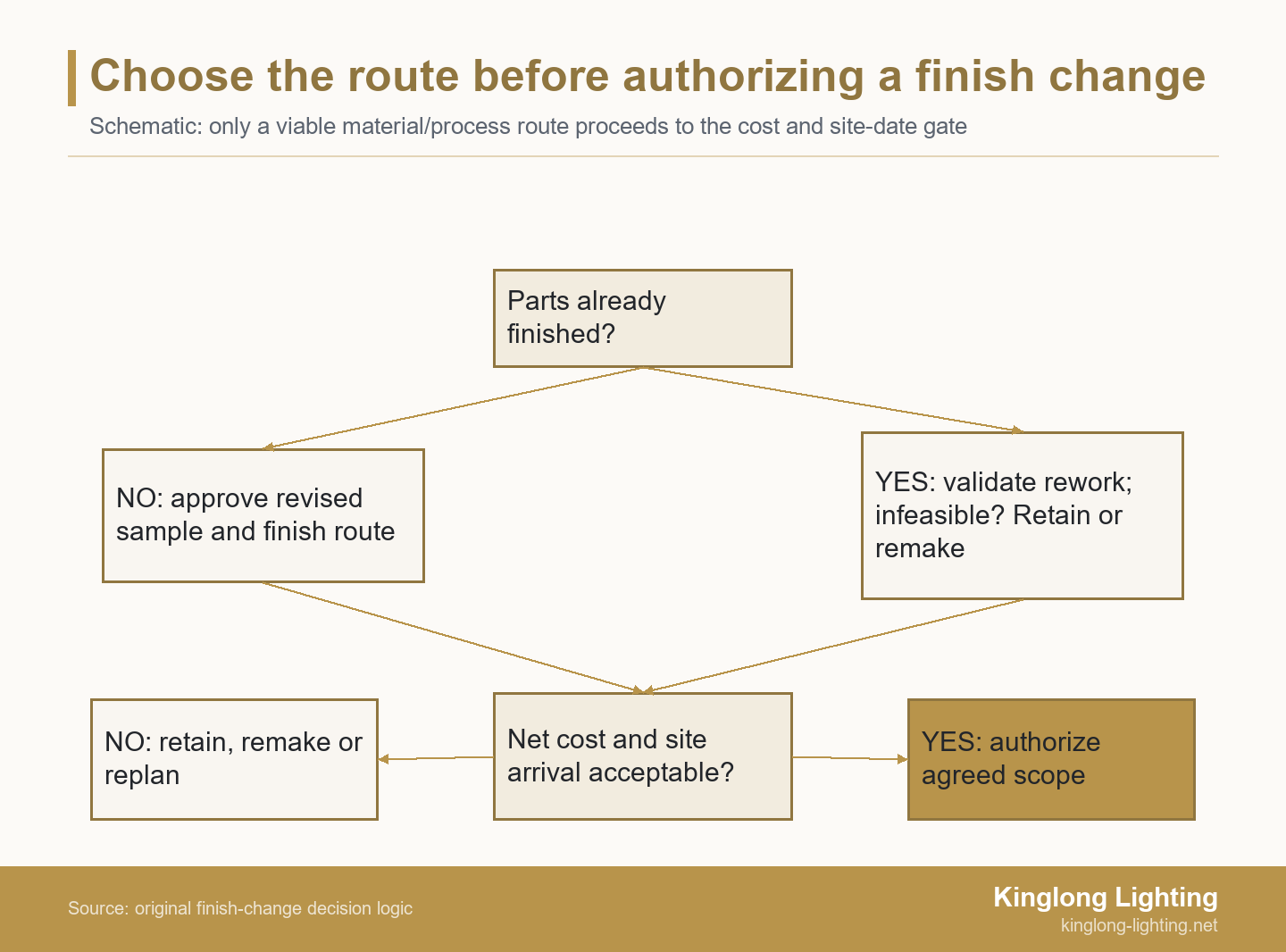
Define the visible matching group while considering a reduced scope. A project portfolio can help explain the room composition and visual relationship you mean; it does not prove that a proposed finish-rework method has been tested.
- Can the existing material and geometry support the new finish? If no, compare remaking suitable parts with retaining the accepted finish. If uncertain, obtain a technical assessment before pricing the route as confirmed. If yes, identify the actual stage.
- Are the affected surfaces still unfinished? If yes, agree the replacement sample, revised process and purchasing instructions. If no, require a specific rework proposal, including any dismantling or replacement parts. An attractive colour reference alone does not validate rework.
- Has the proposed rework been shown suitable for representative parts? If no, hold the affected route or choose retention/remake. If yes, identify the verification scope and proceed to the commercial and scheduling decision.
- Are the net quote and revised site arrival acceptable? If yes, authorize the named parts, reference and scope. If no, compare retaining the original, remaking, reducing the change scope or an expressly approved phased installation. Do not silently mix finishes to protect a date.
Build a Net Change Quote Without Counting the Same Work Twice
Compare incremental work, nonrecoverable commitments and change-related delivery costs, deducting confirmed credits and avoided original work once. Keep the original contract amount separate from the net variation so the buyer can see what actually changes.
| Quote line | Request this basis | Check for duplication |
|---|---|---|
| Samples and technical review | Defined replacement sample, process assessment and approval scope. | Separate new work from development already included. |
| Material or components | Quantity needing replacement and confirmed cancellation/return position. | Do not count full material replacement and a recoverable stock value as the same loss. |
| Finish rework or new finishing | Actual removal/preparation/reapplication or a new-part route. | Deduct original finishing work that will not be performed, where credit is agreed. |
| Handling and verification | Disassembly, protection, checks, reassembly and repacking required by the change. | Distinguish change-related work from the original assembly allowance. |
| Delivery consequences | Agreed storage, split shipment, transport change or site return work. | Show the increment against the original delivery plan. |
A useful net comparison is additional work and unrecoverable change commitments, plus agreed delivery consequences, less confirmed credits and avoided original work. Do not invent a scrap allowance or assume stock has a refund value; ask for the basis.
When evaluating a less disruptive alternative, use the decorative lighting value-engineering guide to frame which visual and functional requirements should be protected.
Calculate Site Arrival from the Remaining Work, Not a Generic Delay
A credible revised site-arrival date needs the remaining approval, material, finishing, verification, assembly, packing and transport dependencies, using confirmed durations and actual available slots. A finishing duration by itself is not a delivery commitment.
A critical path is the path of longest duration through a sequence of activities, as GAO describes in its project-scheduling discussion. This general scheduling concept does not provide a lighting lead time. It explains why the buyer needs linked activities: some can overlap, while others cannot begin until an approval or predecessor is complete.
Ask when the replacement sample can actually be reviewed and who will respond. Then ask which material, finishing and assembly slots remain available at that approval date. A quoted process duration does not show the waiting time before the work can enter the line, and a missed shipping departure can change the arrival plan even if factory work finishes as estimated.
Separate the previous committed arrival, the currently forecast arrival under the proposed change and the site’s required date. Identify the event that starts each duration and whether it uses working or calendar days. Where the supplier cannot confirm an input yet, keep the date conditional on that input rather than presenting a single firm promise.
Finally, confirm the site’s installation sequence, storage and access. A split delivery only helps if the relevant space can use it and the buyer accepts the visual and commercial implications. Escalate a forecast that misses the required date before authorizing the irreversible work.
Verify the Reworked Part Before Releasing the Affected Set
Agree representative verification before applying a proposed rework to the remaining affected parts. Check more than the new colour: the process may also affect coating adhesion, surface condition, fit, assembly or the requirements that originally made the fixture acceptable.
ASTM B571 covers qualitative adhesion tests for metallic coatings; permitted equivalent panels need the same material, surface finish and preplating, electroplating and postplating cycle as the represented parts. This is not a test prescription for every finish. It illustrates why evidence from an unrelated coupon cannot automatically validate the proposed rework on your fixture.
Have the finishing specialist select the applicable method and acceptance requirements for the actual coating system and application. Compare a representative reworked part with the accepted new reference under agreed conditions. Include difficult edges and visible junctions rather than looking only at an easy flat surface.
If the route requires dismantling an assembled fixture, have the manufacturer identify the mechanical and electrical checks affected by disassembly and reassembly. Protect components that are outside the finish scope. Do not assume an appearance approval also confirms electrical safety or the continuing applicability of earlier product evidence.
Record what the first reworked part demonstrates and what remains to be checked on the affected supply. A successful first piece supports that demonstrated route; it is not evidence that every remaining part has already passed. Retain the new reference and the authorized scope for subsequent inspection.
Illustrative Change: Matching a Restaurant Pendant Set
This illustrative restaurant change affects 24 pendants: 16 have finished metalwork and 8 remain uncoated; it is not a Kinglong case or measured cost or schedule result.
The designer requests a warmer finish for pendants installed in one continuous sightline. The stage report shows that the unfinished parts could enter a revised finish process, but the completed metalwork needs a separate rework assessment. Finishing only the uncoated quantity immediately would not answer whether the entire visible set can match.
The buyer therefore requests a representative rework proposal and an alternative quote for replacement metalwork. Both options include the already finished and unfinished groups, the new sample reference, verification and a complete arrival sequence. No coating feasibility, recoverable value or process duration is assumed merely from the quantity split.
If the representative rework is acceptable and the combined plan meets the agreed cost and site constraints, the buyer can authorize the stated route for the set. If rework fails or the revised arrival is unacceptable, the decision returns to remake, retain the accepted finish or approve a different installation plan. The important result is the decision boundary, not a claimed saving: a split manufacturing status does not justify an unapproved split appearance.
Send a Finish-Change Brief the Manufacturer Can Evaluate
Submit the old and requested finish references, fixture and part codes, quantities by stage, substrate/process information and required site date for project-specific review. Add the visible matching group and the person responsible for appearance approval.
You can send the finish-change package for discussion with Kinglong. Ask the team to review drawing feasibility, material selection and sample-development needs, then agree the assessment scope and missing information. Request a project-specific change proposal once the route is defined; do not treat the discussion as guaranteed rework success, a fixed turnaround or an automatic instruction to proceed.
Frequently Asked Questions
Is a finish correction the same as a customer-requested change?
No; a failure to meet the accepted finish reference is different from requesting a new reference after approval. First compare the supplied or in-process part with the documented acceptance basis. Keep a possible nonconformity and a voluntary design variation distinct when assigning the investigation and commercial discussion. Do not relabel a potential defect as a customer change simply because correcting it would involve finishing work.
Can we change only the pieces that have not been coated?
Only if the resulting visible set and the agreed project requirements remain acceptable. A quantity split in the factory is not automatically a suitable visual boundary in the room. Identify which fixtures share a sightline or repeated composition, and obtain the relevant design approval for any reduced scope. Keep part codes, replacement references and installation allocations clear so a planned distinction does not become an accidental mixed delivery.
Can site touch-up preserve the original finish performance?
Do not assume it can; the proposed repair system and the actual application need their own suitability review. Ask about appearance, adhesion, exposure, cleaning conditions and the effect on applicable manufacturer or product terms. A small local repair and a full finish conversion are different scopes. Identify who performs and accepts the work, and do not treat a convenient site application as automatically equivalent to the original factory process.
Can expediting avoid all delay after a finish change?
No; expediting can only shorten activities that can actually be accelerated without bypassing necessary approvals or verification. Ask which activity a proposed rush charge changes, what slot or transport arrangement it secures and which dependencies remain. Paying for faster shipment does not make an unapproved sample ready or establish a viable rework process. Assess the revised arrival against the site’s installation need, not against the label “urgent.”