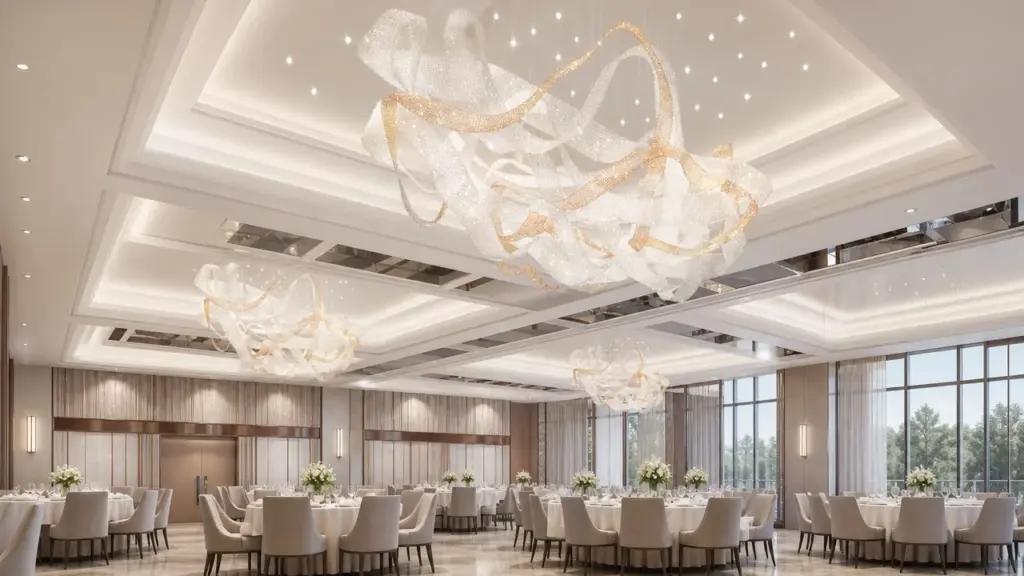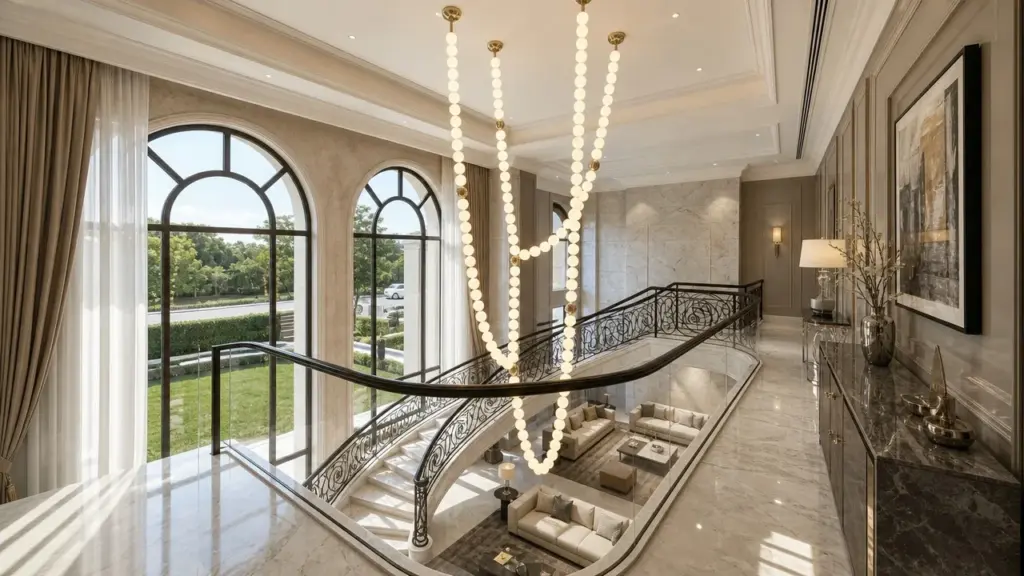
Hand-blown glass and crystal tubes should not be selected by glamour alone; the better lobby material is the one that fits viewing distance, brand identity, maintenance access, and sample repeatability. A boutique resort may need the soft irregularity of glass to make the arrival feel human and crafted. A grand urban lobby may need the sharper modular rhythm of crystal tubes so the fixture remains readable from the porte-cochere, mezzanine, and elevator lobby. The material decision is therefore a project-control decision, not a decorative mood board vote.
Based on our analysis, a practical selection model gives 30% weight to brand identity, 25% to optical control, 25% to maintenance access, and 20% to repeatability from sample to production. Under those assumptions, hand-blown glass often wins a boutique resort scenario where texture and near-field emotion matter most, while crystal tubes often win a tall grand lobby where repeatable sparkle, module density, and replacement logic carry more weight. The numbers are not an industry statistic. They are a way to force the right sample questions before a custom chandelier is released.
Key Takeaways
- Do not buy only by sparkle: Material choice changes glare, mood, cleaning, replacement, and sample risk.
- Hand-blown glass favors emotion: It suits close viewing, organic hospitality concepts, and softer shadow patterns.
- Crystal tubes favor control: They suit tall lobbies, repeated modules, sharper highlights, and clearer spare logic.
- Color quality still matters: Review both materials under the target CCT and color rendition metrics, not showroom lighting.
- Procurement needs proof: Ask for sample photos, module drawings, cleaning access, spare policy, and packing plan before deposit.
Choose material by viewing distance, not glamour language
The first material question is where the guest sees the chandelier from, not which material sounds more luxurious.
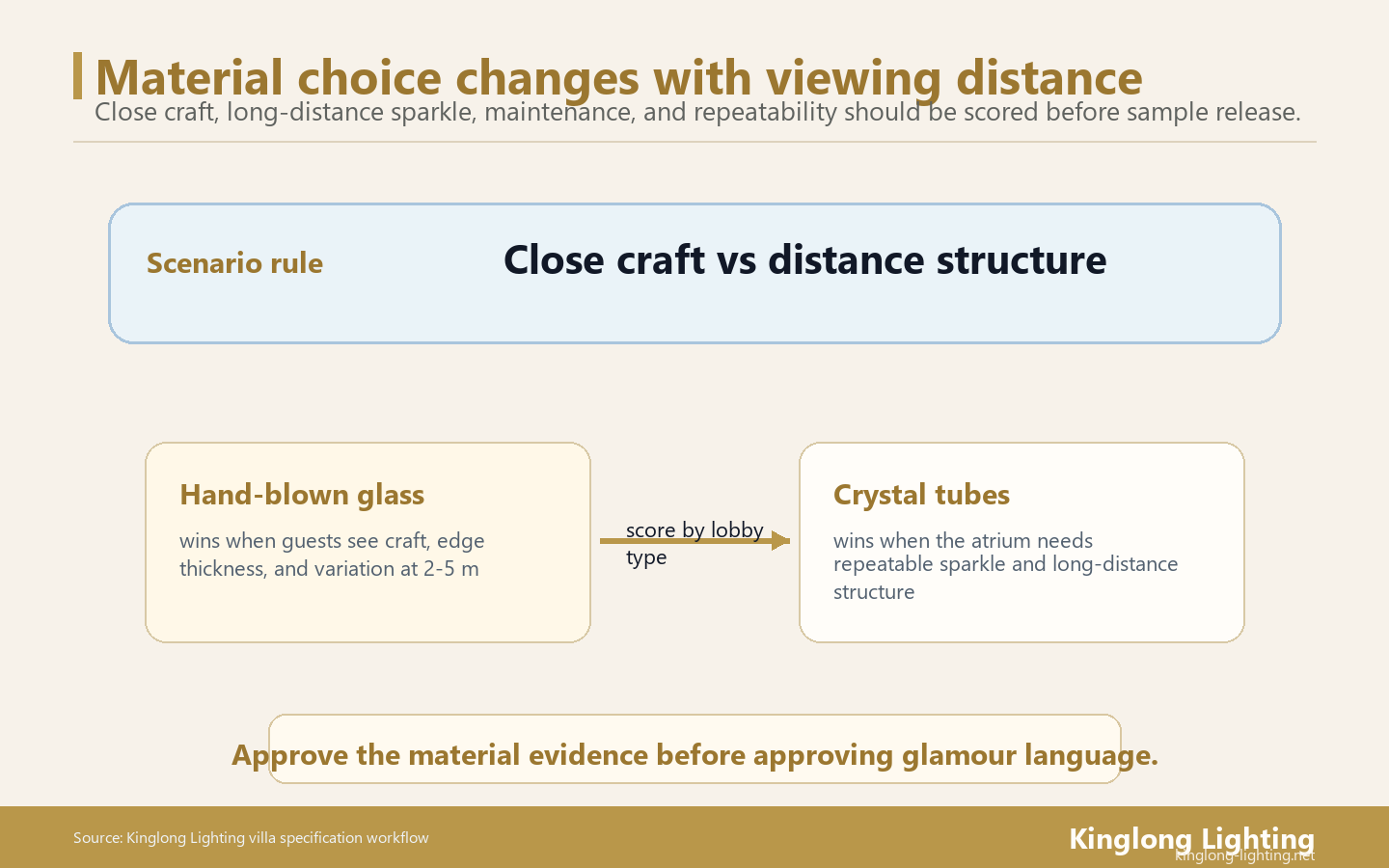
A lobby chandelier is read from multiple distances. At 2-5 meters, guests see edge thickness, bubbles, curvature, and how a glass element catches skin tone. At 8-20 meters, they read silhouette, brightness distribution, and whether the fixture still looks intentional against a high ceiling. Hand-blown glass can give a close-range sense of craft because each element carries slight variation. Crystal tubes can hold a more disciplined rhythm across a larger span because repeated modules preserve density and alignment.
The IES Lighting Library is useful here because it treats lighting as a visual performance discipline rather than a catalog finish choice. The so what for hotel procurement is simple: material selection should be tested under the actual viewing path. A sample that looks beautiful on a conference table can read too busy in a low boutique ceiling or too weak inside a 10-meter volume.
Hand-blown glass gives close-range character
Hand-blown glass is strongest when the lobby concept wants tactility, imperfection, and a warmer handcrafted cue. It can soften LED points, create irregular edge highlights, and make the fixture feel less industrial. That advantage is valuable in resorts, boutique hotels, villas, and hospitality spaces where guests will stand close to the chandelier, take photos under it, or read the material as part of the brand story. The risk is repeatability. If the approved sample has a certain thickness, tint, and bubble pattern, the production lot must be checked so the final chandelier does not drift into a different visual language.
Crystal tubes give long-distance structure
Crystal tubes are strongest when a lobby needs readable brightness and repeated geometry. In a tall space, a large cluster of small expressive pieces can dissolve into visual noise, while tubes can form vertical rhythm, layered density, and cleaner light return. Kinglong Lighting’s Crystal Tube Series is relevant because it gives specifiers a modular reference point for this kind of controlled sparkle. The risk is that a tube-based scheme can become cold or overly formal if CCT, dimming range, and ceiling finish are not tested together. A second risk is module crowding: too many tubes can produce density without hierarchy, so the drawing should show spacing, suspension levels, and replacement access.
Use color science to stop material arguments from becoming subjective
When two materials both look premium, color rendition and sample lighting decide which one will behave better in the lobby.
DOE guidance on TM-30, color rendition uses a multi-metric vocabulary rather than one vague promise. IES also notes in its position on TM-30 that color specification should be handled case by case. For a hotel lobby chandelier, the decision meaning is practical: compare hand-blown glass and crystal tubes under the same LED engine, target CCT, dimming level, ceiling finish, and background material. If one material changes the perceived warmth of marble, brass, timber, or skin tone more than expected, the sample approval should catch that before production.
Material samples should be photographed and reviewed at several dimming levels. A hand-blown element may look rich at 2700K but yellowed at lower dimming if the source shifts too warm. A crystal tube may look brilliant in a showroom but produce hard highlights against polished stone. The evidence does not have to be complicated: one sample board, one controlled light source, one finish board, one viewing-distance photo set, and one written release rule can prevent a long subjective debate.
Run a weighted material scenario before sample approval
A material framework is useful only if it turns a taste debate into a release condition.
For a boutique resort lobby, assume brand identity receives 30 points, optical control 25, maintenance 25, and repeatability 20. If hand-blown glass scores 28, 18, 16, and 14, its total is 76. If crystal tubes score 20, 22, 20, and 18, their total is 80. That result does not automatically choose crystal tubes; it exposes the exact trade-off. The designer may still prefer glass, but procurement now knows the selection needs stronger maintenance and repeatability proof.
For a tall grand hotel lobby, the same model might give crystal tubes 24, 23, 21, and 18 for a total of 86, while hand-blown glass receives 25, 17, 15, and 13 for a total of 70. The decision rule is not “crystal is better.” The rule is that a tall atrium punishes weak long-distance structure more than a low, intimate lobby does. In practice, the model helps the owner ask for the right mockup: distance photos, density drawings, cleaning access notes, and spare-module policy.
Make the decision part of Kinglong’s custom lighting workflow
Kinglong Lighting’s custom lighting workflow is a natural place to resolve this decision because the material choice affects drawings, samples, module spacing, packing, installation sequence, and future replacement. The brand question is not whether hand-blown glass or crystal tubes are more “premium.” It is whether the chosen material can be specified, repeated, transported, installed, cleaned, and supported after opening. A beautiful element that cannot be matched later creates operational risk for the hotel.
The Mofun Design Platform is relevant when the dispute is scale rather than material. A 3D review can show whether a tube cluster reads too dense in a boutique lobby or whether glass pieces disappear in a tall volume. That visual proof should sit beside sample proof. Together, they let the design team preserve emotion while procurement protects delivery.
Request material proof before deposit
| Proof item | Hand-blown glass risk | Crystal tube risk | Release evidence |
|---|---|---|---|
| Sample under final CCT | Tint or thickness shifts mood | Highlights become too sharp | Photo set at target CCT and dimming levels |
| Viewing distance mockup | Texture disappears in tall lobby | Pattern feels too formal close up | 3D view plus sample distance photos |
| Maintenance access | Fragile shapes slow cleaning | Tube count increases handling time | Cleaning method and replacement sequence |
| Production repeatability | Batch variation changes identity | Density drift changes sparkle | Approved tolerance and lot evidence |
Safety and market access evidence should not be treated as an aesthetic afterthought. UL’s luminaire testing and certification, OSHA’s NRTL program, and IEC’s IEC 60598 luminaire standard family all point to the same procurement lesson: a decorative material still lives inside a tested lighting product. Material beauty does not replace electrical, structural, installation, and maintenance evidence.
Related Guides
- Hotel Lobby Color Temperature Standards
- Sculptural vs Cluster Chandelier for Hotel Brand
- Hotel Lobby Chandelier Volume Formula
Material Selection Action Card
- Define viewing distances before choosing the material.
- Compare both materials under final CCT and dimming.
- Ask for sample-to-production repeatability evidence.
- Name cleaning access and spare-module expectations.
- Send lobby photos, ceiling height, finish board, and target mood through the custom chandelier material inquiry.
A material release file should protect both guest perception and replacement logic
The glass-versus-crystal decision should not end with a mood-board preference. The release file should show what the guest sees at close range, what the lobby reads from the entrance, how the material behaves under the target CCT, and how the hotel will replace damaged elements later. Hand-blown glass can carry craft and irregularity beautifully, but that same irregularity must be controlled enough for approvals, packing, and future service. Crystal tubes can give sharper structure and repeatability, but they can also feel cold if the lobby needs a softer residential cue.
Separate close craft from long-distance structure
The first approval question is viewing distance. In a boutique lobby, guests may sit close enough to read bubbles, edge thickness, and hand-worked variation. In a tall atrium, the same details may disappear, while silhouette, sparkle rhythm, and density become more important. The material file should therefore include both near-view and far-view sample photographs, not only a polished render. That evidence lets the designer say which material supports the intended arrival experience.
Freeze a replacement rule before production
Replacement logic is often ignored until the first piece breaks. The project should state whether future replacement pieces must match exact shape, approximate color, batch variation, tube diameter, connector type, or optical density. If hand-blown glass is used, the acceptable variation range should be photographed and signed. If crystal tubes are used, the file should name dimensions, finish, fixing method, and spare quantity. Kinglong Lighting can then connect the sample decision to production and service records instead of treating the material as a one-time decorative purchase.
Make the sample answer a procurement question
The final material packet should include selected material, rejected alternatives, sample photos, CCT condition, finish reference, packing risk, cleaning method, and spare strategy. That packet gives purchasing a way to compare suppliers beyond price. It also gives the hotel a clear reason when one option costs more: the premium is tied to guest perception, replacement confidence, or reduced service ambiguity.
Set a boundary for hybrid material solutions
Some hotel lobbies need a hybrid answer: hand-blown glass near lounge seating and more repeatable crystal or tube elements in the high atrium zone. That can work, but only if the boundary is deliberate. The release file should state which material controls the guest’s close view, which material controls long-distance rhythm, and how the two families meet at connectors, finishes, CCT, and cleaning access. Without that boundary, a hybrid chandelier can become two unrelated fixtures sharing one ceiling point.
Before deposit, the practical next step is to send Kinglong Lighting the lobby height, viewing distances, material intent, close-up sample preference, and future replacement expectation. The supplier response should confirm what can be repeated, what will naturally vary, and what evidence the buyer should approve before production release.
The material board should also record the lighting condition used for approval. Glass and crystal can change character under warm decorative scenes, high-output lobby scenes, and daylight spill from the entrance. If the sample is approved under only one condition, the final lobby may surprise the owner after commissioning. A simple approval note with CCT, dimming level, background finish, and viewing distance prevents that misunderstanding.
Frequently Asked Questions
Is hand-blown glass better than crystal tubes for hotel lobbies?
No. Hand-blown glass is better when the lobby needs close-range craft, organic variation, and a softer emotional cue. Crystal tubes are better when the lobby needs long-distance structure, repeatable density, and clearer replacement logic.
Should both materials be tested under the same lighting?
Yes. The sample review should use the target CCT, dimming range, ceiling finish, and nearby interior materials. Otherwise the team may approve material behavior that will not appear in the finished lobby.
What should procurement request before deposit?
Request sample photos, module drawings, finish and CCT notes, cleaning access, spare policy, packing plan, and production evidence. The decision should be released only when design emotion and operational proof agree.