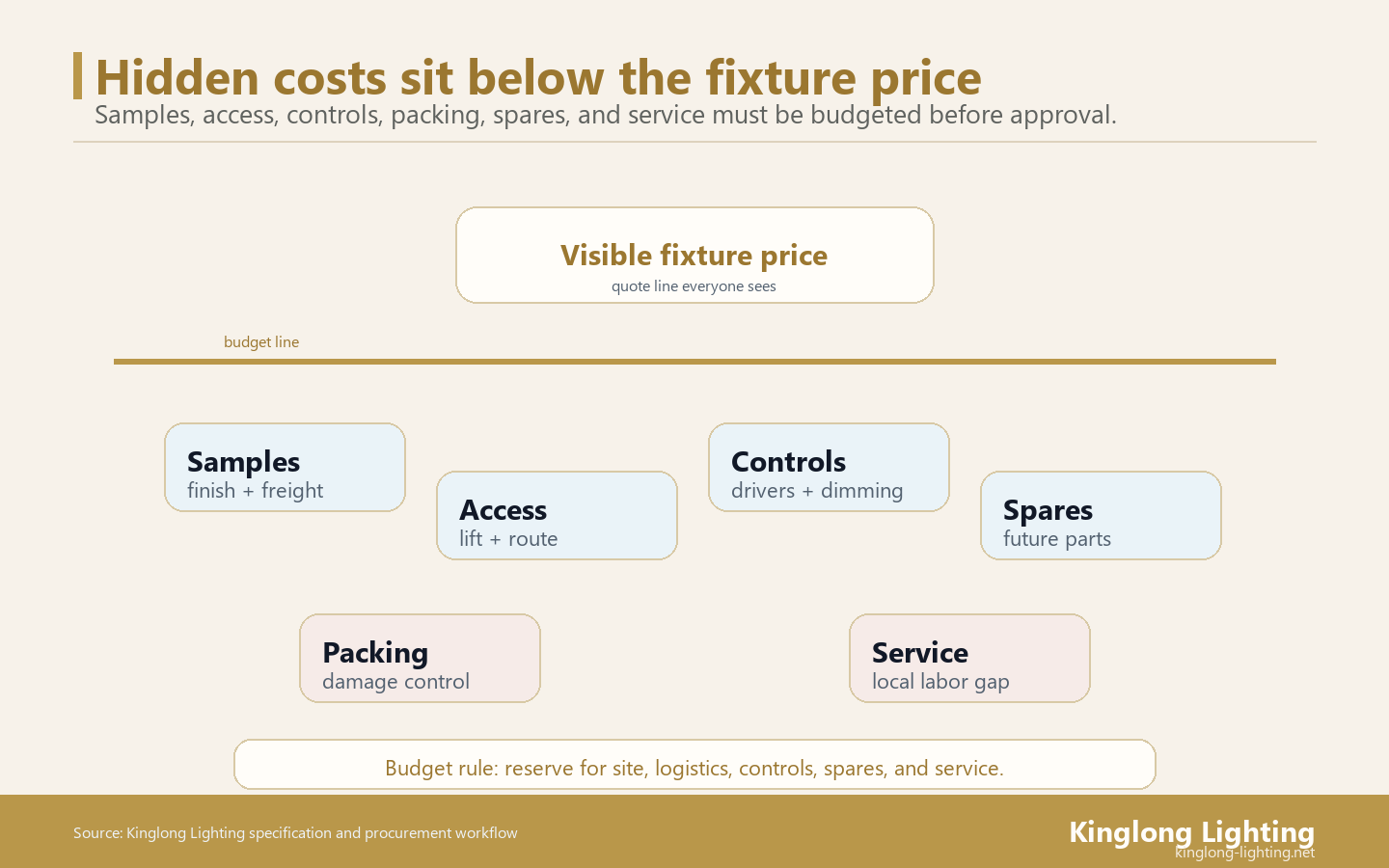
Villa lighting hidden cost usually appears after the owner has already approved a beautiful fixture. The visible price may cover the chandelier, but the real project budget can also include samples, drawing revisions, special finishes, access equipment, electrical coordination, controls, packing, shipping, spares, maintenance, and change requests.
The goal is not to make every villa lighting project expensive. The goal is to name the predictable extras before they become emotional surprises. A hidden cost is often not hidden because anyone intended to deceive the owner. It is hidden because the brief did not force the team to decide who owns the supporting work.
Kinglong Lighting can help owners budget better when decorative lighting is treated as a project file, not only a fixture order. The villa lighting project path should connect visible design choices to the site, logistics, installation, and handover costs that follow.
Key Takeaways
- Fixture price is not project cost: The budget should include supporting work that makes the chandelier installable and maintainable.
- Samples and revisions need rules: Without a sample allowance or revision boundary, small preference changes become budget drift.
- Access can be a major hidden cost: Lift, scaffold, protection, after-hours labor, and service route should be discussed early.
- Shipping and spares are budget items: Fragile custom pieces need packing, replacement logic, and sometimes critical spares.
- A support allowance reduces panic: A realistic contingency helps the owner decide calmly when predictable extras appear.
Separate fixture price from project budget
Villa lighting budget control starts by naming the work that sits around the chandelier, not only the chandelier itself.
The first budget mistake is comparing only fixture prices. A custom chandelier that looks less expensive can become more expensive if samples, drawings, packing, freight, installation support, controls, access, spares, and maintenance are excluded.
The ICC Incoterms 2020 page gives a useful boundary because international delivery responsibility should be named before goods, crates, and spare parts move. For project buyers, the practical action is to define shipping responsibility, insurance, documents, customs, and destination handoff before the owner accepts a price.
Ask what the quote does not include
A useful quote should say what is included and excluded. Owners should ask about samples, shop drawings, finish revisions, mock-ups, spare parts, packing, freight, insurance, duties, taxes, installation, local electrical work, controls, access equipment, and maintenance documentation.
This is not a negotiation trick. It is how the owner compares vendors fairly. A quote with clearer exclusions may be more trustworthy than a low quote that leaves every supporting cost for later.
Budget categories should match decision stages
A villa lighting budget can be organized by decision stage: concept, samples, drawings, production, logistics, installation, commissioning, and support. Each stage has a different cost risk and a different owner decision.
This structure helps the owner see where a late change will land. A finish change before sample approval is one cost. A finish change after production is a different cost. A route problem after shipment is different again.
Samples, finishes, and revisions create quiet cost drift
Luxury lighting projects often drift through small choices rather than one large change order. A second finish sample, a revised glass tone, a denser crystal layout, or a new drop after furniture changes may look minor but can affect multiple teams.
The DOE lighting design page gives a useful boundary because lighting decisions should be judged around the whole space and its use, not only fixture appearance. For project buyers, the practical action is to connect budget choices to whole-room lighting quality and use, not only decorative preference.
Sample budgets need an approval boundary
The owner should know how many sample rounds are included, what counts as a supplier correction, and what counts as an owner preference change. Without that boundary, the sample process can feel open-ended.
A sample allowance is not waste. It is a controlled way to protect the final room. The hidden cost appears when the project has no rule for when sampling ends and production begins.
Color and material changes affect more than appearance
Changing glass, crystal, metal, diffusion, or LED appearance may affect sourcing, production sequence, driver choice, packing, and inspection. It may also require a new sample or drawing note.
The DOE LED lighting page gives a useful boundary because LED performance, heat, service life, and operating behavior need to be part of luminaire decisions. For project buyers, the practical action is to include LED behavior, driver expectations, color, heat, and service assumptions when budget decisions affect light quality.
Site access is often the underestimated line item
Villa owners may budget for the chandelier but not the work required to install or service it. Access can include lift rental, scaffold, after-hours labor, floor protection, ceiling access, route clearing, local permits, or special handling.
The OSHA aerial lifts page gives a useful boundary because overhead installation and later service require planned access and trained site practice. For project buyers, the practical action is to include work-at-height planning, access equipment, and protection when estimating installation cost.
Installation access should be priced before production
Access should be discussed before production because it can affect module size, canopy design, driver location, packing, and installation sequence. If the team discovers the access problem after the fixture is built, the owner has fewer options.
The budget should ask whether the installation needs lift equipment, furniture removal, floor protection, stair protection, ceiling opening, or specialized installers. These are not decorative costs, but they protect the decorative investment.
Future service access is a hidden ownership cost
A chandelier that is difficult to reach may cost more to clean, adjust, or repair. The owner should ask whether drivers, glass pieces, crystal strings, and canopy fasteners can be serviced without damaging finishes.
Future service is often cheaper to solve during design than after handover. A remote driver location or modular access note may cost more upfront but reduce future disruption.
Controls, electrical work, and local review need their own budget
Decorative lighting is often purchased visually, while control and electrical coordination are treated as someone else’s problem. That creates hidden cost when the installed fixture needs local electrical adjustment, dimming compatibility work, scene programming, or authority review.
The NFPA 70 National Electrical Code page gives a useful boundary because electrical installation and field acceptance decisions need local qualified code review. For project buyers, the practical action is to keep local electrical work and code responsibility separate from the manufacturer fixture price.
Dimming and scenes can change the real budget
A custom chandelier may require specific drivers, dimming behavior, control channels, or scene programming. If those expectations are not in the quote, the owner may later face local labor or component changes.
The budget should ask who provides drivers, who confirms compatibility, who programs scenes, and who pays for troubleshooting if the fixture and controls do not behave as expected.
Local professional review is not a supplier discount
Structural, electrical, and safety review may be required locally. The manufacturer can provide information, but the villa team may still need local professionals to review support, wiring, access, and authority requirements.
A budget that ignores local review is not lean; it is incomplete. The owner should treat professional review as risk control, especially for large, heavy, or complex chandeliers.
Spares, packing, and maintenance belong in the first budget
Owners often think about spares and maintenance after installation. For custom lighting, that is late. Fragile or unique parts should be identified before shipment, and maintenance guidance should be included before the owner accepts the project.
The ISTA 3A test procedure page gives a useful boundary because packing evidence should be selected around the distribution environment and package profile. For project buyers, the practical action is to include packing and replacement-part movement when budgeting for fragile custom components.
Critical spares reduce emergency cost
A small spare kit may feel optional, but urgent replacement of a custom glass or crystal component can cost more in time, shipping, and disruption than holding a few critical pieces from the start.
The owner should rank spares by visibility, uniqueness, shipping time, fragility, and whether the missing part affects a signature room. Not every part needs a spare, but the decision should be deliberate.
Maintenance records protect the budget later
Maintenance notes, cleaning rules, part maps, and warranty paths reduce future cost because the owner does not need to rediscover the project. The hidden cost of poor documentation appears when a later repair starts with confusion.
Kinglong Lighting can help connect spares and maintenance records to the custom chandelier workflow so the owner’s budget does not end at installation.
Villa lighting hidden cost table
Use this table to build a more realistic project budget before final fixture approval.
| Decision area | Owner risk if vague | Evidence to request | Acceptance action |
|---|---|---|---|
| Samples and revisions | Owner keeps changing visible details without cost boundary | Included sample rounds, revision rule, sample master | Set allowance and freeze rule |
| Site access | Fixture cannot be installed or serviced with normal labor | Route, lift, scaffold, protection, ceiling access | Price access before production |
| Controls and electrical | Dimming or local wiring creates surprise labor | Driver, control, scene, local professional boundary | Budget local review and integration |
| Shipping and packing | Fragile goods arrive damaged or hard to identify | Crate count, labels, insurance, documents, part map | Clarify movement responsibility |
| Spares and maintenance | Future repair requires urgent custom production | Critical spare list, cleaning note, warranty path | Include ownership support before handover |
A practical contingency rule for villa lighting
For custom villa lighting, a 10-15% coordination and support allowance is often more useful than a vague contingency line. It can cover predictable extras such as sample shipping, extra finish review, packing adjustments, access planning, minor spare parts, or documentation work.
This is not a universal cost rule or a price promise. It is a budgeting discipline. The owner should adjust the allowance upward when the chandelier is large, hard to access, heavily customized, internationally shipped, or tied to complex controls.
The point is to decide calmly. If the budget has no support allowance, every predictable extra feels like a surprise. If the allowance exists, the owner can ask whether the expense protects design intent, installation safety, future maintenance, or simply reflects an optional preference.
A cleaner version is to split the allowance into three buckets before approval. Put visible-decision risk in the first bucket: extra samples, finish review, glass or crystal changes, and mock-up photography. Put site-readiness risk in the second bucket: lift access, route protection, ceiling conditions, local electrical review, and control testing. Put ownership risk in the third bucket: spares, labels, cleaning notes, warranty evidence, and replacement packing.
That split helps the owner reject weak change requests. If a cost does not protect the visible decision, site readiness, or future ownership, it may be a preference upgrade rather than a project-protection item. The buyer can still approve it, but the approval becomes intentional instead of reactive.
It also makes quote comparison fairer. One supplier may include more sample and packing support in the fixture price, while another may show a lower fixture price and leave those costs outside. A budget manager should compare the complete project support path, not only the first number in the quotation.
For owner control, the allowance should have an approval rule. Minor support items can be released quickly when they protect an approved fixture. Costs that change appearance, scope, delivery responsibility, or installation method should return to the owner decision file with evidence and a clear accept, revise, or hold choice.
How Kinglong Lighting helps expose hidden costs early
Kinglong Lighting can help owners expose hidden villa lighting cost by connecting design intent, samples, drawings, packing, installation assumptions, spares, and handover support through the villa lighting project support path.
If a budget is already moving, the useful next action is to send the villa lighting budget file with fixture scope, room photos, destination, installation date, sample questions, control assumptions, and support expectations. Kinglong Lighting can then identify which costs are in the fixture price and which belong in the project budget.
Before approving the villa lighting budget
Use this short action list before the next approval meeting. It is intentionally practical, because vague approval language is the usual source of later rework.
- Ask what the fixture quote excludes.
- Set sample and revision boundaries before production.
- Price access, controls, local review, packing, and spares as project costs.
- Hold a support allowance for predictable extras.
- Keep budget decisions tied to owner value, not panic.
FAQ
What hidden costs appear in villa lighting projects?
Common hidden costs include samples, drawing revisions, special finishes, access equipment, installation labor, controls, shipping, duties, spares, maintenance documentation, and owner preference changes.
Is chandelier installation usually included in the fixture price?
Not always. Installation, access equipment, electrical work, local review, protection, and site coordination may be excluded unless the quote clearly includes them.
How much contingency should owners keep for custom lighting?
A 10-15% coordination and support allowance is a useful starting point for many custom villa projects, but complex fixtures may need more.
How can owners compare lighting quotes fairly?
Compare what each quote includes and excludes: samples, drawings, finishes, packing, freight, insurance, controls, spares, warranty, installation support, and local work boundaries.