
A villa chandelier warranty should cover more than a comforting number of years. Custom lighting combines visible finishes, fragile components, drivers, controls, suspension, site handling, cleaning, and future replacement needs. A warranty that does not explain these boundaries may be difficult to use when the owner actually needs help.
The owner should read warranty standards as a support system: what is covered, what is excluded, what evidence is needed, how spare parts are identified, how site damage is treated, and which local work remains outside the manufacturer’s responsibility.
Kinglong Lighting can support villa chandelier warranty planning when warranty terms are connected to the custom chandelier workflow, component records, spare parts, packing evidence, cleaning notes, and the owner handover file. Warranty should not begin as a dispute; it should begin as a clear operating path.
Key Takeaways
- Coverage needs categories: Custom chandelier warranty should separate structure, finish, electrical components, glass or crystal, shipping damage, wear, and misuse.
- Evidence should be simple: The owner should know what photos, fixture codes, installation records, and maintenance notes are needed for a claim.
- Site damage is different from product defect: Cleaning chemicals, impact, humidity, and local installation issues need their own boundary.
- Spares make warranty usable: A covered claim is still slow if the replacement part cannot be identified or delivered.
- Local work stays local: Electrical, structural, access, and authority-controlled work should remain with qualified local professionals unless separately contracted.
Warranty coverage should be organized by failure type
A villa chandelier warranty is useful when the owner knows how to prove the claim and keep the room operating while it is resolved.
A warranty is easier to use when it is organized by failure type instead of one broad promise. A villa owner needs different evidence for a cracked glass element, a driver failure, finish discoloration, shipping damage, or a loose decorative component.
The UL 1598 standard page gives a useful boundary because decorative chandeliers are still luminaires that need product evidence and qualified installation review. For project buyers, the practical action is to connect custom luminaire coverage to product evidence, component identity, and installation boundaries.
Separate structure, finish, components, and consumables
The warranty should name categories such as frame or structure, suspension accessories, finish, glass, crystal, drivers, LED modules, decorative parts, consumables, and packing damage. Each category should have a coverage boundary and claim evidence requirement.
This is especially important for custom chandeliers because not every visible problem has the same cause. A glass piece damaged during cleaning, a finish changed by chemicals, and a driver failure under normal use should not be judged through one vague clause.
Warranty length should not hide weak scope
A longer warranty period is not automatically better if the scope is vague. Owners should ask what the period covers, when it begins, what voids it, what evidence is needed, how replacement parts are supplied, and whether labor is included or excluded.
A shorter but clearer warranty can sometimes be more useful than a broad long promise. The owner needs a path that works, not only a number that sounds reassuring during purchase.
Electrical and driver coverage needs local boundaries
Drivers, LEDs, dimming, and control behavior can create warranty confusion because causes may sit in product, control system, wiring, site power, heat, or installation practice. The warranty should explain how these claims are diagnosed.
The DOE LED lighting page gives a useful boundary because LED performance, heat, service life, and operating behavior need to be part of luminaire decisions. For project buyers, the practical action is to include LED performance, heat, driver, dimming, and service assumptions in the warranty evidence path.
Driver claims need fixture and site evidence
A driver claim should identify fixture code, location, installation date, symptom, control channel, photos, and any local checks already completed. Without that evidence, the supplier may not know whether the issue is component failure, compatibility, heat, wiring, or misuse.
The NFPA 70 National Electrical Code page gives a useful boundary because electrical installation and field acceptance decisions need local qualified code review. For project buyers, the practical action is to keep local electrical code and installation responsibility separate from manufacturer warranty coverage.
Dimming problems should not be blamed blindly
Flicker, buzz, uneven dimming, or dead travel can come from driver selection, dimming protocol, wiring, load, programming, fixture component, or local supply. The warranty should describe the diagnostic path before promising replacement.
This protects the owner because it reduces circular blame. It also protects the supplier because a replacement part may not solve a control-side problem. The useful warranty response is diagnose, then repair, replace, adjust, or assign to the right party.
Finish, glass, and crystal claims need handling context
The most emotional warranty claims are often visible: finish change, scratched metal, broken crystal, cloudy glass, loose decorative pieces, or uneven appearance. The warranty should separate manufacturing defect from site handling, cleaning, impact, and normal variation.
The DOE TM-30 FAQ gives a useful boundary because color quality needs more precise language than warm, cool, or beautiful when materials are being approved. For project buyers, the practical action is to use precise material and color language when judging visible finish or light-quality complaints.
Cleaning instructions define the owner side of coverage
If the owner uses harsh chemicals, abrasive cloths, excessive moisture, or unsafe access methods, a finish or glass issue may not be a product defect. The warranty should therefore include cleaning instructions and maintenance boundaries before handover.
This does not mean every visible issue is the owner’s fault. It means the claim needs context: where the fixture is installed, how it is cleaned, whether the sample master matches, whether damage is local, and when the issue first appeared.
Accepted variation should be documented
Handmade glass, crystal arrangement, certain metal finishes, and artisanal decorative effects may include variation. The warranty should not fight the design language after installation. It should refer to the approved sample and acceptable variation boundaries.
If the owner expects strict repeatability, that standard should be stated during sample approval. Warranty cannot efficiently solve a tolerance that was never defined.
Spare parts turn warranty into usable support
A warranty promise can still frustrate the owner if the replacement part cannot be identified, produced, packed, shipped, or installed quickly. Spare part planning should therefore be part of warranty standards for custom villa lighting.
The ICC Incoterms 2020 page gives a useful boundary because international delivery responsibility should be named before goods, crates, and spare parts move. For project buyers, the practical action is to define replacement movement, delivery responsibility, customs, insurance, and destination handoff before urgent spares are needed.
Every custom part needs an identity
The warranty file should identify important parts by code, photo, drawing reference, room location, and quantity. This is essential for glass, crystal, drivers, suspension accessories, decorative covers, and custom metal pieces.
If the owner sends only a close-up photo years later, the supplier may need time to identify the part. A part map shortens that process and reduces the chance of shipping the wrong replacement.
Packing quality affects replacement success
Replacement parts need packing evidence too. A fragile spare that arrives broken does not solve the warranty claim. Owners should ask how small replacement orders are protected, labeled, and shipped.
The ISTA 3A test procedure page gives a useful boundary because packing evidence should be selected around the distribution environment and package profile. For project buyers, the practical action is to connect replacement packing method to the real transport risk for fragile custom components.
A claim file should be simple enough to use
Villa owners, household managers, designers, or property teams may submit warranty claims long after the original project. The claim file should therefore be simple, repeatable, and tied to the handover records.
The WBDG building commissioning page gives a useful boundary because commissioning connects design intent, installation quality, operation, and owner handover. For project buyers, the practical action is to connect warranty support to commissioning, owner handover, and long-term operation evidence.
Use one claim template
A practical claim template asks for project name, fixture code, room, symptom, date noticed, photos, installation or maintenance history, urgency level, and any local checks already performed. It should also ask whether the issue blocks room use or is a cosmetic/support question.
The template should not be so complex that nobody uses it. The goal is enough information for the supplier to triage the claim and request the next evidence, not a legal dossier at the first message.
Warranty should close with a recorded action
A warranty response should end in a recorded action: replace part, repair, request local diagnosis, reject with reason, provide maintenance guidance, or price a non-covered change. The owner should keep that record in the villa lighting file.
Kinglong Lighting can help make this process more practical when the owner keeps component maps, photos, and maintenance notes connected to the villa lighting project support record.
Villa chandelier warranty coverage table
Use this table before handover and again when comparing custom lighting suppliers.
| Decision area | Owner risk if vague | Evidence to request | Acceptance action |
|---|---|---|---|
| Product defect | Broad quality promise cannot be acted on | Fixture code, symptom, photos, installation date | Diagnose and repair or replace within stated scope |
| Finish issue | Cleaning or environment damage is confused with manufacturing | Sample master, cleaning history, location photos | Compare with approved sample and maintenance notes |
| Electrical component | Control or wiring issue is blamed on the fixture | Driver info, control channel, local checks, symptom video | Separate product claim from local electrical work |
| Broken glass or crystal | Replacement part cannot be identified | Part map, photo, room location, spare inventory | Use coded replacement path |
| Excluded site damage | Owner expects warranty for misuse or impact | Receiving record, cleaning note, damage context | Record exclusion or price repair/change |
The five-boundary warranty test
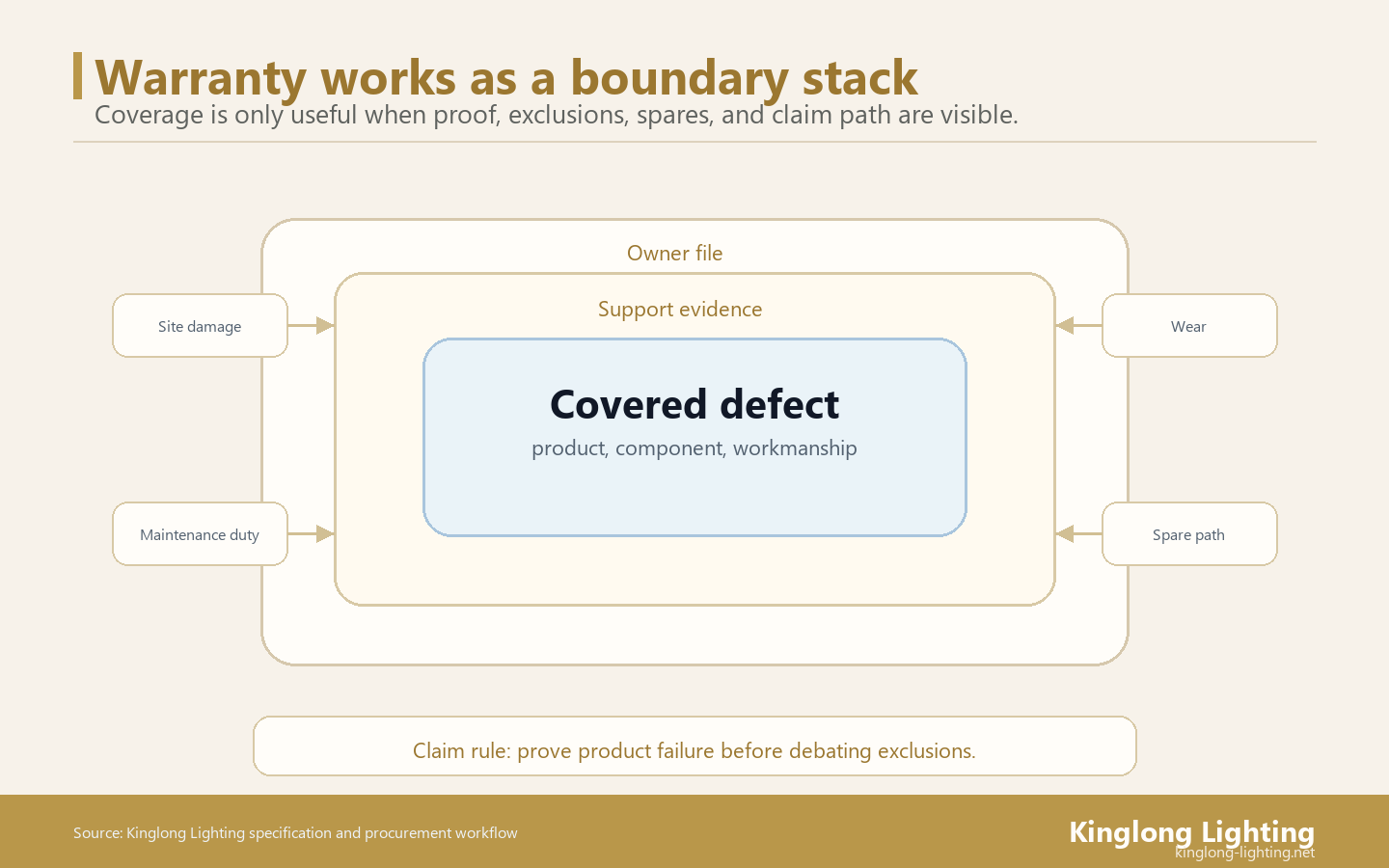
Before accepting a warranty, ask whether it explains five boundaries: covered product defect, excluded site damage, owner maintenance duty, replacement part path, and claim evidence. If those five boundaries are clear, the warranty can work even when the exact failure is unexpected.
This test is more useful than asking only how long the warranty lasts. A long warranty with no claim path may still create slow disputes. A warranty with clear boundaries lets the owner collect the right evidence on day one and understand whether the supplier, local team, or owner action is the next step.
The test also helps during procurement. If two suppliers offer similar pricing, the one with clearer warranty boundaries may reduce future management time, especially in a villa where a single signature chandelier can affect the whole room experience.
The five-boundary test should be run before handover, not after a claim. The owner should ask for the claim template, part map, maintenance notes, and support contact while the project team is still assembled. Once the designer, installer, and supplier have moved on, reconstructing evidence becomes slower and more emotional.
It is also useful to mark which warranty questions belong to local professionals. A manufacturer can identify a driver, provide a replacement part, or explain approved maintenance. A local electrician, installer, or engineer may still need to diagnose wiring, access, support, or regulated site work. A clear warranty does not pretend one party owns every possible cause.
That boundary makes the warranty more believable because it states what support can actually deliver and what the owner must preserve.
How Kinglong Lighting supports villa chandelier warranty planning
Kinglong Lighting can support villa chandelier warranty planning by connecting component records, approved samples, drawings, packing notes, spare parts, cleaning instructions, and claim templates through the custom chandelier workflow. That makes the warranty a usable support path rather than a vague promise.
If a villa owner is comparing warranty terms, the next action is to send the villa chandelier warranty file with fixture type, room location, component concerns, maintenance expectations, and destination. Kinglong Lighting can then clarify which evidence belongs in the handover file before the warranty is needed.
Before accepting a villa chandelier warranty
Use this short action list before the next approval meeting. It is intentionally practical, because vague approval language is the usual source of later rework.
- Ask for coverage categories by part type and failure type.
- Request claim evidence rules before the first problem appears.
- Separate product defect, site damage, cleaning damage, wear, and owner changes.
- Keep part codes, photos, spares, and packing references in the handover file.
- Confirm what local qualified professionals must handle outside manufacturer warranty.
FAQ
What should a villa chandelier warranty cover?
It should cover stated product defects and explain boundaries for finishes, drivers, glass, crystal, structure, spare parts, exclusions, claim evidence, and replacement logistics.
Are broken crystals always covered by warranty?
No. Coverage depends on cause, timing, handling, cleaning, impact, shipping evidence, and warranty terms. The owner needs photos, part codes, and context.
Does warranty include installation labor?
Not always. Installation labor, access equipment, electrical work, and local site service may be excluded unless the contract clearly includes them.
What evidence is needed for a chandelier warranty claim?
Useful evidence includes fixture code, room location, symptom, date, photos or video, installation record, maintenance history, sample reference, and any local checks already completed.