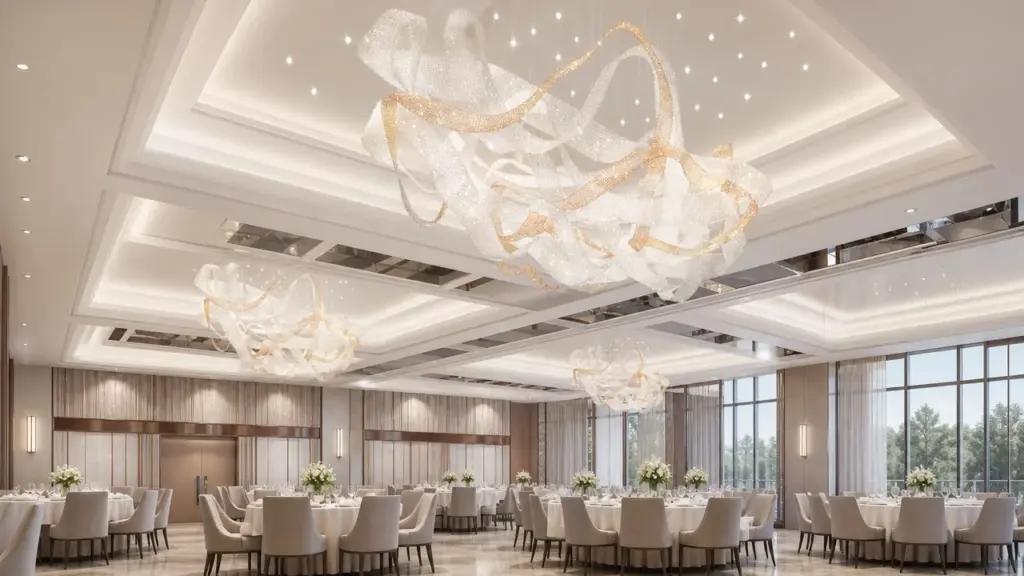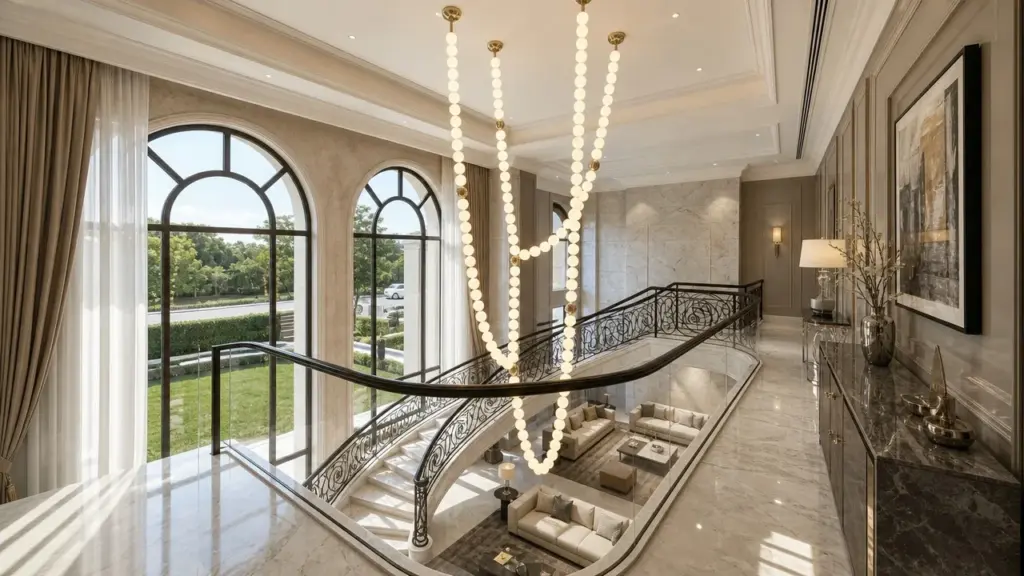
A hotel chandelier maintenance schedule is expensive when access, cleaning, drivers, spares, and handover are designed after opening instead of before purchase. The fixture may be LED, but the hotel still owns dust, glass handling, lift access, dimming drift, driver failure, guest disruption, and replacement matching. A 5-star property does not need a vague promise that the chandelier is easy to maintain. It needs a calendar, a responsible owner, a spare-part rule, and a realistic cost reserve.
Based on our analysis of a $100,000 custom chandelier package, a seven-year maintenance model can reach $25,350 when annual cleaning, annual inspection, access lift every two years, and a year-5 spare/driver reserve are included. That equals 25.35% of the visible fixture package in this scenario. The figure is not a universal hotel benchmark. It is a budgeting lens that helps procurement ask whether the quote includes the operational evidence the property will need after opening.
Key Takeaways
- Maintenance starts before purchase: Access route, cleaning method, and spares should be specified with the chandelier.
- LED does not remove service risk: Drivers, dimming, dust, loose parts, and guest-area downtime still need planning.
- Seven years is a useful budget horizon: It catches the first wave of cleaning habits, access surprises, and spare decisions.
- Handover is the weak point: The design team leaves, but hotel operations inherits the fixture every night.
- Cost model: In the scenario below, planned maintenance equals $25,350 over seven years on a $100,000 package.
Make maintenance a design input, not an operations apology
The cheapest maintenance schedule is the one designed into the chandelier before it is installed.
The most common mistake is to treat a custom lobby or ballroom chandelier as a capital purchase and a separate operations problem. That split is convenient during procurement, but it is expensive after opening. The hotel team needs to know how elements are removed, which parts are fragile, where drivers sit, how dimming equipment is accessed, whether a lift can reach the fixture, and how cleaning can happen without closing the lobby during peak hours.
The IES Lighting Library and the IES lighting maintenance committee’s maintenance work are useful because they remind specifiers that lighting performance changes over time. The so what for a 5-star property is not academic. Dust, driver access, and cleaning disruption become guest-experience costs if the fixture is designed only for day-one appearance.
Year 0 creates the maintenance baseline
Year 0 is the handover year. The supplier, installer, designer, and hotel engineer should agree on the as-built drawing, hanging sequence, cleaning method, spare list, driver location, dimming notes, and access route. This is also the moment to photograph module locations and label replacement parts. If Year 0 is weak, every later maintenance visit becomes detective work. The hotel may spend more time finding the correct element or safe access path than actually cleaning or inspecting the chandelier.
Years 1-3 reveal dust and access reality
The first three operating years test whether the theoretical schedule is realistic. Lobby chandeliers collect dust, restaurant chandeliers collect grease films, ballroom chandeliers face rigging and event-load interruptions, and resort fixtures can face humidity or salt-air stress. A quarterly visual check and annual cleaning may be enough for some lobbies, while high-use ballrooms may need closer inspection after heavy event seasons. The budget should include night work or off-peak access if guest disruption matters.
Years 4-7 expose spare and driver discipline
Years 4-7 are when small early omissions become visible. Drivers may need access review, dimming behavior may drift, broken glass or crystal may need matching, and the hotel may discover that no one ordered spare modules from the original production batch. The U.S. Department of Energy’s LED lighting guidance supports the broader point that LED products can last a long time, but long life still depends on product quality and operating conditions. A luxury hotel should therefore budget for inspection and matching, not only lamp replacement.
Model the 7-year cost before supplier ranking
A chandelier can be low-maintenance only if the access plan is visible in the quote.
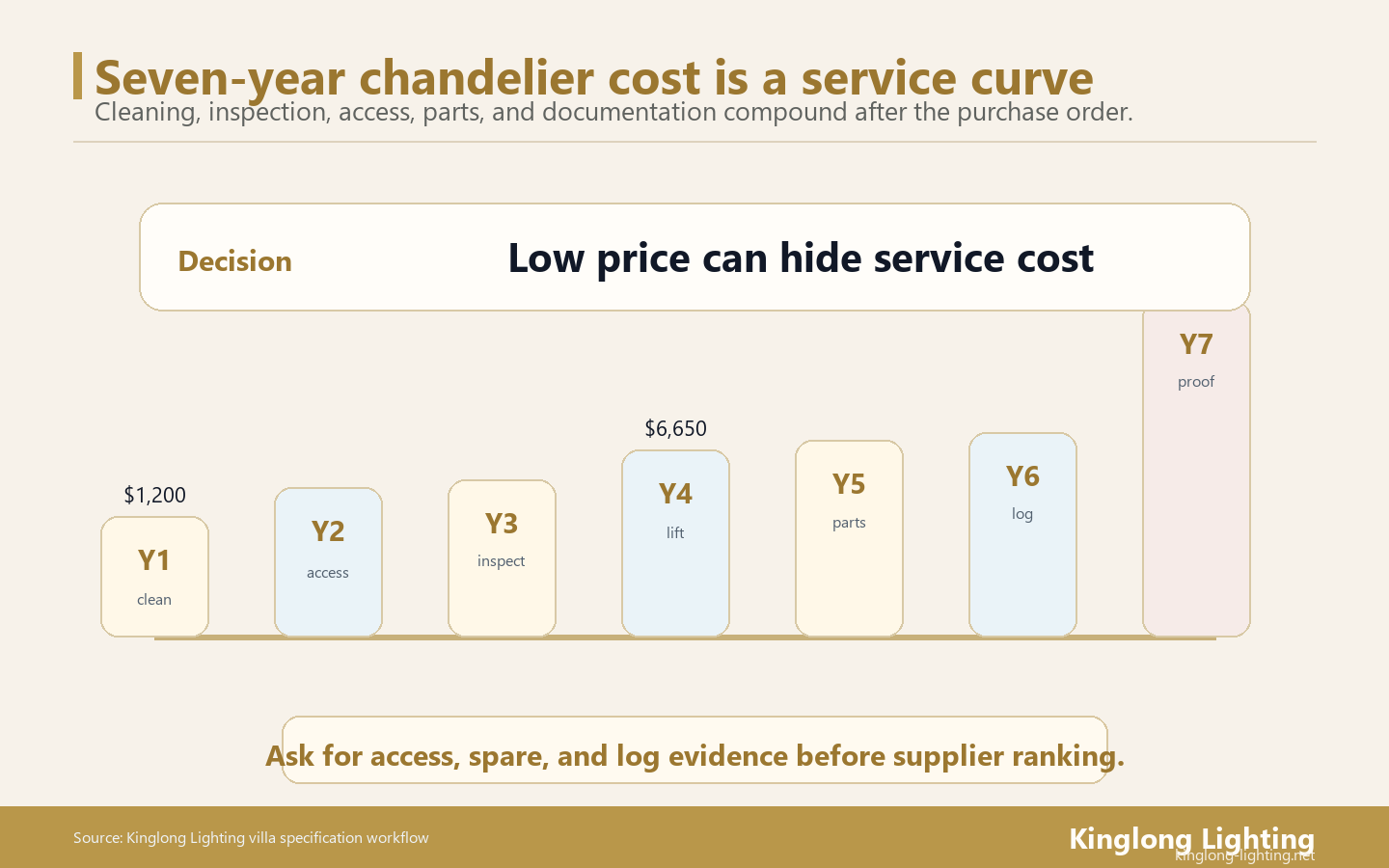
Use a scenario model to make the hidden operations cost visible. Assume a $100,000 custom chandelier package. Cleaning costs $1,200 per year, or $8,400 over seven years. Inspection costs $650 per year, or $4,550. Lift or access work costs $2,400 in years 2, 4, and 6, or $7,200. A year-5 spare and driver reserve adds $4,000. The seven-year total is $25,350, which equals 25.35% of the initial fixture package.
The real cost can be lower or higher. A motorized lift, simple modular structure, and clear spare policy can reduce labor. A double-height lobby with poor access can increase it. The decision value is that procurement can compare suppliers on maintenance boundary, not only fixture price. If one supplier includes a clear access plan and another does not, the quote comparison is incomplete even if the visible fixture price is lower.
There is also a scheduling cost that does not appear in the arithmetic. A lobby chandelier may need night work, protected floors, temporary barriers, guest-routing notices, and coordination with housekeeping or banquet operations. Those activities may be owned by the hotel rather than the lighting supplier, but they still affect the real maintenance burden. The purchase file should therefore record not only how much each service visit may cost, but also which dates, access tools, and hotel departments are required to make the visit possible.
A second budget line is documentation. If the hotel keeps no part list, cleaning log, or service photo history, the seventh-year maintenance visit can become a reverse-engineering task. The operations team may need to identify old drivers, match finishes, measure crystal or glass elements, and confirm which circuit controls which scene. A small documentation habit after each service visit protects the hotel’s ability to buy matching spares later, especially when staff roles change internally.
Use a schedule that separates cleaning, inspection, and parts
| Timing | Task | Owner | Evidence to keep |
|---|---|---|---|
| Handover | As-built, access, spare list, driver map | Supplier + installer + hotel engineer | Manual, photos, labels, drawings |
| Quarterly | Visual check for dust, looseness, dimming issues | Hotel engineering | Checklist and issue photos |
| Annual | Cleaning, hardware check, driver review | Hotel engineering or service team | Cleaning report and part changes |
| Years 2, 4, 6 | Lift or access review for high fixtures | Hotel + contractor | Access plan and safety notes |
| Year 5 | Spare and driver reserve check | Hotel procurement | Updated spare inventory |
Safety evidence matters throughout the schedule. UL’s luminaire testing and certification, OSHA’s NRTL program, and IEC’s IEC 60598 luminaire standard family point to the same boundary: maintenance should not modify or improvise a lighting product in a way that undermines safety, labeling, or local approval. When parts are replaced, the replacement path needs to be specified, not guessed.
Connect the schedule to Kinglong’s hospitality delivery scope
Kinglong Lighting’s hospitality lighting work is relevant because a large chandelier is not finished when it leaves the factory. Hotel buyers need shop drawings, installation guidance, packaging information, replacement planning, and a practical handover package. The custom manufacturing path should therefore capture maintenance questions early: Can the hotel clean modules without special reassembly? Where are the drivers? Which elements need spares? What should be photographed before the ceiling is closed?
This is where a soft procurement step is more useful than a slogan. If the chandelier is already at schematic design, ask Kinglong Lighting to review the maintenance schedule with the fixture drawings, ceiling height, access path, finish list, dimming requirement, spare policy, and hotel engineering constraints before the purchase boundary is frozen.
A good maintenance review should also define who can touch the fixture and who can approve a replacement part. In a 5-star property, a mismatched crystal element, changed driver, or improvised hanging detail can be more visible than a small purchase saving. The schedule should therefore include a part-matching rule, a photo record after each service visit, and a point of contact for technical clarification before the hotel team substitutes anything in the ceiling.
Related Guides
- Large Hotel Chandelier Installation Rework
- Hotel Chandelier Total Cost Surprises
- Ballroom Chandelier Specification Guide
Maintenance RFQ Action Card
- Attach ceiling height, lift access, and guest-area constraints.
- Ask for cleaning method and module replacement sequence.
- Request driver location, spare list, and dimming notes.
- Budget seven years, not only opening month.
- Send drawings and operating schedule through the hotel chandelier maintenance inquiry.
A seven-year maintenance file should make operations visible before purchase
Maintenance cost is not a separate life-cycle footnote. It is part of the chandelier decision because access, cleaning method, driver replacement, spare parts, and documentation all depend on how the fixture is designed and packaged. A hotel that buys a chandelier without a maintenance file may still receive a beautiful fixture, but the property team inherits uncertainty every time the fixture needs cleaning, inspection, or repair.
Turn the cost model into a supplier question
The seven-year model should be used during supplier ranking. If two chandelier packages have similar purchase prices, the better choice may be the one with clearer access, simpler cleaning, available spares, and a documented service path. Ask the supplier to explain how the fixture is cleaned, which parts are replaceable, what tools or lift access are required, and how future parts will be identified. These answers can change the real cost more than a small discount on the initial fixture price.
Keep cleaning, inspection, and parts in separate lanes
Cleaning is about visible finish and guest impression. Inspection is about suspension, wiring, drivers, connectors, and signs of wear. Parts planning is about what the hotel can replace without redesigning the chandelier. When those lanes are combined into one vague maintenance note, nobody knows which risk is being controlled. The release file should give each lane its own frequency, evidence record, owner, and escalation rule.
Use documentation to avoid year-seven reverse engineering
The most expensive maintenance visit is often the one where the team has to rediscover what was installed. A part list, driver reference, finish record, sample photo, packing note, and service log can prevent that. Kinglong Lighting’s handover file should therefore become part of the buyer’s maintenance plan. The goal is not to make the hotel do more paperwork; it is to make the seventh-year repair feel like a planned service task instead of a detective project.
Plan room closure windows before the fixture is ordered
Maintenance also has a revenue side. A lobby chandelier may be reachable during low-traffic hours, while a ballroom chandelier may require lift access, floor protection, banquet blackout dates, and coordination with events. The maintenance file should name the expected room closure window and the work that can be done without full closure. That information helps the owner compare the real operational cost of two designs, especially when one option looks cheaper but requires longer or more disruptive service visits.
For the next RFQ, ask the hotel team to attach ceiling access, fixture height, cleaning restrictions, room closure tolerance, spare-part expectation, and service documentation requirements. The supplier can then price the chandelier with operations in view, not as an isolated decorative object.
The final contract should keep those assumptions visible. If a quote includes fixture supply but excludes lift equipment, on-site cleaning guidance, spare packaging, or replacement documentation, the buyer should see that boundary before award. Clear exclusions are not a problem by themselves; hidden exclusions are. A maintenance-aware quote gives the hotel a cleaner basis for comparing suppliers and avoids turning operations support into a post-opening negotiation.
Frequently Asked Questions
How often should a hotel chandelier be cleaned?
Many properties start with quarterly visual checks and annual cleaning, then adjust for dust, restaurant grease, humidity, guest traffic, and access difficulty. High-use ballrooms or coastal resorts may need closer inspection.
Why model seven years instead of one year?
Seven years captures handover gaps, first cleaning habits, access costs, early spare decisions, and driver review. A one-year budget often misses the operational costs that appear after the design team has left.
What should be included in the maintenance handover?
The handover should include as-built drawings, module map, spare list, cleaning method, driver locations, dimming notes, access route, safety notes, and supplier contact path for matching parts.