
Hotel chandelier total cost surprises procurement when the visible fixture quote excludes the 18-25% coordination band created by packing, freight, customs, installation guidance, site handling, spares, and rework exposure. The band is not a universal surcharge and should not be treated as hidden profit. It is a practical way to ask whether the quotation includes all the work needed to move a large custom chandelier from approved design to safe hotel handover. Based on our analysis of a $100,000 fixture package, an 18-25% coordination band means $18,000-$25,000 of cost exposure can sit outside the visible fixture price.
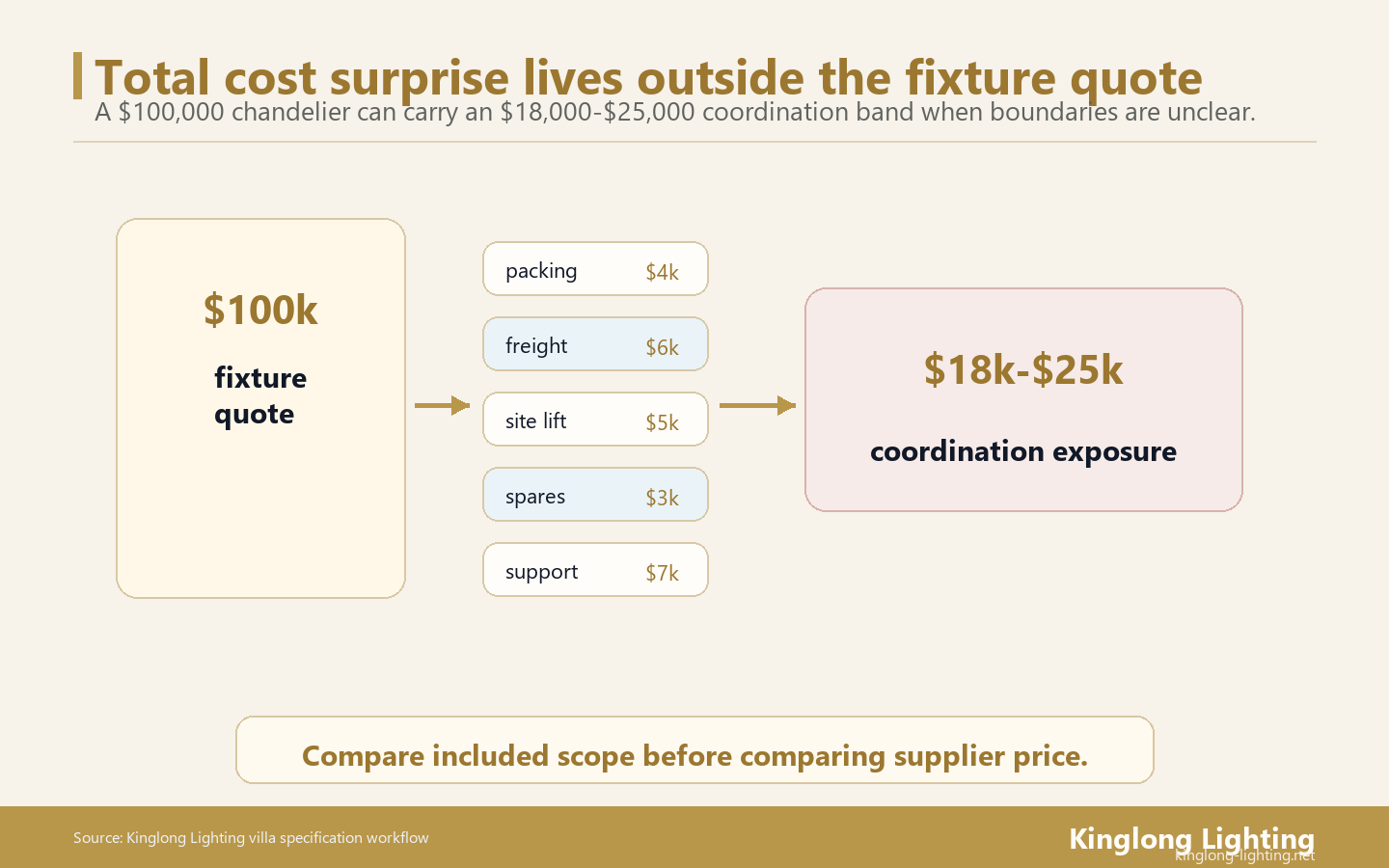
Procurement surprises usually happen because teams compare factory prices while the real project still needs crates, freight, insurance, customs documentation, site lifting, installation guidance, spare parts, and possible rework recovery. The cheaper quote may only be cheaper because it leaves more work outside the number. A total-cost comparison should expose these exclusions before deposit, not after crates arrive at the hotel.
Key Takeaways
- 18-25% is a coordination band: Use it to test excluded cost, not to assume every project has the same markup.
- Fixture price is incomplete: Packing, freight, customs, site handling, installation support, and spares can change the true comparison.
- Rework belongs in risk review: Missing evidence can turn installation problems into extra labor, shipping, or schedule pressure.
- Quotes need the same boundary: Compare suppliers only when included and excluded work packages are named.
- Release evidence: Ask for packing map, incoterm, delivery destination, installation responsibility, spare parts, and site support scope.
Treat 18-25% as a coordination band, not a hidden markup
The procurement question is not “why is the fixture expensive?” It is “which parts of the total project work are inside or outside this quote?”
The 18-25% band is useful because it forces a boundary discussion. For a $100,000 chandelier package, 18% equals $18,000 and 25% equals $25,000. That range can represent special packing, freight, insurance, customs coordination, local handling, lift access, installation guidance, spare parts, and contingency for missing evidence. It should be replaced by real supplier numbers as soon as the project has dimensions, destination, incoterms, site route, and installation scope.
Kinglong Lighting’s custom lighting manufacturing workflow is relevant because a hotel chandelier quote should describe what happens after design approval: shop drawings, samples, production evidence, packing method, shipping coordination, and installation support. Without those boundaries, procurement compares price shadows rather than comparable offers.
Separate fixture cost from project cost
A chandelier quote can be accurate and still be incomplete if the project work around the fixture is excluded.
Fixture cost usually covers materials, fabrication, finish, light source, drivers, assembly, and factory quality checks. Project cost may include special crates, export packaging, freight, destination charges, customs documentation, site receiving, lift equipment, installation labor, factory technical guidance, spare parts, cleaning access, and schedule risk. The quote should define which items are included, which are optional, and which are owned by the buyer, contractor, or hotel operator.
Construction research reinforces the broader risk: rework and field correction affect cost performance. The Construction Industry Institute’s rework reduction guidance and the TRID record for Measuring the Impact of Rework on Construction Cost Performance show why process control matters. For hotel chandeliers, that means cost review should include installation evidence, not only factory price.
| Cost layer | Often visible in quote? | Why it surprises procurement | Evidence to request |
|---|---|---|---|
| Fixture fabrication | Yes | Usually the number buyers compare first | BOM, finish, source, drawings, sample approval |
| Packing and freight | Sometimes | Large modules need protective crates and route planning | Crate dimensions, incoterm, destination, insurance scope |
| Installation support | Often unclear | Site teams may need factory sequence guidance | Installation guide, module map, support-day assumption |
| Spares and maintenance | Often excluded | Hotel operations inherit the fixture after opening | Spare list, cleaning method, driver access notes |
| Rework exposure | No | Missing proof turns into labor, freight, and schedule cost | Release checklist and unresolved-risk log |
Use a total-cost worksheet before supplier ranking
A supplier is not cheaper until the quote boundary, logistics boundary, installation boundary, and handover boundary are the same.
Build a simple worksheet with five columns: supplier, included scope, excluded scope, buyer-owned work, and release evidence. Add lines for packing, freight, insurance, customs, site route, lift access, installation support, spare parts, maintenance file, and rework hold items. If one supplier includes packaging and technical guidance while another excludes them, the comparison should normalize those lines before ranking.
For electrical and safety evidence, ask the project team which standards and local approvals apply. Sources such as UL luminaire testing, OSHA’s NRTL program, and IEC 60598 help define proof vocabulary, while ANSI/ASHRAE/IES Standard 90.1 may matter when lighting power and controls are part of the wider building file. The manufacturer supplies product evidence; the project engineer and local authority decide acceptance.
Ask for cost boundaries before deposit
The best time to find hidden chandelier cost is before deposit, when the supplier can still clarify scope instead of defending a price.
If a quote is missing freight terms, crate dimensions, installation responsibility, spare parts, or site-support assumptions, ask for a revised boundary before ranking. Kinglong Lighting can review the RFQ package when the buyer sends drawings, fixture size, quantity, destination, installation scope, certification requirement, and desired support level. The useful output is a clearer cost boundary, not a vague promise that everything is included.
Based on our analysis of a 5-layer cost worksheet, procurement should separate visible fixture price from 4 surrounding cost families: logistics, installation support, maintenance readiness, and rework exposure. A $100,000 fixture package with an 18% coordination band creates $18,000 of exposure; the same package at 25% creates $25,000. This means a supplier that appears $12,000 cheaper can become the more expensive option if it excludes special packing, site guidance, or spare parts that another quote already includes. The band is not the final answer; it is a prompt to convert vague exclusions into line items.
The most useful total-cost worksheet names who owns each cost before deposit. The factory may own fabrication, shop drawings, samples, testing evidence, packing labels, and export-ready crates. The buyer may own destination handling, local lifting, electrical connection, installation labor, and hotel operations handover. The contractor may own ceiling opening, lift equipment, safety method, and local code coordination. When those boundaries are not named, procurement saves money on paper and spends it later through delay, change orders, or emergency freight. Kinglong Lighting should receive the drawing set, size, quantity, destination, and support expectation early enough to separate true fixture cost from project-side cost.
A quote boundary review should happen in 2 passes. The first pass normalizes commercial terms: incoterm, destination, insurance, packing, payment stage, and delivery responsibility. The second pass normalizes technical risk: certification path, driver data, spare parts, installation guide, factory support, and unresolved drawing questions. If the lower quote fails either pass, procurement should not present it as a clean saving. It is a different scope. That is the core reason hotel chandelier total cost feels surprising: the comparison table looked like a fixture table, while the project needed an installed, serviceable, documented lighting asset. The safest procurement note is blunt: no supplier ranking is complete until every excluded item has an owner, a budget line, or a deliberate hold decision.
Procurement should also ask what happens if an excluded item becomes urgent. Emergency freight, replacement crystals, extra installation days, or late driver changes rarely price like planned work. A total-cost file is strongest when it turns those future surprises into named options before the purchase order is signed. Even a simple allowance note can stop a later argument because the buyer, supplier, and contractor already know which cost bucket absorbs the change. That clarity is part of supplier value, not paperwork decoration, especially when the hotel opening date is already fixed.
Related Guides
- Large Hotel Chandelier Installation Rework
- Hotel Lighting Procurement Framework
- Hotel Lobby Chandelier Volume Formula
Total Cost Action Card
- Normalize fixture, packing, freight, installation, and spares.
- Ask each supplier to mark included and excluded work.
- Convert 18-25% into actual project line items.
- Ask Kinglong Lighting to review quote boundaries before deposit.
- Send drawings, quantity, destination, incoterm, support scope, and unresolved evidence through the hotel chandelier RFQ inquiry.
A total-cost file should expose excluded work before supplier ranking
The hidden 18-25 percent is not a magic surcharge. It is a practical coordination band that appears when the quote does not clearly say who pays for packing, freight, insurance, customs documents, site receiving, lift access, installation guidance, spares, and rework recovery. Procurement teams get surprised when they compare fixture prices while the project work around the fixture remains outside the comparison.
Separate included scope from buyer-owned work
The worksheet should place each cost line into one of three groups: included by the supplier, excluded but known, or buyer-owned and still unpriced. This prevents a low fixture quote from looking stronger simply because it leaves more risk with the owner. If two suppliers use different freight terms, crate assumptions, installation support, or spare-part policies, the worksheet should normalize those differences before ranking.
Ask for release evidence behind each cost boundary
A cost boundary is only useful when it is tied to evidence. Crate cost should connect to dimensions and packing method. Freight cost should connect to destination, weight, and delivery terms. Installation support should connect to module sequence, drawings, and site support level. Spares should connect to replacement strategy. Kinglong Lighting can review these boundaries when the buyer sends the fixture size, quantity, destination, installation scope, and evidence expectations.
Use exclusions as a negotiation tool, not a complaint
Exclusions are not automatically bad. A buyer may choose to own local lifting, customs broker work, or site installation. The problem is hidden ownership. The total-cost file should turn exclusions into deliberate choices, with a named owner and a budget assumption. That gives finance and operations a clearer view of the real project cost before deposit.
Compare payment timing with responsibility timing
Cost surprises also happen when the payment schedule moves faster than the responsibility review. If the deposit is due before packing assumptions, freight terms, spare quantities, or installation-support boundaries are confirmed, procurement loses leverage. The total-cost file should therefore identify which decisions must be closed before deposit, before production, before packing, and before shipment. That timeline makes the 18-25 percent band manageable instead of mysterious.
The practical next step is to ask every shortlisted supplier for the same total-cost boundary: fixture scope, packing, freight, insurance, customs documentation, site receiving, lift access, installation support, spare parts, and maintenance file. Only then can the procurement team compare price with the real work included.
Kinglong Lighting can respond more accurately when the buyer sends not only the fixture design but also destination, access route, delivery terms, installation scope, and the level of factory support expected. A quote built from that package is less likely to win on a low visible price and lose later through excluded coordination work.
The worksheet should stay with the purchase order after award. If freight terms, crate dimensions, spare quantities, or site-support assumptions change, procurement can see whether the change belongs to the supplier, the buyer, or a local contractor. That record keeps later cost movement visible instead of turning every variation into a surprise.
It should also separate optional upgrades from unavoidable project work. Extra spares, premium packing, or on-site technical attendance may be optional in some projects and essential in others. Naming that difference helps the owner decide where to spend money deliberately rather than discovering the need after the lowest quote has already been selected.
Frequently Asked Questions
Is 18-25% a fixed hotel chandelier surcharge?
No. Treat 18-25% as a coordination band for checking excluded project work. Final cost depends on fixture size, destination, packing, freight, site conditions, installation scope, and supplier responsibility.
What costs are often missing from a chandelier quote?
Common missing items include special crates, freight, insurance, customs coordination, destination handling, lift access, installation guidance, spare parts, maintenance files, and rework exposure from missing evidence.
How should procurement compare two chandelier suppliers?
Compare suppliers only after the quote boundary is the same. Normalize included scope, excluded scope, logistics, installation support, certification evidence, spares, and handover documents before ranking price.
When should total cost be reviewed?
Review total cost before deposit and again before production release. After the fixture is packed or shipped, missing scope becomes harder to correct and may turn into site labor or schedule cost.