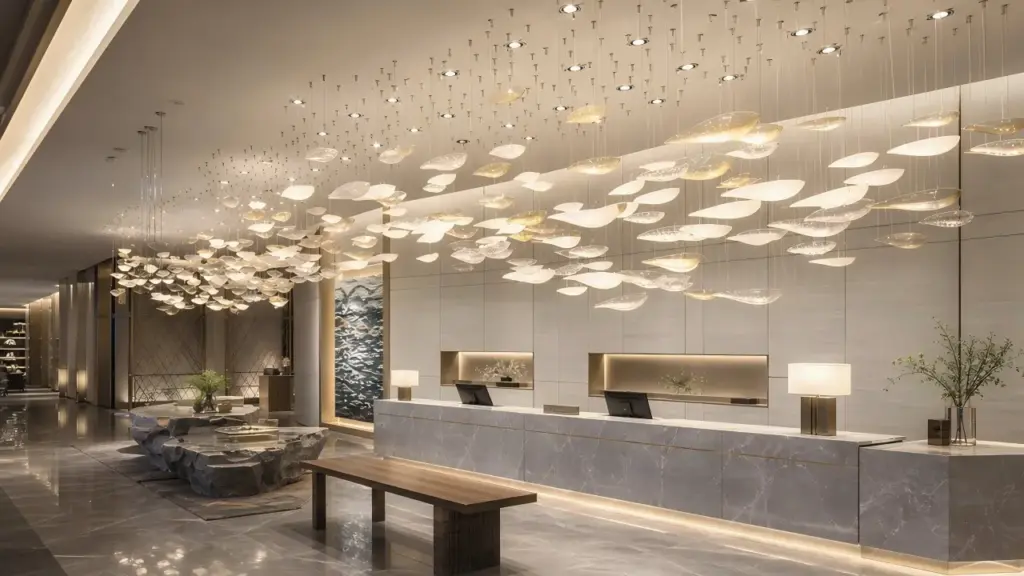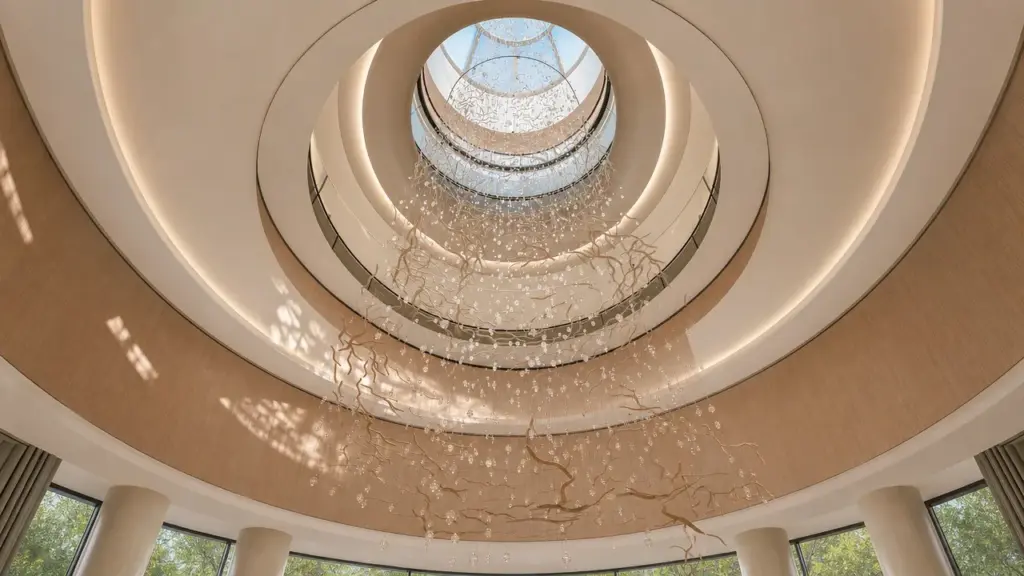
El programa de mantenimiento de la lámpara de araña de un hotel es costoso cuando el acceso, la limpieza, los drivers, los repuestos y la entrega se diseñan después de la apertura y no antes de la compra. La luminaria puede ser LED, pero el hotel aún tiene problemas con el polvo, la manipulación del vidrio, el acceso al ascensor, la desviación de la atenuación, las fallas del driver, las molestias a los huéspedes y la coincidencia de reemplazos. Una propiedad de 5 estrellas no necesita una vaga promesa de que la lámpara de araña será fácil de mantener. Necesita un calendario, un propietario responsable, una norma de repuestos y una reserva de costes realista.
Según nuestro análisis de un paquete de lámpara de araña personalizado de $100 000, un modelo de mantenimiento de siete años puede alcanzar los $25 350 cuando se incluyen la limpieza anual, la inspección anual, el elevador de acceso cada dos años y una reserva de repuesto/driver para el quinto año. Eso equivale al 25,35% del paquete de luminarias visibles en este escenario. La cifra no es un punto de referencia hotelero universal. Es una lente presupuestaria que ayuda a adquisiciones a preguntarse si la cotización incluye la evidencia operativa que la propiedad necesitará después de la apertura.
Conclusiones clave
- El mantenimiento comienza antes de la compra: La ruta de acceso, el método de limpieza y los repuestos deben especificarse con la lámpara.
- El LED no elimina el riesgo de servicio: Los drivers, la atenuación, el polvo, las piezas sueltas y el tiempo de inactividad en el área de invitados aún necesitan planificación.
- Siete años es un horizonte presupuestario útil: Capta la primera ola de hábitos de limpieza, accede a sorpresas y decisiones sobrias.
- El traspaso es el punto débil: El equipo de diseño se marcha, pero las operaciones del hotel heredan la luminaria cada noche.
- Modelo de costos: En el siguiente escenario, el mantenimiento planificado equivale a $25 350 durante siete años en un paquete de $100 000.
Haga del mantenimiento un aporte de diseño, no una disculpa de operaciones
El programa de mantenimiento más económico es el que se diseña en la lámpara antes de instalarla.
El error más común es tratar una lámpara de araña personalizada para un vestíbulo o un salón de baile como una compra de capital y un problema de operaciones independiente. Esa división es conveniente durante la adquisición, pero es costosa después de la apertura. El equipo del hotel necesita saber cómo se retiran los elementos, qué piezas son frágiles, dónde se sientan los drivers, cómo se accede al equipo de atenuación, si un ascensor puede llegar hasta la luminaria y cómo se puede realizar la limpieza sin cerrar el vestíbulo durante las horas pico.
La biblioteca de Iluminación IES y el comité de mantenimiento de iluminación del IES trabajos de mantenimiento son útiles porque recuerdan a los especificadores que el rendimiento de la iluminación cambia con el tiempo. El y qué de una propiedad de 5 estrellas no es académico. El polvo, el acceso del driver y las interrupciones en la limpieza se convierten en costos de la experiencia del huésped si el dispositivo está diseñado solo para su apariencia el primer día.
El año 0 crea la línea base de mantenimiento
El año 0 es el año de traspaso. El proveedor, el instalador, el diseñador y el ingeniero del hotel deben acordar el plano de obra, la secuencia de colocación, el método de limpieza, la lista de repuestos, la ubicación del driver, las notas sobre atenuación y la ruta de acceso. Este es también el momento de fotografiar las ubicaciones de los módulos y etiquetar las piezas de repuesto. Si el Año 0 es débil, cada visita de mantenimiento posterior se convierte en un trabajo de detective. El hotel puede dedicar más tiempo a encontrar el elemento correcto o la ruta de acceso segura que a limpiar o inspeccionar la lámpara.
Los años 1-3 revelan polvo y acceden a la realidad
Los tres primeros años de funcionamiento ponen a prueba si el calendario teórico es realista. Las lámparas de araña de los vestíbulos acumulan polvo, las lámparas de araña de los restaurantes acumulan películas de grasa, las lámparas de araña de los salones de baile enfrentan interrupciones en la carga de eventos y aparejos, y las luminarias de los complejos turísticos pueden enfrentar la humedad o el estrés del aire salado. Una revisión visual trimestral y una limpieza anual pueden ser suficientes para algunos vestíbulos, mientras que los salones de baile de alto uso pueden necesitar una inspección más cercana después de temporadas intensas de eventos. El presupuesto debe incluir el trabajo nocturno o el acceso fuera de las horas pico si la interrupción de los huéspedes es importante.
Los años 4 a 7 exponen la disciplina de repuesto y del driver.
Entre los años 4 y 7 es cuando las pequeñas omisiones tempranas se hacen visibles. Los drivers pueden necesitar una revisión de acceso, el comportamiento de la atenuación puede variar, es posible que sea necesario emparejar vidrios o cristales rotos y el hotel puede descubrir que nadie pidió módulos de repuesto del lote de producción original. El Departamento de Energía de EE.UU. Guía de iluminación LED respalda el punto más amplio de que los productos LED pueden durar mucho tiempo, pero la larga vida útil aún depende de la calidad del producto y las condiciones de operación. Por lo tanto, un hotel de lujo debería presupuestar la inspección y la adaptación, no sólo el reemplazo de las lámparas.
Modele el costo de 7 años antes de la clasificación de proveedores
Una lámpara de araña puede requerir poco mantenimiento sólo si el plano de acceso está visible en el presupuesto.
Utilice un modelo de escenario para hacer visibles los costos de operaciones ocultos. Supongamos un paquete de lámpara de araña personalizado de 100.000 dólares. La limpieza cuesta $1,200 por año, o $8,400 en siete años. La inspección cuesta $650 por año, o $4,550. El trabajo de elevación o acceso cuesta $2,400 en los años 2, 4 y 6, o $7,200. Una reserva de repuesto y driver para el año 5 agrega $4,000. El total de siete años es de $25,350, lo que equivale al 25,35% del paquete de luminarias inicial.
El coste real puede ser menor o mayor. Un elevador motorizado, una estructura modular simple y una política de repuestos clara pueden reducir la mano de obra. Un vestíbulo de doble altura con mal acceso puede aumentarlo. El valor de la decisión es que las adquisiciones pueden comparar a los proveedores en cuanto a los límites de mantenimiento, no sólo en el precio fijo. Si un proveedor incluye un plan de acceso claro y otro no, la comparación de cotizaciones estará incompleta incluso si el precio de la luminaria visible es más bajo.
También existe un costo de programación que no aparece en la aritmética. Una lámpara de araña en el vestíbulo puede necesitar trabajo nocturno, pisos protegidos, barreras temporales, avisos de ruta para invitados y coordinación con el servicio de limpieza o las operaciones de banquetes. Esas actividades pueden ser propiedad del hotel y no del proveedor de iluminación, pero aun así afectan la carga real de mantenimiento. Por lo tanto, el expediente de compras debe registrar no sólo cuánto puede costar cada visita de servicio, sino también qué fechas, herramientas de acceso y departamentos del hotel se requieren para hacer posible la visita.
Una segunda línea presupuestaria es la documentación. Si el hotel no mantiene una lista de piezas, un registro de limpieza o un historial fotográfico de servicio, la visita de mantenimiento del séptimo año puede convertirse en una tarea de ingeniería inversa. Es posible que el equipo de operaciones necesite identificar drivers antiguos, igualar acabados, medir cristales o elementos de vidrio y confirmar qué circuito controla qué escena. Un pequeño hábito de documentación después de cada visita de servicio protege la capacidad del hotel de comprar repuestos correspondientes más adelante, especialmente cuando los roles del personal cambian internamente.
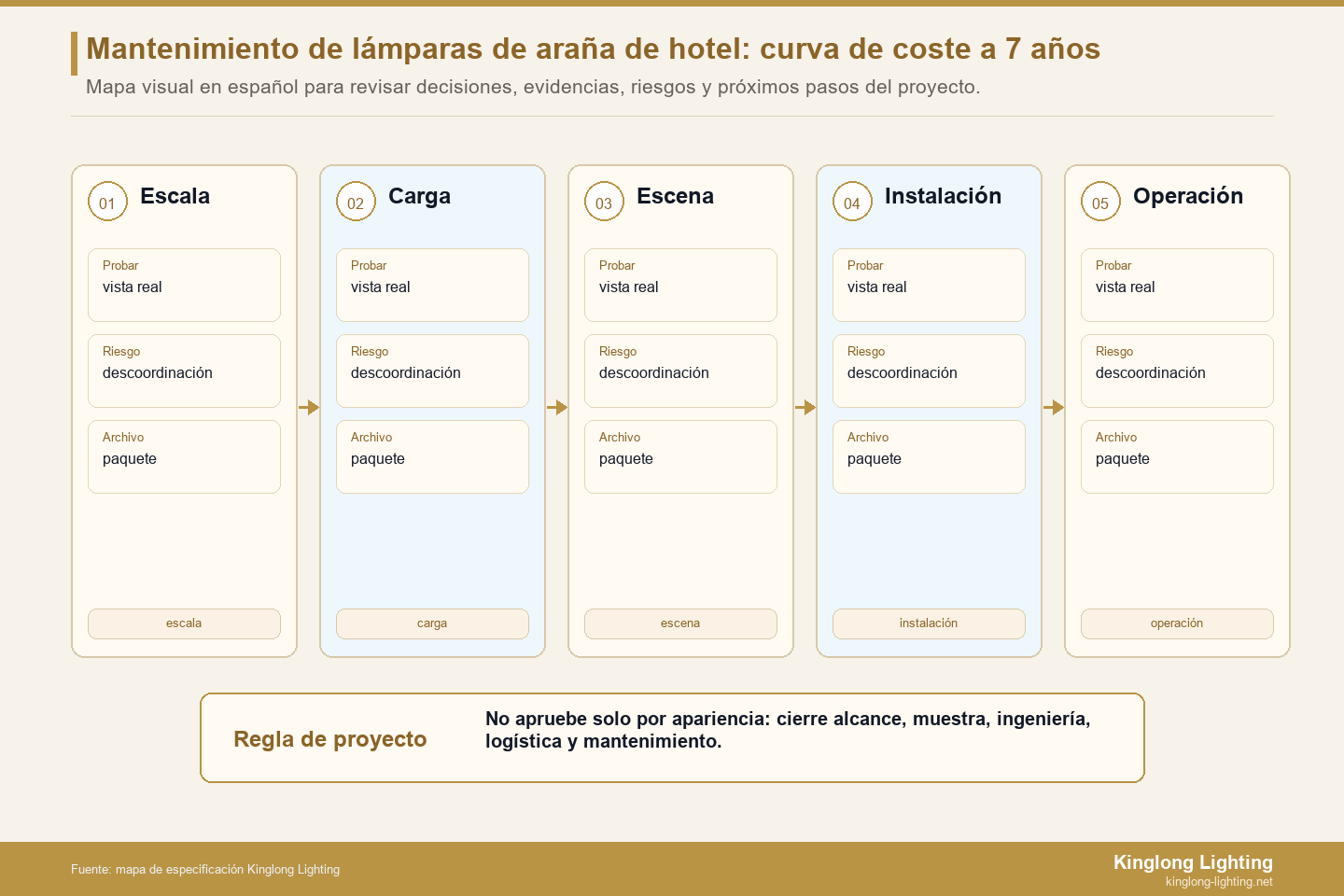
Utilice un cronograma que separe la limpieza, la inspección y las piezas.
| Sincronización | Tarea | Dueño | Pruebas a conservar |
|---|---|---|---|
| Entrega | As-built, acceso, lista de repuestos, mapa de drivers | Proveedor + instalador + ingeniero hotelero | Manual, fotos, etiquetas, dibujos. |
| Trimestral | Comprobación visual de polvo, holgura y problemas de atenuación | Ingeniería hotelera | Lista de verificación y fotografías del problema |
| Anual | Limpieza, revisión de hardware, revisión de drivers. | Equipo de ingeniería o servicio del hotel. | Informe de limpieza y cambios de piezas. |
| Años 2, 4, 6 | Revisión de ascensores o accesos para fijaciones altas | Hotel + contratista | Plano de acceso y notas de seguridad. |
| Año 5 | Comprobación de reserva de repuestos y driver. | Adquisición hotelera | Inventario de repuestos actualizado |
La evidencia de seguridad es importante a lo largo del cronograma. UL pruebas y certificación de luminarias, OSHA programa NRTL, y IEC Familia estándar de luminarias IEC 60598 apuntan al mismo límite: el mantenimiento no debe modificar ni improvisar un producto de iluminación de manera que socave la seguridad, el etiquetado o la aprobación local. Cuando se reemplazan piezas, es necesario especificar la ruta de reemplazo, no adivinarla.
Conecte el cronograma al alcance de entrega de hotelería de Kinglong
Kinglong Lighting iluminación de hostelería El trabajo es relevante porque una gran lámpara de araña no está terminada cuando sale de fábrica. Los compradores de hoteles necesitan planos de taller, orientación sobre la instalación, información sobre el embalaje, planificación de reemplazos y un paquete de entrega práctico. el fabricación personalizada Por lo tanto, la ruta debería captar las preguntas de mantenimiento con antelación: ¿Puede el hotel limpiar los módulos sin un reensamblaje especial? ¿Dónde están los drivers? ¿Qué elementos necesitan repuestos? ¿Qué se debe fotografiar antes de cerrar el techo?
Aquí es donde un paso de adquisición suave es más útil que un eslogan. Si la lámpara de araña ya tiene un diseño esquemático, solicite a Kinglong Lighting que revise el programa de mantenimiento con los planos de las luminarias, la altura del techo, la ruta de acceso, la lista de acabados, los requisitos de atenuación, la política de repuestos y las limitaciones de ingeniería del hotel antes de que se congele el límite de compra.
Una buena revisión de mantenimiento también debe definir quién puede tocar el dispositivo y quién puede aprobar una pieza de repuesto. En una propiedad de 5 estrellas, un elemento de cristal que no coincide, un driver cambiado o un detalle colgante improvisado pueden ser más visibles que un pequeño ahorro en la compra. Por lo tanto, el cronograma debe incluir una regla de coincidencia parcial, un registro fotográfico después de cada visita de servicio y un punto de contacto para aclaraciones técnicas antes de que el equipo del hotel sustituya algo en el techo.
Guías relacionadas
- Retrabajo de la instalación de lámparas de araña de hoteles grandes
- Sorpresas en el costo total de la lámpara de araña del hotel
- Guía de especificaciones de lámparas de salón de baile
Tarjeta de acción de solicitud de presupuesto de mantenimiento
- Adjunte restricciones de altura del techo, acceso al ascensor y área de invitados.
- Pregunte por el método de limpieza y la secuencia de reemplazo del módulo.
- Solicite la ubicación del driver, la lista de repuestos y notas sobre atenuación.
- Presupuesto siete años, no sólo mes de apertura.
- Enviar planos y cronograma de operación a través del Consulta sobre el mantenimiento de la lámpara del hotel..
Un archivo de mantenimiento de siete años debería hacer visibles las operaciones antes de la compra.
El costo de mantenimiento no es una nota a pie de página separada del ciclo de vida. Es parte de la decisión sobre la lámpara porque el acceso, el método de limpieza, el reemplazo del driver, las piezas de repuesto y la documentación dependen de cómo está diseñado y empaquetado el dispositivo. Un hotel que compra una lámpara de araña sin un archivo de mantenimiento aún puede recibir un hermoso luminaria, pero el equipo de la propiedad hereda la incertidumbre cada vez que la luminaria necesita limpieza, inspección o reparación.
Convierta el modelo de costes en una cuestión de proveedor
El modelo de siete años debería utilizarse durante la clasificación de proveedores. Si dos paquetes de lámparas de araña tienen precios de compra similares, la mejor opción puede ser la que tenga un acceso más claro, una limpieza más sencilla, repuestos disponibles y una ruta de servicio documentada. Pídale al proveedor que le explique cómo se limpia el dispositivo, qué piezas son reemplazables, qué herramientas o acceso al ascensor se requieren y cómo se identificarán las piezas futuras. Estas respuestas pueden cambiar el coste real más que un pequeño descuento sobre el precio inicial del dispositivo.
Mantenga la limpieza, la inspección y las piezas en carriles separados.
La limpieza se trata de un acabado visible y la impresión del huésped. La inspección se refiere a la suspensión, el cableado, los drivers, los conectores y los signos de desgaste. La planificación de piezas se trata de lo que el hotel puede reemplazar sin rediseñar la lámpara de araña. Cuando esos carriles se combinan en una vaga nota de mantenimiento, nadie sabe qué riesgo se está controlando. El archivo de aprobación debe dar a cada carril su propia frecuencia, registro de evidencia, propietario y regla de escalamiento.
Utilice la documentación para evitar la ingeniería inversa del séptimo año.
La visita de mantenimiento más costosa suele ser aquella en la que el equipo tiene que redescubrir lo que se instaló. Una lista de piezas, una referencia del driver, un registro de acabado, una fotografía de muestra, una nota de embalaje y un registro de servicio pueden evitarlo. Por lo tanto, el expediente de entrega de Kinglong Lighting debería formar parte del plan de mantenimiento del comprador. El objetivo no es que el hotel haga más trámites; es hacer que la reparación del séptimo año parezca una tarea de servicio planificada en lugar de un proyecto de detective.
Planifique las ventanas de cierre de la habitación antes de pedir la luminaria.
El mantenimiento también tiene su lado de ingresos. Es posible que se pueda acceder a una lámpara de araña del vestíbulo durante las horas de poco tráfico, mientras que una lámpara de araña de salón de baile puede requerir acceso al ascensor, protección del piso, fechas restringidas para banquetes y coordinación con eventos. El archivo de mantenimiento debe nombrar la ventana prevista de cierre de la habitación y el trabajo que se puede realizar sin un cierre total. Esa información ayuda al propietario a comparar el costo operativo real de dos diseños, especialmente cuando una opción parece más barata pero requiere visitas de servicio más largas o más disruptivas.
Para la próxima solicitud de cotización, solicite al equipo del hotel que adjunte el acceso al techo, la altura de las luminarias, las restricciones de limpieza, la tolerancia del cierre de la habitación, las expectativas de repuestos y los requisitos de documentación de servicio. De este modo, el proveedor puede fijar el precio de la lámpara teniendo en cuenta las operaciones y no como un objeto decorativo aislado.
El contrato final debería mantener visibles esos supuestos. Si una cotización incluye el suministro de luminarias pero excluye el equipo de elevación, la guía de limpieza en el sitio, el embalaje de repuesto o la documentación de reemplazo, el comprador debe ver esos límites antes de la adjudicación. Las exclusiones claras no son un problema en sí mismas; las exclusiones ocultas lo son. Una cotización teniendo en cuenta el mantenimiento le da al hotel una base más limpia para comparar proveedores y evita convertir el apoyo operativo en una negociación posterior a la apertura.
Preguntas frecuentes
¿Con qué frecuencia se debe limpiar la lámpara de araña de un hotel?
Muchas propiedades comienzan con controles visuales trimestrales y una limpieza anual, luego se ajustan al polvo, la grasa del restaurante, la humedad, el tráfico de huéspedes y la dificultad de acceso. Es posible que los salones de baile de uso frecuente o los centros turísticos costeros necesiten una inspección más detallada.
¿Por qué modelar siete años en lugar de uno?
Siete años capturan las brechas en la entrega, los primeros hábitos de limpieza, los costos de acceso, las decisiones tempranas sobre repuestos y la revisión del driver. Un presupuesto de un año a menudo omite los costos operativos que aparecen después de que el equipo de diseño se ha ido.
¿Qué se debe incluir en la entrega de mantenimiento?
La entrega debe incluir planos construidos, mapa de módulos, lista de repuestos, método de limpieza, ubicaciones de los drivers, notas sobre atenuación, ruta de acceso, notas de seguridad y ruta de contacto con el proveedor para las piezas coincidentes.