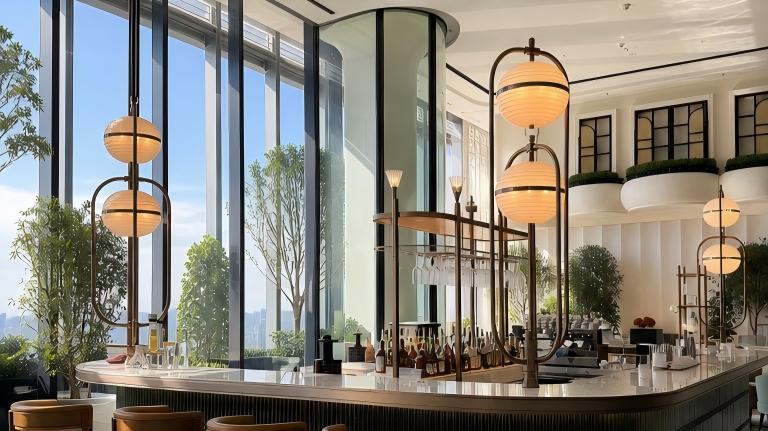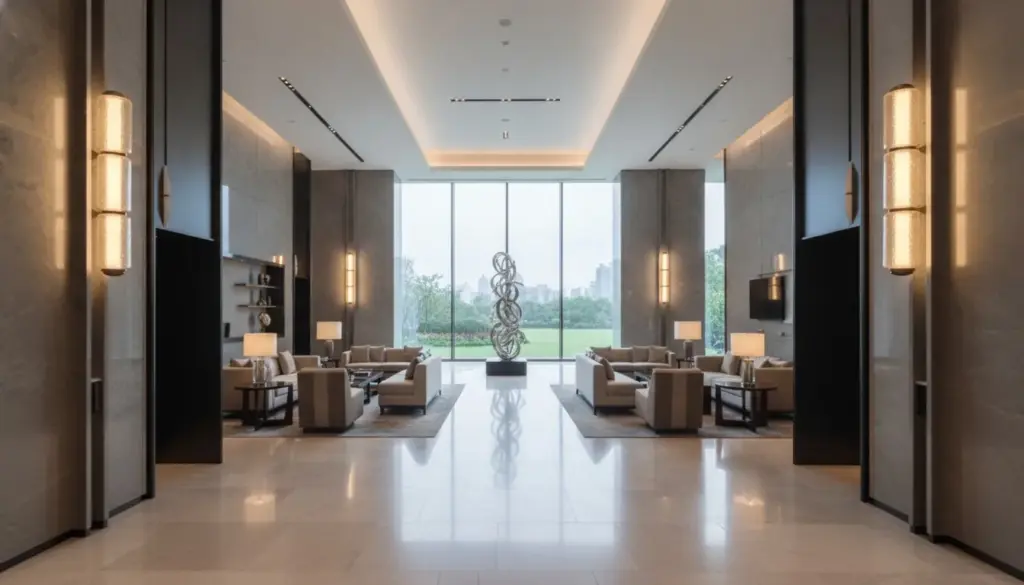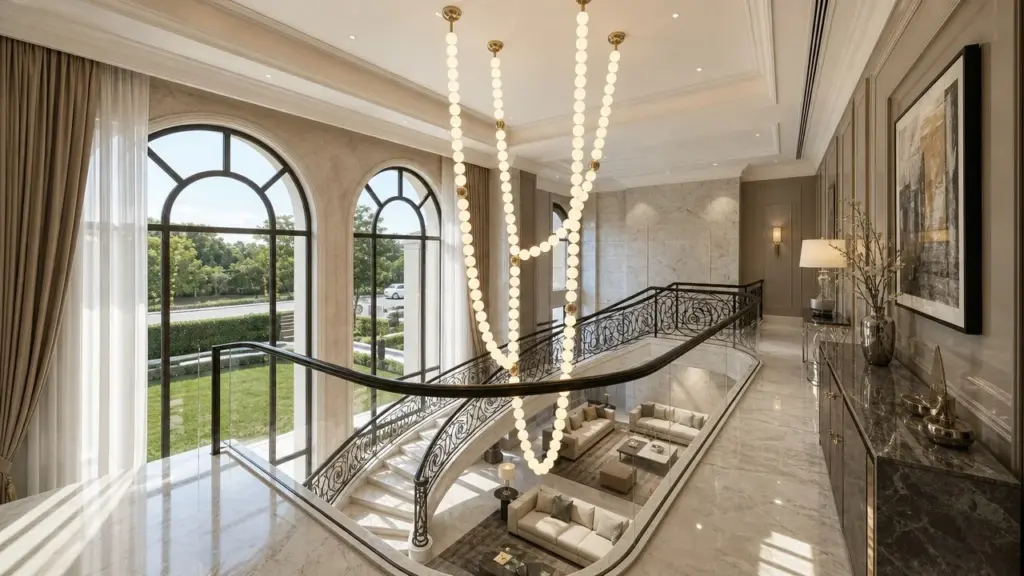
Four Seasons lighting quality is not only a matter of expensive fixtures because the reputation depends on consistency across service culture, guest comfort, design restraint, operations, and long-term maintenance. A chandelier can look luxurious and still fail the benchmark if it creates glare, distracts from service, ages poorly, or cannot be maintained quietly. The quality signal is the absence of friction.
Public Four Seasons information and general lighting references can guide context, but they are not an official Four Seasons lighting standard and do not imply endorsement of Kinglong Lighting. The goal is to help hotel specifiers understand what a Four Seasons-style quality benchmark might require from decorative lighting: not louder design, but better-controlled experience.
Key Takeaways
- Quality benchmark: Four Seasons-style lighting should be judged by comfort, consistency, service support, and material endurance.
- Design restraint: Expensive-looking fixtures are less important than lighting that feels effortless in use.
- Operational proof: Maintenance access, cleaning, dimming, driver location, and spare parts belong in the luxury file.
- Evidence discipline: Color quality, glare, controls, finish masters, and production traceability should be checked before release.
- Kinglong relevance: Kinglong Lighting can support quality-led custom lighting by turning experience goals into manufacturing evidence.
Quality starts with service, not spectacle
A Four Seasons-style lighting benchmark is passed when guests feel cared for without noticing how much the lighting is working.
The official Four Seasons homepage presents the brand through service standards, innovation, and luxury travel. The service culture page describes satisfying discerning customer needs and tastes. The lighting implication is subtle: a decorative fixture should help service feel natural. It should guide the guest, flatter materials, support staff movement, and make transitions feel smooth.
Benchmark lighting reduces visible friction
Guests rarely praise a perfectly dimmed chandelier, a quiet driver, or a clean replacement route. They simply experience the property as polished. The benchmark therefore includes many invisible decisions: no harsh glare at the host stand, no buzzing driver in a private dining room, no cold tone on warm stone, no unserviceable crystal cluster over a busy lounge, no awkward shadow on a concierge moment.
Visible friction often appears as a small mismatch between lighting and service. A guest has to squint at a menu. A staff member leans into shadow to explain a reservation. A lounge table looks inviting in photos but feels too bright in person. A chandelier reflection makes a polished wall sparkle in the wrong place. These details are not dramatic on a drawing, but they shape whether the experience feels truly resolved.
Restraint is still a design decision
Four Seasons-style quality does not mean the chandelier must disappear. It means the fixture should know its role. A lobby feature may create memory, but it should not fight the architecture, service choreography, or guest comfort. A ballroom chandelier may feel celebratory, but it should also support event flexibility. A villa pendant may be quiet, but it should be beautifully detailed at close range.
Restraint also requires supplier skill. It is often harder to manufacture a quiet fixture because flaws have fewer decorative distractions. Finish consistency, edge alignment, diffuser quality, driver silence, and proportional accuracy become more visible. A simple-looking chandelier may need tighter control than a more ornate one. That is why benchmark lighting should not be evaluated by complexity alone.
Public design signals point toward serenity and context
The Four Seasons Magazine article Four Seasons By Design discusses a move toward contemporary, clean-lined serenity and thoughtful interpretation of luxury. The company’s environmental commitment page also references design services sustainability standards and supply-chain responsibility. For lighting specifiers, those public signals suggest a benchmark built from guest feeling, local context, material durability, and responsible operational choices.
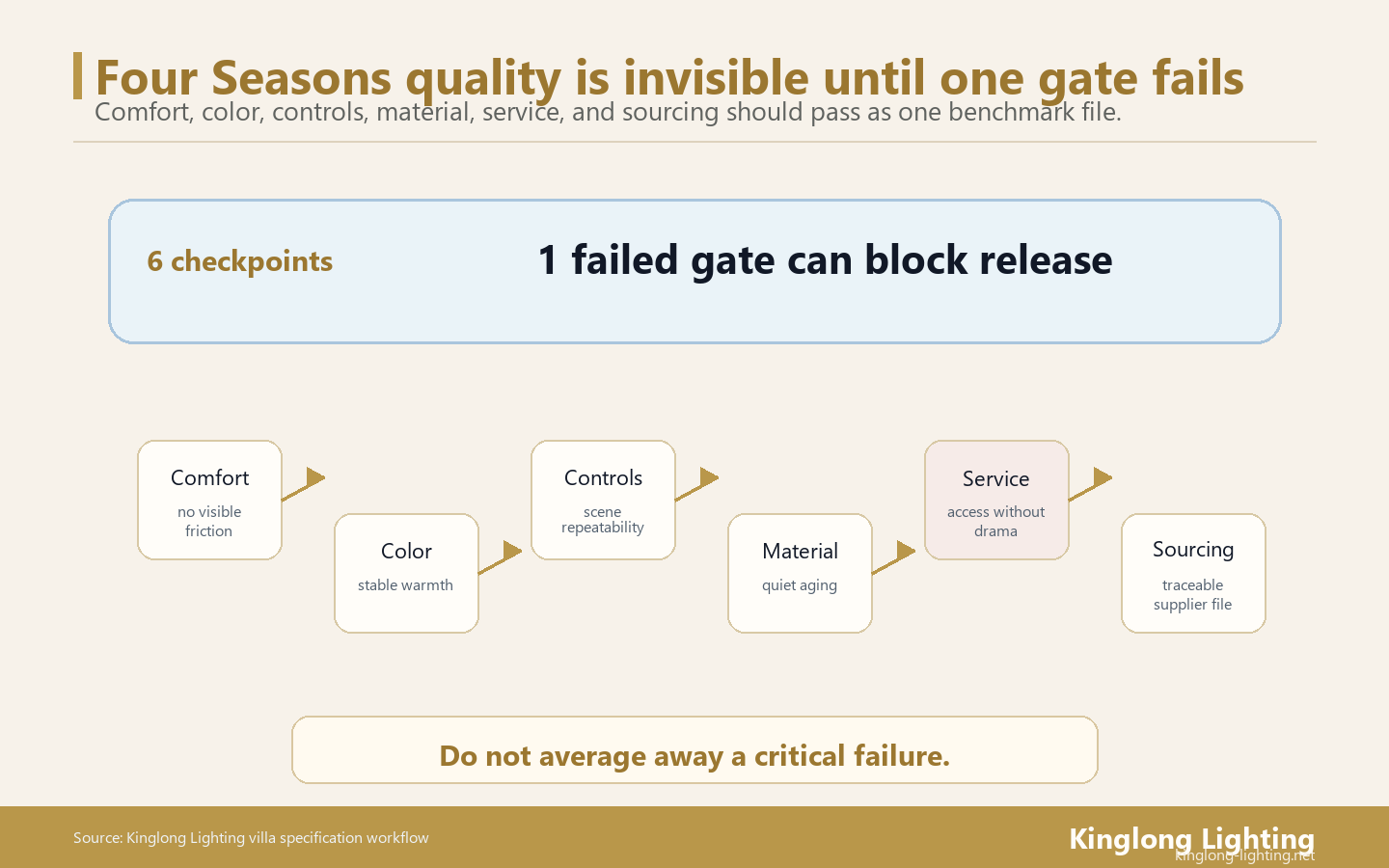
Based on our analysis, a quality-led chandelier brief should use 6 checkpoints: comfort, color, control, material, service access, and sourcing evidence. These checkpoints do not replace the design concept. They protect it. A fixture that passes all 6 can be expressive or restrained; a fixture that passes only the visual concept remains incomplete.
The six checkpoints also help owners decide where to spend. If comfort and control are weak, adding more expensive decorative material will not fix the guest experience. If service access is weak, a beautiful fixture may age visibly or require disruptive maintenance. If sourcing evidence is weak, the risk sits with procurement even when the design team is happy. Quality spending should first remove these failure points, then enrich the visual language.
Turn reputation into measurable lighting checkpoints
| Benchmark area | Lighting decision | Evidence to request | Failure mode |
|---|---|---|---|
| Guest comfort | Low glare from seated and standing views | Viewpoint photos and scene levels | Luxury becomes eye fatigue |
| Material truth | Warm, accurate rendering of stone, timber, metal, fabric, and skin tone | CCT and color evidence | Expensive materials look flat |
| Service support | Light guides arrival, dining, lounge, and circulation | Guest journey scene schedule | Staff and guests work around shadows |
| Maintenance | Fixture can be cleaned and serviced discreetly | Access plan and spare list | Visible aging or disruptive service |
| Controls | Dimming is smooth, quiet, and scene-ready | Driver and control test | Flicker, jumps, or noise |
| Supply chain | Materials and production route are documented | Supplier file, QC note, lot record | Reputation risk moves into procurement |
The conclusion is that quality reputation is operational. It is created by repeated small decisions that prevent guest discomfort and staff friction.
Use lighting references to protect the invisible details
The IES Lighting Library gives professional context for controls, maintenance, and application guidance. The WELL v2 Light concept centers visual comfort and human experience. The DOE TM-30 FAQ helps specifiers discuss color rendition with more precision. The UL luminaire testing and certification page reinforces that luminaires need evidence beyond appearance.
Calculated from a 6-checkpoint benchmark: 1 failed checkpoint / 6 total checkpoints = 16.7 percent of the file, but that single failure can dominate guest perception if it is glare, noise, or visible aging. This is why luxury lighting QA should not average scores. A critical failure needs correction even when the rest of the fixture looks beautiful.
Quality-led procurement favors quiet documentation
Four Seasons-style lighting procurement should make the evidence easy to review. The supplier should not send only renderings. A strong file includes a fixture narrative, scaled view, shop drawing, finish master, color evidence, dimming scene, driver location, product evidence route, packing plan, installation assumptions, spare parts, and cleaning method. The best documentation is not theatrical. It is calm, complete, and easy for a project team to approve.
The hidden cost of a weak file is repetition. If one property has to rediscover the same glare, service, or maintenance issue that another property already solved, quality becomes personality-dependent. Documentation makes quality repeatable. For a luxury brand reputation, repeatability is not boring. It is the reason guests can trust the experience.
A quality-led supplier should therefore send a release pack that is easy to audit later. The pack should show which finish was approved, which driver was used, which scene levels were tested, which access route was accepted, and which spare parts were shipped. When a property renovates, replaces a module, or expands the design language into another area, that record saves time and protects consistency.
For a Four Seasons-style benchmark, the quietest documentation is often the most powerful. It lets the operator maintain the same guest feeling after staff turnover, supplier changes, or a later renovation.
How Kinglong Lighting can support a Four Seasons-style benchmark
Kinglong Lighting can frame its custom hospitality work around the six checkpoints instead of simply presenting decorative options. The hospitality lighting page can support the hotel scope, the customization workflow can support drawings and production handoff, and the about page can support manufacturing scale and experience. The useful pitch is not “more luxury.” It is controlled comfort, stable materials, serviceable construction, and evidence-ready production.
The soft next step is to send Kinglong Lighting a benchmark brief through the contact page. Include the public-area role, service sequence, material palette, guest viewpoints, scene schedule, maintenance restrictions, destination market, and quality risks to avoid. Ask for a proposal organized by comfort, color, controls, materials, service access, and sourcing evidence.
Related Guides
- Hotel Chain Chandelier Procurement
- CNAS-Accredited Testing for Hotel Chandeliers
- Hotel Chandelier Maintenance Schedule
Four Seasons Benchmark Action Card
- Review the chandelier against comfort, color, controls, material, service access, and sourcing evidence.
- Treat glare, noise, visible aging, and poor maintenance access as critical failures.
- Ask for evidence that makes the quality repeatable, not only attractive.
- Test scenes from real guest and staff positions before release.
- Send the six-checkpoint benchmark brief to Kinglong Lighting.
A Four Seasons benchmark file should make quiet quality measurable
Four Seasons-style lighting is easy to misunderstand because the best decisions may not call attention to themselves. The chandelier may look simple in a render, but the real quality sits in comfort, stable color, scene control, material aging, service access, and supplier discipline. A benchmark file should therefore explain what guests should not notice: glare, noise, uneven dimming, visible aging, awkward cleaning, or a fixture that dominates the room for the wrong reason.
Define the invisible failures first
A quality benchmark should start by naming the failures that would damage the guest experience. In a lobby, that might be a bright eye-level sparkle point. In dining, it might be color that makes finishes or food feel wrong. In a corridor, it might be a service panel or driver location that turns maintenance into a visible interruption. Naming those failures early gives the designer and supplier a shared target that is more useful than asking for a generally luxurious chandelier.
Check serviceability as part of the luxury promise
A fixture that is difficult to clean, relamp, inspect, or repair will eventually reveal that weakness to the guest. The benchmark file should include access method, module labeling, spare logic, finish care, driver location, and a post-installation inspection path. These details are not secondary to design. They are part of the reason the lighting can remain calm and consistent after opening, seasonal occupancy, and repeated service visits.
Use restrained design to demand better evidence
Restraint does not make specification easier. It often makes evidence more important because there is less ornament to hide defects. Small differences in metal tone, glass clarity, dimming curve, or suspension alignment become visible. Kinglong Lighting can support this kind of file by separating visual samples, technical drawings, material masters, control assumptions, and packing notes. The buyer then sees how a quiet design will stay quiet through manufacturing and installation.
Do not average away a critical issue
If five checkpoints pass and one critical checkpoint fails, the decision is still not ready. A glare problem, unsafe access route, unstable color target, or missing spare plan can dominate the guest experience even if the chandelier looks beautiful. The release note should name which failures block approval and which issues can be refined. That gives the project team a practical benchmark instead of a vague reputation target.
Make the benchmark useful for the supplier
The benchmark should be written so a manufacturer can act on it. Instead of asking for a refined atmosphere, the file should state the room role, viewing distance, finish master, scene target, service path, and the evidence expected at each review. That gives Kinglong Lighting a way to answer with drawings, material samples, control notes, module logic, and packing assumptions. A quiet luxury project becomes easier to manufacture when the quietness is attached to visible approval evidence.
The benchmark should also say how close is close enough. A finish sample may have an acceptable range, but a glare point near a seating area may have no tolerance. A dimming curve may be adjustable on site, while module spacing may need to be frozen before packing. These distinctions prevent a quality benchmark from becoming a polite list of preferences.
Frequently Asked Questions
What makes Four Seasons-style lighting feel high quality?
It usually feels comfortable, consistent, calm, material-aware, service-friendly, and easy to maintain. The fixture should support the experience without creating friction.
Does quality lighting require the most dramatic chandelier?
No. A dramatic chandelier can work, but the benchmark is comfort, proportion, material truth, control, serviceability, and long-term performance.
How should a supplier prove lighting quality?
Provide drawings, samples, color evidence, scene tests, driver information, safety route, packing plan, maintenance access, and production traceability.