
A custom lighting spare parts kit should solve a replacement problem, not simply add a bag of extra pieces to the shipment. Identify the components that could interrupt use or visibly disrupt an installation, confirm which replacements actually fit, and agree quantities against the owner’s recovery expectations. Keep approved crystal and finish samples separately: a reference for judging a replacement is not necessarily a part available to install.
For hotel and furniture, fixtures and equipment procurement teams, the useful deliverable is a part-specific proposal that facilities staff can understand after the project team has left.
Plan the Kit Around Recovery, Not a Percentage
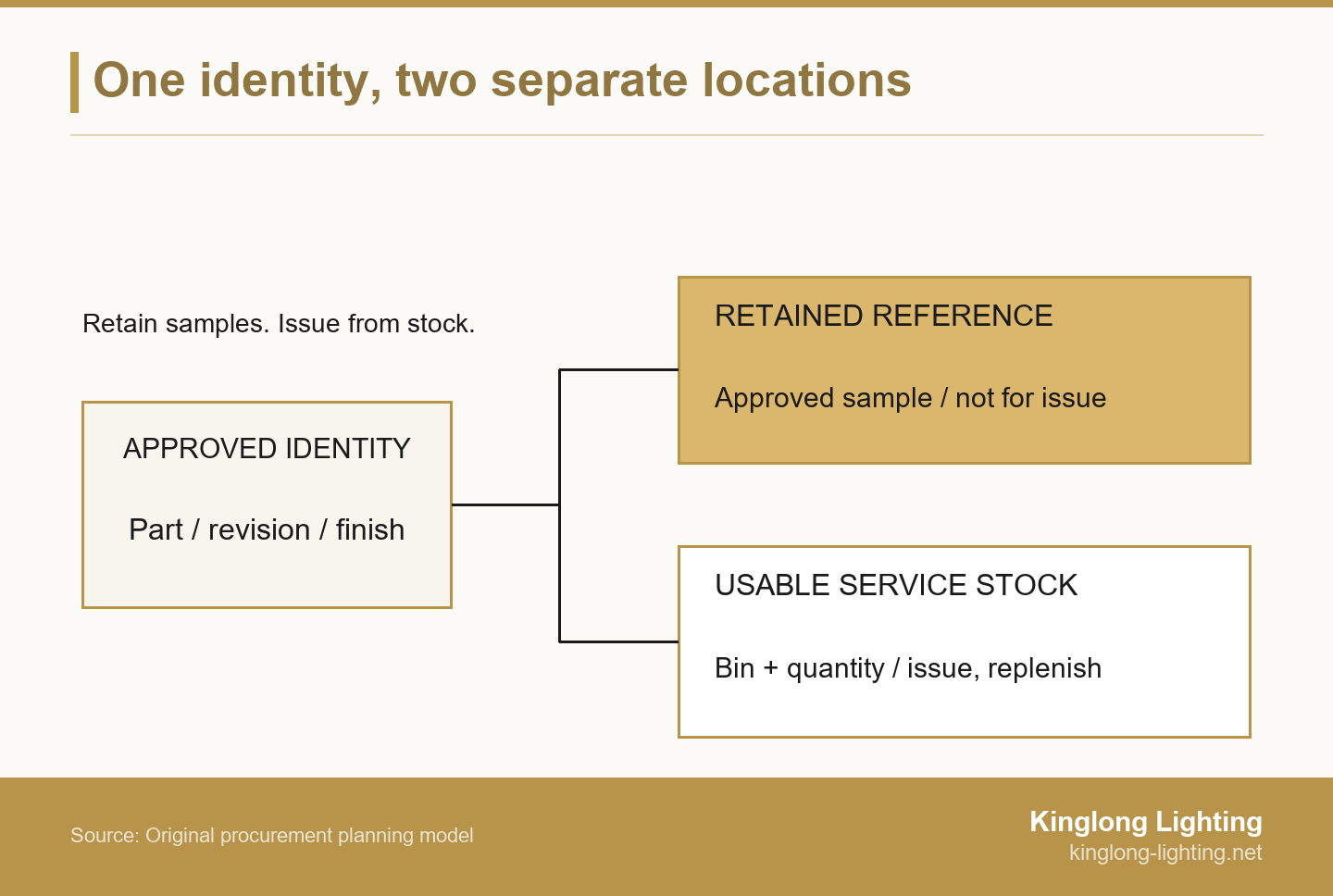
Build the replacement kit around three connected items: approved references, usable service stock and a retrieval map. One spare type can conceal a gap in another, so total quantity alone says little about recovery. Approve quantities against the intended replacement scenario, rather than applying the same percentage to every component.
- Retain the reference. Keep identified crystal samples and finish references for comparison; do not count them as available replacement stock.
- Reserve usable parts. Service stock means replacement parts reserved for use after handover, distinct from pieces intended for installation losses.
- Make the kit retrievable. Connect each part code to its compatible fixture, approved revision, quantity and physical storage location.
Separate storage locations make that distinction visible. A technician should be able to retrieve an approved replacement without dismantling the sample library or borrowing the only retained reference.
A useful data precedent is the National Institute of Building Sciences’ COBie V3 product-type record, which associates products or equipment with manufacturer and model information. That identity helps someone find the right record; it does not establish that a particular spare will fit. Use the owner’s existing asset system where possible, rather than creating an isolated list nobody will maintain.
Begin with the current fixture schedule and approved drawings. If those are still being assembled, the lighting specification and procurement resources provide broader preparation context; the spare proposal should still name the exact components in this order.
Select Spares with a Component Risk Matrix
Choose a stock route by considering breakage exposure, matching risk, confirmed replacement lead time, replaceability and storage together. A fragile piece deserves attention, but stocking it is useful only if the site can identify, protect and install it through an agreed service method.
Use the matrix below as a proposed planning aid, not an industry stocking standard. For each applicable row, enter the actual component code, the quantity proposed by the supplier and the quantity accepted by the owner. A blank row is a question to resolve, not permission to assume availability.
| Component | Risk that changes the choice | Evidence and stock route | Quantity decision |
|---|---|---|---|
| Repeated crystal drops or glass elements | Handling exposure and visibly missing pieces | Identify each shape and mounting detail; consider protected on-site stock of compatible pieces. | Agree the recoverable loss scenario for each type, not the installation total alone. |
| Handed or individually shaped decorative pieces | A similar silhouette can conceal a different fit | Separate variants by drawing and position; confirm whether each piece is interchangeable or individually matched. | Allocate by compatible variant; record any piece that requires a new commission. |
| Visible finished metal components | Later color, sheen or texture mismatch | Retain the finish reference and batch identity; assess whether a complete visible component is more useful than repair material. | Balance appearance-critical recovery against storage size and finish protection. |
| Clips, connectors and small attachment parts | Loss of a small part can prevent assembly | Confirm exact compatible hardware and the responsible specialist’s replacement method. | Propose complete service sets where a loose individual item would be unusable. |
| Drivers or other electrical assemblies | Electrical and control compatibility, not appearance | Obtain specialist confirmation of the approved assembly and service route before selecting stock. | Use the verified configuration and recovery plan; do not substitute by a headline rating. |
| Retained crystal and finish samples | The comparison reference disappears into repairs | Keep a separately identified reference library, protected from routine issue. | Record reference holdings separately; exclude them from usable spare totals. |
The conclusion may be stock, supplier-held availability to be confirmed, an agreed repair route or a longer replacement process. Record which option applies. “No on-site stock” is defensible only when the owner understands the resulting interruption and accepts the alternative.
Make Crystal and Finish References Unambiguous
A compatible replacement needs more than the right product photograph. Record the decorative part’s geometry and mounting details, its drawing revision and its associated finish reference. Two pieces that look alike from below can differ at the hole, attachment or hidden interface.
For crystal or decorative glass, ask which features define the approved piece: profile, dimensions and agreed tolerances, hole position, edge treatment, appearance and attachment arrangement. Keep a marked photograph alongside the drawing so facilities staff can recognize the part without treating the photograph as a dimensional inspection. Where production variation is accepted, record the agreed range rather than relying on one attractive sample.
Kinglong Lighting’s published hospitality process describes physical sample boards and confirmation of crystal, glass and metal finishes. For a replacement-kit discussion, ask which approved references relate to the supplied components and which samples will remain with the owner. The published process does not establish a particular project’s spare allocation.
For a finish library, identify the substrate, finish designation, approved sample code, approval date and relevant production batch. Agree how the replacement will be compared with the installed surface. A retained sample establishes an appearance target; it cannot guarantee that a future component will match an aged installation.
Viewing conditions matter, and a color standard’s scope matters too. ASTM D1729-22 addresses diffusely illuminated opaque materials; its public scope excludes the directional viewing needed for critical metallic or pearlescent paint appraisal. It is not a universal acceptance method for transparent crystal or reflective decorative finishes. Agree a material-appropriate comparison method instead of citing a standard number as proof of a match.
Approve Quantities Against a Recovery Scenario
Agree quantities by compatible part and by the interruption the owner wants to manage. Keep an installation reserve separate from maintenance stock: if installers consume pieces before handover, the same pieces cannot also be counted as the owner’s remaining service stock.
Start with the recovery question. Is the aim to replace an isolated damaged drop, restore a complete decorative group, or keep a critical space usable while another component is sourced? Those are different purchases. Ask the supplier to identify the component or assembly needed for each route, including any associated attachment parts, rather than proposing an unexplained allowance.
Then establish the period the stock is intended to cover. Use a confirmed replenishment lead time where one is available, and record its date and assumptions. If it remains unknown, ask the owner to choose between accepting that uncertainty, increasing a justified reserve or agreeing another recovery arrangement. Do not convert an unconfirmed lead time into a numerical stocking formula.
A portfolio image is not evidence of replacement-part availability. Attach the actual fixture location and approved part reference to the proposal so the discussion moves from appearance to a defined service need. For visual context when preparing that location brief, see Kinglong’s installed decorative-lighting projects.
Make the quantity proposal reviewable with these fields: compatible part code; installed locations and count; recovery scenario; installation reserve; handover service quantity; retained reference location; replenishment route and confirmed timing; storage capacity; proposed quantity; accepted quantity; and the accepting owner representative. Where no stock is proposed, record the alternative in the same row.
There is no benefit in buying a bulky, fragile assembly that cannot be stored safely or installed through the agreed service route. In that case, compare a smaller serviceable subassembly, a protected supplier-held arrangement if offered, or an owner-accepted longer interruption. The decision is not simply “more spares”; it is which practical recovery option the project is paying for.
Check the Proposal Against the Installed Mix
Test the proposal by compatible type before increasing the total quantity. A kit can contain plenty of pieces while leaving a particular fixture with no usable replacement.
Example: Six Spares, but the Wrong Mix
In this illustrative example, a hotel buyer and facilities manager are checking an order of 18 pendants before shipment. Nine use glass type A and nine use type B. The supplier has proposed 6 spare glass pieces across 2 distinct glass types, but the team has not yet compared the spare allocation with the installed mix.
All six proposed pieces are type A. Type B looks similar, but its mounting-hole position differs. The total therefore conceals a gap: none of the proposed pieces is compatible with type B. Buying more of the same would enlarge the box without solving that problem.
For this example only, the owner accepts a recovery plan based on replacing isolated pieces and agrees to divide the six spares into three A and three B. The supplier reallocates the pieces, records the compatible part and revision for each, and keeps the retained appearance references outside that service-stock count.
Before packing closes, the responsible specialist checks fit against the approved references and drawings, and the buyer reconciles labels and quantities. This invented example is not a Kinglong case or a breakage forecast. Three pieces per type is an assumed allocation, not a recommended ratio; a different recovery requirement could justify a different mix or total.
Pack for Transport and for Later Retrieval
Protect the actual materials while keeping each part identifiable. Ask for packaging instructions for the supplied crystal, glass and finished metal, and plan the final storage location before shipment. An intact transit crate is not automatically a convenient long-term spare store.
The Canadian Conservation Institute’s heritage glass-care guidance recommends padded storage that prevents glass objects from rolling or touching one another. The transferable lesson is physical separation, not adoption of museum environmental requirements. For the spare kit, ask the supplier to define protected compartments or wrapping that suit each piece and its vulnerable attachment points.
Contact materials deserve a separate check. The Canadian Conservation Institute’s museum metal-storage guidance warns that some storage materials emit corrosive gases and recommends chemically stable materials. Apply that lesson as a question for the finish supplier: which wrapping, foam, adhesive and enclosure are suitable for this finish? Neither a generic “dry store” instruction nor an unverified foam specification answers it.
Put the part identity on the protective pack as well as the outer box. Include a simple compartment map so someone can locate the correct variant without unwrapping every piece. Keep identification off delicate finished surfaces unless the supplier has approved the marking method. Protect the retained samples too, but make their non-issue status obvious.
Ask facilities staff to confirm available shelf space, access arrangements and who can issue stock. Record any material-specific environmental or inspection instructions supplied for the actual components. If the proposed location cannot meet them, change the location or recovery arrangement before accepting the kit; additional stock does not correct unsuitable storage.
Close the Kit and Define Replenishment
Before shipment, reconcile the counted parts with their compatible references and storage locations. Assign both a stock custodian and a replenishment trigger, so the first repair does not silently exhaust the agreed reserve.
If the original part becomes unavailable and a proposed substitute changes the design, use the decorative-lighting value engineering guide to frame the design and commercial review. Do not label a changed finish, geometry or electrical configuration “like-for-like” merely because it can be obtained sooner.
Use this pre-shipment closure check with the actual packing list:
- Count: reconcile accepted quantities by part and variant, excluding retained samples and any consumed installation reserve.
- Identify: match pack labels to the approved drawing revision, finish reference and compatible fixture locations.
- Retrieve: have the receiving team follow one selected record to its protected compartment and confirm the proposed storage location.
- Service: confirm the responsible specialist, replacement method and any associated parts needed for the intended repair.
- Replenish: name who records an issue, checks the remaining quantity and requests a replacement under the agreed trigger.
Check transit protection separately from that stock record. FedEx’s breakable-shipment guidance recommends individual wrapping and cushioning that restricts movement. Those principles do not validate a bespoke crate: confirm the actual pack for the component, shipment route and handling arrangements.
On receipt, reconcile the kit against the packing list before putting it away. Preserve evidence of any discrepancy and resolve whether affected stock remains usable. Record subsequent issues against the installed asset and part code; that makes the next enquiry a defined replacement request rather than a search based on a photograph.
Bring the Proposed Kit into the Project Enquiry
For a Kinglong Lighting project discussion, send the current fixture schedule, component codes or drawings, approved finish references, proposed quantities and recovery assumptions. Include who will store and service the parts. Ask which components and supporting records fall within the actual supply scope, and which availability or lead-time questions still need confirmation.
Identify unresolved rows explicitly: a variant without a confirmed reference, a quantity without an agreed recovery assumption, or a component without a workable storage location. That gives procurement and the supplier a concrete issue to resolve before the kit is packed.
Do not assume every historic component can be reproduced or every spare kept available indefinitely. Use the current project materials to request a replacement-kit discussion with Kinglong.
Frequently Asked Questions
Can a Warranty Replace an On-Site Spare Kit?
A warranty does not by itself provide an immediately available replacement on site when a decorative component is damaged. Read the actual terms for eligibility, exclusions, evidence and supply arrangements, then assess recovery timing separately. A project may need usable stock even when a potential warranty claim exists; conversely, buying spares does not alter the agreed warranty.
Is a Finish Touch-Up Kit the Same as a Finish Library?
A touch-up kit and a finish library serve different purposes and are not interchangeable parts of a replacement strategy. The library retains the approved appearance reference; repair materials are for a specifically agreed repair method. Ask the finish supplier where that method is appropriate, how materials should be stored and whether any use restrictions apply. Do not assume a local repair will reproduce the appearance of a complete replacement component.
What if a Component Changes After the Spares Are Packed?
Recheck the affected spare records and physical parts against the newly approved revision before treating them as available service stock. Identify which geometry, finish or interface changed and ask the responsible specialist whether the existing spares remain compatible. Update affected labels and records together. Unaffected components need not be replaced simply because another part changed, but the basis for retaining them should be clear.
Who Should Approve Electrical Service Spares?
The responsible electrical specialist should confirm electrical spare compatibility and permitted replacement methods for the actual approved fixture and installation. Procurement can collect component identities and proposed quantities, but should not infer interchangeability from appearance or a single rating. Keep the agreed service instructions with the stock records, and use qualified personnel for work that requires them rather than treating the spare kit as a DIY repair guide.