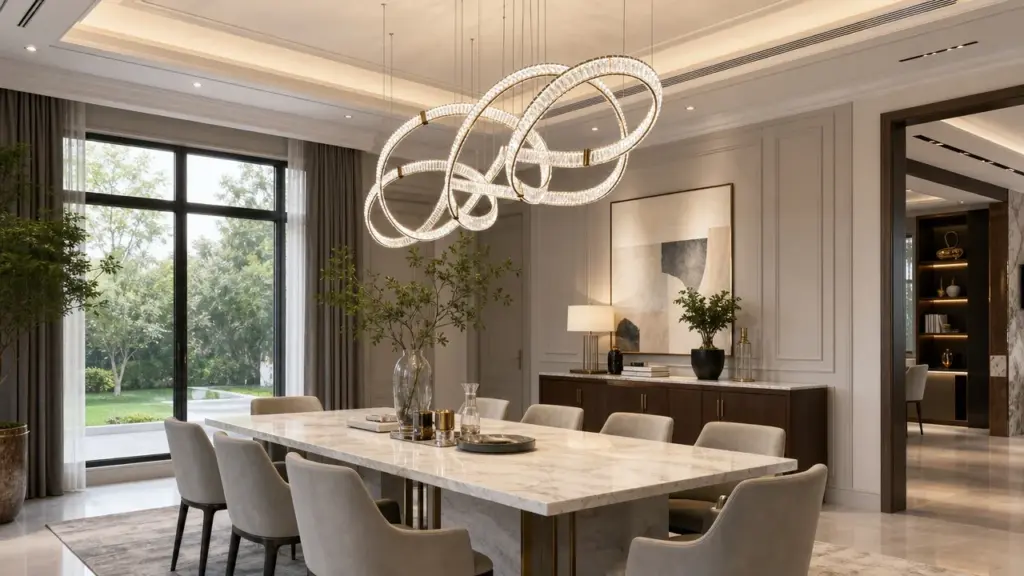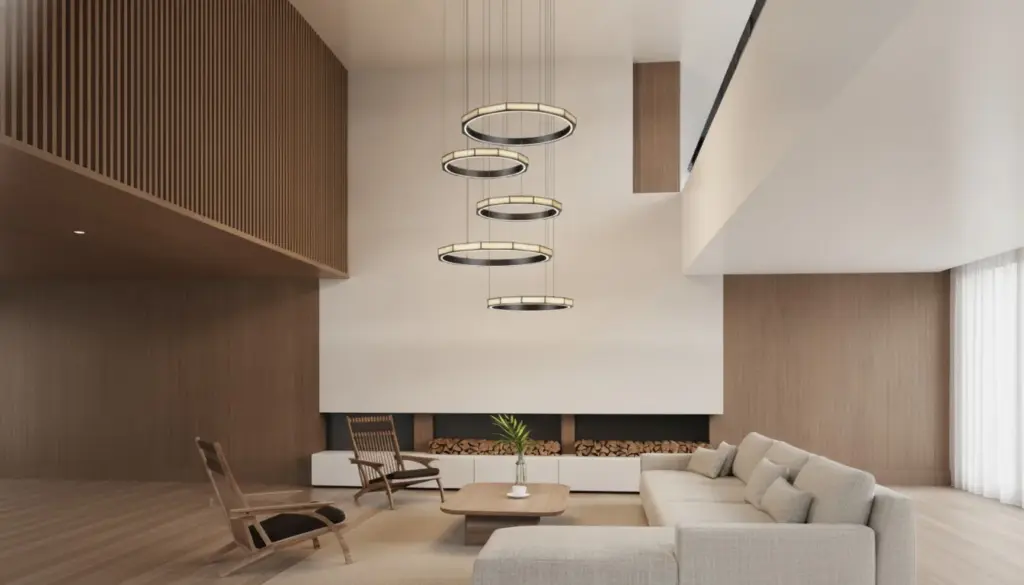
Living room chandelier size in an open-plan villa should start with the familiar width plus length formula, but it should never end there. Open-plan rooms add sightlines, seating zones, TV reflection, stair or dining adjacency, and layered lighting requirements that a simple diameter number cannot see.
The formula is useful because it creates a first size envelope. The correction is where the real design happens: ceiling height, furniture grouping, visual axis, material density, glare risk, and how the chandelier relates to nearby rooms.
Kinglong Lighting can help turn a living room chandelier size estimate into a project-specific range with visualization, material proof, suspension assumptions, and a release-ready drawing.
Key Takeaways
- Formula starts the range: Add room width and length for a first diameter estimate.
- Open-plan needs correction: Seating zones and adjacent rooms change perceived size.
- Height changes presence: Tall ceilings may need vertical rhythm more than width.
- Glare caps size: TVs, art, mirrors, and stone can make sparkle feel larger.
- Release as a range: Final size should include max width, preferred presence, and drop limit.
Use width plus length as the first estimate
The formula gives a starting envelope; the open-plan room gives the correction.
The IES Lighting Library supports application-specific decisions, and an open-plan living room is not a simple square room. It is often a shared visual field with dining, stair, foyer, terrace, art, and media zones.
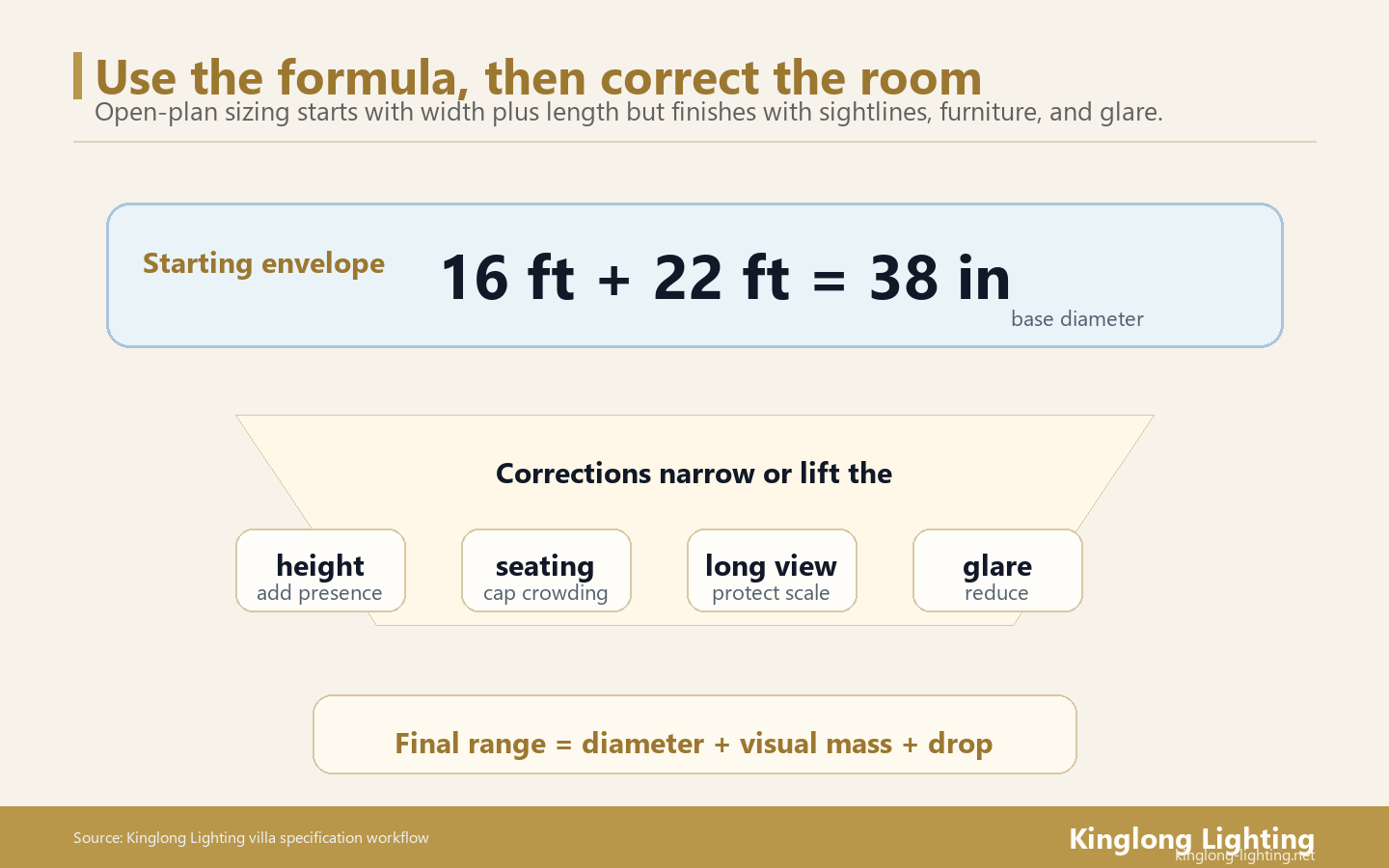
A common starting point is to add room width and length in feet, then read the result as a rough chandelier diameter in inches. For example, a 16 by 22 foot living zone starts near 38 inches before height, furniture, and sightline correction.
The decision rule is to treat the formula as a beginning, not a verdict. The living room chandelier size should be approved only after the seating zone and adjacent-room views are checked.
The furniture zone may be smaller than the room
In open-plan villas, the architectural room can be much larger than the actual seating group. If the chandelier is sized to the whole open area, it may dominate the sofa zone or compete with dining and foyer fixtures. If it is sized only to the coffee table, it may disappear from the wider space. The correct range usually sits between architectural scale and furniture scale.
The visual axis may be larger than the ceiling point
A living room chandelier is often seen from the foyer, dining room, stair, terrace door, or upper bridge. Those long views can make a standard fixture look too small even when the seating area feels correct. The answer is not always a wider diameter. Sometimes vertical layers, lighter material density, or a companion cove layer provide presence without crowding the seating zone.
Correct the formula for height, seating, and glare
The IES Illuminance Selector FAQ is useful because lighting criteria depend on task and application context. In a living room, the application includes conversation, media, circulation, art, and atmosphere rather than one table surface.
Calculated from a 16 by 22 foot living zone, 16 plus 22 equals a 38 inch starting diameter. Add a 10 percent height correction for a tall ceiling and the visual range moves near 42 inches before glare, seating, and material density caps are applied.
| Correction | Question | Typical adjustment | Evidence |
|---|---|---|---|
| Ceiling height | Does the room need more presence? | add height rhythm before width | elevation |
| Seating zone | Will it crowd conversation? | cap diameter near sofa group | furniture plan |
| Open sightline | Does it read from adjacent rooms? | increase visual density carefully | long-view render |
| Media glare | Will sparkle reflect in screens? | reduce exposed points | night scene test |
| Layered light | Can other layers support scale? | use cove or wall wash | scene plan |
The DOE residential lighting guide reinforces that residential lighting quality depends on layered planning and glare control. That is why a large living room chandelier should not carry every lighting job.
The Lutron layered lighting guide is useful because ambient, task, and accent layers should work together. The chandelier can create identity while other layers protect reading, art, and low evening scenes.
Material density can make the same size feel larger
A 42 inch open metal chandelier, a 42 inch dense crystal chandelier, and a 42 inch hand-blown glass cluster do not feel the same. Visual density, reflection, and brightness change perceived size. This is why the final range should name material density, not only diameter.
The UL residential lighting guidance is useful because decorative luminaire evidence should include completed product and component proof. For a living room chandelier, suspension, driver access, dimming, and replacement logic belong in the size approval file.
In practice, the best approval packet contains a plan, elevation, seating view, adjacent-room view, night scene, and service note. If any one of those views fails, changing width alone may solve the wrong problem.
The range should also state what will not change. If the ceiling point is fixed, the correction may need to come from drop height, tiering, or material density. If the screen location is fixed, the correction may need to come from shielding or lower sparkle rather than a smaller fixture.
How Kinglong Lighting can turn the formula into a real range
Kinglong Lighting’s Mofun Design Platform can help test living room chandelier size before production by showing scale, material density, and visual relationship to the room.
The practical next step is to send living room dimensions, furniture plan, ceiling height, screen/art locations, preferred style, and adjacent-room photos through the project inquiry page. Ask Kinglong Lighting for a size range with preferred diameter, visual presence, drop limit, and glare note.
Kinglong Lighting should also ask which view matters most. Some open-plan rooms are judged mainly from the sofa, while others are judged from a stair landing, foyer axis, or terrace approach. The same formula result can lead to different fixture shapes depending on which view carries the room identity.
Turn the size formula into a living-room model
The width plus length formula is useful because it gives the team a shared first number. The problem is that open-plan villas are not one visual field. They contain an architectural room, a furniture zone, long views from adjacent spaces, and glare surfaces that can each change perceived size.
A stronger living room chandelier recommendation turns the formula into a model. The model explains which number came from geometry and which correction came from the way the room will actually be seen and used.
The model should keep the base formula visible so the correction can be explained. If the final recommendation moves upward, the reason might be ceiling height or long-view weakness. If it moves downward, the reason might be seating comfort, screen glare, or dense material. That transparency helps the owner accept a range instead of arguing over one number.
The architectural model measures the whole volume
Start by measuring the larger architectural volume: width, length, ceiling height, ceiling feature, column line, stair or foyer adjacency, terrace opening, and the main wall planes. This model prevents the chandelier from being too small for the open-plan envelope. A 16 by 22 foot seating zone may suggest 38 inches, but a taller ceiling or a long view from the foyer may require more visual presence. The response can be height, tiering, spacing, or material rhythm rather than diameter alone.
The furniture-zone model measures conversation comfort
The furniture-zone model looks smaller and more human. It asks how the chandelier relates to sofas, lounge chairs, coffee table, side tables, circulation, and seated eye level. A fixture that fits the architectural volume may still feel too wide over an intimate seating group. Conversely, a fixture sized only to the coffee table may disappear from the room. The final range should sit between these models, with a written reason for choosing more room presence or more furniture comfort.
The long-view model checks neighboring rooms
Open-plan living rooms are often judged from the dining room, foyer, stair landing, kitchen, terrace, or upper corridor. These long views can make a chandelier feel smaller than it appears from the sofa. The long-view model should compare silhouette, material density, vertical rhythm, and relation to nearby decorative fixtures. If the living chandelier competes with the dining chandelier, reduce density or separate scene behavior. If it disappears from the foyer, add visual structure before simply increasing diameter.
The glare model caps size around screens and reflective finishes
The largest technically possible chandelier is not always the best living room chandelier. Screens, polished stone, glass rails, mirrors, lacquer, and artwork can multiply sparkle and make a moderate fixture feel busy. The glare model should be checked at evening output, not only in daylight. If the room has a large TV or reflective wall finish, the size range may need a lower visual-density cap. This is where material choice, lamp shielding, dimming, and layered wall lighting can matter more than diameter.
Use the formula to create a range, then defend the correction
The strongest living room sizing recommendation explains why the final range is different from the base formula. A 38 inch starting diameter may become a 42 inch visual target because the ceiling is tall, or it may stay closer to 36 inches because the seating zone is intimate and the screen reflection is strong.
The correction should be written, not hidden in taste language. If material density makes the chandelier feel larger, record it. If adjacent-room views make the fixture feel smaller, record it. If cove lighting carries ambient work, record it. These notes make the final size defensible.
Kinglong Lighting can use this range to prepare drawings and visualization that compare physical diameter, perceived visual mass, and drop height. That prevents the project from treating a formula as a fixed answer when the open-plan room is asking for a balanced envelope.
For custom production, that range should become a drawing instruction. Diameter, drop, tier spacing, canopy location, material density, and driver access should all correspond to the same preferred range. Otherwise the project may approve the right diameter while producing the wrong visual mass.
The final range should also include a coordination note for nearby decorative fixtures. An open-plan living chandelier may share sightlines with dining pendants, stair lighting, or a foyer statement piece. If each fixture is sized in isolation, the room can feel crowded even when every individual calculation is correct.
The coordination note should include a hierarchy decision. Decide whether the living room chandelier is the dominant object, a quiet counterpoint to a foyer chandelier, or part of a pair with dining lighting. Once the hierarchy is written, size, material density, and scene brightness can support the same intent instead of competing for attention.
For homes with large windows, the range should also be checked at night from outside. A chandelier that looks balanced from the sofa may become a bright floating object when viewed through glass from the garden or driveway. Exterior sightlines are part of open-plan sizing when the villa is meant to read as one composed volume.
| Formula output | Correction | Why it changes |
|---|---|---|
| 38 in | 42 in visual target | tall ceiling and long view |
| 42 in | 38 in physical cap | screen glare and seating comfort |
| 36 in | add vertical rhythm | needs presence without width |
| 44 in | lighter material density | large view but low visual mass |
Living room sizing action card
- Calculate width plus length as the first diameter estimate.
- Separate room size from seating-zone size.
- Check long views from adjacent spaces.
- Cap sparkle around screens, art, and mirrors.
- Release a size range, not one fixed number.
Related Guides
- Villa Chandelier Size Formula
- Double-Height Foyer Chandelier Selection
- Smart Lighting and Luxury Chandeliers
Frequently Asked Questions
What size chandelier works for an open-plan living room?
Start by adding the living zone width and length in feet, then read the result as inches. Correct that number for ceiling height, seating layout, adjacent-room views, glare, and material density.
Should the chandelier be centered over the coffee table?
It can be centered over the coffee table when the seating group is the clear room anchor. In open-plan villas, the better center may be the visual axis between seating, foyer, dining, and terrace views.
Can a living room chandelier be too large?
Yes. A chandelier can be too large if it crowds conversation, reflects in screens, competes with adjacent fixtures, or feels heavier than the furniture zone. Material density can make a measured size feel larger.
What should Kinglong Lighting review before sizing?
Kinglong Lighting should review room dimensions, ceiling height, furniture plan, screen and artwork locations, adjacent-room views, material preference, dimming scenes, and installation access.