Chandelier mock-up approval should not release final hotel specifications because the sample looks beautiful; it should release them because scale, finish, light quality, structure, control, access, and packaging evidence have all been closed. The mock-up is the last inexpensive moment to expose a mistake. After production starts, the same mistake becomes a drawing revision, freight problem, site delay, or guest-facing compromise.
For a custom hotel chandelier, approval is a managed handoff between design intent and manufacturing reality. The designer wants atmosphere, material truth, and proportion. The owner wants cost control and risk visibility. The contractor wants a fixture that reaches site in a buildable package. The manufacturer needs a locked bill of materials, test route, finish control, and installation sequence. A good chandelier mock-up approval process turns those competing needs into named evidence instead of taste debate.
Key Takeaways
- Approval gate: Treat the mock-up as a release checkpoint, not a decorative sample viewing.
- Seven proofs: Close scale, finish, color quality, structure, controls, access, and logistics before production.
- Evidence first: Attach photos, measurements, finish references, test data, drawing revisions, and open comments to the same approval file.
- Change control: Any post-mock-up revision should state whether it changes cost, lead time, testing, packing, or installation.
- Supplier role: Kinglong Lighting can support custom hotel mock-ups with drawings, 3D visualization, sample coordination, and production handoff.
Why the mock-up is a release gate, not a mood sample
The most expensive mock-up failure is not an ugly sample. It is a beautiful sample that hides an unresolved production decision.
The phrase “mock-up approval” often sounds visual, but hotel chandelier approval is partly engineering, partly procurement, partly brand stewardship. The IES Lighting Library helps frame this because lighting decisions sit inside a broad professional body of application guidance, controls, maintenance, and design practice. That context matters because a chandelier in a five-star lobby is not isolated decoration. It interacts with illuminance, glare, color appearance, control scenes, ceiling coordination, and maintenance access.
The risk hidden in a perfect sample
A sample can look correct under showroom light and still be wrong for the hotel. The crystal density may be too heavy for the approved ceiling support. The metal finish may look warmer under 2700 K than under 3000 K. The driver may fit the sample canopy but conflict with the final access panel. The shipping crate may protect a 1 m module but not a 5 m assembled ring. The risk is a responsibility gap: each party sees one attractive object, but nobody has closed the chain from design approval to installed fixture.
Mock-up scope must include the invisible systems
The sample review should cover the parts guests do not see. The DOE TM-30 FAQ helps frame this because modern color evaluation uses more than a single familiar score, so color appearance should be reviewed with a named method and target, not by memory. The WELL v2 Light concept also reinforces that light affects visual comfort and human experience. The mock-up should therefore record driver choice, dimming behavior, optical material, color target, glare risk, and maintenance route, not only the decorative finish.
The seven approvals designers should close
Based on our analysis, a 7-gate mock-up pack is the minimum practical control set for a custom hotel chandelier because each gate protects a different downstream cost. If two gates remain unresolved, the file is not 71 percent complete in a useful way; it is blocked at the point where the missing gate can still force rework. That is why the approval form should not offer one signature line. It should expose which gate is accepted, conditionally accepted, or still open.
| Approval gate | What the designer checks | Evidence to attach | Release risk if skipped |
|---|---|---|---|
| Scale | Diameter, drop, sightline, density | 3D view, ceiling plan, room section | Fixture dominates or disappears in the lobby volume |
| Finish | Metal tone, glass clarity, texture | Physical swatch, finish code, approved photo | Different batches produce visible mismatch |
| Color quality | CCT, color rendition, beam impression | Photometric note, lamp or LED module record | Material looks dull after installation |
| Structure | Suspension, canopy, ceiling load route | Shop drawing, weight note, fixing detail | Late ceiling reinforcement or redesign |
| Controls | Dimming curve, scenes, driver access | Control protocol, scene table, driver location | Flicker, buzzing, or unstable scenes |
| Maintenance | Cleaning, module replacement, reach | Access sketch, spare part list, cleaning sequence | Beautiful fixture becomes expensive to service |
| Logistics | Module size, crate, lift path, install order | Packing drawing, crate count, site route | Damage or site delay after delivery |
The conclusion is simple: mock-up approval is meaningful only when every checked item has a matching document. A verbal “approved” is weak. A marked drawing, dated photo set, finish reference, performance note, and production revision file create a decision record the factory can build from and the project team can defend.
Build a controlled approval pack
The approval pack should be short enough for busy designers and strict enough for procurement. The first page records the project name, fixture code, mock-up date, sample version, responsible reviewer, and approval status. The second page holds photos under agreed lighting conditions. The third page captures comments by gate: accepted, revise, or not applicable. The fourth page lists the drawing and bill of materials version that production will use.
A strong approval pack also names the decision owner for each gate. The designer should not be forced to approve driver access. The engineer should not be asked to judge decorative warmth without a finish reference. Procurement should not be left to interpret whether a design comment changes cost. When each gate has one responsible owner and one required proof item, the project team can approve quickly without blurring accountability. This is the difference between a beautiful meeting and a usable manufacturing release.
For custom chandeliers, that ownership record is also useful months later when a contractor asks why a canopy, crystal length, or driver location was chosen.
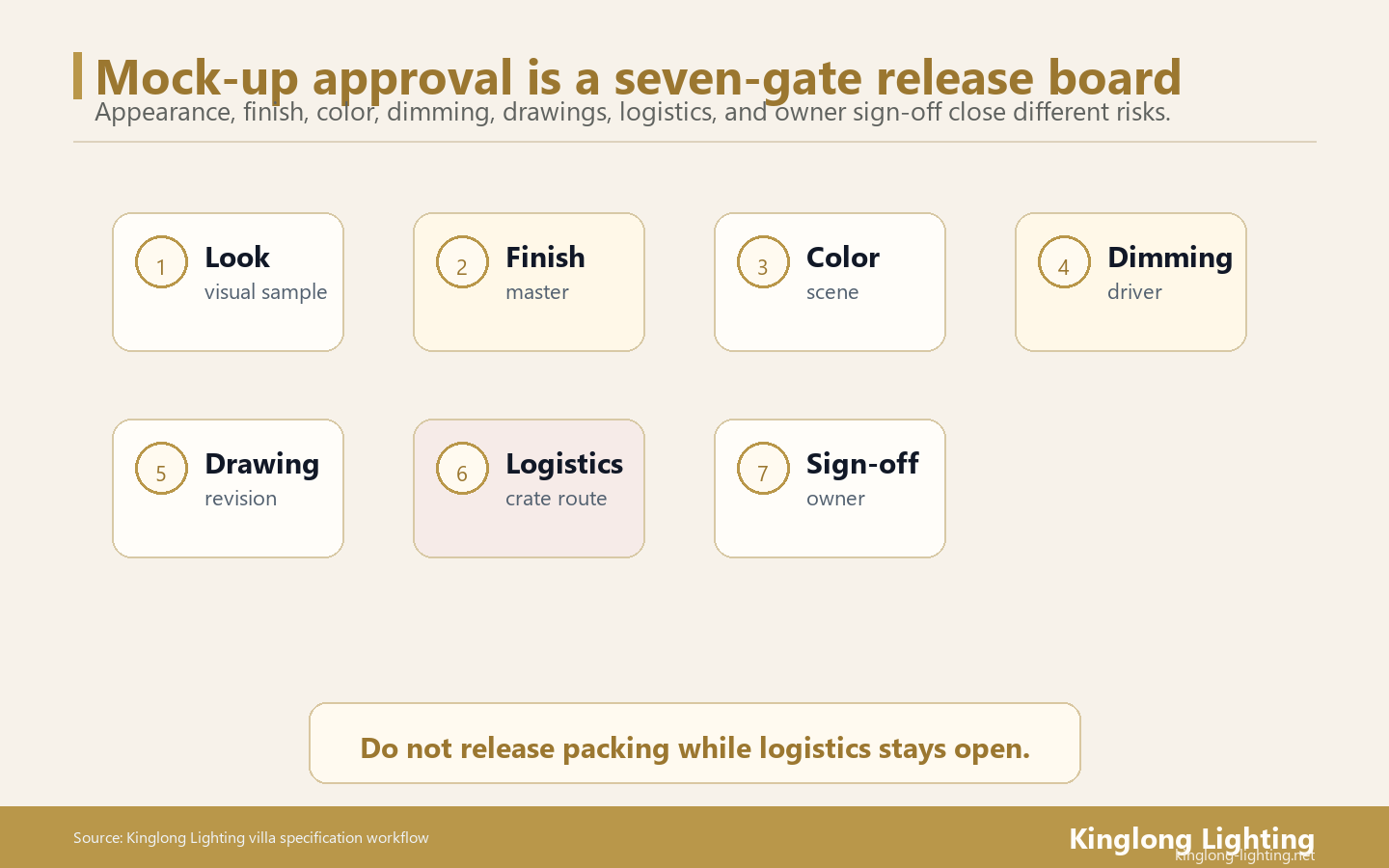
Calculated from a 7-gate review: 1 unresolved logistics gate / 7 gates = 14.3 percent of the checklist, but it can still affect 100 percent of installation timing because the chandelier cannot be received, lifted, or assembled safely if the crate and site route are wrong. That is why a mock-up should never be approved with “logistics to be confirmed later” unless the production order is explicitly held before packing release.
Connect approval to testing, controls, and destination requirements
Mock-up approval does not replace product evidence. It tells the team which version should be tested, purchased, packed, and installed. For safety and destination-market review, official sources such as UL luminaire testing and certification and the IEC 60598 luminaire standard family show why product evidence must be matched to the actual fixture configuration. For building operation, ANSI/ASHRAE/IES Standard 90.1 provides energy and controls context that can affect the chandelier’s control intent.
The mechanism is change control. If the designer changes the crystal length after the mock-up, that may alter weight, glare, packing, or installation time. If procurement swaps a driver, that may alter dimming behavior or certification evidence. If the ceiling contractor moves an access panel, maintenance may become impractical. Every post-mock-up change should therefore be labeled as visual only, performance affecting, structure affecting, cost affecting, or schedule affecting.
How Kinglong Lighting supports the handoff
Kinglong Lighting is most useful when the mock-up file becomes a production tool. The customization workflow can connect project drawings, material samples, finish decisions, and production requirements. The Mofun Design Platform can support scale and composition review before a physical sample is locked. For hospitality projects, Kinglong Lighting should receive the hotel brand requirement, ceiling information, desired CCT, finish reference, control requirement, and installation constraints before final approval.
The soft next step is specific. Send the marked mock-up comments, drawing revision, finish reference, destination market, and installation window through the custom chandelier inquiry. Ask for a production release package that names the approved sample version, open exclusions, test route, packing plan, and responsible contact. That request makes approval faster because it removes ambiguity before manufacturing begins.
Related Guides
- Hotel Lighting Procurement Framework
- Large Hotel Chandelier Installation Rework
- Hotel Chandelier Total Cost Surprises
Mock-Up Approval Action Card
- Open the review with the exact fixture code, drawing version, and sample version.
- Record decisions by the 7 gates: scale, finish, color, structure, controls, access, and logistics.
- Attach photos, swatches, measurements, and open comments in one dated approval pack.
- Mark every post-mock-up change as visual, performance, structure, cost, or schedule affecting.
- Send the approved pack to Kinglong Lighting before production release.
A hotel chandelier mock-up file should define exactly what is approved
A mock-up is not a decorative mood sample. It is a release gate that should tell the project team which version can move toward drawings, testing, purchasing, packing, and installation. If the mock-up only confirms that a finish looks attractive, the file remains weak. The approval should state what has passed, what is conditional, what failed, and what still needs evidence before production starts.
Define the authority of the mock-up
The file should say whether the mock-up approves appearance only, finish range, source behavior, dimming, module size, installation assumptions, or owner acceptance. These are different decisions. A designer may approve the finish while the engineer still needs weight and suspension detail. An owner may approve the look while the installer still needs crate dimensions and lift route. A good mock-up file prevents those decisions from being collapsed into one signature line.
Record failed samples as useful evidence
Failed samples should stay in the record because they explain what the team rejected. A finish may be too yellow, a shade too opaque, a crystal too sharp, or a dimming range too narrow. These failures help the supplier avoid repeating the same path and give the buyer a reason for the final selection. Kinglong Lighting can use failed-sample notes to refine material, finish, CCT, driver, suspension, or module logic before the production drawing is locked.
Connect sign-off to drawings and logistics
The approved mock-up should connect directly to shop drawings, bill of materials, sample photos, control notes, installation assumptions, crate design, and site route. The 7-gate review matters because one unresolved logistics gate can block the whole installation even if the fixture looks perfect. If packing, access, or lifting is still open, the file should state whether production is held before packing release.
Prevent post-mock-up drift
After mock-up approval, changes should be classified. Some are cosmetic refinements. Some reopen engineering, testing, cost, or schedule. The file should name who can approve each class of change. Without that boundary, a late finish tweak or density change can move through email and quietly alter the version that everyone thought was approved.
The final mock-up packet should include photos, sample labels, open comments, CCT and dimming notes, drawing revision, installation assumptions, logistics status, and sign-off owner. That is the point where a visual sample becomes a production control tool.
The packet should also keep a short change log after approval. If the team approves the mock-up and then changes finish, crystal density, driver, suspension length, packing method, or site route, the log should say whether that change is harmless, conditional, or a formal re-approval item. This keeps the final chandelier tied to the sample everyone remembers.
That change log should be visible to procurement, not only the design team. A change that looks aesthetic can affect price, lead time, certification evidence, packing, or installation labor. When the commercial impact is listed beside the visual impact, the owner can approve the change with a clearer understanding of cost and schedule.
The same control should carry into the purchase order. The released version should name the accepted sample, drawing revision, finish code, driver assumption, packing method, and any hold points that remain before shipment. If procurement issues an order without those links, the factory can manufacture a chandelier that matches the price but not the mock-up intent.
Frequently Asked Questions
What should be included in chandelier mock-up approval?
Include the approved sample version, drawings, finish reference, photos, color target, structural notes, control requirements, maintenance access, packing plan, open comments, and final approval status.
Can a designer approve a chandelier from photos only?
Photos can support early review, but final approval for a custom hotel chandelier should also check scale, finish under agreed light, structural details, controls, and logistics evidence.
When should the factory start production after mock-up approval?
Production should start only after the approval pack names the final drawing version, sample version, material decisions, testing route, and any conditions that remain open.