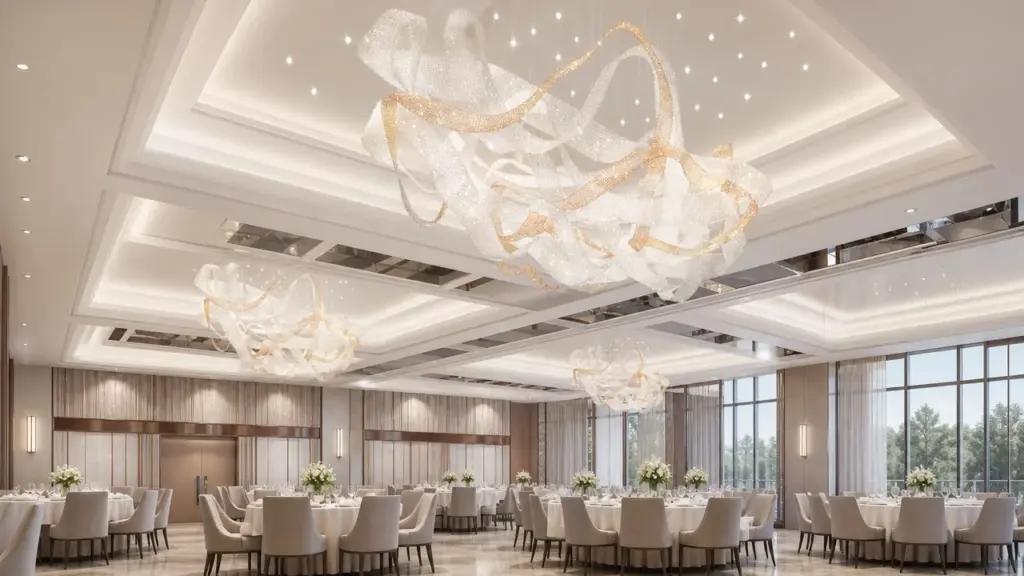
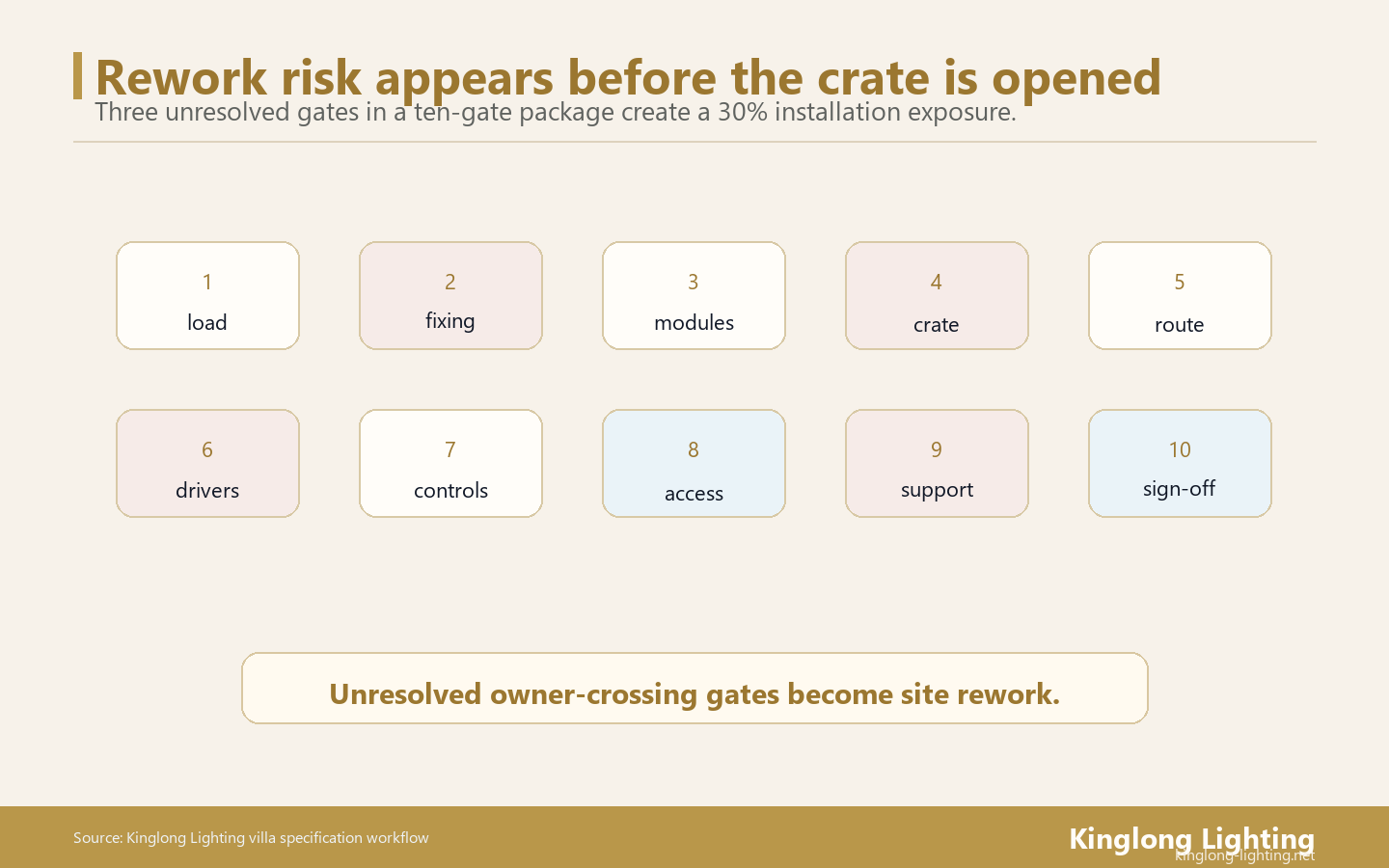
Large hotel chandelier installations enter a 30% rework-risk zone when the project approves the fixture before load path, modules, controls, packing, and site ownership are proven. The 30% figure should be read as a project-risk threshold, not as an unavoidable industry law. Based on our analysis of a 10-step installation package, if 3 critical steps remain unverified before shipment, the project has already created a 30% failure exposure before anyone opens a crate on site. The avoidable part of rework usually begins in the approval file, not on the lift.
Large chandeliers fail differently from small decorative fixtures. They cross design, engineering, production, logistics, electrical, ceiling, and hotel-operations boundaries. A late problem can be blamed on the installer, but the root cause may be a missing suspension drawing, a driver-access assumption, a crate sequence error, a ceiling opening conflict, or a mock-up that never represented the production assembly.
Key Takeaways
- 30% is a risk signal: Treat it as 3 unresolved critical steps out of 10, not a universal market statistic.
- Rework starts early: Most preventable installation failures are created before shipment.
- Ownership must be named: Designer, engineer, factory, contractor, electrician, and hotel operations need visible handoff rules.
- Site support matters: Large custom chandeliers often need factory installation guidance or technical standby.
- Release evidence: Hold shipment until load path, module map, controls, crate order, and installation method are confirmed.
Read the 30% figure as a risk zone, not an industry law
The useful question is not whether every project has a 30% rework rate; it is whether this project has left 3 of 10 critical installation gates unresolved.
Construction rework is a recognized project-delivery problem. The Construction Industry Institute publishes rework reduction guidance, and the TRID record for Measuring the Impact of Rework on Construction Cost Performance describes research using a CII project database. These sources are not hotel chandelier manuals, but they validate the broader point: rework is usually a process-control problem before it is a craft problem.
For hotel chandeliers, the 30% risk zone can be modeled simply. List 10 installation gates: final dimensions, weight, suspension points, ceiling opening, driver access, control grouping, module map, crate sequence, site route, and installation owner. If 3 are unresolved at shipment release, the project is not 70% safe; it is carrying 30% unresolved critical evidence. Kinglong Lighting’s hospitality lighting work is relevant because large custom fixtures need this gate discipline before a hotel opening date turns every question into a delay.
Rework cause 1: the load path was assumed, not proven
A chandelier can be visually approved while the ceiling still has no confirmed path for weight, vibration, access, and fixing responsibility.
Large hotel chandeliers require early coordination with the project engineer and ceiling contractor. The drawing should identify fixture weight, suspension method, canopy interface, fixing points, and any secondary support assumptions. A beautiful rendering does not answer those questions. If the ceiling is already closed or decorative finishes are installed, a load-path correction becomes rework even if the fixture itself was built correctly.
Safety evidence also belongs in the release package. Depending on market and local authority, teams may need vocabulary from UL luminaire testing and certification, OSHA’s NRTL program, or IEC 60598. The manufacturer does not replace the project engineer, but it should provide the product data and assumptions the engineer needs.
Rework cause 2: module and crate order were not installation-led
Large chandelier packing should follow the installation sequence, not only the factory’s convenience or the freight forwarder’s carton logic.
Many large chandeliers are shipped as modules. If the modules, labels, hardware, glass, crystal, drivers, and spare parts are not mapped to the installation sequence, site teams lose time matching parts. A crate may be technically complete and still operationally confusing. The packing map should tell the installer what opens first, what stays protected, which components are fragile, which tools are needed, and which spare parts should be held by the hotel.
| Unresolved gate | Typical rework trigger | Evidence before shipment |
|---|---|---|
| Load path | Ceiling support or fixing point conflicts after arrival | Weight, suspension, canopy, and engineer review note |
| Module map | Wrong assembly order or missing hardware on lift day | Numbered module drawing and crate sequence |
| Controls | Driver access, circuit grouping, or dimming mismatch | Driver data, control note, and access location |
| Site route | Crate cannot reach lobby, ballroom, or lift access zone | Crate dimensions and site route confirmation |
Rework cause 3: controls and access were left to the field
A chandelier installation is not complete if nobody can access drivers, replace components, clean the fixture, or commission the scene without reopening finished work.
Drivers, dimmers, emergency interfaces, control zones, access panels, and maintenance routes should be coordinated before production release. The IES Lighting Library includes commissioning and maintenance topics because lighting systems are meant to be operated, not merely installed. For hotel projects, this matters because a fixture that cannot be serviced gracefully will become an operations problem after opening.
The factory should provide installation guidance, but the site team must own local safety and access. For complex fixtures, factory technical support during installation can prevent interpretation gaps. Kinglong Lighting’s custom manufacturing workflow should be used to clarify what support is included, what the contractor owns, and what must be checked before the crates leave the factory.
Based on our analysis of a 10-gate installation release file, the highest-risk gates are usually the ones that cross owners: suspension points, driver access, crate route, module sequence, and site support. Each looks like a small detail until the fixture is already packed. If the factory assumes the contractor will solve access, the contractor assumes the designer approved the ceiling, and the designer assumes the engineer checked the load, the site team inherits a responsibility gap. This means the 30% risk zone is often created by 3 missing decisions, not by 1 dramatic mistake.
A practical prevention method is to add a hold point before packing. The hold point should ask 5 questions: has the engineer reviewed the load assumption, has the ceiling interface been checked, has the module map been matched to crate order, has the control owner confirmed driver access, and has the hotel confirmed site route and lift access? If the answer is unclear on 2 or 3 of those questions, the project should not pretend installation is ready. Large chandelier rework is expensive because correction happens inside finished architecture. A missing part can be shipped, but a wrong fixing point or inaccessible driver may require ceiling work, labor rescheduling, and guest-area protection.
The site calendar also changes the cost of every mistake. A lobby chandelier may be installed while flooring is protected, reception millwork is finished, lifts are limited, and opening photography is already scheduled. A ballroom chandelier may share the room with AV, ceiling, sprinkler, and movable-partition teams. If one module does not fit, the issue can block several trades rather than one installer. This is why the release package should include a site-day sequence, not only a factory drawing. The package should say what is unpacked first, who checks alignment, who approves energizing, who records defects, and who holds spare parts after handover. It should also include a stop-work trigger: if a fixing point, driver location, or module label does not match the signed file, the installer pauses for written clarification instead of improvising inside a finished hotel space.
For very large chandeliers, the release file should also name a communication channel for installation day. The installer needs to know who can answer module questions, who can approve a minor adjustment, who can reject unsafe improvisation, and who records lessons for future maintenance. A short daily photo log can also protect everyone, because it records which modules were opened, what was accepted, and where a deviation first appeared. This record becomes the maintenance baseline.
Related Guides
- Hotel Lighting Procurement Framework
- Ballroom Chandelier Specification Guide
- Hotel Chandelier Total Cost
Installation Rework Prevention Card
- Hold shipment if 3 of 10 installation gates are unresolved.
- Confirm load path, module map, controls, crate route, and owner.
- Request factory installation guidance for large custom fixtures.
- Ask Kinglong Lighting to review the release package before packing.
- Send drawings, ceiling details, site route, fixture size, destination, and installation scope through the large chandelier project inquiry.
An installation release file should close owner-crossing gates before shipment
Large chandelier rework usually appears on site, but its causes are often created in the approval file. Load path, module sequence, crate route, driver access, controls, and site support all cross different owners. If the designer assumes the contractor will solve access, the contractor assumes the supplier has labeled the modules, and the supplier assumes the site route is clear, the project has already built rework into the process.
Make load path a signed release gate
The release file should show weight, suspension method, fixing points, canopy interface, secondary support assumptions, and the party responsible for local structural approval. A rendering cannot prove those items. A chandelier can look approved while the actual load path remains conditional. That gap becomes expensive when the ceiling is closed or the fixture is already shipped.
Make crate order follow installation order
Large custom fixtures should not be packed only by manufacturing convenience. Crates, modules, hardware, glass or crystal, drivers, and spare parts should be labeled against the installation sequence. If the site team opens crates in the wrong order or searches for matching parts during lift work, the project loses time and increases damage risk. The packing plan is therefore part of the installation release, not a warehouse detail.
Define what factory support includes
Factory drawings and site support are different things. The file should state whether Kinglong Lighting provides installation guidance, remote support, on-site technical attendance, replacement part identification, or post-installation adjustment advice. It should also state what the contractor owns locally. Clear support boundaries prevent last-minute disputes when a problem appears above the lobby floor.
Use a hold point before final packing
The strongest rework prevention step is a hold point before final packing. At that moment, the project can still check module labels, crate sequence, driver access, missing hardware, spare parts, site route, and unresolved owner responsibilities. If the hold point is skipped, the next opportunity may be after the fixture arrives at the hotel, when every correction costs more time and involves more people.
Before shipment, ask for a ten-gate release file covering load path, fixing, module labels, crate route, driver access, controls, emergency interface, maintenance route, site support, and sign-off owner. If three gates remain open, treat the shipment as a rework-risk decision rather than a normal delivery milestone.
The release file should also record who can accept a conditional shipment. Sometimes a project chooses to ship while one local item remains open, such as final lift schedule or ceiling access confirmation. That can be reasonable only when the open item, owner, deadline, and fallback plan are written down. Otherwise the condition becomes an invisible rework risk.
After installation, the same file should be used for handover. Photos of final suspension, module order, driver locations, access panels, and replacement parts give the hotel a practical record for future maintenance. Rework prevention is not only about avoiding the first installation problem; it is also about making the next service visit easier to plan.
The handover record should be short enough for the hotel engineering team to use. A long technical folder that nobody opens will not prevent future mistakes. The useful version names the installed condition, the replacement parts, the access method, and the contact path for supplier clarification. That makes the installation file valuable after opening, not only during construction.
Frequently Asked Questions
Does 30% mean every large chandelier project has that rework rate?
No. Treat 30% as a risk-zone model: 3 unresolved critical installation gates out of 10. It is a practical release warning, not a universal industry statistic.
What causes large hotel chandelier installation rework?
Common causes include unconfirmed load path, unclear module map, driver-access problems, control mismatch, crate sequence confusion, ceiling conflicts, missing hardware, and no named installation owner.
When should factory support be planned?
Plan factory support before shipment for large, custom, modular, or high-risk fixtures. The factory can clarify module order, fragile components, assembly sequence, and replacement parts, while the local team owns code and site safety.
What evidence should be checked before shipment?
Check signed drawings, weight and suspension assumptions, module map, driver and control notes, crate labels, site route, installation guide, spare parts, and owner responsibilities before release.