
Use a pilot when an unresolved manufacturing question could be repeated across the order. A full run is more defensible when the relevant design, process and inspection evidence already apply. For a mixed lighting assortment, the useful answer is often a split decision: trial the uncertain work and release genuinely independent repeat work, rather than treating the whole purchase order as equally ready.
The buying task is to identify what the trial needs to prove before committing the balance. A fixed percentage of the order, or one attractive sample of every stock-keeping unit (SKU), does not answer that question.
Choose the production route by unresolved risk
For a multi-SKU lighting order, choose pilot scope around unresolved failure modes and meaningful production differences. A shared component can connect several styles, while a different suspension, finish or package can create a separate risk. Release only the work represented by the evidence, and state what remains outside that permission.
- Pilot first: new tooling, uncertain assembly or an unproven packed-product configuration needs a defined trial before the affected balance.
- Proceed with applicable controls: unchanged repeat work has relevant evidence, confirmed specifications and no unresolved dependency on the pilot.
- Hold for development: drawings, materials or acceptance criteria are still unsettled; making more units would reproduce an undefined design.
- Recheck the grouping: a shared finish run, component or packaging method connects supposedly independent work.
These are proposed procurement routes, not a universal factory procedure. Agree their practical and commercial implications with the manufacturer before issuing manufacturing permission.
Separate a design sample, a pilot and lot acceptance
A pilot batch is a limited production trial built to answer a defined manufacturing question under agreed conditions. A design sample may establish appearance or fit without showing that the intended production method can repeat it. Ask how the sample was made, what was adjusted by hand and which materials, tooling and packaging will change for production.
Protolabs’ first article inspection guidance describes inspecting selected parts from the beginning of a production run, with a defined scope, appropriate measurement equipment and recorded results. Its discussion concerns molded parts; it does not establish a standard pilot quantity or complete lighting-order approval. The useful buyer question is what characteristics the inspection actually covers.
For the design and specification work that precedes this decision, Kinglong’s lighting design and procurement resources provide additional context. Keep aesthetic sign-off separate from evidence about repeated assembly, component identification and shipment preparation. The same physical unit can contribute to several checks, but the record should identify each purpose rather than just say “sample approved.”
NIST’s explanation of acceptance sampling concerns random selection from a lot to decide whether that lot should be accepted or rejected. A deliberately selected pilot made earlier is not automatically that sample. Keep the later lot’s agreed inspection and release arrangements in place; do not turn an early success into a claim about every future unit.
Rank failures before counting pilot units
A practical way to choose the pilot question is to compare the consequence of failure, the quantity exposed and how late the buyer could discover the problem. This qualitative screen helps prioritize the trial; it is not a calculated probability or a substitute for qualified technical assessment.
A finish mismatch visible beside an approved reference needs a different check from an inaccessible wiring connection or an assembly sequence that damages glass. Name the unwanted outcome first. Then ask what observation would change the decision: a measured interface, a completed assembly without improvised adjustment, a consistent finish comparison, or a packaging test under an agreed protocol.
Repetition matters because a small error can be carried into many units. Novelty matters because the previous result may not describe the current process. Neither alone dictates a pilot quantity. A new high-volume wall light might need repeated assembly observations across relevant setups; a low-quantity feature chandelier might need a carefully planned first build around its unique suspension and installation interfaces.
For a villa’s whole-home package, the assortment may be small but highly varied. A repeatability trial is less useful for a genuinely unique piece than checks of its actual fabrication, fit and packing. For a wholesaler, the concern may instead be a common part used across many saleable styles. Ask the factory which variation can expose the failure and why the proposed number of trial units is sufficient to observe it. Record that reasoning, including what the trial cannot establish.
Group SKUs by what the evidence can represent
Group SKUs by the specific characteristic being checked, not just their collection name. Two pendants may share a canopy and wiring route but have different glass weight, suspension geometry and cartons. A successful canopy-fit check can inform the shared interface without proving the heavier pendant’s support arrangement or transport protection.
For packaged-product tests, ISTA cautions against blanket approval of untested products when extending knowledge from tested items. Its guidance calls for understanding product and packaging attributes, documenting the rationale and monitoring distribution outcomes. That is a packaging-evidence boundary, not permission to extend electrical certification across a lighting family.
Make a short coverage list beside each trial: represented SKU codes and revisions, shared feature, deliberate differences, and separate checks still needed. Include the variants that challenge the proposed similarity. “Largest” is not automatically the worst case for every failure: the longest glass element, the least supported component and the heaviest assembly may be different products.
Kinglong Lighting describes drawing review for feasibility and material selection within its custom lighting development process. That is a useful starting point when the proposed group depends on an uncertain interface or material choice. Confirm the actual development and trial scope for the project rather than assuming the service description includes a particular pilot quantity or test package.
Build a usable pilot-release decision matrix
Before making pilot units, define each release group by the risk to resolve, the production conditions the trial will represent, the evidence needed to pass and the exact work that may follow. Complete the matrix jointly with the manufacturer’s production and quality contacts; the purchaser identifies who has authority to accept the result.
The entries below are prompts to replace with project-specific information. They are not prescribed test values. A blank response leaves an open decision, not an implied approval. Agree tolerances and test methods before the trial; otherwise a disagreement about what “good enough” means can consume the time the pilot was meant to protect.
| Plan field | Complete for each risk group | Decision enabled |
|---|---|---|
| Group and baseline | SKU codes, quantities, drawing and component revisions: ____ | Identifies which balance the result could release. |
| Unresolved failure | Specific unwanted outcome and affected shared feature: ____ | Explains why the trial is needed. |
| Representative conditions | Materials, tooling, assembly method, finish route and packaging to use: ____ | Separates production evidence from a specially prepared sample. |
| Coverage and quantity | Variants and trial quantity, selection rationale, exclusions and destructive-test units: ____ | Shows what the pilot can and cannot represent. |
| Pass evidence | Characteristic, agreed limit, method, result record and approving person: ____ | Makes a pass reproducible rather than subjective. |
| Permission after a pass | Exact SKUs, revisions, quantities and operations allowed; remaining holds: ____ | Prevents a limited pass from releasing the whole order. |
| Failure and change response | Affected stock, containment, correction, repeat check and responsible contacts: ____ | Controls what happens before more work is committed. |
| Timing and commercial treatment | Trial/review dates, balance trigger, reserved resources, costs and disposition of trial units: ____ | Exposes the schedule and cost consequences of waiting or failing. |
Release the group only when its agreed evidence and outstanding prerequisites support the stated permission. Keep the drawing, physical reference and result record identifiable so another person can understand what was accepted without reconstructing an email conversation.
When assessing a supplier’s design and project context, a decorative-lighting project portfolio can help you frame relevant questions. Finished-project photographs do not show the pilot conditions, inspection results or current readiness of your order. Ask for the evidence appropriate to the matrix rather than treating a similar-looking installation as proof.
Turn pilot results into a bounded production release
A pilot release should name the permitted work and the evidence that supports it. Identify the approved revisions, represented variants, outstanding actions and the person authorizing the balance. “Approved to proceed” is ambiguous if engineering reads it as permission to order parts while production reads it as permission to finish and pack everything.
Separate accepted features from open ones. A finish trial can close an appearance question while installation-interface verification remains open. If the remaining question could change the finished item, limit work before that irreversible step. Purchasing, engineering and production need the same instruction, including any restrictions on substitutions or alternate assembly methods.
Pilot approval also differs from certification. UL’s Follow-Up Services description explains ongoing factory inspections for UL Certified products and checks of materials and component traceability against the applicable program requirements. That scope is specific to UL Certified products; a buyer’s pilot sign-off is not a substitute, and it says nothing by itself about Kinglong’s certification coverage for a proposed fixture.
Retain the agreed checks on subsequent production. Record how the factory will recognize a changed component, tool, work instruction or finish route, and who will decide whether the earlier evidence still applies. A passing trial should improve the production instruction, not merely produce an approved object that later units are expected to resemble.
Protect the schedule without bypassing the pilot
To protect the schedule, identify work that can proceed without prejudging the trial result. Confirmed purchasing for an independent repeat group may be reasonable; completing the uncertain shared component for the entire assortment before reviewing it defeats the intended hold. Agree who carries the cost if authorized advance work becomes unusable.
Ask the manufacturer to show the sequence from trial manufacture through review, any correction, the balance and shipment preparation. A promised completion date that assumes an immediate pass is a different plan from one that allows a correction and another check. Releasing work in phases can also create new finish runs, setups, storage or packing interfaces. Confirm those effects rather than assuming a split is free or automatically faster.
Changes can reopen a question the pilot appeared to close. ISTA’s retesting guidance covers changes to product, package or process that may affect packaged-product performance. A revised glass shape, carton insert or distribution route therefore needs a packaging-impact decision, not an assumption that the old result transfers.
Where the proposed change is cost-led, use the decorative lighting value-engineering guide to structure the design and commercial review. Then update the affected matrix rows and confirm any additional checks before using the change in the balance.
Worked example: split one order at the actual risk boundary
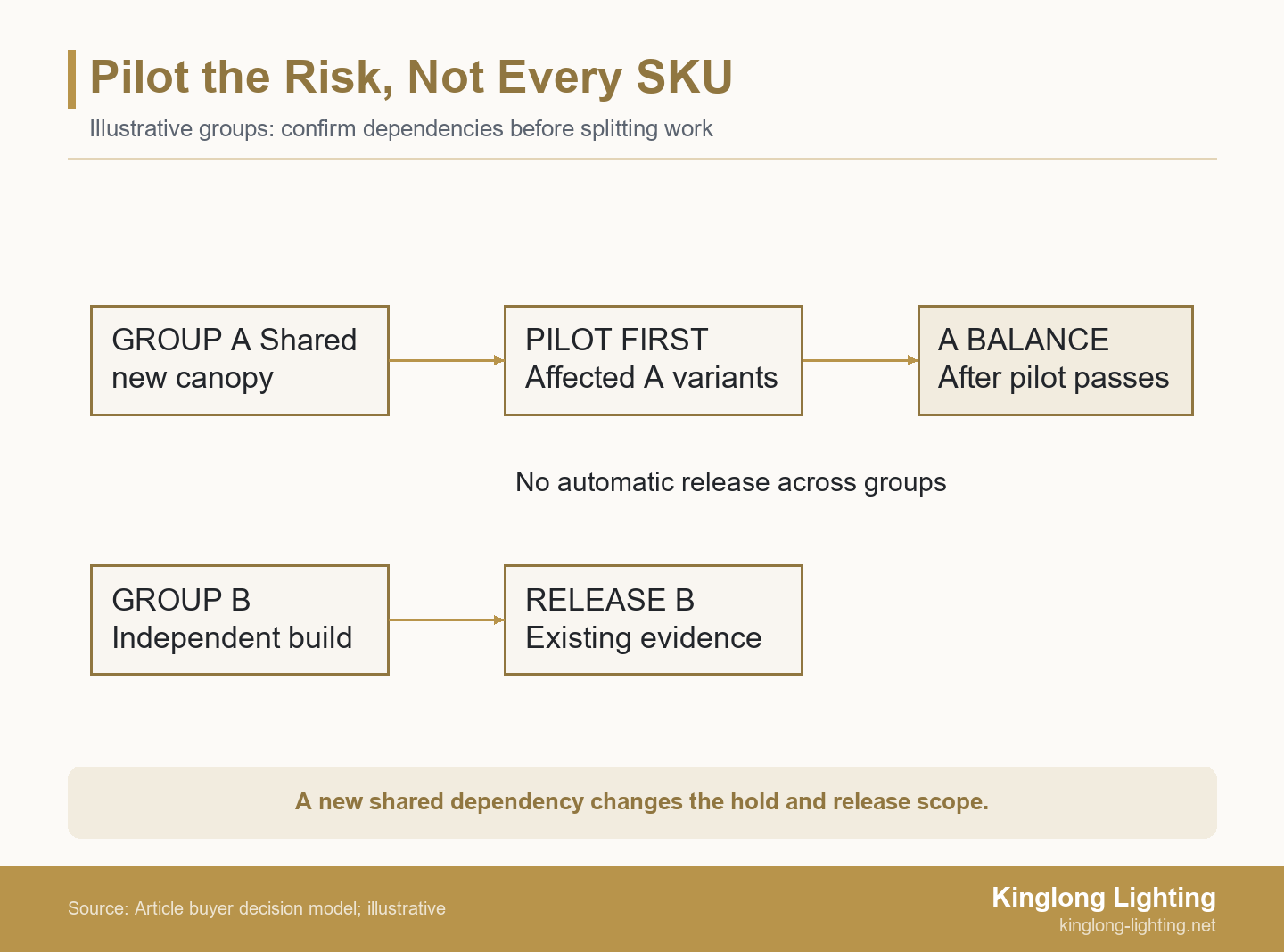
Consider an illustrative importer order of 300 repeat wall lights, 120 pendants and 24 new chandeliers. The pendants and chandeliers use a shared new canopy arrangement; the wall lights use a different proven mounting assembly. These invented quantities show the release logic, not an actual Kinglong order or recommended pilot size. A canopy problem affects the 120 pendants and 24 chandeliers, but does not automatically affect the 300 wall lights.
The buyer initially proposes approving a photographed pendant and starting every style. The drawing comparison instead shows that the chandelier has a different cable arrangement inside the shared canopy. A pendant appearance check cannot resolve that difference. The revised plan trials the relevant canopy configurations with the intended parts and assembly method, while separately confirming that the wall-light revision, process and packing evidence still apply.
Suppose the trial reveals that the connection space cannot accommodate the chandelier configuration as drawn. Hold the affected canopy work for both connected groups until engineering establishes which configurations the defect reaches. Identify any already made parts and prevent their unintended use. The manufacturer proposes a drawing and assembly correction; the buyer agrees the checks and acceptance criteria for the revised configurations rather than accepting a new photograph alone.
Before releasing the affected balance, compare the revised assembly results with those criteria and confirm the resulting instructions and parts are the ones production will use. If the two groups need different solutions, record separate permissions. The wall lights can proceed only after checking that their resources and inputs remain independent, including any shared finish operation. If that independence fails, revise their timing too. The value of the split is not a guaranteed earlier delivery; it is avoiding an unnecessarily broad hold without manufacturing past an unresolved dependency.
Prepare a development discussion before committing the balance
Bring SKU quantities, current revision-controlled drawings, shared components, unresolved risks, existing evidence and the required production or site sequence when you discuss the custom lighting development brief with Kinglong Lighting. Ask which drawing-feasibility and material-selection questions need closing before a trial proposal can be agreed. This gives the discussion a defined scope; it does not pre-agree a pilot quantity, test package, price or delivery date.
Frequently asked questions
Is a small first order the same as a pilot batch?
No: a small first order serves a commercial order, while a pilot is built around a defined production question and release decision. The two can overlap if their purposes and conditions are explicit. Agree whether the units are development evidence, saleable stock or both, and whether the supplier has permission to make the balance before you review them.
Can pilot units be sold or included in the final shipment?
Possibly, if the agreed condition, testing history, traceability and sales requirements permit it; test units are not automatically saleable stock. Keep destructively tested, altered or repeatedly assembled units separately identified. Confirm whether accepted units count toward the order quantity, which references will be retained and who authorizes their shipment after the trial has served its purpose.
Who pays if a pilot exposes a design problem?
The agreed commercial terms determine responsibility; the release plan should distinguish a supplier deviation from an approved design that needs changing. Before the trial, discuss development costs, replacement units, repeat checks and authorized advance work. Finding a problem does not by itself determine who pays, and approving a correction should not silently approve its additional cost or timing.
Does a repeat order always need another pilot run?
A repeat order does not necessarily need a new pilot if the relevant product, process and evidence remain applicable; a repeat SKU code alone does not establish that nothing has changed. Compare revisions, components, production methods and packing with the accepted baseline. Decide whether the change needs a focused check or a broader trial, while retaining the order’s agreed inspection arrangements.