
Plan each SKU against approved inputs, compatible process families, available resources and materials, then regroup finished work by complete site-delivery requirements. A list sorted by fixture code or order quantity cannot show whether a small missing item will prevent a room from being installed.
For the FF&E procurement manager, the useful question is not simply how many pieces the factory has made. It is which approved work can run next, what is holding the rest, and whether the next shipment contains the complete scope the site can use. The method below turns those questions into a supplier-facing production map.
Plan the Package by Dependencies, Not SKU Count
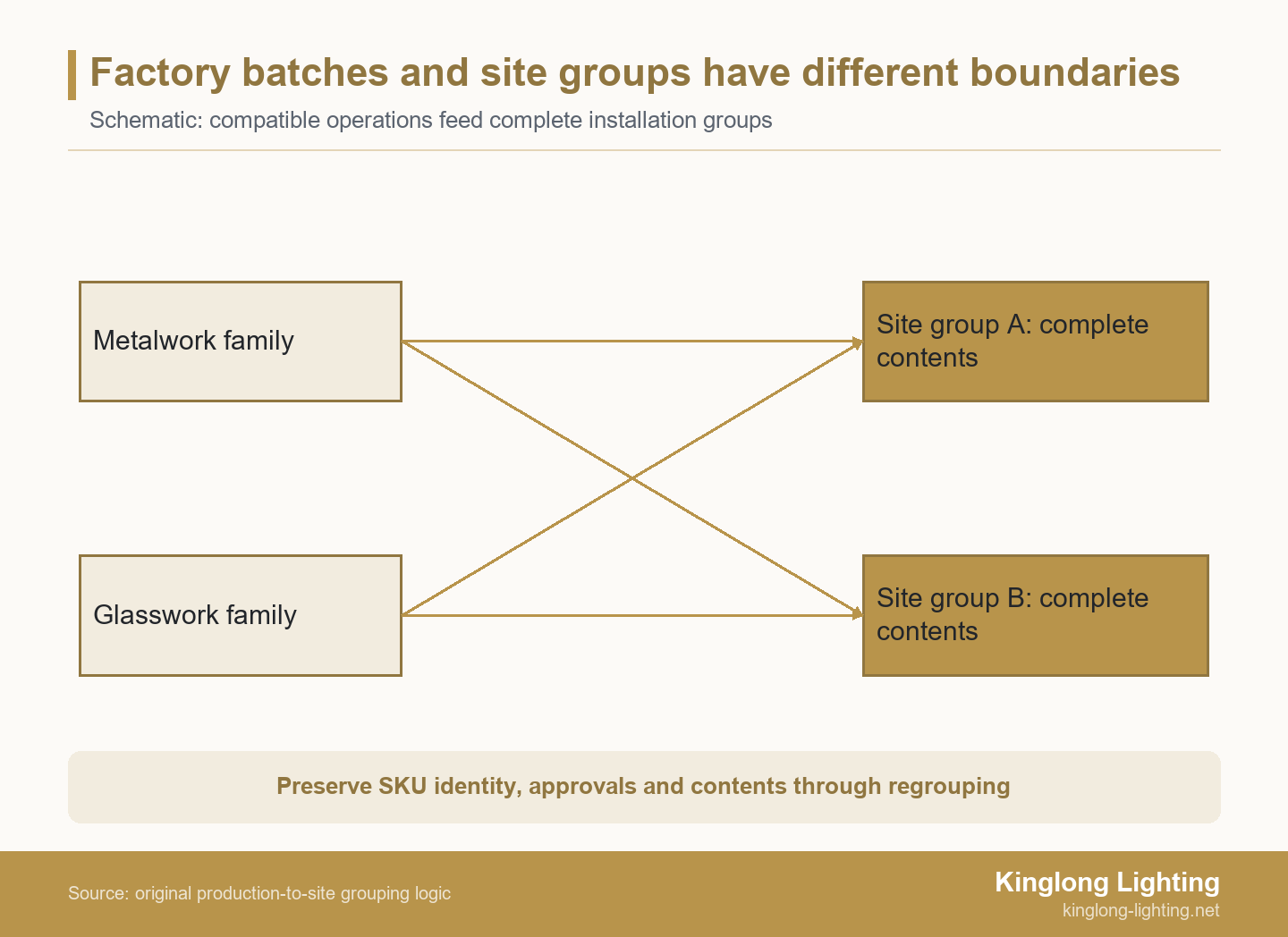
A process batch and a site delivery group solve different problems: one shares manufacturing work, while the other makes the named installation scope usable. A hotel room may need fixtures from several process families, so finishing a large family does not necessarily complete that room.
Keep both views. The factory planner needs material, tooling, route and resource information; the buyer needs quantities, approval decisions and a delivery sequence tied to site readiness. Link these through controlled fixture identities rather than forcing the factory to manufacture in room order or asking the site to accept whatever is easiest to make.
Factories may use different planning systems. Agree the actual operations, approval responsibilities, commercial commitments and dispatch permissions for the project before treating the supplier’s plan as an instruction to proceed.
Turn the Lighting Schedule into Controlled Production Inputs
Keep fixture identity, revision, quantity, material and finish, electrical configuration, approval status and site need linked in the production input record. Define a SKU as the separately controlled configuration being ordered, not merely a similar-looking product name.
Check the buyer’s schedule against drawings and the order before combining quantities. Left- and right-handed versions, different suspension lengths or electrical configurations may require separate identities even when they share a photograph. Distinguish installation quantities, approved spares and sample units so the same allowance is not purchased twice.
Kinglong’s lighting project resources provide related design and procurement reading. Use them to prepare questions, while retaining the project’s actual drawings, approvals and quantity schedule as the production inputs.
Name the unresolved decision and its owner. “Pending approval” is too vague if the metal body can be fabricated but the finish is still undecided. The record should identify the operation that is blocked and the document or sample needed to unblock it. An agreed material purchase does not automatically authorize irreversible finishing or final assembly.
Separate the required arrival at site from the factory-ready date. Ask the logistics and site teams to supply the relevant transport, receipt, storage and installation dependencies; do not obtain a manufacturing deadline by quietly ignoring them. Where these inputs are unknown, keep the forecast conditional and state whose confirmation is outstanding.
Group Compatible Work Without Merging Product Identities
A process family is a group of items that can share a genuinely compatible manufacturing operation. It is not automatically a product collection, a common colour name or a room category.
Group work only where materials, tooling, process route and approved finish are genuinely compatible; keep every SKU and revision traceable. A shared metal preparation operation may be possible even when the same items later need different glass, wiring or packing.
Ask the planner to identify what is actually shared: raw stock, cutting setup, forming tool, finishing route or assembly fixture. Similar surface colours do not establish identical substrates or compatible treatment conditions. Keep drawing references and component allocations visible when a shared operation feeds several final configurations.
The Lean Enterprise Institute definition of effective machine cycle time includes machine cycle time, loading and unloading, and changeover time allocated across the pieces between changeovers. This explains why quantity alone is insufficient for comparing workloads; it does not prescribe an optimal lighting batch size.
Have the supplier explain where combining work reduces a repeated setup and where it creates waiting, storage or mixing risk. A large common operation may be sensible, but splitting later assembly into site-priority groups can still be necessary. Record the proposed split rather than assuming the procurement lot, production batch and dispatch lot are identical.
A Multi-SKU Production Map You Can Use
A usable multi-SKU production map connects each controlled item to its process family, release boundary, constraint, owner and complete delivery group. Copy these fields into the project register; expand them into separate columns when that makes updates easier.
| Planning field | Information needed for a usable row |
|---|---|
| Controlled item and quantity | SKU, drawing revision, configuration, installation quantity and separately identified spares. |
| Material and component readiness | Required materials and components, allocated quantities, confirmed availability and missing supply. |
| Process family and route | Compatible shared operation, tooling or setup, then the remaining item-specific operations. |
| Approval and release boundary | Approved reference, unresolved decision and exactly which operation may proceed. |
| Constraint and scheduled work | Required resource, existing load, operation durations, proposed slot and any conditional dates. |
| Responsibility and next action | Named factory planner, buyer decision owner, outstanding action and next update point. |
| Inspection and packing group | Applicable checks, matching or assembly group, packing contents and traceable package identity. |
| Site group and delivery need | Destination zone, complete required contents, site-ready need, dispatch dependencies and missing items. |
Kinglong describes coordinating logistics for project-phase delivery on its hospitality lighting capabilities page. That is a relevant starting point for discussing the required project phases, not proof of a particular mixed-SKU capacity or a guaranteed delivery date.
Read across a row before accepting its date. If an approval is missing, the row should show the affected operation rather than a confident final completion date. Read down the site-group field as well: every item needed for a named installation scope must appear, including low-volume pieces that look insignificant in a package total.
Test the Plan Against Real Resource and Material Limits
With finite capacity and finite materials, Microsoft Dynamics 365 operations scheduling requires capacity and materials to be available together in the required quantities before production can start. This describes that scheduling configuration; it does not establish which software a lighting supplier uses.
For the actual package, ask for the resource behind each proposed slot and the load already committed to it. Include preparation, outsourced work where relevant, transfer and required checks in the route. A nominal assembly capacity cannot resolve a delay at a shared finishing resource or a missing component.
Google OR-Tools describes a job-shop model with precedence constraints between tasks and no overlapping tasks on the same machine. It makes dependencies visible, but its simplified machine model is not a complete representation of every batch process or workshop.
The supplier therefore needs actual route and resource assumptions, not a software screenshot alone. Ask which operations can overlap, what must finish first, and how the next stage receives usable parts. If a slot or supply date remains provisional, show the condition and the affected site group. Do not convert an unknown duration into a zero-duration operation to make the plan fit.
Protect Small Critical Items and Complete Room Groups
Prioritize approved, runnable work by its effect on the next complete installation group, not by quantity or apparent ease alone. Check the group’s outstanding fixtures and components before deciding which job should use the next available resource.
The Lean Enterprise Institute defines batch-and-queue as moving large batches onward regardless of actual need, leaving them waiting for the next process. The practical concern here is unfinished flow: busy upstream work can accumulate without producing the next usable site scope.
Do not reserve every easy operation for high-quantity variants while a small bespoke item loses its required tooling or sample-review slot. Equally, an urgent site label cannot make an unapproved item runnable. Escalate its missing decision and use available capacity for compatible approved work that does not compromise the revised sequence.
A project portfolio can help the buyer show the intended relationships among guestrooms, corridors and public spaces. It is visual context for the scope, not independent evidence of current factory loading or a promised completion rate.
Track what matters to the next handover: complete required quantities, remaining blockers and readiness of the named site group. Keep unit counts as a separate progress view. This prevents a reassuring total from concealing a missing decorative fitting or mounting component needed to finish the installation.
Reconcile Factory Batches with Site Delivery Groups
Plan the regrouping before packing starts. Items made together may go to different floors, while one floor may need items made by different process families. Link the final SKU and revision to the destination group, package contents and any separate assembly instructions or hardware.
GS1 describes the SSCC as identifying a logistic unit, which may combine trade items packaged together for storage or transport. This distinction helps explain why the shipping-unit identity and the product identity are different; GS1 adoption is not assumed for this project.
Use the agreed identification system to reconcile physical contents with the packing list. Verify quantities by SKU, matching groups, destination and required accessories. A traceable carton number is helpful only if its contents record is accurate and the receiving team can identify what remains outstanding.
For split shipments, agree what is complete, what is deferred and whether the site can safely receive and store the partial scope. Retain protective packing and clear handling information. Treat a factory-ready milestone, shipment authorization, dispatch and site receipt as different events; a finished production family does not prove any of the later events occurred.
Illustrative Package: 80 SKUs, Different Quantities, Different Routes
This illustrative hotel package has 80 SKUs: 60 guestroom variants at 10 units each, 16 public-area variants at 3 each, and 4 statement variants at 1 each, giving 600 + 48 + 4 = 652 fixtures. These are assumed quantities for explaining the method, not a Kinglong case or measured production result.
| Illustrative item group | Planning treatment | What still controls delivery |
|---|---|---|
| Guestroom variants | Group compatible metalwork; retain separate configurations and split assembly by destination need. | All required room fixtures, accessories and packing records, not the metalwork total. |
| Public-area variants | Reserve the relevant glasswork and finishing resources against confirmed references. | Approved appearance, available components and the complete public-area installation scope. |
| Statement variants | Protect item-specific technical and sample decisions rather than placing these behind every large batch. | Resolved interface details, suitable resources and the actual release conditions for each item. |
Suppose the first guestroom delivery group needs both a wall-light configuration and a pendant configuration. The metalwork for the wall lights is ready, but the pendant’s glass approval is unresolved. Making more wall-light metalwork may raise the completed-piece count without completing that delivery group.
The planner identifies the blocked glass operation, obtains the buyer’s decision and reserves the remaining compatible work against confirmed resources. After the affected components arrive and the agreed checks pass, the team reconciles the group’s complete fixture and accessory contents before proposing dispatch. Until then, the group remains incomplete; no recovered days are assumed.
If the original configuration cannot meet the site need, use the decorative lighting value-engineering guide to frame a separate review of what may change and what must be protected. A planning problem is not permission to substitute an unapproved finish or quietly remove a fixture.
Escalate Changes with Their Downstream Consequences
When an approval, material or site sequence changes, trace the affected items through their remaining operations and delivery groups before accepting a replacement date. Record the new assumption, decision owner and latest confirmed evidence in the map.
Keep the earlier commitment visible so the change can be explained. Identify already committed materials, work in progress, revised resource needs and packing or transport consequences. Ask for feasible options such as resequencing independent work, a specifically approved alternative or an agreed phased scope, with their commercial and installation implications.
The update should show what changed in the next usable delivery group, not merely move every bar on a chart. Confirm whether the proposed action actually removes the blocker and whether it creates a new shortage elsewhere. Reconcile the revised schedule with the buyer, factory and relevant site or logistics owner before treating it as a new commitment.
Ask for a Scoped Hotel Lighting Planning Review
Bring the controlled fixture schedule, quantities, drawings and approvals, site phases and packaging requirements to a project-specific discussion of feasibility and missing planning inputs. Highlight incomplete delivery groups and the operations currently blocked, rather than sending only a total fixture quantity.
With those inputs, you can request a hotel lighting planning discussion with Kinglong. Ask the team to assess the relevant hospitality scope and agree the planning inputs still needed for a project-specific proposal. The outcome should be an agreed review scope and missing-input list, not an assumed capacity reservation or guaranteed dispatch date.
Frequently Asked Questions
Does a shared process family mean one MOQ applies to the whole package?
No; commercial minimums and process grouping are different questions. Sharing an operation does not prove that all variants share raw-material purchase quantities, tooling costs, component minimums or packaging commitments. Ask the supplier to identify which minimum applies to which item or process and whether quantities can genuinely be combined. Keep any agreed package-level exception in the commercial record; do not infer it from the production map.
Can materials be bought before all samples are approved?
Only for a specifically agreed scope with the unresolved risks and authority identified. The buyer and supplier should establish exactly what may be committed, which design assumptions remain open and who bears the consequences if they change. Identify reusable stock separately from custom or nonrecoverable commitments. A limited purchasing instruction is not blanket permission to fabricate, finish or assemble the unresolved configurations.
How should late quantity changes be handled?
Record the approved quantity change against the affected items and reconcile commitments, capacity and delivery groups. Check additional requirements or surplus at each remaining operation, including separately specified spares and packing. Retain the previous quantity so the reason for a changed quotation or schedule is traceable. Reconfirm the affected site group’s contents and dates rather than distributing a new grand total without updating the underlying rows.
Is a dedicated planning system essential for this package?
Not necessarily; the plan needs reliable item identities, dependency records, owners and updates regardless of software. A controlled spreadsheet may support buyer coordination, while the factory uses its own scheduling system. Agree the authoritative version, access rights and update responsibilities, and test whether a change can be traced to every affected delivery group. Software sophistication does not compensate for missing approval inputs or unconfirmed resource assumptions.