A villa chandelier lead time of 12-16 weeks sounds like a manufacturing estimate, but the factory is only one part of the clock. The real schedule is a chain of owner approvals, sample decisions, shop drawing review, component procurement, production, packing, shipping, site readiness, and installation coordination.
Owners often ask why a bespoke chandelier cannot be rushed like a standard pendant. The answer is not that custom work is slow by nature. The answer is that every beautiful detail needs a frozen decision before another team can act safely: scale before drawing, sample before finish, engineering before frame, route before packing, and site access before installation.
Kinglong Lighting can make lead time more predictable when the owner uses the villa lighting project path to turn preference into evidence early. The best schedule conversation is not when will it finish? It is which decisions must be frozen this week so the next stage can start without rework?
Key Takeaways
- Lead time is a critical path: The longest dependent chain controls the delivery date, not the fastest single task.
- Owner decisions consume calendar: Late concept, sample, and drawing approvals can lose weeks before production is technically delayed.
- Samples protect production: A fast production start with an unresolved finish or glass decision often creates more delay later.
- Shipping is not the last risk: Packing, documents, customs, receiving, site access, and installation slotting all affect the usable delivery date.
- Compression has trade-offs: Rushing may be possible, but only when the buyer knows which evidence, cost, or flexibility is being sacrificed.
Lead time starts when the owner freezes intent
A villa chandelier is late when the critical path is unmanaged, not only when the factory misses a production date.
A project clock should not start from the first inspirational image. It starts when the owner freezes enough information for the manufacturer to design responsibly. That freeze does not require every detail, but it must include room intent, approximate scale, destination, major material direction, and known constraints.
The DOE lighting design page gives a useful boundary because lighting decisions should be judged around the whole space and its use, not only fixture appearance. For project buyers, the practical action is to connect lead time to room purpose and whole-space lighting decisions instead of treating timing as a factory-only number.
The first week is often a decision week
The first week should clarify what the chandelier must do for the room: vertical drama in a stair void, soft focus over a dining table, low-glare sparkle in a lounge, or sculptural calm in a double-height living room. Without that decision, the manufacturer can only create options, not a controlled schedule.
Owners can shorten the real project by preparing dimensions, photos, ceiling height, reference attributes, finish preferences, control expectations, and decision authority before the supplier starts. This is not paperwork. It is how the factory avoids designing three directions when one focused direction would be enough.
Digital scale review prevents false urgency
The Mofun Design Platform is useful because lead time pressure often comes from uncertainty about scale. If the owner still does not know whether a chandelier should be wide, tall, dense, or light, rushing a quote may only accelerate the wrong decision.
A digital scale review does not replace structural review, sampling, or site measurement. It protects the early schedule by exposing proportion problems before the project spends time on finish samples or shop drawings that depend on a weak concept.
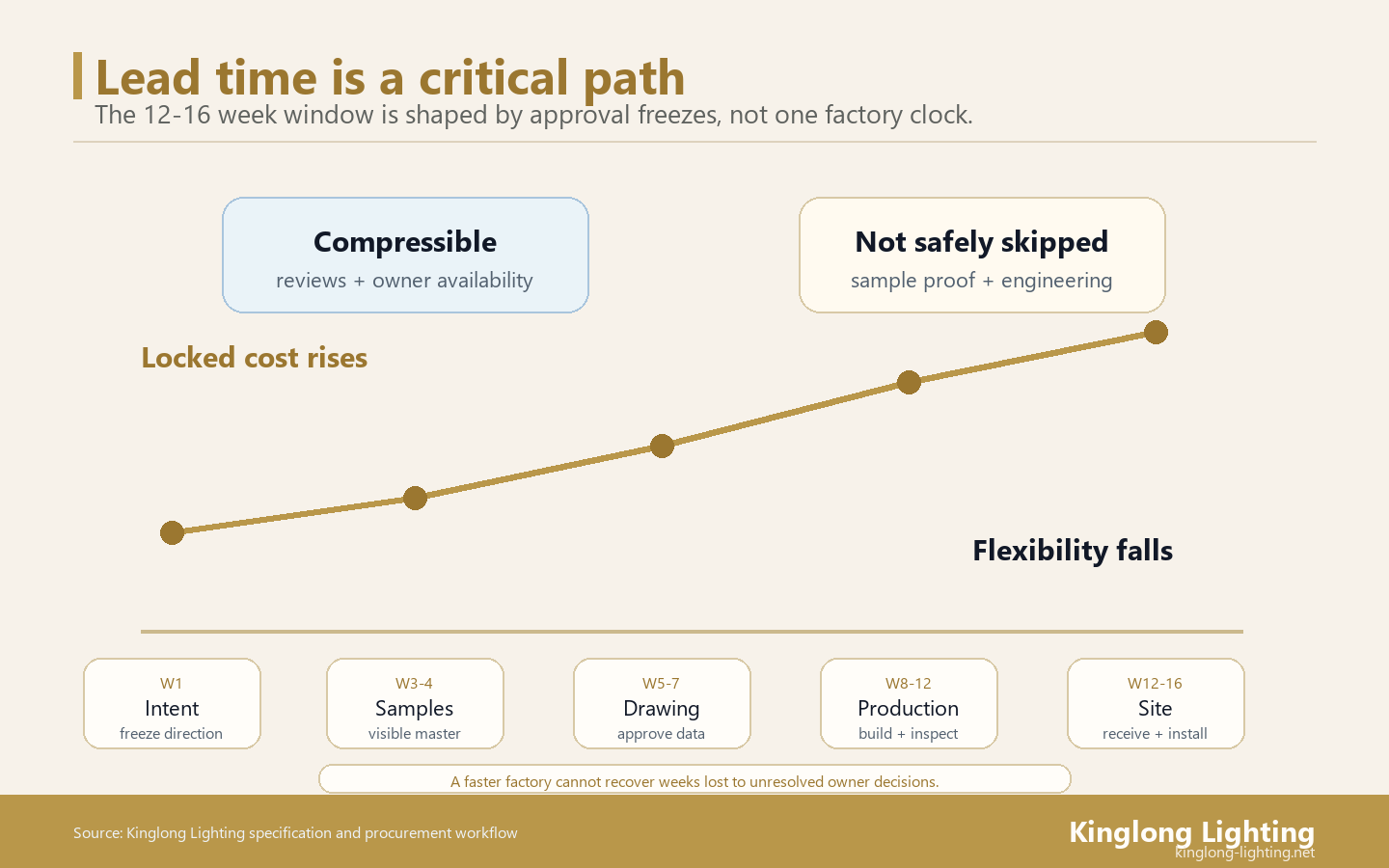
The 12-16 week clock has four different clocks inside it
A realistic villa chandelier schedule contains at least four clocks: owner approval time, supplier engineering time, production time, and logistics/site time. The project slips when everyone watches only the production clock and ignores the others.
The DOE TM-30 FAQ gives a useful boundary because color quality needs more precise language than warm, cool, or beautiful when materials are being approved. For project buyers, the practical action is to treat finish, color, and material review as a decision clock that must happen before production locks.
Sample time is not decorative waiting
Finish, glass, crystal, diffusion, color temperature, and metal tone cannot be fully approved from a rendering. Sample time protects the owner from discovering the wrong visible quality after the frame is built. It also protects the manufacturer from building against an unstable target.
If sample review is skipped to save a week, the buyer should record what risk is being accepted. A rushed sample decision may be reasonable for a hidden component, but it is dangerous for the part of the chandelier that defines the room’s luxury feel.
Shop drawing time depends on clean inputs
Shop drawing review is faster when the manufacturer has ceiling information, desired drop, canopy expectation, route limits, control assumptions, and material decisions. It slows down when every drawing becomes a question about an unresolved owner preference.
A useful lead time breakdown separates drawing creation from drawing clarification. Creation is supplier work. Clarification is shared work. When the clarification loop is invisible, the owner may think the factory is slow while the real delay sits in missing site or approval data.
Production can start only after the right decisions are frozen
Production is where many owners expect speed, but custom chandelier production depends on frozen evidence. Frame fabrication, finish processing, crystal or glass preparation, wiring, assembly, inspection, and packing all rely on decisions that should already be stable.
The UL 1598 standard page gives a useful boundary because decorative chandeliers are still luminaires that need product evidence and qualified installation review. For project buyers, the practical action is to keep luminaire evidence and product boundaries visible before the custom fixture enters production.
A rushed start can create a longer finish
Starting production before sample and drawing approval may look efficient, but it can convert one week of waiting into several weeks of rework. A frame dimension, finish tone, driver location, or suspension detail that changes after production starts may affect multiple components.
The smarter compression method is parallel preparation, not premature production. The supplier can prepare component sourcing, packing logic, and production scheduling while the owner completes the approval file, as long as the team clearly marks which items remain unchangeable and which remain open.
Quality inspection needs protected time
Inspection time is often the first item sacrificed when a project is late. That is risky. A custom chandelier should be checked against the approved drawing, sample master, component list, finish reference, electrical assumptions, and packing plan before the owner releases shipment.
If the project compresses inspection, the owner should choose which evidence can be reduced and which cannot. For a signature villa space, overview photos alone are rarely enough. Detail photos, labels, spare parts, and packing sequence can prevent more delay after arrival.
Shipping and site readiness decide the usable delivery date
The chandelier is not delivered in a useful sense when it leaves the factory. It is delivered when it reaches the villa, can be received safely, can be inspected, and can be installed in the right site window. Logistics and site readiness therefore belong inside the lead time breakdown.
The ICC Incoterms 2020 page gives a useful boundary because international delivery responsibility should be named before goods, crates, and spare parts move. For project buyers, the practical action is to name delivery responsibility, documents, insurance, customs, and destination handoff before shipment is treated as complete.
Packing design is schedule protection
Packing is not only damage prevention. It is schedule protection. If crates are poorly labeled, fragile pieces are not mapped, or the installation sequence is hidden in the packing, the site team loses time during receiving and assembly.
The ISTA 3A test procedure page gives a useful boundary because packing evidence should be selected around the distribution environment and package profile. For project buyers, the practical action is to ask how crate logic, component protection, and transport assumptions will reduce damage and identification delays.
Site access can hold a finished chandelier hostage
A finished chandelier can still wait if the villa is not ready. The route may be blocked by construction, the lift may not fit, the ceiling support may not be confirmed, the room may not be protected, or the installer may not have the right access equipment.
The OSHA aerial lifts page gives a useful boundary because overhead installation and later service require planned access and trained site practice. For project buyers, the practical action is to include lift path, work-at-height planning, floor protection, and qualified local site practice in the schedule file.
How to compress lead time without hiding risk
Lead time can sometimes be compressed, but compression should be a controlled decision. The owner should not simply ask the supplier to be faster. The owner should ask which stage can run in parallel, which decision must freeze earlier, and which evidence must not be sacrificed.
The WBDG building commissioning page gives a useful boundary because commissioning connects design intent, installation quality, operation, and owner handover. For project buyers, the practical action is to connect final schedule compression to acceptance, operation, and handover evidence instead of treating completion as shipment alone.
Parallel work should have a boundary
Some tasks can overlap. The supplier can prepare drawings while the owner gathers site data. The owner can review material families while the manufacturer checks component availability. Packing planning can begin before final assembly. But each overlap needs a boundary that says what may change and what may not.
Without that boundary, parallel work becomes rework. A factory that prepares a frame before drop and suspension logic are frozen may lose time later. A buyer who changes finish after component sourcing begins may pay for speed with waste.
The schedule should show the last responsible dates
The most useful lead time chart is not a decorative Gantt chart. It shows last responsible dates: concept freeze, sample approval, drawing approval, production release, inspection window, shipment release, receiving date, and installation slot.
If any date slips, the team should show the effect on downstream work. That makes urgency visible without blaming. The owner sees which decision matters now, the supplier sees what can proceed, and the installer can protect the site window.
Villa chandelier lead time breakdown table
Use this table when a supplier quotes 12-16 weeks. It shows what is usually inside the number and what the owner can control.
| Decision area | Owner risk if vague | Evidence to request | Acceptance action |
|---|---|---|---|
| Concept freeze | The supplier designs multiple directions | Room intent, scale test, reference attributes | Start schedule only after direction is stable |
| Sample approval | Production starts with unstable visible quality | Finish, glass, crystal, CCT or diffusion sample | Freeze sample master or record accepted risk |
| Shop drawing | Drawing loops consume production time | Ceiling, route, drop, canopy, controls, access assumptions | Approve or mark open items with dates |
| Production and inspection | Late changes create rework | Approved drawing, sample master, component list, inspection photos | Release production only when evidence is frozen |
| Logistics and site | Finished goods wait for route, documents, or access | Packing map, Incoterms, receiving plan, lift path | Treat site readiness as part of lead time |
A simple lead time scenario estimate
Take a villa chandelier planned for 14 weeks. If concept freeze is delayed four working days, sample sign-off four days, drawing approval four days, and site access confirmation four days, the project does not lose only 16 working days on paper. It may lose more than three calendar weeks because each delay pushes a dependent stage and may miss a production or installation window.
This estimate is illustrative, not a universal schedule rule. It shows why owners should manage approval dates with the same seriousness as supplier production dates. A manufacturer can sometimes recover one small slip, but repeated approval drift usually becomes visible only when the owner asks why the final installation window moved.
The practical decision is to identify the last responsible date for every owner-controlled task. If a decision is not needed yet, keep it open. If it affects the next dependent stage, freeze it or accept the schedule consequence in writing.
How Kinglong Lighting makes lead time more predictable
Kinglong Lighting can make a villa chandelier lead time more predictable by connecting concept review, scale testing, sample logic, shop drawings, production release, packing, and handover into one evidence path. The custom chandelier workflow is most useful when the buyer shares constraints early instead of asking for speed after decisions drift.
If the owner already has a target installation date, the next useful step is to send the villa chandelier lead time file with room dimensions, drawings, reference attributes, site access notes, destination, desired install window, and open approvals. Kinglong Lighting can then identify the true critical path instead of quoting a vague timeline.
Before you accept a 12-16 week schedule
Use this short action list before the next approval meeting. It is intentionally practical, because vague approval language is the usual source of later rework.
- Ask which owner approvals sit on the critical path.
- Separate sample time, drawing time, production time, logistics, and site readiness.
- Record last responsible dates for concept, sample, drawing, and shipment release.
- Compress by parallel planning, not by hiding sample or inspection risk.
- Confirm receiving and installation access before the goods ship.
FAQ
Why do custom villa chandeliers take 12-16 weeks?
They take time because concept, samples, drawings, component sourcing, production, inspection, packing, shipping, site readiness, and installation coordination depend on each other.
Can a villa chandelier lead time be shortened?
Sometimes. The safest compression comes from fast owner approvals, parallel preparation, clear site data, and protected inspection, not from skipping critical sample or engineering decisions.
When should the lead time clock start?
It should start after the owner freezes enough information for a responsible quotation and schedule: intent, dimensions, destination, major material direction, and known constraints.
What causes the most avoidable chandelier delays?
Unclear owner decisions, late sample approval, missing ceiling or route information, unresolved controls, packing damage, and site readiness gaps are common avoidable delays.