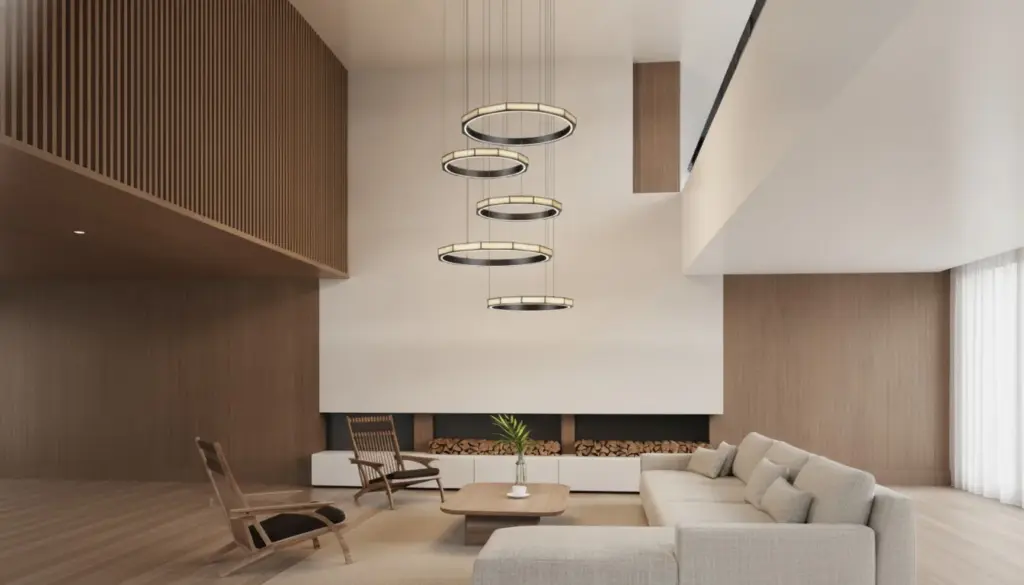
Villa chandelier lead time varies because the fixture is not one product decision; it is a sequence of design approval, sample proof, engineering confirmation, control coordination, packing planning, shipping, and site readiness.
A designer who asks only for a production week count will often get a misleading answer. The real schedule depends on how many decisions are frozen, how many are still aesthetic, and how many require another party before the factory can release the order.
Kinglong Lighting can help designers turn lead time into a visible release path so owners understand which delay creates proof and which delay comes from missing information.
Key Takeaways
- Lead time is staged: Sampling, drawing, engineering, control, packing, and site readiness each matter.
- Custom adds gates: Bespoke work is slower when finish, scale, or structure remains open.
- Fast is not always ready: Skipping proof can move risk from factory schedule to site rework.
- Site readiness matters: Ceiling support, access, and controls can delay even finished fixtures.
- A release map helps: Designers should show owners what each week is proving.
Lead time varies because the risk profile varies
The useful lead-time question is not how long production takes; it is which decisions are still unfrozen.
The IES Lighting Library helps frame the issue: lighting decisions depend on application. A villa chandelier for a stair void, master suite, penthouse, tropical residence, or Mediterranean foyer does not carry the same proof burden.
A simple stock fixture with a known finish, standard size, and clear installation point can move quickly. A custom chandelier with a new finish, large drop, special suspension, smart controls, or climate exposure needs more proof before the factory can responsibly build and ship it.
Lead time therefore varies less because factories are mysterious and more because project decisions arrive at different levels of readiness.
Custom shape adds approval gates
When the chandelier shape is custom, the team must approve proportion, drop, module size, component spacing, finish, material, and sometimes mock-up behavior. Each approval gate can be fast when inputs are clear or slow when the owner, designer, engineer, and installer are still negotiating the same detail. The schedule should show which gate is open instead of treating all custom delay as production time.
Site readiness can delay a finished fixture
A chandelier can be manufactured and still not be installable. The ceiling may need backing, the access route may be blocked, the lift may not fit, the control system may not be ready, or the room finishes may not tolerate installation work. Designers should separate factory lead time from site readiness so the owner understands where the schedule risk actually sits.
Build the schedule from gates, not promises
A good schedule names the decisions that create the timeline. It should identify what happens before quotation, before deposit, before material purchase, before production, before packing, before shipping, and before installation.
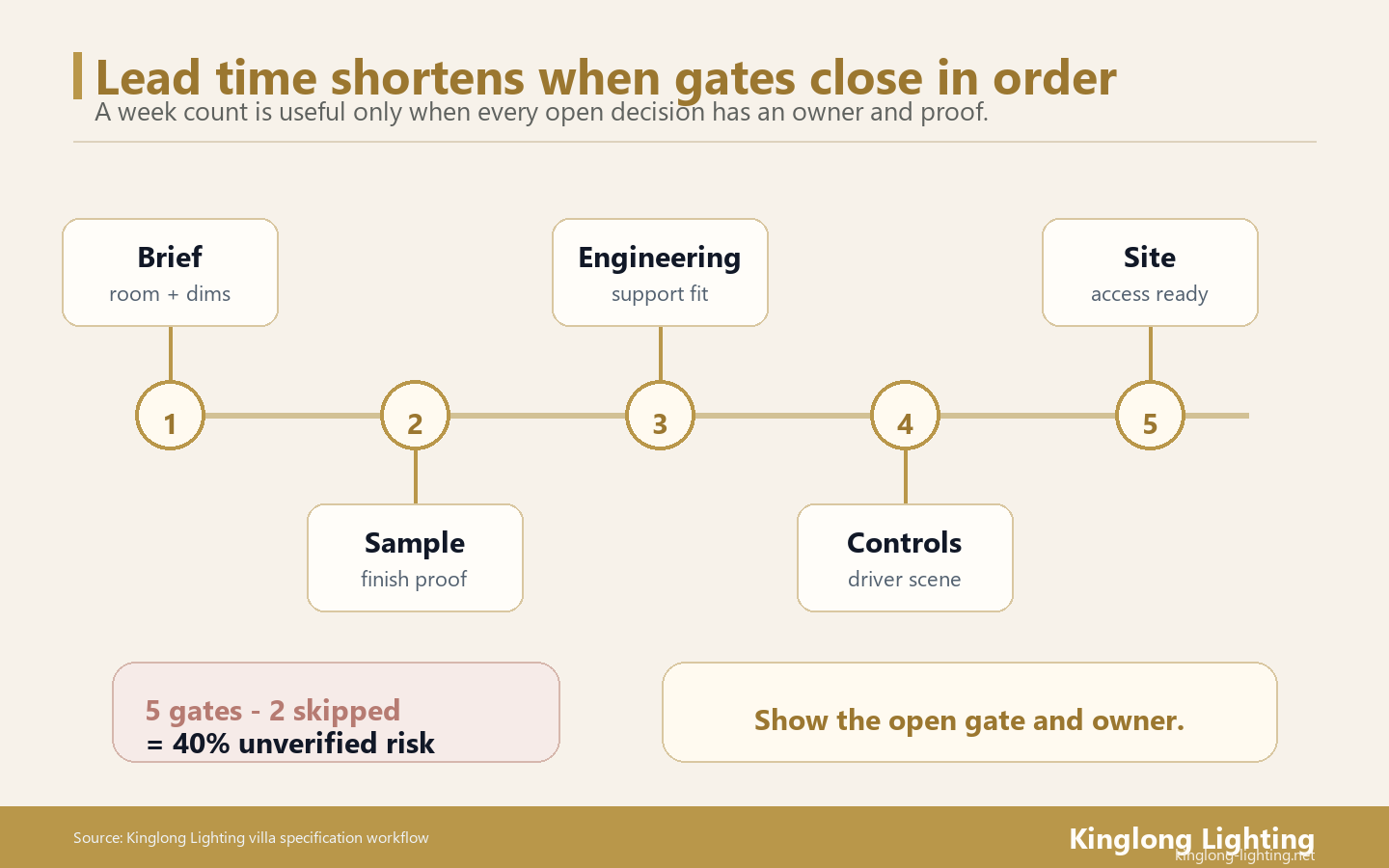
Calculated from a five-gate custom model, skipping sample proof and site readiness appears to save two gates, but it leaves 40 percent of the release path unverified. That risk does not disappear; it moves to rework, delay, or owner dissatisfaction.
| Lead-time gate | What it proves | Typical delay cause | Designer response |
|---|---|---|---|
| Brief gate | room and intent are clear | missing dimensions or mood | freeze owner inputs |
| Sample gate | finish and material are approved | sample rejection | define tolerance range |
| Engineering gate | support and modules fit | ceiling or access uncertainty | involve installer early |
| Control gate | driver and scene work | system not selected | name dimming requirement |
| Packing gate | shipment can be protected | module size or route issue | confirm delivery path |
The Lutron control guidance matters because control decisions can change driver, dimming, access, and commissioning assumptions. Treating controls as a late add-on can make a short fixture schedule behave like a long one.
The UL indoor and decorative lighting page and ANSI UL 1598 page are useful reminders that decorative lighting still needs product evidence. Documentation, components, and market requirements should be part of the release calendar.
Longer lead time should reduce uncertainty
A longer lead time is justified only if it creates useful evidence. If extra time produces drawings, samples, finish masters, weight checks, driver notes, packing plans, and installation assumptions, the owner receives risk reduction. If extra time only means waiting, the schedule is not transparent enough.
This is where designers can protect trust. Instead of telling the owner that a custom chandelier takes a fixed number of weeks, the designer can show which decisions drive the range. A clear release map feels more credible than a single optimistic promise.
The most important habit is to mark what is frozen. A frozen finish, frozen size, frozen driver, and frozen ceiling point create a very different schedule from a concept that is still open across every discipline.
A useful range should therefore separate factory-controlled time from project-controlled time. Drawing revision, sample approval, finish tolerance, control confirmation, ceiling support, and access readiness do not belong in one vague production delay bucket. When they are separated, the owner can decide whether to simplify the fixture, freeze a finish, accept a standard component, or wait for stronger proof.
This is also where a designer can protect the supplier relationship. If the owner sees only a missed week, the factory looks slow. If the owner sees that the sample was not approved, the ceiling backing was not confirmed, or the control requirement changed after quotation, the conversation becomes a project decision instead of a blame cycle.
How Kinglong Lighting can make lead time visible
Kinglong Lighting’s customization workflow can organize custom chandelier work into visible steps: design input, drawing, sample, proof, production, packing, and shipment. The Mofun Design Platform can help test scale earlier so physical sampling does not carry every decision.
The next step is to send drawings, dimensions, preferred finish, material, control requirements, ceiling condition, target installation date, and delivery constraints through the project inquiry page. Ask Kinglong Lighting to return a lead-time range with open decisions named.
Write a designer's lead-time reality check
A lead-time reality check is a short document that explains why the schedule is what it is. It should be shared before the owner hears only a week count and assumes every delay belongs to the manufacturer.
The reality check should connect schedule to decisions. It can be attached to the quotation or used internally before procurement commits to a date. Its value is that it makes the project team honest about what is known and what still has to be proven.
It should also show the cost of rushing: which sample is skipped, which fallback becomes default, and which site assumption remains open before anyone commits.
A good reality check is not pessimistic. It lets the designer shorten timing responsibly by closing the highest-risk decision first, using a standard fallback where custom proof is not worth the delay, and keeping site-readiness items outside the factory production promise.
The document should be updated when decisions change. If the owner changes finish direction, the engineer changes ceiling support, or the control consultant changes dimming requirements, the schedule should show the change rather than hiding it inside a revised delivery week. That habit keeps the lead-time range credible throughout the project.
List frozen inputs separately from open questions
The first page should separate confirmed dimensions, approved mood, finish direction, budget range, ceiling condition, and desired installation date from open questions. Open questions may include material tolerance, driver type, access route, shipping module, or owner approval timing. This separation prevents the schedule from pretending uncertain inputs are already resolved.
List sample decisions before production dates
Samples can accelerate the project when the team knows what they must decide. They slow the project when they become open-ended exploration. The reality check should say whether the sample is for finish, color, glass thickness, crystal sparkle, metal tone, dimming behavior, or owner confidence. Each sample should close a decision, not create another round of vague preference.
List external dependencies outside factory control
Some schedule drivers sit outside the manufacturer: structural confirmation, control-system selection, site access, lift availability, customs paperwork, owner travel, and interior finish readiness. A realistic schedule names these dependencies so procurement does not blame factory production for a ceiling, control, or access issue that was never ready.
List the risk of compressing the schedule
Acceleration is sometimes possible, but it should name the tradeoff. The team may reduce sample iterations, limit finish options, choose standard drivers, simplify module design, or ship with a different packing sequence. The reality check should explain what risk is accepted when time is compressed. That makes fast delivery a conscious decision rather than an unspoken transfer of risk.
Convert uncertain lead time into owner-facing decisions
Designers can reduce lead-time frustration by translating uncertainty into decisions the owner can understand. Instead of saying the chandelier is delayed, the schedule can say which approval, sample, engineering answer, control choice, or site condition is still open.
This framing matters because custom chandelier timing often involves several parties. When the owner sees the dependencies, lead time becomes a managed project path rather than a vague manufacturing promise.
Use a 4-column lead-time sheet: decision, owner, proof, and deadline. If a gate has no owner or no proof date, treat it as an open risk instead of counting it as part of a reliable production schedule.
Name the decision owner for every open gate
Every open gate should have an owner. The designer may own proportion and mood, the owner may own finish approval, the engineer may own ceiling support, the control consultant may own dimming, and the installer may own access. If a gate has no owner, it can sit quietly until the schedule is already under pressure. Naming owners makes the lead-time range more honest and easier to shorten responsibly.
Keep a standard fallback when custom risk is too high
A realistic lead-time plan should include fallback paths. If a custom finish fails, the team may choose a standard finish. If a complex module threatens the schedule, the design may simplify. If a control protocol is unresolved, the driver strategy may need to change. Fallbacks do not weaken the design; they protect the project from being trapped by a single custom assumption.
Use the sample queue to close decisions in order
Samples should not arrive as a pile of options. They should arrive in an order that closes the riskiest decision first: finish color, glass tint, crystal density, metal texture, dimming behavior, or module proportion. A sample queue reduces repeated approval loops because each sample has a job. If the job is unclear, the sample is likely to create more opinion instead of reducing lead time.
Treat site readiness as a schedule gate, not a footnote
Site readiness can be the difference between a finished fixture and an installed fixture. Ceiling backing, access route, lift availability, control wiring, room protection, and storage all affect the final date. The owner-facing schedule should show these as gates with owners. That prevents a factory completion date from being mistaken for a project completion date.
Lead-time reality action card
- Separate factory lead time from site readiness.
- Mark frozen decisions and open questions before quoting.
- Use samples to close decisions, not explore endlessly.
- Name control, engineering, packing, and shipping dependencies.
- Ask for a lead-time range with assumptions attached.
Related Guides
- Custom vs Off-the-Shelf Villa Chandeliers
- Penthouse Chandelier Engineering
- Working with Interior Designers on Villa Lighting
Frequently Asked Questions
Why do custom villa chandelier lead times vary so much?
Lead times vary because each project has different design approval, sampling, engineering, control, packing, shipping, and site-readiness needs. A custom chandelier is released through gates, not only production days.
What causes the most common chandelier schedule delays?
The most common delays are unclear dimensions, late finish approval, unresolved ceiling support, driver or control uncertainty, sample revisions, packing constraints, and installation access problems.
Can lead time be shortened safely?
Lead time can sometimes be shortened by using standard finishes, simpler modules, fewer sample rounds, early control decisions, and clear site information. Compression should always name which proof is being reduced.
What should Kinglong Lighting receive for accurate timing?
Kinglong Lighting should receive drawings, dimensions, finish preference, material target, control requirements, ceiling condition, installation date, access notes, shipping destination, and decision-maker timing.