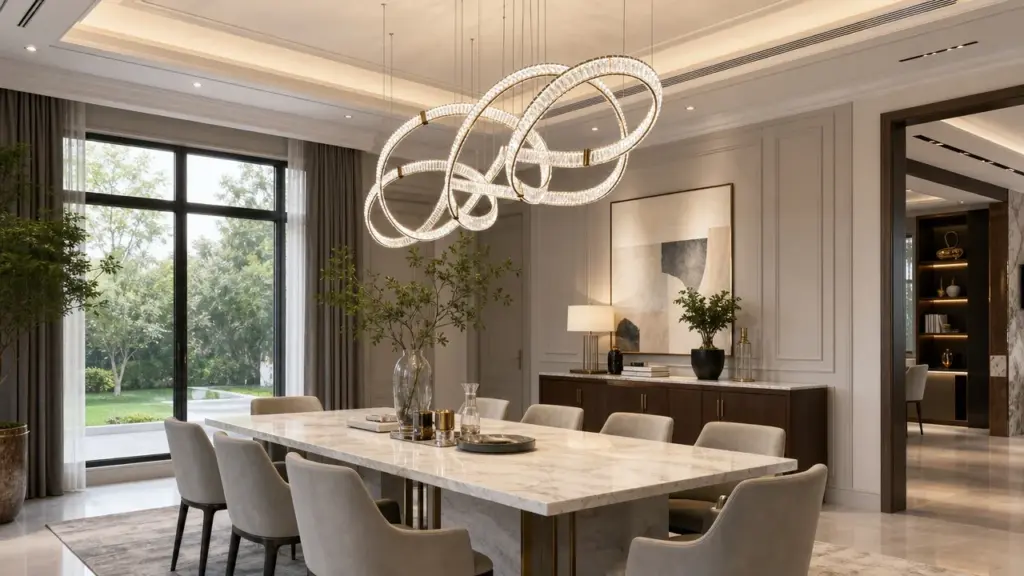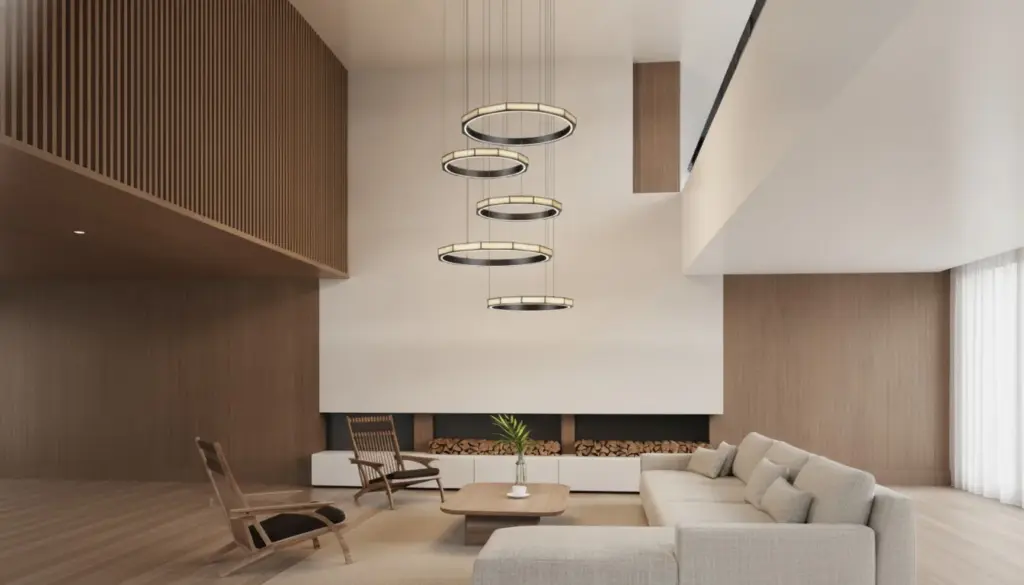
A custom villa chandelier is worth the lead time when the room has constraints an off-the-shelf fixture cannot resolve: unusual ceiling height, exact finish palette, stair or foyer sightlines, special suspension, or a design story that needs to match architecture rather than a catalog size.
Off-the-shelf chandeliers are useful when the room is standard, the finish tolerance is flexible, and the buyer accepts the fixture as designed. Bespoke work is justified when a wrong size, wrong finish, or wrong access assumption would create expensive rework after the villa is already finished.
Kinglong Lighting can help compare both paths by turning the decision into a release-risk calculation: what is saved by buying fast, and what might be lost if the fixture does not fit the villa.
Key Takeaways
- Buy stock for standard rooms: Off-the-shelf works when size, finish, support, and lead time all fit.
- Go custom for hard constraints: Bespoke makes sense when architecture changes the fixture logic.
- Lead time buys evidence: Custom time should produce drawings, samples, controls, and installation proof.
- Rework is the hidden cost: A cheap fast fixture can become expensive after site changes.
- Freeze decisions early: Custom work fails when buyers keep changing finish, size, or scene intent.
Start with the cost of being wrong
The custom decision is not about luxury for its own sake; it is about whether the room can afford a wrong fixture.
The IES Lighting Library treats lighting decisions as application-specific. A villa foyer, stair void, dining room, or master bedroom can each make a standard chandelier behave differently from the catalog photo.
An off-the-shelf fixture is attractive because it reduces waiting. But that speed has value only if the fixture already fits the space, ceiling condition, finish palette, dimming behavior, and installation route.
The decision rule is to price the risk of mismatch before comparing fixture prices. If the cost of being wrong is low, stock may be smart. If the cost of being wrong is high, custom lead time can be a form of risk control.
Off-the-shelf works when the room is forgiving
A forgiving room has enough ceiling height, flexible finish expectations, standard junction conditions, and a layout that does not require the chandelier to solve multiple viewpoints. In that case, a stock fixture can be efficient. The buyer still needs to check weight, certification evidence, replacement parts, and dimming compatibility, but the design does not need a full custom engineering path.
Custom works when the room is specific
A specific room has a stair landing, double-height foyer, open-plan sightline, exact brass tone, unusually large table, fragile ceiling condition, or strict owner mood requirement. In these cases, the chandelier is not just a product. It is a tailored object inside an architectural envelope, and the lead time should produce proof that the object will fit that envelope before production.
Use a lead-time break-even check
Lead time should buy decisions, not just delay. A custom path is justified only when it produces useful evidence: size drawings, material samples, finish masters, dimming notes, suspension details, installation planning, and service logic.
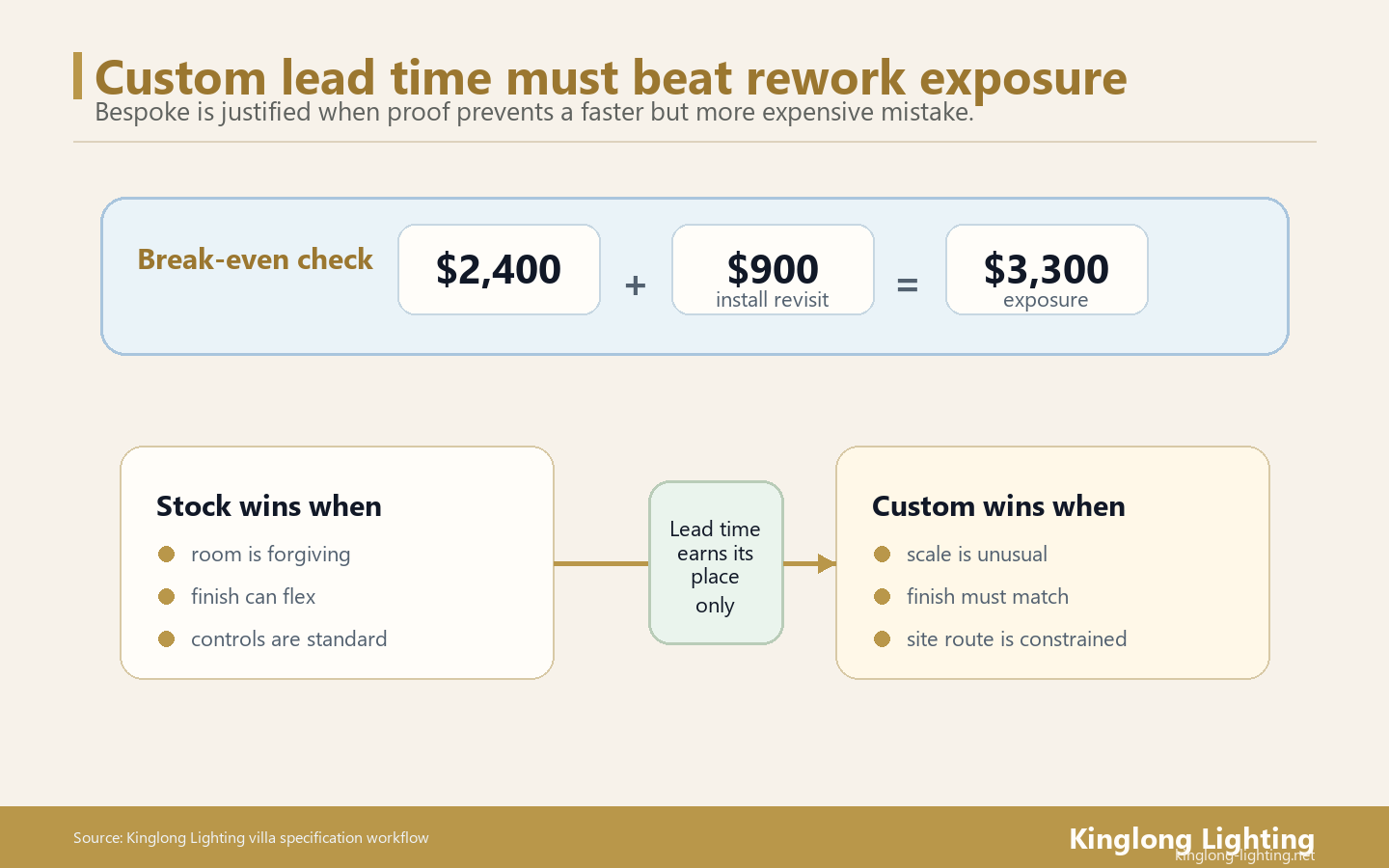
Calculated from a simple villa risk model, one wrong chandelier change at USD 2,400 plus one installation revisit at USD 900 equals USD 3,300 of avoidable exposure. If custom proof prevents that exposure, a longer approval path can be cheaper than a fast mistake.
| Decision factor | Stock advantage | Custom advantage | Break-even signal |
|---|---|---|---|
| Speed | available faster | slower approval path | stock wins if room is standard |
| Size | fixed dimensions | room-specific envelope | custom wins if scale is unusual |
| Finish | limited options | sample and finish master | custom wins if palette is exact |
| Controls | driver may be fixed | scene and dimming proof | custom wins if scenes matter |
| Access | standard installation | planned module route | custom wins if site is constrained |
The Lutron control guidance matters because control planning affects how a room behaves in use. A stock chandelier that cannot dim smoothly into the villa’s scenes may fail even if the size looks right.
The UL residential lighting guidance is useful because decorative luminaire evidence matters as a product decision. Both stock and custom paths should therefore provide safety, support, and component documentation.
Bespoke lead time should create a visible approval path
Kinglong Lighting’s customization workflow should be used to convert lead time into evidence. The buyer should not wait weeks only to receive a vague update. The approval path should show what was decided and what still needs owner, designer, or installer confirmation.
The Mofun Design Platform can support early scale review before a physical mock-up. This is useful when the owner is unsure whether the chandelier needs more width, more vertical rhythm, or a different material density.
In practice, the release file should freeze size range, material, finish, lamp behavior, dimming requirement, suspension detail, packing method, service access, and spare-part expectations. If those decisions are not produced, the custom path has not earned its lead time.
A stock adaptation can still be disciplined. The buyer should confirm that the available size, finish, driver, weight, and spare parts match the room before accepting the faster path. Speed is only an advantage when it does not hide a future site correction.
How Kinglong Lighting can help choose the right path
Kinglong Lighting can review the villa room, ceiling, finish palette, and schedule through its villa lighting service, then recommend whether stock adaptation or full custom work is safer.
The next step is to send dimensions, photos, finish references, desired delivery date, control requirements, and access limits through the project inquiry page. Ask for a stock-vs-custom recommendation that names the risk being avoided, not only the price difference.
Write a bespoke justification memo before choosing custom
A custom villa chandelier should earn its lead time in writing. The memo does not need to be long, but it should explain which project risks the custom path will reduce and which proof items the team expects to receive before production.
This keeps bespoke work from becoming a vague luxury label. It also protects the buyer from paying for custom when a well-selected stock fixture would solve the room with less delay.
The memo should also state what would make the team abandon custom. If the room constraint disappears, if the owner accepts the available finish, or if the schedule risk becomes more expensive than the design risk, stock can become the better decision again. A custom recommendation is stronger when it includes this reverse test.
A practical memo can be built in four lines: the room constraint, the proof the custom path will create, the rework it prevents, and the point where stock becomes acceptable. That format keeps the decision commercial instead of emotional. It also makes the custom supplier accountable for delivering the proof that justified the wait.
Define the room constraint that stock cannot solve
Custom is justified when the room has a constraint that a catalog fixture cannot absorb cleanly. That constraint might be a double-height void, unusual ceiling point, long dining table, exact finish palette, weight limit, smart-control requirement, or a sightline that makes standard proportions feel wrong. If the team cannot name the constraint, the custom process may only be adding cost. If the constraint is clear, the bespoke path can focus on solving it rather than decorating around it.
Define the approval gate that lead time will produce
Lead time is easier to defend when each week produces evidence. A good custom process should move from scale confirmation to material sample, then to finish master, driver note, drawing release, packing plan, and installation assumption. Those gates should be listed before the order is placed. If the schedule only says production waiting period, the buyer cannot tell whether the lead time is creating proof or simply postponing risk.
Define the rework cost that custom is preventing
An off-the-shelf chandelier may look cheaper until the hidden rework cost is included. Rework can mean ceiling reinforcement after finishes are complete, a fixture that hangs too low, incompatible dimming, finish mismatch, glare in a mirror, or a body that cannot be installed through the available route. The bespoke justification should compare the custom premium against those realistic failure costs. Custom is strongest when it prevents a risk that would be expensive, visible, or embarrassing to correct later.
Define when stock still wins the decision
A custom recommendation is more credible when it admits where stock is better. Stock may win for secondary rooms, standard ceiling heights, short project schedules, rental or resale scenarios, or spaces where the owner accepts the available finish and size. In those cases, Kinglong Lighting can still support specification by checking weight, dimming, certification evidence, and finish compatibility. The point is not to make every chandelier bespoke. The point is to reserve bespoke lead time for rooms where proof matters.
Make lead time earn its place in the schedule
Custom lead time should be visible in the project plan. A buyer should know which week produces size confirmation, which week produces material proof, which week freezes drivers, and which week locks packing and installation assumptions. If the schedule only says waiting for production, it is not doing enough work.
The strongest custom path also includes stop points. If the finish sample fails, the team should know whether to adjust finish, change material, or move back to a stock option. If the ceiling support fails, the team should know whether to reduce weight, change suspension, or split the fixture into modules.
Kinglong Lighting can help by returning a release map rather than a vague bespoke promise. That map should name decisions, owners, evidence, and deadlines so lead time becomes controlled proof instead of open-ended delay.
For procurement, the release map should be easier to compare than two prices on a spreadsheet. It should show which supplier has accounted for scale, finish, controls, suspension, packing, and access. If one quote is faster because it skipped those gates, the buyer is not comparing equal scope.
The final decision should not punish speed or romanticize custom. It should ask whether the chosen path removes the most expensive uncertainty in the room. When uncertainty is low, stock is efficient. When uncertainty sits in scale, finish, control behavior, or installation access, bespoke lead time can be the cheaper professional path.
The buyer should also keep a simple decision record. Record why stock was accepted or why custom was released, what assumptions were known at the time, and which proof items were promised. If a later schedule dispute appears, the team can return to the original decision instead of reopening the whole design conversation.
For multi-room villa projects, this record prevents over-customization. The statement chandelier may deserve full bespoke work, while a corridor, guest room, or service zone may only need a checked stock adaptation. Treating each room by risk level keeps the budget aligned with architectural importance.
| Lead-time gate | Decision | Proof |
|---|---|---|
| Scale gate | custom size still justified? | plan and elevation |
| Sample gate | finish direction approved? | material master |
| Control gate | driver and scene compatible? | dimming note |
| Release gate | ready to build and ship? | BOM and packing note |
Stock vs custom action card
- Price the cost of a wrong size, finish, or driver.
- Use stock only when the room is forgiving.
- Use custom when architecture creates a hard constraint.
- Demand drawings, samples, controls, and access proof.
- Freeze release decisions before production starts.
Related Guides
- Hand-Blown Glass vs Crystal for Villas
- Complete Luxury Villa Chandelier Guide
- Villa Chandelier Size Formula
Frequently Asked Questions
When is a custom villa chandelier worth it?
A custom villa chandelier is worth it when room scale, finish palette, ceiling support, sightlines, or control scenes cannot be solved safely with a standard fixture. Lead time is justified when it produces evidence that prevents rework.
When should I buy an off-the-shelf chandelier?
Buy off the shelf when the room is standard, the desired finish is flexible, the fixture size already fits, and the installation route is simple. You should still verify weight, dimming, safety evidence, and replacement support.
Does custom always mean more expensive?
Custom often costs more upfront, but it can be cheaper than correcting a wrong fixture after installation. The real comparison should include rework, schedule delay, finish mismatch, and installation revisit risk.
What should Kinglong Lighting review before quoting custom work?
Kinglong Lighting should review dimensions, photos, ceiling condition, finish references, target mood, controls, budget range, delivery window, and installation access before recommending a custom path.