
In a villa lighting project, the owner normally sets priorities and approves the spending scope, the designer develops the visual recommendation, and procurement organizes supplier information and the order process. Those descriptions still leave an important question unanswered: who may approve this particular change or send the next instruction? A useful RACI names people against defined decisions, including the appointed technical reviewers. It separates liking a fitting from accepting its technical evidence, approving its cost and authorizing an order. Use the example below as a working template, then replace its assignments with the appointments actually agreed for your project.
Define RACI Before Assigning the Villa Team
Assign RACI to defined villa-lighting decisions and actual named people. A job title, or participation in a discussion, does not by itself establish the project authority to commit an order.
Asana’s RACI guide defines the letters as responsible, accountable, consulted and informed. It describes the accountable person as signing off on the work and owning the final result. For the villa team, write the assignment beside a specific task or decision:
- R — Responsible: prepares or completes the work needed for that row.
- A — Accountable: owns that row’s result or approval within their actual appointment.
- C — Consulted: supplies input before the decision is closed.
- I — Informed: receives the outcome needed for their subsequent work.
Written appointments make the boundaries easier to see. The UK government’s senior responsible owner guidance includes how people are appointed, including appointment letters. Its government-project model is not a requirement for private villas; the practical lesson here is to record who has been appointed and for what scope.
Start with names, decision categories and any limits in the actual project agreements. Give an owner representative an explicit remit rather than expecting the word “representative” to settle every question. Gather the room plans and product references with the help of lighting specification and procurement resources, so the team assigns decisions against real inputs.
Separate Design, Technical, Budget and Purchasing Decisions
Aesthetic recommendation, technical review, budget approval, supplier selection and purchasing authority are different decisions. Give each a defined approval scope instead of putting “lighting approved” beside an entire room.
Design recommendation and the accepted product selection
The designer can explain why a chandelier suits the room, compare its scale with the furniture and propose related wall lights. The owner or an appointed design delegate can then accept the visual direction. Record the actual model, configuration and finish reference to which that acceptance applies. A mood image is useful for expressing preference, but it is not the same decision as accepting a particular proposed product.
This distinction also helps when there are several acceptable alternatives. The designer can identify the features that must remain, while procurement asks suppliers about the corresponding variants. An owner who prefers an alternative should know which characteristics are changing, rather than being asked to approve a product name without its room context.
Technical review and approval of a budget change
The technical reviewer answers the questions within their appointed discipline: for example, the proposed electrical arrangement or the support interface for a suspended fitting. The budget approver decides whether to accept a defined commercial change. A favorable price does not answer a missing technical question, and technical feasibility does not establish that extra expenditure has been authorized.
Procurement can assemble the comparison, including what each proposal includes or excludes, while the designer explains what the alternative changes visually. Put unresolved freight, accessories or installation-scope questions into the comparison instead of treating unknown items as free. If the budget decision depends on one of those answers, identify the missing item and who must obtain it before the approver is asked to decide.
Supplier selection and authority to commit the order
Procurement may lead the supplier comparison and recommend a shortlist. The person accepting that recommendation must have the relevant project authority; being copied into the quotation does not establish it. Keep the supplier decision separate from permission to place an order, issue a deposit instruction or authorize a manufacturing step. These actions may have different requirements in the agreed purchasing process.
Atlassian’s DACI decision play makes a useful distinction between the person driving decision preparation and the one approver who makes the decision. DACI is a separate model; that distinction helps explain why preparing an order does not automatically authorize committing it.
When discussing candidates from Kinglong’s decorative collections, assign the actual product questions to the supplier contact and the project choices to the relevant appointees. Confirm available variants rather than assuming a catalogue family answers every room’s specification.
Copy This Villa Lighting RACI and Replace the Role Names
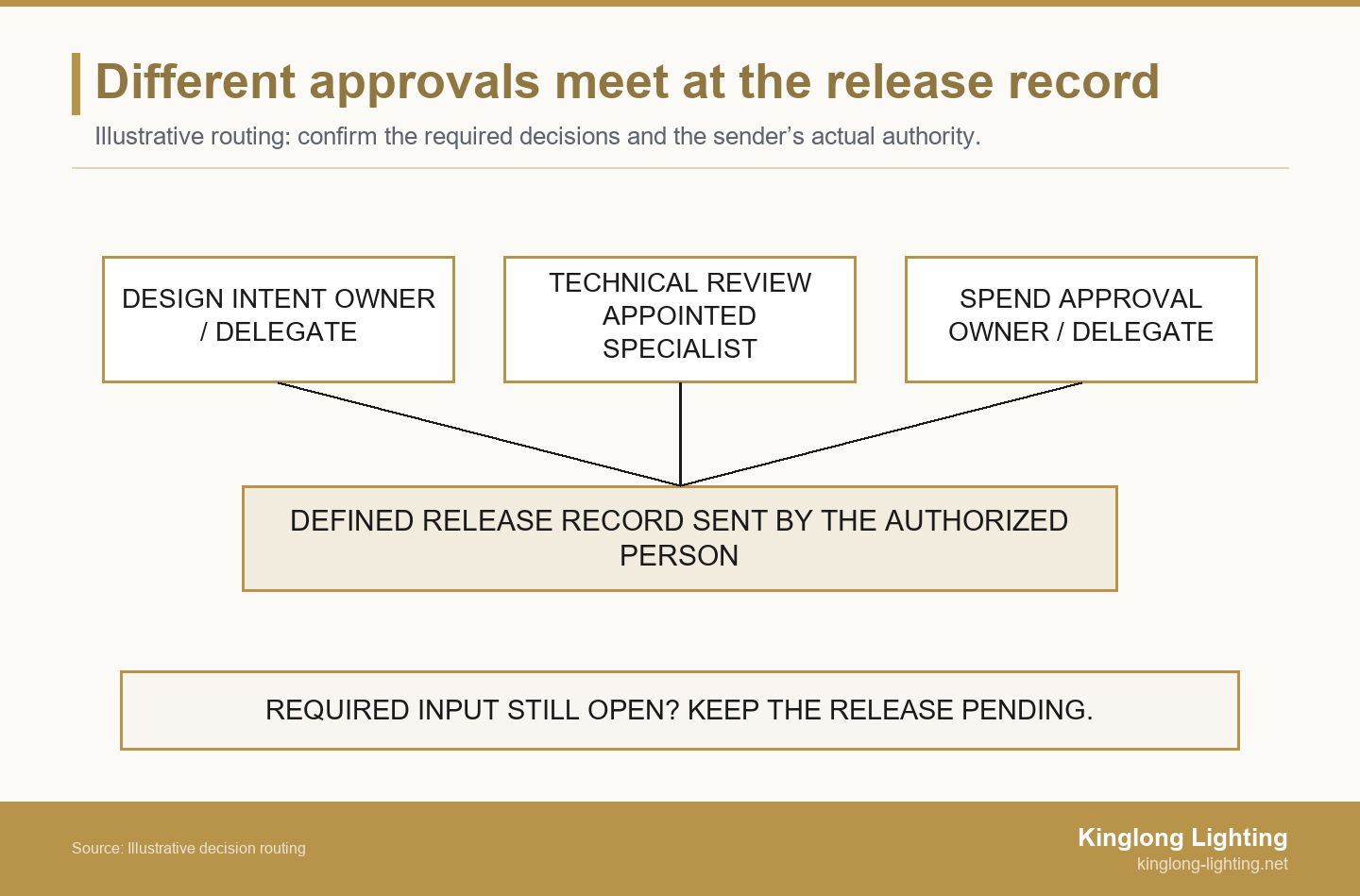
The proposed matrix separates the lighting brief, design selection, technical review, budget change, supplier choice, product record, order commitment, order issue and release transmission. Each row has one A. Replace the role headings with actual names and confirm their scope before using the assignments.
Here, technical reviewer means the appointed professional for the question concerned, not one person assumed competent in every discipline. A/R means that the named person both owns and completes that row. Procurement’s A/R for issuing documents applies only after the necessary authority is established; it does not grant permission to approve spending or start manufacture.
| Defined decision or task | Owner / appointed delegate | Designer | Procurement | Technical reviewer | Manufacturer |
|---|---|---|---|---|---|
| Agree the lighting brief and priorities | A | R | C | C | I |
| Accept the proposed visual selection | A | R | C | C | C |
| Complete the appointed technical review | I | C | I | A/R | C |
| Approve a defined budget change | A | C | R | C | C |
| Accept the supplier recommendation | A | C | R | C | I |
| Confirm the selected product and finish record | A | R | C | C | C |
| Authorize the stated order commitment | A | C | R | C | I |
| Issue the agreed purchase order | I | C | A/R | I | I |
| Transmit the specifically authorized production release | I | C | A/R | C | I |
Conventions for R are not identical in every guide: the Asana guide above recommends one Responsible role, while Atlassian’s RACI guidance allows several responsible contributors and recommends a single accountable individual. This compact example uses a named lead R so requests have a clear destination; list additional contributors in the decision record where needed.
Decision record to copy: Decision and fixture position: ___; current drawing/product/sample references: ___; lead R: ___; named A and authority scope: ___; C inputs required: ___; I recipients: ___; unresolved evidence: ___; outcome and conditions: ___; action authorized next: ___; authorized sender: ___; date/reference: ___.
Use published decorative-lighting projects to discuss the type of installation involved if useful. An installation image supplies context; it does not document who held each role or prove that this example matches a real client’s approval process.
Keep Technical Review With the Appointed Specialists
An owner’s visual preference and procurement’s price comparison do not replace the appointed specialists’ electrical or structural review. Ask the right reviewer to identify the evidence needed for the actual fitting and location before marking that decision complete.
The manufacturer can provide available product information and answer questions about the proposed construction or components. The project’s appointed reviewer must assess what that information means for the site and their discipline. A supplier can be responsible for preparing a requested drawing or component sheet in a separate task; that does not make the supplier the villa’s appointed technical approver.
UL Solutions’ marking and application guidance explains how product markings and certification information help assess UL-certified equipment for a particular installation. The certification scope matters: this does not establish that a proposed fitting is UL certified or suitable for every destination.
Translate an open technical question into an actionable request. “Please confirm the light” is too broad. “Provide the proposed source and control-component identifiers for the appointed electrical reviewer” names both an input and its recipient. A mounting question may require a different specialist and different site information. Keep those assignments separate when the work crosses disciplines.
If no reviewer has been appointed for a required question, record the role as unassigned and ask the owner or project lead to arrange the appointment. Do not assign the A to procurement simply because procurement is chasing the answer. Leave the affected technical decision open until the appropriate person and evidence are available.
Route a Late Fixture Change Through the Affected Decisions
In this illustrative D1 change, the owner prefers a different shade for the dining pendant after the initial visual selection. The team routes the design, technical and budget consequences separately before any authorized order or release instruction. This is a proposed example, not a reported client project.
The designer first records what changes in the room: the shade appearance, proportions and relationship to the table. Procurement asks the manufacturer to identify the proposed version, its included components and the commercial difference. The appointed technical reviewer receives any changed component or mounting information relevant to their scope. The owner’s preference starts the review; it does not close those other questions.
Use the matrix’s visual-selection row for the design decision and its technical-review row for the relevant specialist conclusion. If the proposal changes the agreed expenditure, use the budget-change row as well. Enter each outcome against the same D1 reference in the decision record. Procurement then checks that the next instruction matches the decisions actually completed and the authority granted for that step.
If the supplier has not identified the revised component, keep that technical question open and request the missing information. A visual selection can remain recorded as a preference or a conditional design decision, while the affected release stays pending. When the information arrives, send it to the named reviewer and update the record with that outcome. Do not copy an earlier technical conclusion onto a version with unknown components.
For a change that needs alternatives, the decorative-lighting value engineering guide can help structure the design and commercial comparison. Keep the comparison scope explicit so the budget approver sees what is being accepted, including exclusions and unresolved items.
Set Escalation Rules Before the Team Disagrees
When a decision cannot be resolved within an appointee’s authority, identify the open question and escalate it to the named approver or appointing authority. Do not treat silence as approval.
Agree how the lead R raises a blocked decision: the fixture positions affected, current references, missing input, consequences of waiting and the action requested. Use the project’s agreed response dates rather than inventing a standard deadline. If the named A is unavailable, follow the documented substitute or escalation route; attendance at a meeting is not an appointment.
A disagreement about appearance belongs with the appointed design decision-maker. A question outside a specialist’s scope needs the appropriate appointment. A proposed change beyond a spending delegation returns to the person with the relevant budget authority. If a row seems to need two competing A assignments, first ask whether it contains two different decisions, such as design acceptance and permission to spend.
After the decision, send the outcome to the people marked I with its conditions and current reference. A group message saying “all agreed” is less useful than a record stating which decision is closed and which remains open. Before issuing an instruction, check that it has not turned a limited approval into a broader commitment.
Send the Manufacturer a Decision Brief, Not Conflicting Instructions
- Name the people preparing and approving each defined decision.
- Keep technical, design and budget outcomes attached to the current product reference.
- State the next action authorized and the person permitted to send it.
Give the manufacturer current fixture references, named decision contacts and the unresolved questions. This tells the supplier whether the request is for information, an alternative, a sample discussion or a specifically authorized next instruction.
To discuss the villa lighting brief with Kinglong, bring the floor plan, ceiling height, preferred mood and budget requested on its villa page, together with current product references and named contacts. Kinglong Lighting’s published process includes sample or detail mock-up review. Confirm the actual options available for your enquiry and identify the next product or sample questions; the project team retains its appointed design, technical and purchasing decisions.
Frequently Asked Questions
Can the owner and procurement role be held by the same person?
One person can hold more than one role if each decision’s scope, required inputs and authority remain explicit in the project arrangements. Keep the rows separate so a product preference is not confused with an order commitment. Combining administrative roles does not supply missing technical competence; retain the appointed specialist review where the actual question requires it.
Does an owner’s representative automatically have authority to approve spending?
An owner’s representative needs an explicit appointment and spending scope; the title alone does not establish authority for every purchasing decision. Check the actual delegation before assigning the budget or order A. If a proposed change falls outside that remit, route it to the appropriate approver and record the outcome. The RACI should reflect those arrangements rather than create them.
Should every supplier receive the complete RACI and competing quotations?
Suppliers should receive the role and decision information needed for their own scope, rather than automatically receiving competing quotations or confidential comparisons. Identify the contact for product questions and the person authorized to issue instructions. Keep internal budgets, bid comparisons and unrelated appointments within the project’s agreed information-sharing rules. An I assignment means a relevant outcome is communicated, not unrestricted access to the whole file.
What happens when the designer or procurement contact changes?
A change of contact requires an explicit role handover, including its effective point, current references, completed decisions and outstanding actions. Record who now holds the assignment and notify the affected contributors and suppliers. Preserve the conditions attached to earlier decisions; do not reopen everything automatically or assume that attending the handover meeting transfers the authority to approve or issue instructions.