
Lead-free crystal is changing chandelier specifications less because it guarantees a greener fixture than because it forces buyers to separate four claims that older briefs often collapsed: composition, market compliance, visual performance, and replaceability. Each claim has a different evidence owner. A supplier can declare chemistry, a qualified reviewer must establish the destination-specific legal basis, the project team must approve appearance, and production records must carry that decision into the installed fixture and its spares. Removing lead may be a valid material objective, but it does not by itself prove a lower life-cycle impact, a destination compliance conclusion, or an identical optical result.
Four Decisions the Material Label Cannot Make for You
A lead-free label should open four reviews, not close the material decision. The label can be useful, but only after the buyer turns it into four separate questions with visible evidence and a named decision owner.
- Composition: Which formulation, component, revision, batch, and stock does the declaration cover?
- Market: Which rules apply to the finished electrical product at its destination?
- Appearance: Does the proposed crystal deliver the approved result under the intended room conditions?
- Continuity: Can production pieces and replacement stock be traced to the approved material and sample?
The practical trend is therefore not a simple move from one oxide recipe to another. It is a move from an implied material promise to a documented selection. That makes sustainability language more precise and gives project teams a better chance of preserving the approved chandelier after installation.
Start With the Composition Claim, Not the Sustainability Slogan
Start with what the declaration covers before asking what the marketing claim implies. “Lead-free” should identify a material fact about a defined crystal option. It should not silently expand into claims about every component in the fixture, every production lot, every destination, or the complete environmental profile. Until the material identity is stable, the remaining reviews have no reliable object to assess.
Crystal Names Do Not Describe One Universal Chemistry
The EU category scheme itself shows that crystal is not one universal chemistry. In the EU crystal-glass directive, “full lead crystal” and “lead crystal 24%” use minimum PbO criteria of 30% and 24%, while two other crystal-glass categories rely on different oxide combinations and physical-property tests. The point is not to apply this European naming system everywhere. It is to show why a purchase line that says only “crystal” or “lead-free crystal” remains chemically incomplete.
Alternative formulations can use different combinations of barium, zinc, potassium, or other constituents to achieve crystal-like optical and working properties. Buyers do not need to reverse-engineer the recipe. They do need enough identity to ensure that the declaration, sample, production batch, and spare stock refer to the same selected material.
Make the Lead-Free Declaration Name What It Covers
A material declaration is useful only when the buyer can tell exactly what it covers. Here, the product boundary means the exact material, covered component, and batch or stock named in the statement. Ask the supplier to name the formulation or material code, crystal component, issuing entity, document revision, production coverage, and any replacement-stock coverage. A declaration for a loose sales sample cannot automatically represent a later order made under another code or by another source.
Also ask what “lead-free” means in that document. Is it an intentional formulation statement, a test result against a named limit, or a commercial description? The answer changes how the evidence can be used. Record the declaration date and revision so that a material substitution cannot pass unnoticed between sample approval and production.
Treat RoHS as a Market-Scope Question
RoHS is a product-and-market question, not a synonym for lead-free crystal. RoHS means the EU rules for restricted substances in electrical equipment and other in-scope electronic equipment. The European Commission overview lists ten restricted substances and explains that the framework includes exclusions and application-specific exemptions. A supplier declaration can support that file, but the compliance conclusion belongs to the finished in-scope product and its current legal basis.
This distinction matters for decorative lighting because the fixture combines electrical equipment with decorative glass or crystal components. A buyer should not infer the status of the whole chandelier from a material adjective on one component, even when that adjective points in a useful direction.
Crystal-Glass Exemptions Make the Current Status Matter
A past exemption date is not, by itself, a current-status conclusion. The official text of Delegated Directive (EU) 2019/174 identifies Annex III entry 29 for lead bound in crystal glass defined by categories 1 to 4 of Directive 69/493/EEC. That legal history is one reason a simple “RoHS bans lead, therefore all chandelier crystal must be lead-free” statement is unreliable.
The second reason is timing. The Commission’s current RoHS implementation guidance explains that an existing exemption remains valid while a timely renewal request is under review. An annex date that appears to have passed may therefore need to be read with the live renewal status and later decisions. This does not prove that a particular chandelier can rely on entry 29. It tells the project team what must be checked before making a destination-specific conclusion.
Build a Destination-Specific Compliance File
A useful compliance file shows the destination and legal basis, not only a pass label. For an EU project, record the country of placing on the market, the finished product covered, the material or test evidence, any exemption relied upon, the current status checked, and the person or organization responsible for the review. For a project outside the EU, replace the RoHS assumption with the applicable national or tender requirements.
The file should also show document dates and revisions. That makes a later formulation change visible and prevents an old declaration from being attached to a new batch without review. Treat “RoHS compliant” as a conclusion that needs a traceable basis, not as a supplier slogan that closes the question.
Approve Optical Performance and Continuity as Separate Gates
Composition paperwork cannot approve the room appearance or future replacement match. Two formulations can both satisfy a stated lead-free claim while differing in colour cast, cut response, edge quality, mass, or how a group of pieces behaves under the specified light. Conversely, a beautiful sample can pass the visual review while its material identity and replacement route remain undocumented. That is why optical approval and continuity need their own records.
Review a Representative Sample Under the Intended Room Conditions
Approve the optical result under the room conditions that will actually reveal it. Record the light source and dimming state, the background, normal viewing distance, critical viewing angle, and whether the review uses one piece or a representative group. A master sample is the approved physical reference for comparing production appearance; it should carry the material code, sample date, and project approval reference.
Product imagery can establish a design direction, but it cannot replace that review. For example, Kinglong Lighting’s Crystal Tube Series identifies K9 optical crystal glass as its current product context. If a project proposes another formulation, place the proposed material beside the selected reference under the agreed room conditions. Do not assume that the words optical crystal, K9, or lead-free guarantee the same visible result.
For a large chandelier, review the way several pieces work together. A single drop can hide a slight colour shift or inconsistent cut response that becomes clear across a repeated curtain, tier, or tube array. The approval record should state which differences are acceptable and which require another sample.
Bind the Master Sample to Production Batches and Spares
A crystal approval is incomplete if replacement stock sits outside the approved record. The production file should connect the supplier, material code, document revision, master sample, batch or lot reference, finished quantity, spare quantity, and storage identification. If the source or formulation changes, the buyer should know whether the declaration and optical review must be reopened.
Replacement matching deserves attention before shipment because a chandelier may be serviced years after installation. If spare pieces come from an unrecorded later source, the team may discover the difference only after a broken element is replaced in the lit room. Continuity is therefore not a promise that glass will remain perfectly identical forever. It is a documented route for comparing any later stock with the approved reference and deciding whether a new sample is needed. The storage label should remain legible after commissioning.
That sample-to-production handoff is relevant to Kinglong’s hospitality lighting development workflow, which describes physical sample confirmation and production quality control as parts of project delivery. The internal route provides project context; the material declaration and destination review still have to be specific to the selected crystal and order.
A Lead-Free Claim Is Not a Life-Cycle Assessment
Lead-free is a specific composition claim, not a blank cheque for the word sustainable. A self-declared environmental claim is a company statement about an environmental attribute; it is not certification by an independent third party. ISO 14021:2026 sets requirements and guidance for such product claims and their evaluation or verification methods. In the US marketing context, the FTC Green Guides summary likewise warns that broad, unqualified environmental-benefit claims are difficult to substantiate and places conditions on “free-of” claims.
The buyer-facing implication is simple: say what has been established. “This identified crystal formulation is declared lead-free under the supplier’s stated basis” is narrower and more defensible than “this chandelier is eco-friendly.” If a tender asks for a broader environmental benefit, request the comparison method, covered product, indicators, data period, and verification behind it.
A composition change is not the same analysis as a life-cycle comparison. ISO 14040 describes life-cycle assessment through goal and scope definition, inventory analysis, impact assessment, and interpretation. Those stages can consider raw materials, energy, manufacturing, transport, service, and end-of-life assumptions. Without a study using an appropriate boundary, buyers cannot reliably rank lead-free and lead crystal formulations by total life-cycle impact.
What can be said is that demand for restricted-substance information, more specific environmental language, and auditable sourcing is changing the selection process. The strongest sustainability improvement may be better evidence and longer service continuity: a material choice that can be identified, reproduced, and replaced is easier to manage than one approved only by a label.
Convert the Decision Into a Four-Part Material Approval File
Release the crystal only at four of four mandatory gates. This is a proposed project-control rule, not a legal certification score. The logic is deliberate: a strong result in one category cannot compensate for a missing mandatory category. A beautiful sample does not cure an undefined declaration, and a complete declaration does not prove the installed appearance.
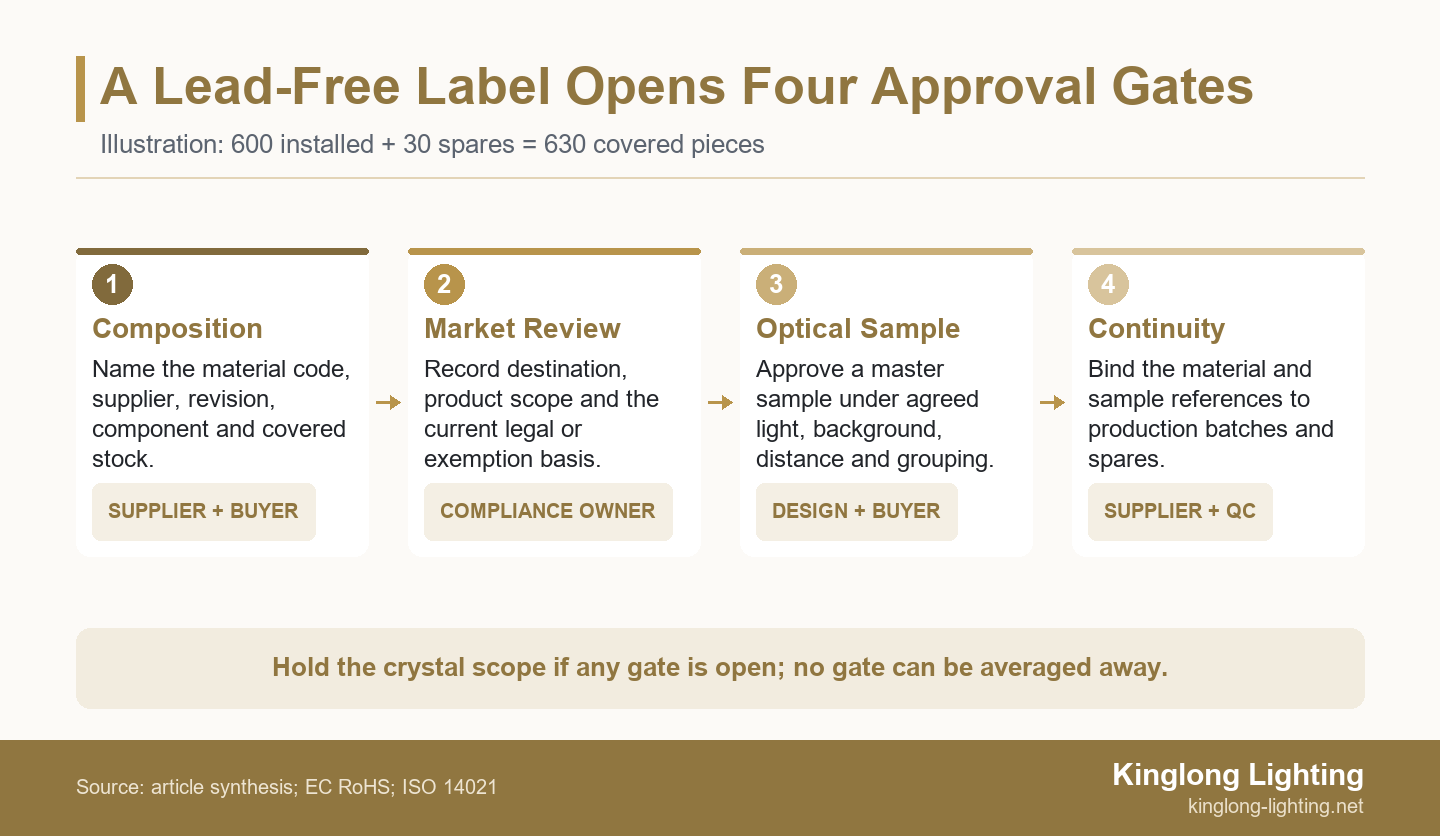
| Approval part | Evidence to retain | Decision owner | Stop condition |
|---|---|---|---|
| Composition | Material code, covered component, issuer, revision, batch or stock scope | Supplier and buyer | The declaration cannot be tied to the selected crystal |
| Destination review | Market, finished product scope, substance evidence, current legal or exemption basis | Qualified compliance owner | The conclusion relies on a label or stale status |
| Optical sample | Master sample, room conditions, grouped arrangement, accepted and excluded differences | Design team and buyer | The sample does not represent the installed visual condition |
| Continuity | Production batch, spare-stock batch, quantities, material and sample references | Supplier production and QC | Production or spares sit outside the approved record |
Before relying on the process, review the supplier’s published project context as well as the four article-specific records. A project portfolio is first-party background, not proof that one crystal option satisfies a new declaration, market, appearance, or continuity requirement. Supplier experience and material approval answer related, not identical, questions. For application context, review the Kinglong Lighting project portfolio.
One Declaration Must Cover 630 Pieces, Not One Show Sample
In this illustration, the material rule covers 630 pieces, not one show sample. The quantities make the document boundary visible; they are not a universal chandelier specification.
A hotel project team is approving lead-free crystal drops for one custom lobby chandelier, with appearance already treated as a critical design decision.
The illustrative fixture uses 600 installed drops. The buyer also assumes 30 replacement drops, equal to a 5% spare allowance for this example.
The room-condition sample looks acceptable, yet the supplier declaration names only its sample code. It does not state whether production and spare stock share that material identity.
The visible sample passes the agreed review under the intended light, background, viewing distance, and grouped arrangement.
The current declaration does not identify all 600 production drops or the 30 replacement drops that may later enter the installed chandelier.
The arithmetic is 600 installed pieces plus 30 spares, so 630 pieces depend on the same material and continuity decision. Optical approval has closed only one of four required reviews.
Hold release of the affected crystal scope. Other fixture work may continue only where it can be released independently without hiding the open material records.
Revise the declaration and batch record to cover the complete quantity. Bind the material code, production batch, spare-stock batch, and approved sample reference.
Release the crystal after the revised file names all 630 pieces and a reviewer confirms that the composition, destination, appearance, and continuity records agree.
The 600-piece order and 5% spare allowance are illustrative assumptions. Each real project must set its own quantity, spare strategy, and legal review.
Send Five Inputs Before You Request a Crystal Sample
A useful sample request begins with five inputs, not the word lead-free alone. The supplier needs enough context to propose the right declaration boundary, sample arrangement, and continuity record before the project spends time approving a loose piece.
- Name the destination market and project decision owner.
- Attach the current supplier declaration and its material code.
- State the lighting, background, viewing distance, and group size.
- Separate installed quantity from required replacement stock.
- Ask how both quantities stay tied to the master sample.
When those inputs are ready, send Kinglong Lighting the fixture drawing and target schedule. The useful deliverable is not a generic confirmation that lead-free crystal is available; it is a project-specific plan for declaration review, representative sampling, production identification, and spare-stock continuity. To begin that project discussion, request a crystal material review.
FAQs
Lead-free crystal still needs separate composition, compliance, appearance, and continuity evidence. These answers keep that boundary intact for the questions buyers most often need to resolve quickly.
What Does Lead-Free Crystal Mean in Chandelier Specifications?
Lead-free crystal is a crystal-style glass formulation whose supplier declares that lead is absent or below the stated claim threshold for the identified product. The name does not describe one universal alternative recipe, so buyers should ask for the material or formulation code and the scope of the declaration. Optical performance also needs a separate sample review because a composition statement does not guarantee the colour, cut response, weight, or grouped appearance required by a chandelier design.
Does lead-free crystal automatically comply with RoHS?
No; a lead-free material declaration is useful evidence, but RoHS compliance belongs to the in-scope electrical product and its applicable destination-specific legal file. The review should identify the market, finished product, current substance evidence, and any exemption basis. In the EU, crystal-glass exemptions and renewal procedures make current legal status important. A buyer should therefore ask a qualified reviewer to confirm the project basis instead of accepting “lead-free” or “RoHS compliant” as a complete answer.
Is lead-free crystal always more sustainable than lead crystal?
Not automatically; removing lead is a specific composition change, while overall sustainability depends on the life-cycle boundary, evidence, and environmental impacts being compared. A broader claim may need data on raw materials, manufacturing energy, transport, service life, replacement, and end-of-life assumptions. Without that comparison, use narrow language that states the verified composition attribute. Better traceability and reliable replacement stock can still improve project management and service continuity without being presented as proof of total environmental superiority.
What should buyers request before approving lead-free chandelier crystal?
Request a product-specific composition declaration, the destination compliance basis, a room-condition optical sample, and a batch record that also covers replacement stock. The declaration should name the material, component, revision, and covered quantity. The sample record should state how and where the crystal was viewed. The continuity record should connect production and spares to the same material and master sample references. If any of those four records is open, keep the affected crystal scope on hold.