Hotel lighting commissioning is often treated as the final walk-through after the chandeliers, sconces, controls, and decorative fixtures are already installed. Owners should treat it earlier and more seriously. Commissioning is the moment where the hotel proves that the purchased lighting package can operate as a guest experience, a maintenance asset, and a documented part of the building handover.
The word standard can be misleading. A supplier cannot replace the local code authority, electrical engineer, fire-safety consultant, or commissioning agent. What an owner can demand is a project acceptance standard: which rooms are checked, which scenes are tested, which evidence is recorded, who owns each correction, and what must be closed before final acceptance.
Kinglong Lighting is most useful in this stage when the decorative lighting scope is connected to drawings, samples, packing records, installation assumptions, spare parts, and the hotel lighting solution rather than left as a catalogue order. That evidence gives the owner a practical way to separate style approval from operational acceptance.
Key Takeaways
- Commission the room, not the object: The owner should test scenes, controls, glare, maintenance access, and handover evidence, not only whether the fixture turns on.
- Separate factory proof from site proof: Factory inspection can confirm build quality, but site commissioning must prove controls, location, access, and owner acceptance.
- Use a close-out matrix: Every defect should have a category, owner, deadline, evidence format, and accept, revise, or hold decision.
- Protect the opening date: Small unresolved lighting issues become disruptive after furniture, guests, operators, and brand inspections enter the space.
- Keep qualified local review visible: Supplier documents support local professionals; they do not replace electrical, structural, safety, or authority review.
Commissioning should start with the room promise
The owner should not ask whether the chandelier is installed; the owner should ask whether the hotel can operate the approved lighting promise.
A hotel owner cannot commission a decorative lighting package well if the room promise is still vague. The commissioning file should repeat the approved design intent in operational language: arrival drama in the lobby, calm low-glare circulation in corridors, flattering light in lift lobbies, repeatable guestroom scenes, or easy banquet turnover.
The WBDG building commissioning page gives a useful boundary because commissioning connects design intent, installation quality, operation, and owner handover. For project buyers, the practical action is to tie each acceptance check back to design intent, installed function, and owner handover rather than treating commissioning as a late paperwork event.
Define scenes before fixture sign-off
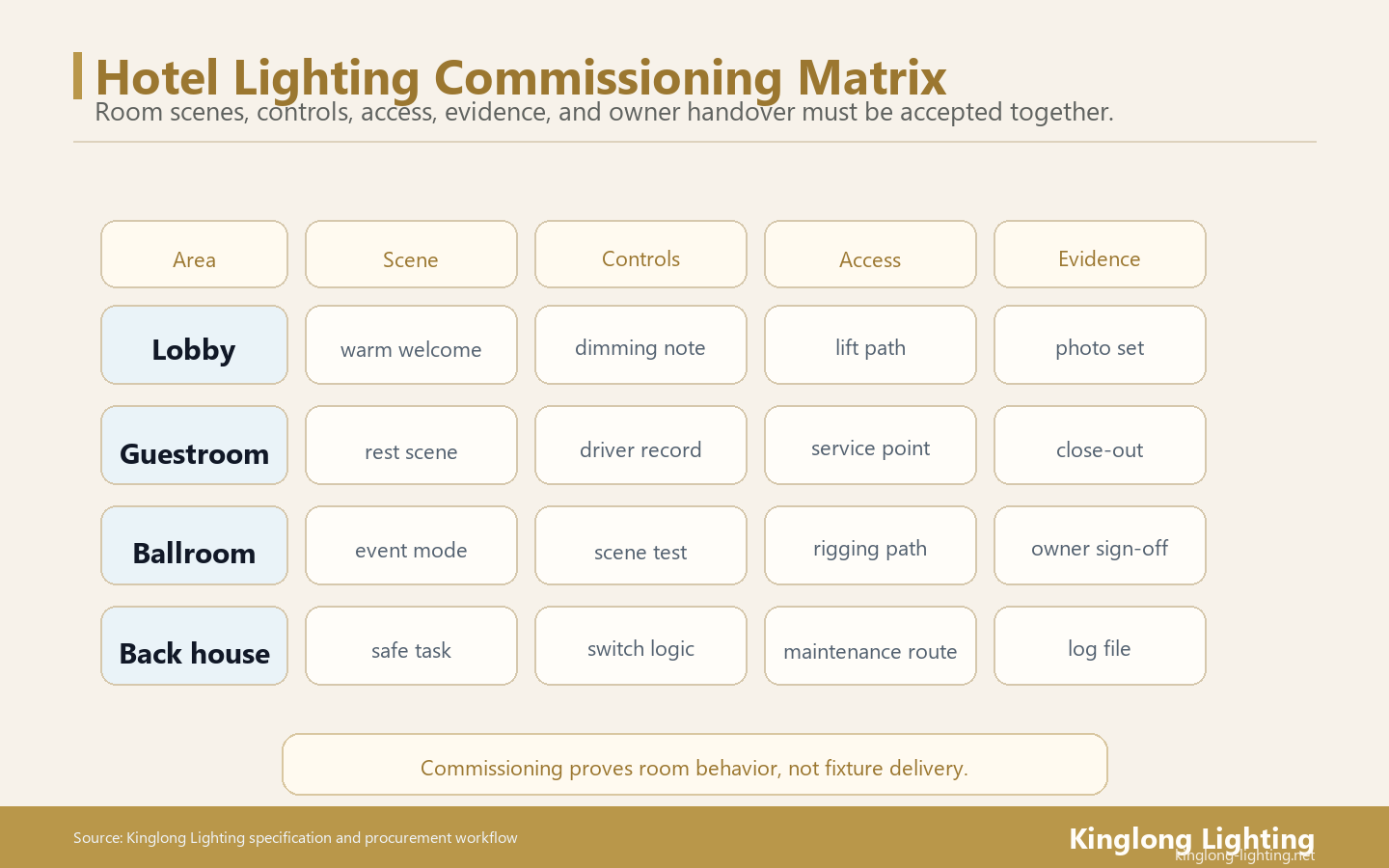
Scene language should be written before final fixture sign-off. If the lobby needs day arrival, evening arrival, photography, cleaning, and emergency-support scenes, those scenes should appear in the commissioning matrix. Otherwise the team may approve a beautiful chandelier that produces only one impressive look and leaves operations to improvise.
The same rule applies to guestroom decorative lighting. Bedside, entry, vanity, cove, reading, and master scenes need repeatable behavior across room types. Owners should request a sample room or typical-room record that proves switching order, dimming response, lamp appearance, driver noise, and control labels before the issue is multiplied across floors.
Separate factory proof from site proof
Factory proof can show that a chandelier was built to the approved drawing, that finishes match the signed sample, that components were packed correctly, and that basic electrical checks were completed. It cannot prove the site scene, local dimmer behavior, final ceiling relationship, or post-installation access route.
A stronger commissioning standard therefore uses two evidence columns. The supplier column covers drawings, samples, inspection photos, packing lists, test references, and spare parts. The site column covers installed level, scene behavior, ceiling interface, lift access, labeling, damage, and owner sign-off. Confusing those two columns is how disputes survive into opening week.
Demand a room-by-room acceptance matrix
Commissioning should not depend on whoever happens to attend the walk-through. A room-by-room matrix gives the owner a stable method for deciding what has passed, what has failed, and what needs more evidence. The matrix can be short, but it must be specific enough to prevent vague comments from becoming unowned defects.
The DOE lighting design page gives a useful boundary because lighting decisions should be judged around the whole space and its use, not only fixture appearance. For project buyers, the practical action is to judge decorative lighting by whole-space use, visual comfort, and operating purpose instead of isolated fixture appearance.
Public areas need scene behavior, not only brightness
Lobby, ballroom, restaurant, spa, corridor, and lift-lobby lighting should be checked under the scenes the hotel will actually use. A chandelier that looks dramatic during a single evening mock-up may still fail cleaning, banquet reset, morning arrival, or photography scenes. The owner should ask for the commissioning record to name each scene.
The matrix should also record what the owner will accept as evidence. For example: a signed scene photo set, control panel screenshot, dimming percentage note, issue tag, and close-out photo. That does not turn commissioning into bureaucracy. It prevents a late argument where one party remembers a subjective mood and another remembers a technical pass.
Guestrooms need repeatability and maintenance access
Guestrooms are risky because one successful sample room can hide repetition problems. Owners should check typical rooms, accessible rooms, suite types, and any room with unusual ceiling or control conditions. The question is not whether every room receives a custom essay; it is whether variations are known before defects become a floor-wide maintenance pattern.
Maintenance access belongs in the guestroom commissioning file as well. If a decorative pendant, mirror light, driver, or dimming component cannot be reached without damaging finishes, the room may pass visually and fail operationally. Owners should insist that access notes and spare strategy appear before final acceptance, not after the first service ticket.
Make controls, access, and responsibility visible
The most expensive commissioning disputes often sit between trades. A fixture supplier, control vendor, electrician, designer, installer, and hotel operator may each be partly involved, which means a defect can move around the meeting room without becoming a task. Owner standards should make responsibility visible before the punch list becomes political.
The DOE LED lighting page gives a useful boundary because LED performance, heat, service life, and operating behavior need to be part of luminaire decisions. For project buyers, the practical action is to include LED behavior, driver compatibility, heat, dimming, and service expectations in the acceptance file.
Dimming faults are often ownership faults
Flicker, dead travel, color shift, buzzing, and uneven dimming are not always caused by the chandelier alone. They can come from driver selection, control protocol, wiring practice, load assumptions, scene programming, or a late substitution. The owner should require a responsibility column that names who investigates which layer first.
That responsibility column should not become an excuse for the supplier to avoid the issue. It should make the diagnostic path faster. A practical record names the fixture, driver, control channel, scene, symptom, test performed, responsible party, next action, and required proof. Without that structure, a small dimming fault can consume more meetings than the chandelier deserves.
Access plans belong in acceptance
Commissioning is not finished if the chandelier looks correct but no one can safely reach the canopy, driver, crystal strings, decorative glass, or suspension point after furniture and floor protection are removed. Access is part of the owner asset, especially in double-height lobbies, restaurants, stair voids, and ballrooms.
The OSHA aerial lifts page gives a useful boundary because overhead installation and later service require planned access and trained site practice. For project buyers, the practical action is to record lift path, access restrictions, and service responsibility before final acceptance for overhead decorative lighting.
Use commissioning math to protect the schedule
The purpose of a commissioning standard is not to make the project slower. It is to expose the small issues that become expensive after opening. A hotel that accepts unclear lighting evidence may save an hour in a meeting and lose many more hours in after-hours service, guest complaints, and management escalation.
The UL 1598 standard page gives a useful boundary because decorative chandeliers are still luminaires that need product evidence and qualified installation review. For project buyers, the practical action is to keep luminaire evidence, installation limits, and qualified local review visible during owner acceptance.
A small unresolved list becomes a return-visit budget
Consider a 120-room hotel with a lobby, restaurant, ballroom prefunction, corridors, and guestrooms. If ten decorative lighting items remain unclear at acceptance, and each item needs a return visit, a site escort, a control check, a supplier response, and an owner close-out note, the coordination burden can easily reach eight to twelve hours before any repair labor is counted.
That estimate is not a universal cost formula. It is a planning warning. Owners should use it to justify early close-out discipline: identify defect type, decide who owns it, request the missing proof, and close it before the hotel is operating around the defect.
Punch items need categories and owners
A useful punch list does not say only dimming issue or chandelier problem. It uses categories such as visual alignment, scene behavior, electrical symptom, finish damage, access restriction, missing spare, missing document, packing damage, or owner preference change. Each category suggests a different proof path and a different responsible party.
The owner should also separate blocking items from cosmetic or documentation items. A chandelier that cannot be controlled safely may block acceptance. A missing spare part label may not block room opening but should block final handover closure. The standard should state those thresholds before the final walk-through.
What the owner handover file should contain
Commissioning is incomplete if the knowledge remains in emails, meeting memory, or one project manager’s laptop. The handover file should help hotel engineering, operations, housekeeping, purchasing, and future renovation teams understand what was approved and how to protect it.
The ICC Incoterms 2020 page gives a useful boundary because international delivery responsibility should be named before goods, crates, and spare parts move. For project buyers, the practical action is to connect delivery documents, crate responsibility, replacement parts, and destination handoff to the final owner file.
Evidence should survive staff turnover
Hotels change engineers, operators, designers, and purchasing contacts. The handover file should therefore include final drawings, room schedules, scene notes, driver and lamp references, approved finish samples or sample codes, spare part list, cleaning guidance, warranty terms, packing references, and contact path for replacement items.
If the chandelier is large, modular, custom-finished, or difficult to access, the file should include assembly sequence and service notes. Future teams should not have to reverse-engineer the fixture from photos when a glass piece breaks or a driver needs replacement.
Warranty and spare records should connect to commissioning
Warranty evidence is weaker when it is detached from commissioning. If a problem appears later, the owner needs to know whether the issue was visible at acceptance, caused by site conditions, related to misuse, connected to a consumable part, or covered by a product commitment. The commissioning file gives the warranty discussion a factual starting point.
The NIST NVLAP accreditation page gives a useful boundary because test evidence is stronger when the method, traceability, competence boundary, and report scope are clear. For project buyers, the practical action is to separate test report scope from field acceptance and avoid treating any report as a promise beyond its stated method.
Owner commissioning demand table
Use this table before the final lighting walk-through. It keeps the owner discussion focused on evidence, responsibility, and acceptance instead of taste alone.
| Decision area | Owner risk if vague | Evidence to request | Acceptance action |
|---|---|---|---|
| Room scenes | A room looks good once but fails operating modes | Scene list, photos, control settings, owner witness | Accept only when named scenes operate as approved |
| Dimming behavior | Flicker, buzz, dead travel, or uneven response appears after opening | Driver notes, control channel, symptom record, retest photo | Assign diagnostic owner and close with retest evidence |
| Access and service | Future maintenance damages finishes or interrupts operations | Lift path, canopy access, driver location, service note | Hold final handover if access is unknown |
| Finish and damage | Arguments rely on memory rather than signed samples | Finish master, installed photo set, defect category | Close with signed accept, repair, or replace decision |
| Spares and warranty | Operations cannot act when parts fail | Spare list, part map, claim path, warranty boundary | Link support records to the commissioning file |
How Kinglong Lighting supports commissioning evidence
Kinglong Lighting can help hotel owners connect decorative lighting approval to manufacturing records, sample references, packing files, replacement parts, and the custom chandelier workflow. This support is strongest when the buyer shares room schedules, scene requirements, drawings, destination information, control assumptions, and the owner acceptance matrix before final production release.
The next step is not a broad catalogue request. If the commissioning risk is already visible, the buyer should send the hotel lighting commissioning file with room types, quantities, scene concerns, open defects, and required evidence. Kinglong Lighting can then respond with a more useful mixture of drawings, inspection records, spare logic, and handover notes.
Before you release final hotel lighting acceptance
Use this short action list before the next approval meeting. It is intentionally practical, because vague approval language is the usual source of later rework.
- Freeze the accepted room scenes and keep them in the commissioning matrix.
- Ask whether each defect belongs to fixture, control, electrical, site, finish, access, document, or owner-change category.
- Require a close-out record for every blocking item before final acceptance.
- Keep local professional review visible for electrical, structural, safety, and authority questions.
- Attach warranty and spare part records to the same file that records commissioning acceptance.
FAQ
What should hotel lighting commissioning include?
It should include room scenes, control behavior, visual alignment, finish condition, access, local review boundaries, punch list ownership, spare parts, warranty path, and owner handover evidence.
Is factory inspection the same as hotel commissioning?
No. Factory inspection checks the product before shipment. Hotel commissioning checks the installed lighting system in the actual room with controls, access, site conditions, and owner acceptance.
Who should sign off decorative lighting commissioning?
The owner or owner’s representative should sign the acceptance record, with input from the designer, installer, electrical team, control vendor, supplier, and qualified local professionals where required.
Can commissioning standards prevent all lighting defects?
No. They reduce ambiguity and make correction faster. A good standard cannot remove every defect, but it can prevent defects from becoming unowned disputes after opening.