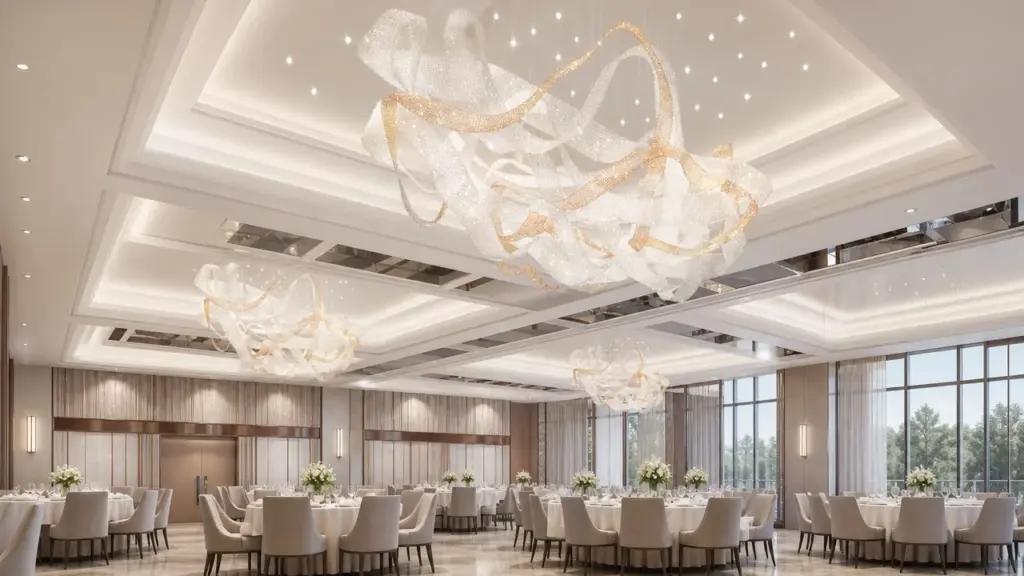
A reference sample should show the visual family intended for a hand-blown chandelier, not a single exceptional piece. Hand-blown glass gives a chandelier a quality that machine-made components cannot fully copy: subtle shifts in contour, thickness, transparency, and colour make the composition feel alive. Variation itself is not the project risk; the risk is a difference between the variation the design intended and the variation the project can accept.
For a project, the goal is not to eliminate handmade character. Define the family of variation that belongs in the design, then approve it under the light and at the viewing distance that matter. The blowing process changes the final look, so the sampling criteria should also keep a large installation visually coherent.
Key Takeaways
Approve a visual family, not an unbounded handmade exception. Here, a visual family means an approved range of related form and colour that the team can recognise in the finished composition. The approval should say what belongs together, what cannot vary, where the glass will be seen, and which physical sample represents that decision.
- Choose a forming character before asking for a tolerance: different forming routes create different visual expectations.
- Make illumination part of the approval record when colour, translucency or reflections affect the chandelier’s appearance.
- Keep thermal-history evidence proportionate to the component, mounting and project risk rather than asking for a generic certificate.
- When the same excluded shift appears repeatedly, pause that family and compare it against the approved reference before accepting more pieces.
How the Blowing Process Shapes the Final Look
Free-blown work shapes a hot glass bubble with gravity, motion and tools. The Victoria and Albert Museum’s explanation of free-blown glass makes the mechanism clear: the maker manipulates a parison rather than simply filling a final enclosing mold. That does not make the outcome uncontrolled. It means the project must decide which organic shifts in contour, thickness, bubbles or optical movement are part of the intended character before production begins.
Mold-assisted blowing can establish a pattern or shape before later hot finishing. As the Metropolitan Museum describes in its account of mold-blown glass, hot glass can take the form and pattern of a mold and then receive more work. For chandelier teams, the useful question is therefore not whether a piece is “handmade,” but where the design needs freedom and where it needs repeatable geometry: a soft, cloud-like pendant asks for a different brief than a repeated drop with a precise silhouette. Once that choice is clear, buyers can explore chandelier collections by visual direction without confusing product style with an approval rule.
That distinction also changes the sample request. When the design depends on organic movement, ask the maker to show the intended range across several elements rather than retouching every irregularity out of the reference. When a repeated outline must align with metalwork or a tight chandelier rhythm, identify the dimensions and interfaces that cannot drift. This separates a desired hand-worked character from a fit, balance or installation issue that the fixture design must control.
Define the Intended Variation Before You Approve a Sample
A variation contract needs a visual family, a labelled reference sample, a physical envelope, excluded differences and a viewing condition. It gives the team a place for purposeful irregularity while making unacceptable shifts visible. Write the agreement before an attractive single sample gains too much influence, and keep the range visible in a group rather than trying to infer it from a single piece.
| Contract field | What to record | What it prevents |
|---|---|---|
| Visual family | Approved range of form, colour density, bubbles, texture and optical movement. | Approving a single exceptional piece as the whole standard. |
| Physical envelope | Relevant size, opening, weight or fit limits for the fixture design. | Using an aesthetic approval to imply an unagreed dimensional tolerance. |
| Excluded differences | Specific shifts that do not belong, such as a directional amber cast, unwanted haze or a distorted opening. | Calling every difference “artisanal” after it arrives. |
| Viewing condition | Light source, approximate colour temperature, viewing distance and whether the piece is lit in an assembly. | Resolving a colour dispute under a different light from the one the design team approved. |
The physical envelope deserves its own line because visual approval cannot quietly absorb an assembly requirement. A hand-blown shade may look right but still need an agreed opening, wall thickness, weight range or seating detail to work with the chandelier structure. Conversely, a dimensional limit should not erase the surface movement that made the glass appropriate for the design. Put each kind of control in the brief so that a visual reviewer and a fixture engineer are not asked to interpret the same sample for incompatible purposes.
Object colour changes with illumination, so the approval view must be stated. CIE identifies D65 as a standard average-daylight illuminant of approximately 6 500 K, which can be useful vocabulary when a project chooses a daylight reference. A NIST colour-measurement paper also notes that an object’s colour changes with the illumination spectrum and that measurement geometry matters. Record the project condition instead of treating a colour name as a complete instruction. For a custom request, Kinglong Lighting can translate a glass family into a custom chandelier brief that starts with those observable choices.
Treat the labelled group as the reference sample. Its acceptance view should state the light, distance and assembly context, while the same identifiers belong in the production record used to compare later pieces. This turns a selection conversation into a traceable instruction without asking every piece to look identical.
Review the Glass in Three Useful Stages
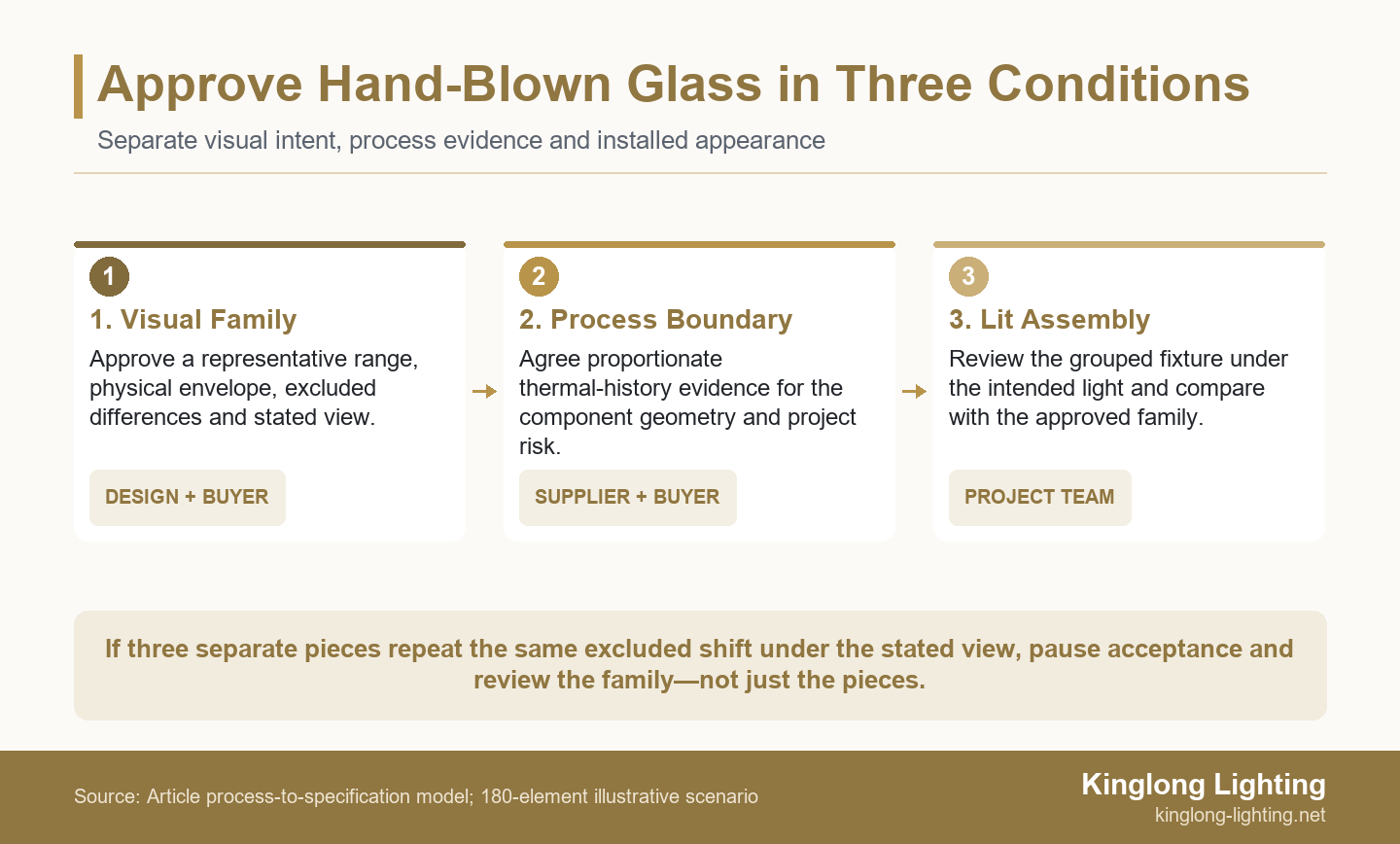
Sequence reference-family approval, proportionate process evidence and lit-assembly review. They answer three different questions: what visual range belongs to the design, whether a material-control record is needed for the project, and how the grouped glass appears in its intended chandelier context. Combining them into one sample sign-off usually hides which question has actually been answered.
Approve a Family, Not a Single Showcase Sample
Approve a labelled multi-piece visual family as the production reference. For a chandelier with many visible elements, lay out several samples together and identify the accepted range: lighter and deeper pieces, more and less active surfaces, and the intended relationship among them. A hero piece is one unusually attractive single sample that is not representative of the wider range. Label the group, photograph it under the agreed condition and connect it to the relevant glass family or production requirement. The purpose is not to flatten hand-blown character; it is to give receiving, assembly and design reviewers the same object of comparison.
Choose the group to reveal the decisions the installation will make visible. If pendants sit in a vertical cluster, include samples that show the strongest and quietest acceptable optical character beside one another. If multiple chandeliers will be seen across a lobby, include pieces from more than one fixture position. The reference need not be a statistical sample; it needs to make the intended composition legible enough that a later reviewer can identify an excluded directional shift without debating personal taste.
Ask for Thermal-History Evidence Only When the Project Needs It
Annealing after forming helps control final physical properties. In plain terms, annealing is controlled cooling after forming that reduces stress in the glass; the Canadian Conservation Institute describes controlled cooling and annealing as part of controlling glass’s final physical properties. That is a reason to ask a focused project question, not a reason to demand the same paperwork for every decorative component.
ASTM C770 links stress-optical measurement to thermal residual stress and specification acceptance. Its published scope for the stress-optical coefficient shows one possible route for discussing residual stress where a project genuinely needs it. It is not a universal pass-fail requirement for chandelier glass. A proportionate request might ask for the relevant process record, a defined check on a risk-sensitive shape, or an agreed test method; mounting, loading and local compliance requirements still need their own project review.
Review the Lit Assembly, Not Only the Glass on a Bench
Review the agreed glass assembly under its intended light context, not only on a bench. For a lit mock-up, inspect a representative assembled fixture under the agreed light; that exposes glow, overlap, reflection and the visual effect of the actual grouping. NIST’s solid-state-lighting measurement work sets operating and optical conditions as part of assessment, while its discussion of colour rendering cautions that colour fidelity does not exhaust appearance. The project inference is simple: a colour-temperature label or bench inspection alone cannot settle the installed impression.
The goal is not to create a miniature finished installation for every order. It is to select a review setup that can reveal the risk the bench cannot: whether the chosen glass becomes too amber in a warm lamp, whether adjacent elements merge into one bright mass, or whether a change in drop spacing alters the perceived density. Record the lamp, dimming state if relevant, fixture position and viewing distance so that a later comparison returns to the same decision context.
Before samples are lit, the layout should already make visual sense. Kinglong Lighting offers a way to review glass distribution in the Mofun Design Platform, helping a team consider grouping and drop pattern before the physical family is assessed under the agreed light.
When Variation Needs a Second Look
Repeated excluded visual shifts need a stated escalation point. Without one, a team can replace individual pieces indefinitely while a directional change continues through the order and gradually alters the chandelier composition.
Illustrative Scenario: Keeping an Arrival-Space Chandelier Coherent
This illustrative scenario concerns a hospitality design team specifying grouped hand-blown glass chandeliers for a double-height arrival space where the glass is visible from several approach angles.
The order has 180 amber-to-smoke glass elements across 15 chandeliers, including 60 elements concentrated in the three fixtures that define the arrival area.
Before production acceptance, the team approves a six-piece visual family and a 3000 K lit mock-up, with the selected samples retained as the visual reference.
During delivery review, three separate elements from the same glass family look noticeably more amber than the reference when placed beside it under the stated light.
The record identifies the family but contains no trigger for moving a repeated visual shift from individual replacement to a family-level review.
Three repeat deviations under the same stated view should trigger a batch review, not three isolated replacements. This is an illustrative project rule, not a statistical sampling plan: the important signal is that the shift points in one direction across separate pieces after a visual family and viewing condition have already been agreed.
Do not accept further elements from the affected delivery family until the team has paused visual acceptance and compared the pattern against the approved six-piece reference.
Compare the three elements and retained family under the recorded 3000 K condition, correct the visual-boundary record, and request a new production reference before further acceptance from that family.
Resume acceptance only after a repeat lit review places the corrected family inside the approved range and the revised record clearly identifies the production family being released.
This is an illustrative escalation example, not a Kinglong project case, a defect-rate claim or a substitute for safety, mounting, electrical or local compliance approval.
What to Include in a Project Glass Brief
Bind visual reference, intended light, geometry and acceptance boundary before manufacturing review. A useful brief lets a supplier price the project honestly and lets the design team see which differences are being controlled. It should name the chandelier or fixture group, the number of visible glass elements, the intended forming character, a retained visual-family reference, the light condition for review and the excluded visual shifts. Add the physical envelope that affects assembly, then state who can approve a deviation and when a repeated pattern must be escalated.
- Attach representative images or physical samples and describe the approved range, not just the preferred centre point.
- State the fixture geometry, component count and where differences will be most visible.
- Specify the review condition, including the intended lamp or a named reference condition such as D65 when that is the agreed visual baseline.
- List excluded differences, the evidence needed for any risk-sensitive component, and the escalation rule for repeated shifts.
Before release, compare the brief against the retained sample group and confirm that the person approving appearance can see the stated light condition. This avoids a common handoff gap: the manufacturer receives an attractive image, while the project team assumes the image also defined geometry, light and the response to repeated shifts. With those inputs in hand, the team can request a hand-blown glass specification review.
Frequently Asked Questions
Does Hand-Blown Glass Always Mean Every Piece Must Look Different?
No—hand-blown glass may show purposeful variation, but the project can approve a defined range and reject differences outside it. The point is not to force identical pieces; it is to define the range that makes the composition feel intentional. A retained sample group and stated viewing condition give both the design team and supplier a shared way to judge that range.
Should a Project Specify a Colour Temperature for Glass Approval?
It should specify the viewing light or agreed reference condition when colour appearance is important, because glass can look different under different spectra. State the lamp type or target colour temperature for an installed review, and add viewing distance or orientation if those change the effect. D65 is useful only when it is actually the chosen daylight-like reference, not as a substitute for a lit fixture review.
Is an Annealing Record Required for Every Decorative Glass Piece?
An annealing record is not automatically required for every decorative piece; the evidence should match geometry, mounting and project risk. A low-risk decorative component may need a simpler process record than a shape or installation where residual stress is a material concern. Visual approval, mounting design and local requirements remain separate decisions.
What Should a Hand-Blown Glass Approval Sample Include?
Include the intended glass family, component shape and size, stated viewing condition, approved visual boundary and a traceable link to the production requirement. A multi-piece reference is stronger than one attractive sample because it shows the accepted range. For a chandelier, also record how pieces are grouped and lit, since the installation can reveal a relationship that a loose component does not.