
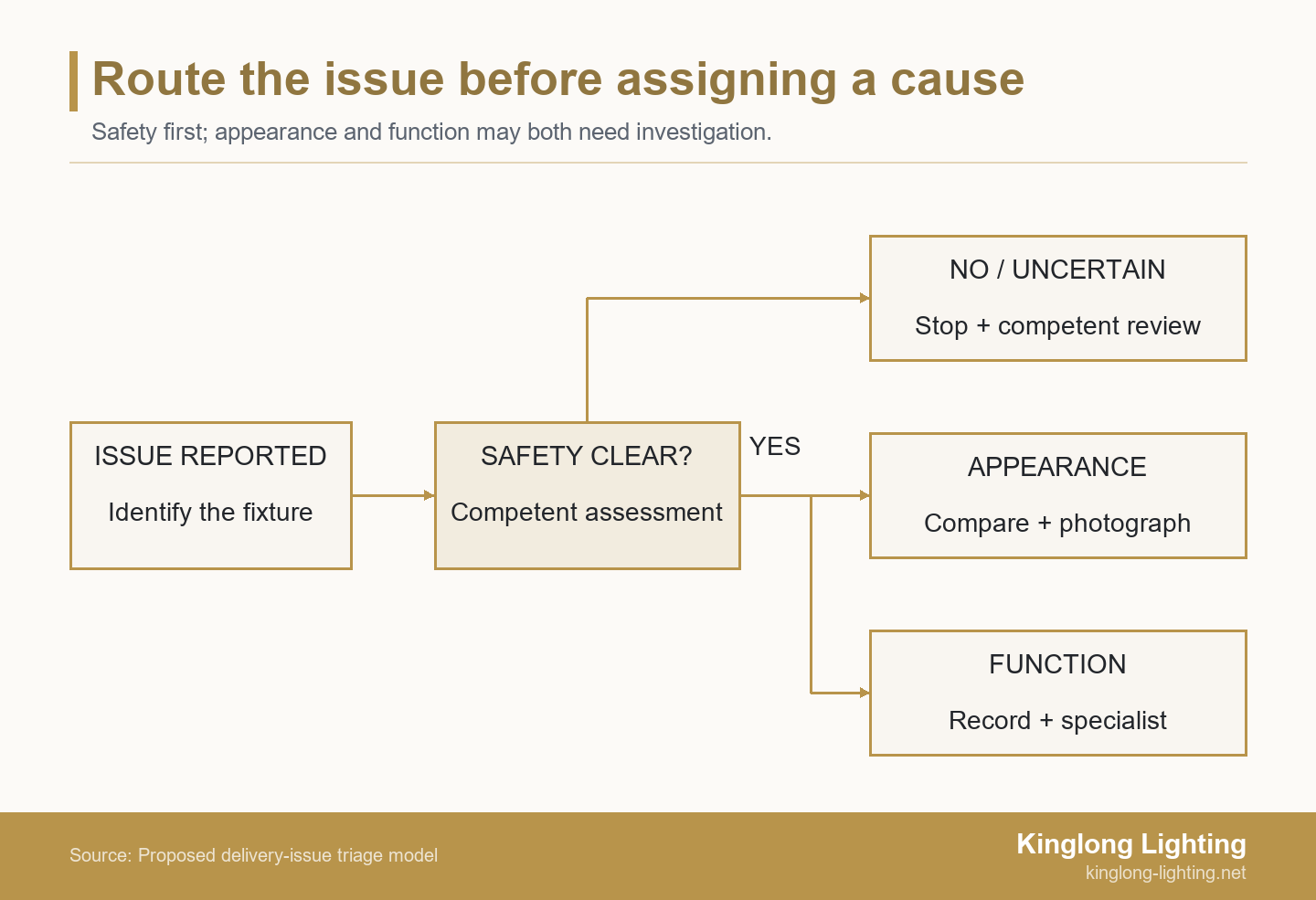
When a delivered decorative light has a problem, first control any safety risk, preserve its condition and record what actually happened. Use appearance and function to describe the symptom; investigate manufacturing, transport, handling and installation as possible causes. An installation-related problem can also be cosmetic or functional, so these are not three mutually exclusive boxes.
For a fit-out contractor or design-and-build procurement lead, the immediate job is to get the right investigation started. A useful report identifies the fixture, the observation and the missing evidence before anyone agrees a repair, replacement or cost allocation.
Separate the Symptom From Its Cause
Decorative lighting defect triage means sorting a reported problem by urgency and the next investigation it needs. In the proposed method here, cosmetic and functional are symptom labels. Installation, handling, transport and manufacture are possible causes, kept provisional until evidence supports a conclusion. Record both kinds of information without making one stand in for the other.
- Screen for safety first. A cracked component or loose assembly may need immediate control even if the light still works.
- Describe the symptom precisely. Write “scratch on the canopy” or “flicker at the recorded dimming scene,” rather than “bad quality.”
- Preserve the timeline. Distinguish receipt, unpacking, assembly, installation, cleaning and first operation.
- Route the question. Ask for evidence that can distinguish the remaining causes, then agree the next action and who checks its result.
A mixed complaint can follow more than one route. The purpose is to make an unresolved issue investigable, not to determine liability from a category name. Use this routing table with the project’s actual instructions and acceptance requirements.
| Observed condition | Immediate route | Evidence to request | Who investigates next |
|---|---|---|---|
| Suspected electrical or mechanical danger | Stop the affected activity; use the site’s safety process | Safe observations, location and incident details | Responsible competent site specialist |
| Finish, color or surface complaint | Preserve the surface; compare with the agreed reference | Location views, close-ups, sample code and handling history | Designated appearance reviewer and supplier |
| Failure to light, flicker or unexpected controls behavior | Refer for an authorized product-and-system assessment | Fixture, driver and control identities; operating conditions | Electrical/controls specialist with supplier input |
| Misalignment, loose parts or incorrect assembly | Assess safety, then compare the installed arrangement | Applicable drawing, assembly reference and installation record | Responsible installer and relevant technical reviewer |
| Several symptoms or missing records | Open linked investigation paths; keep cause unresolved | Separate observations and the specific missing information | Project coordinator assigns each question |
Put Safety Ahead of Fault Classification
Do not start by deciding whether a defect is “only cosmetic.” Broken glass, insecure decorative parts, damaged suspension, exposed conductors, burning signs or unexpected protective-device operation warrant the site’s safety response. Stop affected use or work and keep people clear as appropriate; have authorized competent personnel determine isolation, access and further investigation. Do not keep energizing a suspect fitting to obtain a better video.
The UK Health and Safety Executive, HSE, advises stopping use of apparently faulty equipment and having a competent person check it in its electrical safety guidance. Its UK context should remain clear: the project’s local requirements and competent site personnel govern the actual electrical work. A procurement report is not authorization to open a live fitting or test a circuit.
Record the safety status before the ordinary complaint category: who controlled the area or equipment, which activity is restricted and who may authorize the next step. If the safety assessment is unavailable, mark it as awaiting assessment. A neat photograph or successful previous operation does not answer whether the present assembly is safe.
Once the immediate situation is controlled, use the lighting specification and procurement resources to help reconstruct the technical questions and approved scope. Background guidance supplements the fixture’s own instructions; it does not replace a missing site assessment.
Capture the Condition Before It Changes
Start the issue record with an identifiable fixture and a dated observation. Include its type code, location, order or delivery reference and affected quantity. Separate that quantity from the number delivered or inspected. “Several damaged lights” gives neither the investigator nor the replacement coordinator a reliable scope.
Photograph the overall location, the affected part and its relationship to the assembly. Add a close-up that shows the reported condition, with a scale reference when useful and safely obtainable. Keep original files and distinguish views taken at receipt from those taken after installation. For appearance comparisons, document viewing and lighting conditions instead of relying on a single heavily processed image.
Preserve the shipping evidence too. FedEx’s claims guidance identifies photographs of packaging and damaged contents as supporting documents and asks claimants to retain original packaging and contents until resolution. That is a carrier-specific example of evidence preservation. Check the actual carrier’s process, contract and notice requirements promptly. Applicable deadlines depend on those terms; preserving evidence does not establish that transport caused the damage.
Keep carton labels, internal packing arrangements and receipt exceptions connected to the same fixture record. Note who unpacked, stored, assembled and cleaned the item, with dates where known. An intact carton or a missing receipt photograph leaves a question open; neither should be rewritten as proof of a particular cause.
Then retrieve the applicable approved drawing, finish sample reference, component information and installation instructions. Identify the revision used. If a record is missing, request that exact document rather than a general catalogue. Mark an account based on memory as such, so investigators can distinguish it from a dated inspection or photograph.
Kinglong’s published hospitality process describes construction drawings, physical material samples and final sign-off documentation. These are useful supplier-side reference points. Confirm which records were actually supplied for this project and compare them with site evidence; the service description itself does not establish the cause of a complaint.
Assess Appearance Against the Agreed Reference
An appearance complaint needs a defined comparison. Identify the surface, its approved sample or finish code and the viewing conditions agreed for acceptance. A canopy that looks different under site lighting may need a controlled comparison before anyone can distinguish a genuine mismatch from the effect of the photograph or setting. Do not invent a universal scratch length, color tolerance or viewing distance.
Describe the pattern: a localized mark, repeated marks at similar contact points, a difference across a batch, or a change after handling or cleaning. These observations help form questions. They do not establish when the condition arose. Ask what receipt, packing, handling and installation records can confirm before attributing a scratch to the factory or installer.
Avoid an improvised polishing or cleaning trial while the cause is being investigated. For its own luminaires, Schonbek’s care guidance warns that ammonia-containing packaged cleaning fluids may degrade crystal and the fixture finish. This manufacturer-specific warning illustrates why the actual material instructions matter. It is neither a cleaning recipe for another supplier’s fitting nor evidence that a reported stain was caused by cleaning.
Ask the designated reviewer to state the result against the agreed reference: accepted, requiring correction, or awaiting better evidence. Before a touch-up changes the surface, confirm its permitted method and how the result will be assessed. For cracked glass, loose trim or damaged supporting parts, return to the safety route rather than allowing an appearance decision to clear a mechanical concern.
The decorative-lighting project portfolio provides context for discussing visible assemblies and finishes. Use project-specific samples and records for acceptance; a portfolio photograph cannot prove this delivered fixture’s condition or hidden construction.
Record Functional Symptoms Without Guessing at the Driver
Report what the fixture does and under which conditions. Distinguish no light, intermittent light, flicker, delayed response, an unexpected scene or audible noise. Note when the symptom first appeared, the control setting already in use and whether other fittings on the same system were affected. Record existing observations rather than asking unqualified staff to reproduce a potentially unsafe condition.
A driver is the control gear that supplies suitable power to an LED light source. Identify its exact product and applicable controls arrangement from accessible records or a safe specialist inspection. “The driver is faulty” is a diagnosis, not a substitute for recording the symptom. Keep the luminaire, driver, lamp where applicable, and control identities distinguishable.
A functional symptom can involve the connected system. In Lutron’s Maestro LED+ troubleshooting guidance, incompatibility between a dimmer and an LED bulb is identified as a possible cause of flickering, buzzing or humming when dimmed. That example concerns the specified controls and LED lamps. It does not diagnose an integrated-driver fixture, establish that every flicker is incompatibility, or justify copying its component-substitution steps onto an unrelated installation.
Ask the responsible electrical or controls specialist to define the investigation using the actual instructions and installed system. Useful questions include whether approved and installed product identities agree, whether the recorded configuration applies and what evidence would distinguish a product fault from a control or installation condition. Leave test methods and electrical measurements with the competent specialist.
A working fitting can be a useful comparison only when the relevant product and system conditions are understood. Similar appearance does not establish that its control gear or settings match. If a specialist changes an approved setting or component during an authorized investigation, record the before-and-after identities, the result and any remaining limits on the conclusion.
Check Installation Evidence Alongside Product Evidence
Before calling an issue installation-related, compare the actual assembly and site conditions with the applicable approved instructions. Review mounting, orientation, component positions and interfaces that matter to the symptom. Obtain concealed-condition evidence through the responsible specialist, not an instruction for the procurement lead to dismantle the fitting.
A tilted shade could raise an assembly question, but the investigation may still need to distinguish a misplaced part, a deformed component and the supporting surface. Likewise, a loose connection is an observation requiring qualified assessment; it does not explain by itself when or why it became loose. Ask the installer and supplier targeted questions against the same drawing revision.
Include storage and site exposure in the timeline when relevant. Record what is known about moisture, dust, protection, handling or other trades working nearby, and compare it with the product’s permitted conditions. Do not turn an undocumented possibility into an exclusion of warranty coverage. Where product and site records disagree, state the disagreement and assign the question that would resolve it.
Keep investigation separate from a proposed design change. A different lamp, driver, suspension detail or finish may alter the agreed package even if offered as a quick solution. Use the decorative-lighting value engineering guide to frame review of an alternative. Confirm its technical and appearance consequences through the appointed parties before treating it as an equivalent replacement.
Work Through a Mixed Delivery Complaint
Consider this illustrative example: a contractor reports scratched canopies and flickering pendant lights after installation. No actual client complaint or outcome is being described. The coordinator first obtains a competent safety assessment, then creates separate linked records for the canopy marks and the flicker instead of giving the whole delivery one presumed cause.
For the canopies, the available photographs were taken after installation and do not show receipt condition. The coordinator retains the packing, requests any earlier unpacking views and asks the installer for the handling sequence. The appearance reviewer also needs the approved finish reference. Until those inputs are available, the record says “surface marks, origin unresolved”; it does not say “transport damage” merely because delivery preceded discovery.
For the flicker, an existing commissioning note identifies a particular dimming scene, but the control product reference is missing. The electrical specialist asks for that reference and actual luminaire/driver information before defining a suitable investigation. The missing record changes the next action to document retrieval. It does not justify a procurement instruction to replace every driver.
If later evidence establishes a canopy mismatch and an authorized system assessment identifies a separate controls issue, the project can agree different remedies and checks for the two records. If evidence remains inconclusive, keep the cause open and document the next investigation. The useful result is a specific question, investigator and expected evidence for each symptom, rather than a confident explanation unsupported by the available facts.
Close the Issue With Evidence of the Agreed Remedy
Use a proposed issue-and-closure record to connect the affected fixture, original evidence, agreed action and confirmation result. Technical closure and commercial settlement can progress separately: a repaired fitting may still have an unresolved cost question. Do not erase the original observation when the status changes.
| Record field | Entry to complete for this issue |
|---|---|
| Fixture and scope | Issue ID, location, type/version, delivery reference, affected quantity and quantity checked |
| Safety and symptom | Current restriction; who assessed it; precise appearance/function observation |
| Original condition | Dated photographs, packaging references, discovery stage and relevant handling events |
| Investigation | Working hypotheses, evidence supporting or limiting each, investigator and missing input |
| Agreed remedy | Approved action, responsible party, applicable method and affected component identities |
| Confirmation | Agreed acceptance reference, actual check/result, checker, date and remaining restrictions |
| Commercial follow-up | Notice references, unresolved payment/coverage questions, assigned reviewer and next action |
HSE’s UK work-equipment maintenance guidance recommends a way for workers to report damaged or faulty equipment and the use of manufacturer maintenance instructions. The form above is a proposed lighting coordination tool applying that reporting discipline, not an official HSE form or a prescribed acceptance standard.
Choose confirmation to match the agreed remedy: the applicable appearance comparison for a finish correction, the relevant specialist assessment for functional work, or the responsible installation check for assembly changes. Record what the check actually covers. A successful local correction does not establish that every fitting in the shipment has been inspected.
Where supplied-product information is missing, bring the fixture and order reference, original photographs, symptom timeline and specific drawing or component question to ask Kinglong to clarify the supplied-product records. Request the available reference and clarification of unresolved supplier-side scope. Agree investigation, remedy and commercial responsibility through the actual project arrangements.
Frequently Asked Questions
Does an undamaged carton rule out transport damage?
An undamaged outer carton does not settle the cause; keep the internal packing and the first condition records for review. Record which surfaces were observed and when the item was unpacked. The investigator may need both the packing arrangement and later handling history. Avoid treating an intact carton or the absence of a delivery exception as conclusive evidence for or against a carrier claim.
Can a contractor fit a spare before the supplier responds?
Fit a spare only through the project’s authorized method and record the removed part, replacement identity and original condition first. The responsible specialist should confirm suitability and safe installation; a visually similar component is not enough. Preserve removed parts as required by the investigation or claims process. Document urgent operational needs alongside the decision, rather than allowing them to erase evidence of the initial complaint.
What if the owner wants a different finish instead of a repair?
Treat a requested finish change separately from the reported defect, so the project can distinguish correction from a new preference. Retain the original approved reference and appearance assessment of the delivered item. Record the alternative, its approval and effects on linked parts or schedule. A negotiated change may resolve the practical issue without proving that the original product failed the agreed specification.
Who pays for investigation and replacement after delivery?
The symptom category does not decide who pays; use the agreed contract, warranty and delivery terms alongside the technical findings. Parties may have separate notification and evidence requirements, so have the project’s commercial lead check them promptly. Preserve unresolved allocation in the issue record. This triage method organizes the investigation; it does not create a universal supplier, installer or carrier payment rule.