
Make each confirmation specific enough to act on
A useful custom chandelier approval workflow separates design intent, technical definition, representative samples and manufacturing release. For each decision, record the exact item and version reviewed, the authorized decision-maker, unresolved conditions and the work permitted to proceed. An accepted colour sample, for example, establishes a different decision from authorization to manufacture the complete fixture.
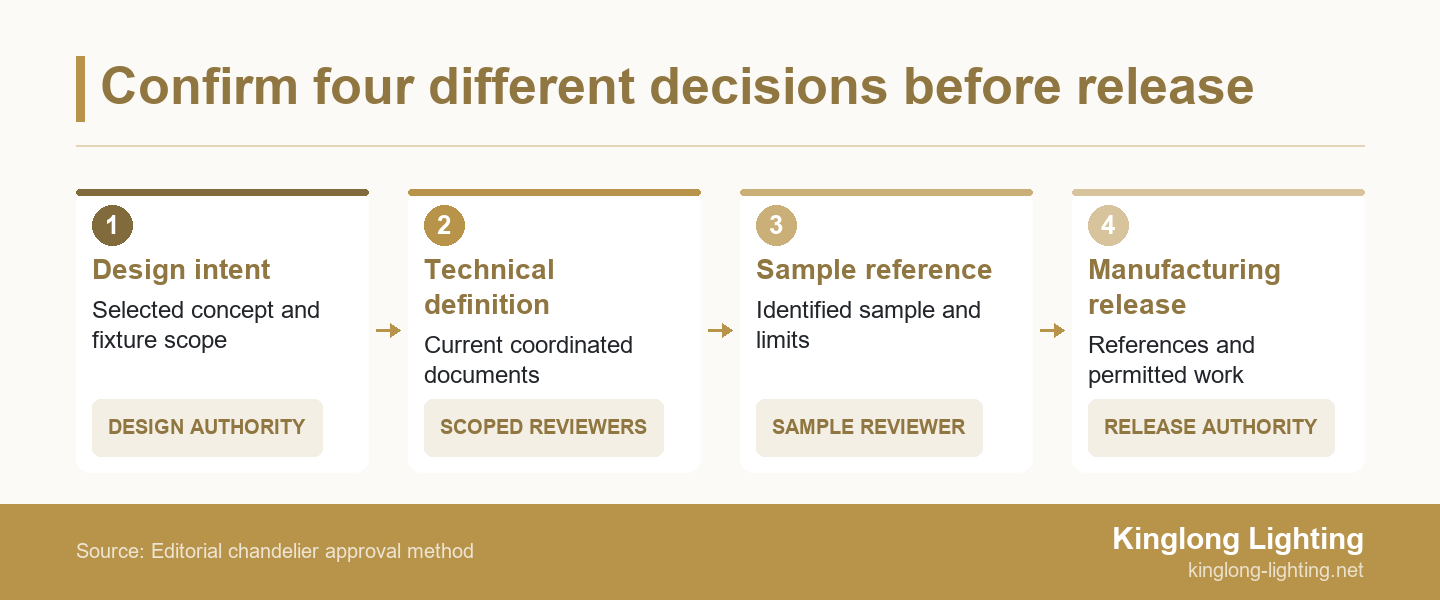
The four stages below are an editorial method for organizing those decisions. Adapt their sequence and responsibilities to the actual project appointments, order and review procedure. A stage can contain several discipline-specific decisions, and a later change can reopen the affected decisions without erasing the history of what was previously confirmed.
- Identify what the decision covers and which drawing, sample or product information defines it.
- Separate the person providing comments from the person authorized to record the relevant decision.
- State the permitted next activity, with open items and changed information kept visible.
This record supports coordination between the buyer, designer, manufacturer and appointed project reviewers. Structural, electrical, installation and other professional reviews remain with the parties appointed for those scopes. The four-stage method does not establish a customer’s existing procedure or create a statutory approval system.
Agree who can decide before sending the first submission
Autodesk’s approval-workflow instructions distinguish initiators, reviewers and approvers and allow those participants to be assigned to workflow steps. Autodesk workflow participant settings
That is an example of a document tool separating participation and response authority. Your project still needs to establish its own decision responsibilities, whether it uses a platform, a register or email. A copied recipient list does not tell the manufacturer which response controls the next activity.
Agree working dispositions such as Accepted for the stated scope, Revision required and Awaiting decision. Use the project’s established terms where they exist. Ask each respondent to identify any conditions and the affected work. When a response is missing, retain the open status and assign a follow-up rather than silently changing the record to accepted.
Stage 1. Confirm the design intent and proposed scope
Confirm the proposed chandelier’s visual direction, intended location, broad outline and included fixture scope. The design decision-maker records the selected concept against identified drawings or visual references. The buyer records the commercial assumptions that accompany that concept, including any alternatives that still need a choice.
Give the manufacturer the current fixture schedule, room references and design information available. Mark proposed dimensions and unresolved site inputs clearly. Separate the selected visual idea from details still under development. For example, accepting an arrangement of decorative elements can allow the manufacturer to develop that arrangement while the final suspension detail remains open.
The output is a dated design-intent record with the chosen option, reference versions, open questions and agreed next action. Identify whether the decision permits proposal development, sample preparation or another defined activity. The person recording it should avoid an unqualified “approved” response when the project has confirmed only a concept.
Use the Kinglong lighting resource library to develop the fixture questions accompanying the submission. Keep the actual project references in the decision record so later reviewers can identify the selected configuration.
Stage 2. Confirm the coordinated technical definition
Review the proposed fixture against a coordinated technical submission. Identify the drawing revisions, fixture construction, dimensions, materials, electrical components, control interface and installation information needed for the project. Assign the relevant questions to the manufacturer and the appointed building-side reviewers.
The manufacturer provides the fixture-side information within its scope. The structural professional reviews the building-side support design, the electrical and controls reviewers assess their interfaces, and the appointed contractor addresses site installation matters. The record should show each relevant decision and any dependency that remains unresolved. A commercial selection does not establish the outcome of those separate professional reviews.
The DALI Alliance states that its database information relates to the specific product tested and links certification validity to matching product identifiers and versions. Its database also distinguishes components from luminaires. DALI Alliance product identity and database scope
Where a DALI component is proposed, retain the relevant identifiers and ask the controls reviewer to assess the actual configuration. A component entry cannot establish every requirement for the finished chandelier. Keep changes to the proposed driver or other relevant version visible instead of carrying forward a decision for a different item.
UL describes Product iQ searches using identifiers including a file number, category control number and model number. UL Product iQ search identifiers
When UL certification is part of the actual project requirement or supplier claim, obtain the relevant identification and evidence for review. The responsible reviewer determines its relevance to the proposed product and use. Do not substitute a company name or an unrelated report for the evidence requested for the fixture package.
Close this stage with the current technical document set and a list of accepted, revised and outstanding items. State what the result allows, such as preparation of a sample against the reviewed configuration. If an unresolved support or controls question prevents a later release, name that restriction in the record.
Stage 3. Confirm the representative sample and its limits
Identify what each sample is intended to establish before requesting a decision. A finish chip can define a selected colour and surface reference. A decorative element can establish its visible form and agreed variation. A complete sample assembly can support additional observations, provided its actual components and trial conditions are recorded.
RAL’s digital colour library instructions describe screen illustrations as approximate and ask users to use a physical colour sample for final colour decisions. RAL digital and physical colour references
For the chandelier proposal, agree the actual sample used to decide colour, sheen, texture or other appearance characteristics. A colour reference alone does not define every surface characteristic. Record the sample identifier, material and finish description, associated drawing revision, reviewer and decision. Identify who retains the reference and how production or a replacement will be compared with it.
Where operation is being reviewed, record the source, driver, control equipment and conditions used in the trial. Keep appearance acceptance separate from any pending technical or operating question. Ask whether a sample represents every ordered variant, and list the differences that require their own confirmation.
A collection such as Kinglong’s Ice Flower series can communicate a starting visual direction. The approval record still needs the identified project sample and selected variant, together with the actual characteristics the reviewer has accepted.
Stage 4. Authorize a defined manufacturing scope
The manufacturing-release decision brings the accepted references together for a specified activity. The authorized party identifies the order, quantities or fixture variants, current drawings, sample references, relevant technical decisions and any remaining restrictions. The manufacturer acknowledges the document set and the work covered by that authorization.
Reconcile discrepancies before releasing the affected work. For example, the order’s finish description, drawing note and retained sample should identify the same selected finish. If the references conflict, assign a correction and obtain the decision needed to establish the current instruction. Avoid leaving the production team to choose between inconsistent documents.
A partial release needs an explicit boundary. Identify the permitted activity and excluded work, the assumptions it depends on and the person who authorized it. The project’s commercial and technical decision-makers should assess the consequences of that choice. An open item remains open until the relevant reviewer records its disposition.
Copy this chandelier confirmation record
Use one record for each decision or clearly defined group of decisions. Enter the references that the respondent actually reviewed, including revisions and sample identifiers. Preserve the original decision when later information changes it, then link the new decision to the affected earlier record.
| Record field | Project entry |
|---|---|
| Decision identity | [Record ID / fixture or variant / stage / object being confirmed] |
| Evidence reviewed | [Order or submission reference / drawing revision / sample ID / product or trial information] |
| Decision authority | [Named respondent / appointed role / scope of this decision] |
| Disposition and conditions | [Accepted for stated scope, Revision required or Awaiting decision / exact conditions] |
| Permitted activity | [Work that may proceed / excluded work / dependencies] |
| Open item and follow-up | [Question / responsible party / agreed next action and response date] |
| Change and history | [Related change request / earlier decision affected / retained or superseded references] |
| Confirmation and acknowledgement | [Decision-maker and date / manufacturer acknowledgement / distribution reference] |
For a returned submission, identify the revised evidence needed to close the question. For an accepted item, state the scope precisely enough that the receiving party can perform the permitted activity. Keep comments that do not constitute a decision visible without converting them into release authority.
Use Kinglong’s published project portfolio to discuss the kind of decorative fixture being considered. Obtain the current project’s release documents and agreed manufacturing scope separately.
Reopen the decisions affected by a change
Record a proposed change before treating it as the current instruction. Identify the old and proposed details, the affected fixture variants, the reason for the request and any commercial or programme implications that need a decision. Ask the relevant reviewers which earlier confirmations the change affects.
Autodesk’s submittal-processing documentation provides a Create new revision action for generating a new version of a submittal item. Autodesk submittal revision function
For this approval record, retain the old reference and connect the replacement submission to the change request. The record should show which decisions remain valid and which need another response. A revised drawing number by itself does not explain whether the reviewer accepted its changed content.
Ask the manufacturer to identify the work affected and the point at which the new instruction can be implemented. Record any authorized hold or partial continuation through the project’s agreed procedure. After the necessary reviews, issue an updated release identifying the accepted revisions and any continuing restrictions.
Walk through a finish change after sample acceptance
In this fictional example, the designer has accepted a chandelier’s general form at Stage 1, the relevant technical submission has been reviewed at Stage 2, and finish sample F01 has been accepted at Stage 3. Before the proposed manufacturing release, the buyer requests a darker finish. The request identifies a new decision to make, with the existing accepted sample retained as part of the history.
| Fictional record | Decision and evidence | Effect on progression |
|---|---|---|
| Change request FIN-01 | Buyer requests a darker finish. Drawing and new physical reference remain pending. | The new finish has no release authorization. Record the affected finishing work and obtain the relevant responses. |
| Updated design and technical review | Design respondent confirms the new direction. Assigned reviewers assess the revised finish notes and identify any affected interfaces. | Record which earlier decisions remain valid and which require revised evidence. |
| New sample F02 and drawing revision C | Appearance decision-maker accepts F02. Relevant reviewers confirm the current document references for their scopes. | Replace the active finish reference with F02 and retain F01 in the decision history. |
| Updated release REL-02 | Authorized party identifies revision C, sample F02, included variants and remaining restrictions. | Manufacturer acknowledges the current scope before proceeding with the authorized work. |
If F02 is rejected, keep the finish decision open and request another sample or a revised proposal. A statement that the new colour is “closer” to the brief does not establish the accepted production reference. If the change also affects a technical interface, include that review in the open items instead of treating a visual decision as its technical confirmation.
The record can retain an unchanged general form while updating the finish-related decisions and release. Any continued work on an unaffected item still needs the project’s stated authorization and a clear boundary. The example shows how to preserve earlier decisions without allowing their scope to expand silently.
Send the manufacturer a traceable decision package
Kinglong Lighting supplies custom decorative lighting for project buyers. Share the fixture schedule, current drawings, design references, destination, decision contacts and open questions through its custom lighting manufacturing service page to discuss the proposed fixture and manufacturing scope.
Ask for a response against the identified submission and mark any proposed substitution or assumption. Keep the accepted sample references, technical replies and release record available to the people carrying out the next activity. A clear package lets the buyer and manufacturer identify the current instruction and the questions still awaiting a decision.
Custom chandelier approval questions
Can a sample be accepted before all technical questions are closed?
A project can record a defined appearance decision while technical questions remain open, provided the sample and its limits are identified. State which observations were accepted and which activities remain restricted. Have the authorized project parties determine any permitted next work under the actual order and review procedure.
Does one person’s approval cover every discipline?
The scope follows that person’s actual appointment or delegated authority. Identify the required design, technical, commercial and release decisions separately, even if one person holds more than one role. Record unresolved discipline-specific questions with their assigned reviewers instead of assuming that a general response covers them.
How long should each approval stage take?
Agree the response dates against the actual submission, project programme and availability of the relevant reviewers. Track missing inputs and revisions because they can change the next decision date. Ask the supplier to confirm any consequence for the manufacturing programme rather than assigning a universal duration to all four stages.