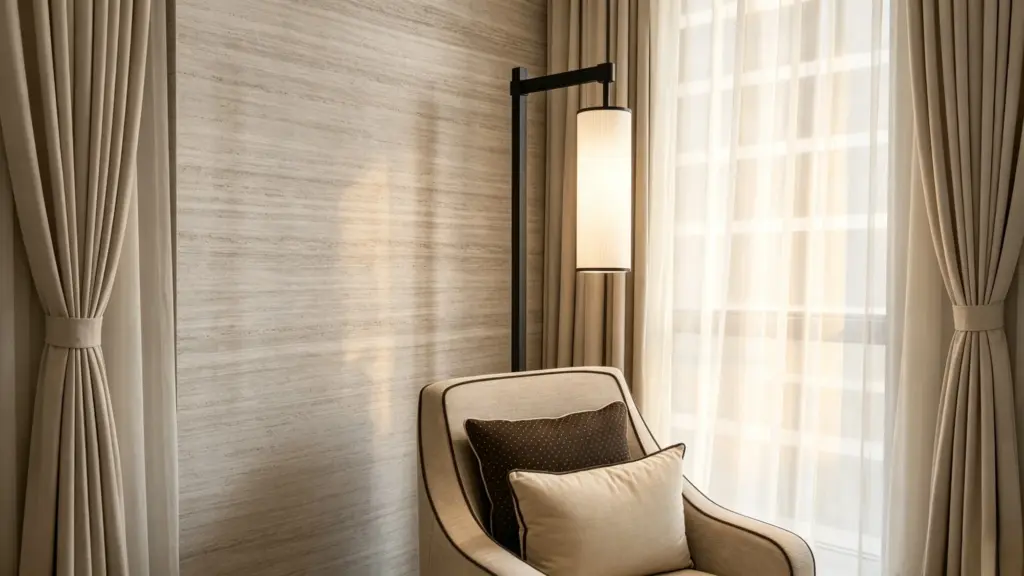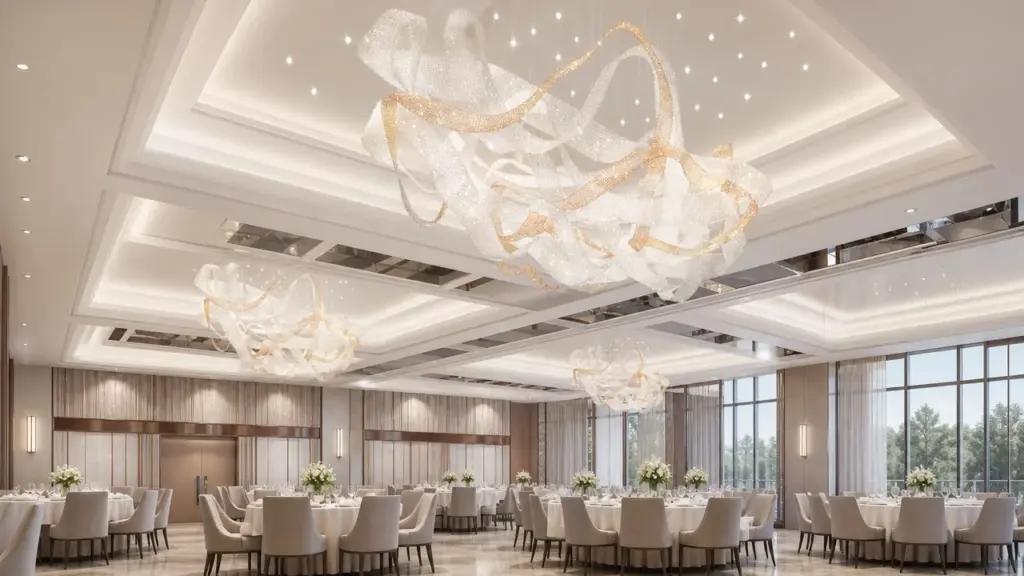
Ballroom layered lighting fails when ambient, decorative, and accent layers are specified as fixture types instead of scene responsibilities. A chandelier is not automatically the decorative layer, downlights are not automatically the ambient layer, and wall washers are not automatically the accent layer. Each layer has a job: base visibility, hotel identity, focal hierarchy, event flexibility, guest comfort, and operations support.
Based on our analysis of a divisible 900 m2 ballroom with gala, conference, wedding, and service scenes, the safest design brief keeps at least three independently controllable responsibilities: ambient coverage for safe movement and table visibility, decorative light for brand centerpiece and ceiling identity, and accent light for stage, wall, floral, or architectural focus. The point is not a fixed wattage ratio. The point is to prevent one layer from carrying every scene.
Key Takeaways
- Layer by responsibility: Ambient, decorative, and accent layers should be defined by job, not fixture label.
- Ballrooms need scene logic: Gala, wedding, conference, banquet, cleanup, and divisible-room modes need different priorities.
- Decorative light is not task light: Chandeliers create identity, but they should not be forced to solve every visibility problem.
- Controls are part of the standard: Layered design fails if zones cannot dim or switch independently.
- Procurement proof: Ask for scene schedule, dimming protocol, chandelier load, maintenance access, and mockup evidence.
Define layers by scene responsibility
The standard is not “three fixture types”; the standard is three lighting responsibilities that remain controllable during events.
Ambient lighting gives the ballroom a usable base. It supports guest movement, table service, cleaning, setup, and non-dramatic conference scenes. Decorative lighting gives the room identity. It is the chandelier, ceiling feature, pendant cluster, or custom sculpture that guests photograph and remember. Accent lighting gives hierarchy. It directs attention to stage, floral, walls, artwork, head table, buffet, or architectural rhythm. When these responsibilities are confused, the room becomes either flat, glaring, or difficult to operate.
The IES Lighting Library is useful because it frames lighting through visual performance, controls, maintenance, and design application rather than fixture count. For hotel ballrooms, the so what is clear: the lighting schedule should be organized around scenes and user tasks before the decorative chandelier is finalized.
Ambient is the fallback layer
Ambient light is the layer that keeps the room usable when the event concept changes. It should support guest circulation, banquet service, registration, conference note-taking, setup, cleaning, and divisible-room operation. It should be dimmable because gala and wedding scenes may need lower base levels, while conference and service scenes need higher visibility. If ambient light is too weak, the chandelier is forced to do task work. If ambient light is too strong or poorly shielded, the room loses drama and may create glare on stage or at dining tables. A separate service scene is useful because cleaning crews need visibility that guests should never see during a gala.
Decorative is the identity layer
Decorative lighting is the memorable layer, but it should not be overloaded. A ballroom chandelier can define luxury, ceiling scale, camera angle, and brand story. It can also create maintenance, load, glare, and dimming challenges if it is treated as the main light source. Kinglong Lighting’s hospitality lighting scope is relevant because custom ballroom chandeliers require design intent, engineering, production, packing, installation guidance, and future service to work as one system. The chandelier should be specified with weight, suspension, dimming, cleaning, and module evidence, not only a rendering.
Accent is the focus layer
Accent lighting gives the ballroom a visual hierarchy that changes by event. A wedding may need floral and head-table emphasis. A gala may need stage and wall drama. A conference may need speaker visibility and lower audience glare. A banquet may need table presentation without flattening the room. Accent circuits should therefore be documented by event use, not only by fixture location. Without that control logic, the ballroom can look premium in one scene and awkward in another. The accent schedule should name the focal surfaces and the scenes where each surface is active.
Use standards as boundaries, not as a one-size scene recipe
Standards protect performance boundaries, but the ballroom still needs a scene brief.
ASHRAE’s Standard 90.1, developed with IES, gives energy and control context for buildings. The U.S. DOE Building Energy Codes Program is another useful reference for energy-code thinking. The practical lesson is that ballroom lighting should not be specified as a single always-on decorative load. Layers need controls, dimming behavior, and zoning logic that respond to event use while respecting project energy and code requirements.
WELL’s Light concept also matters because ballrooms are human-experience spaces. Guests sit, dine, listen, photograph, dance, and move through changing light levels. Visual comfort cannot be solved at the fixture catalog level. It must be checked through scenes: gala entrance, seated dinner, speech, performance, conference, cleaning, and room turnover.
Build a ballroom scene matrix before the fixture schedule
| Scene | Ambient responsibility | Decorative responsibility | Accent responsibility | Control proof |
|---|---|---|---|---|
| Gala dinner | Low base visibility | Warm centerpiece | Stage and floral focus | Independent dimming scenes |
| Conference | Higher table visibility | Reduced sparkle | Speaker and wall focus | AV-compatible control |
| Wedding | Soft guest comfort | Camera-friendly identity | Head table and aisle | Photo and video review |
| Cleaning/setup | High even visibility | Service-safe level | Minimal | Separate service scene |
DOE’s TM-30 FAQ and IES’s TM-30 position also have a place in ballroom specification because food, florals, skin tone, fabrics, and finishes change under different sources. The so what is not to overload the chandelier specification with every color metric. It is to make sure the decorative and accent layers do not make premium materials look wrong when dimmed.
Map layer failures as scene risk
The most expensive ballroom lighting problem is a scene that cannot be created after the fixtures are already installed.
Flat gala scenes usually appear when ambient light dominates and decorative/accent layers cannot create hierarchy. Stage glare appears when downlights or chandeliers are aimed without speaker positions in mind. Weak centerpiece effect appears when the chandelier is scaled as a fixture but not integrated into ceiling brightness, table layout, and camera angles. Control overlap appears when ambient, decorative, and accent loads are wired together because the fixture schedule was approved before the scene matrix.
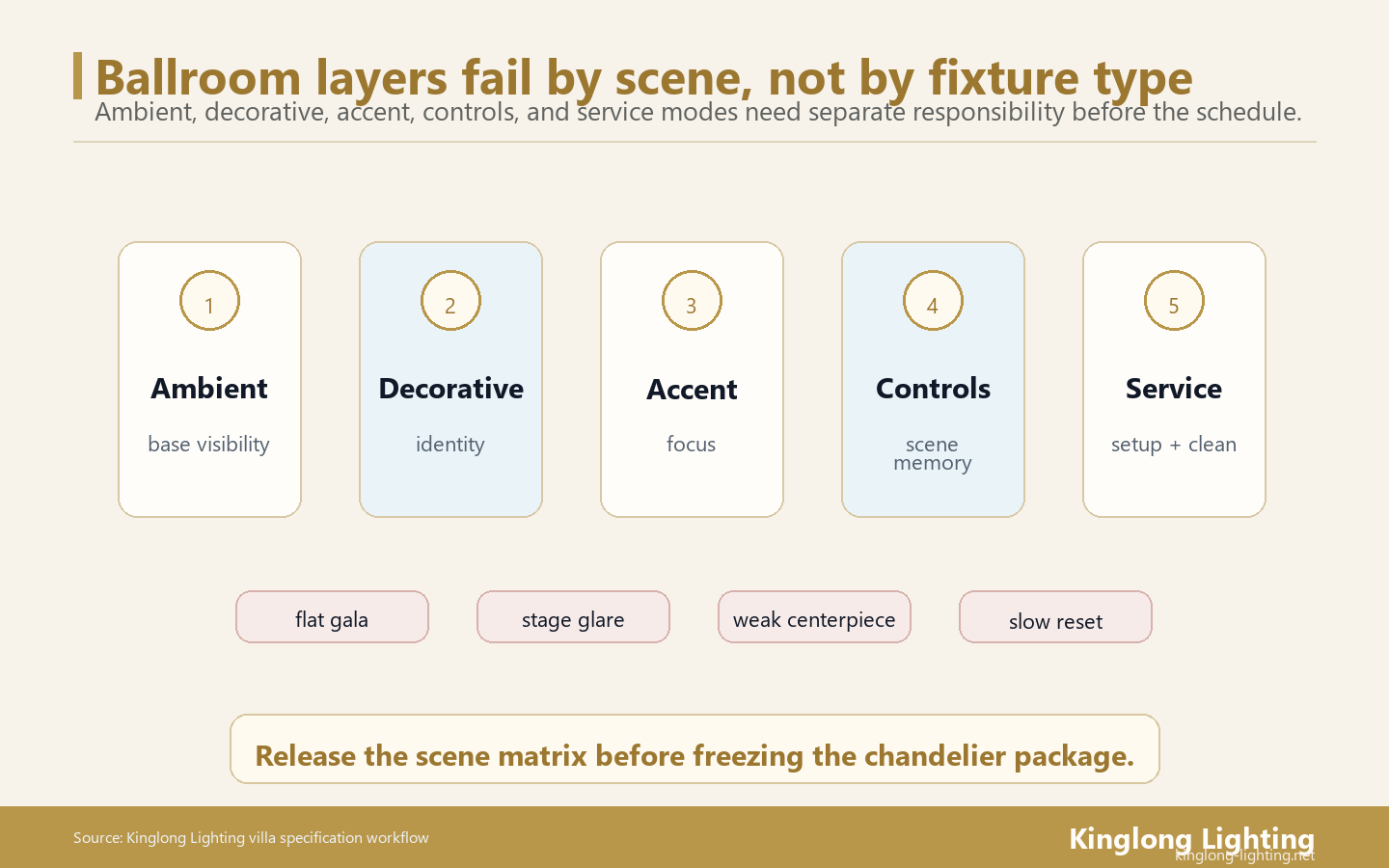
The risk heatmap is useful because it turns aesthetic disagreement into control evidence. If the gala scene is flat, ask which layer is carrying contrast. If the stage is uncomfortable, ask which fixtures create vertical or direct glare. If the centerpiece is weak, ask whether the chandelier is under-scaled, over-dimmed, or competing with ambient brightness. These questions should be resolved before fixture quantities and circuiting are frozen.
Connect layered design to Kinglong’s custom ballroom delivery
Kinglong Lighting’s custom lighting manufacturing process should receive a scene brief, not only an inspirational chandelier image. The useful input package includes ballroom dimensions, ceiling plan, divisible-wall layout, event types, target CCT, dimming protocol, decorative fixture concept, maintenance access, and control-zone expectations. When those inputs arrive early, chandelier design can align with ambient and accent layers instead of fighting them later.
If the ballroom is already in schematic design, the next step is to send Kinglong Lighting the reflected ceiling plan, section, fixture concept, scene list, control intent, and procurement deadline. The team can then review whether the decorative chandelier should be a central statement, repeated modules, a perimeter rhythm, or a hybrid system that leaves enough room for ambient and accent layers to do their jobs.
The review should also separate what belongs to the chandelier supplier from what belongs to the lighting designer, electrical engineer, AV consultant, and hotel operations team. Kinglong Lighting can support decorative fixture design and custom production, but the final ballroom standard still needs project-level coordination for control schedules, emergency requirements, dimming compatibility, ceiling services, and local approval. That ownership split keeps the decorative layer ambitious without making it responsible for every technical layer in the room during events.
Related Guides
- Ballroom Chandelier Specification Guide
- Hotel Lobby Color Temperature Standards
- Hotel Lighting Procurement Framework
Layered Design Action Card
- List ballroom scenes before choosing decorative fixtures.
- Assign ambient, decorative, and accent responsibilities.
- Separate control zones before the fixture schedule freezes.
- Check glare, color, maintenance, and AV constraints.
- Send the scene matrix through the ballroom lighting design inquiry.
A ballroom scene file should assign responsibility before fixture approval
Layered ballroom lighting fails when every fixture is expected to do every job. Ambient light should carry base visibility, decorative light should carry identity, accent light should support focus, controls should preserve scenes, and service modes should help the hotel reset the room. A chandelier can be central to the room, but it should not be forced to solve banquet service, speaker comfort, stage glare, emergency cleaning, and gala drama alone.
Write scene responsibility into the schedule
The fixture schedule should state which layer carries each scene responsibility. A conference scene may need stronger vertical comfort and low glare for presenters. A gala scene may need decorative sparkle without flattening table lighting. A wedding scene may need warm, photograph-friendly faces and flexible dimming. These are not just control presets; they are responsibilities that affect fixture position, optical shielding, finish, driver selection, and dimming behavior.
Use failure modes to test the matrix
The strongest test is to ask how each scene can fail. If a gala scene is flat, the decorative and accent layers are not creating enough hierarchy. If a stage scene is harsh, the ambient or decorative layer may be aimed into speaker sightlines. If cleaning takes too long, the service mode and access plan may be missing. Mapping those failures before production helps the owner approve a scene matrix, not just an attractive chandelier render.
Make controls part of the manufacturing brief
Controls are often treated as a separate consultant package, but custom chandeliers still need driver, channel, wiring, dimming, and maintenance assumptions. Kinglong Lighting should receive the intended scene matrix before decorative production release. That allows the factory team to confirm whether the chandelier package supports the lighting designer’s layers and whether any visual choice creates a control or service problem.
Call out divisible-room and AV exceptions
Ballrooms rarely behave as one room all the time. Air walls, stages, projection screens, camera positions, temporary backdrops, and AV rigs can all change which lighting layer carries the scene. The coordination file should mark these exceptions before the decorative package is frozen. A chandelier or ceiling feature that works in full ballroom mode may conflict with a half-room meeting, a keynote stage, or a wedding head table. Naming those exceptions lets the controls consultant, interior designer, operator, and supplier decide where the standard scene matrix needs a special rule.
Before final approval, send the scene matrix, reflected ceiling plan, event types, divisible-wall layout, CCT targets, dimming protocol, and service access expectations. The useful supplier answer is not only a price; it is a confirmation of which layer each custom element can realistically support.
The file should also name the service and setup scene. Hotel teams often need a bright, practical mode for cleaning, table changeover, banquet setup, and technical rehearsal. If that scene is not planned, staff may override carefully tuned event scenes or use portable work lights that create their own risks. A service scene protects the decorative intent by giving operations a legitimate mode for work that guests rarely see.
That same service scene should be tested against decorative dimming limits. Some chandelier drivers behave cleanly at event levels but flicker or step awkwardly at very low levels. Others work well for gala scenes but do not give enough practical light for setup. Testing the service range early prevents a controls problem from being discovered during the first banquet turnover.
Frequently Asked Questions
What are the three main ballroom lighting layers?
The three practical layers are ambient for base visibility, decorative for room identity, and accent for focus. The exact fixture types can vary, but the responsibilities should stay clear.
Can a chandelier provide the main ballroom lighting?
It can contribute, but it should not be forced to solve every task. A chandelier is usually strongest as the decorative identity layer, while ambient and accent systems handle visibility, scene flexibility, and focus.
What should be approved before ballroom lighting procurement?
Approve the scene matrix, control zones, dimming protocol, chandelier concept, maintenance access, glare review, color-quality expectations, and installation responsibility before fixture schedules are frozen.