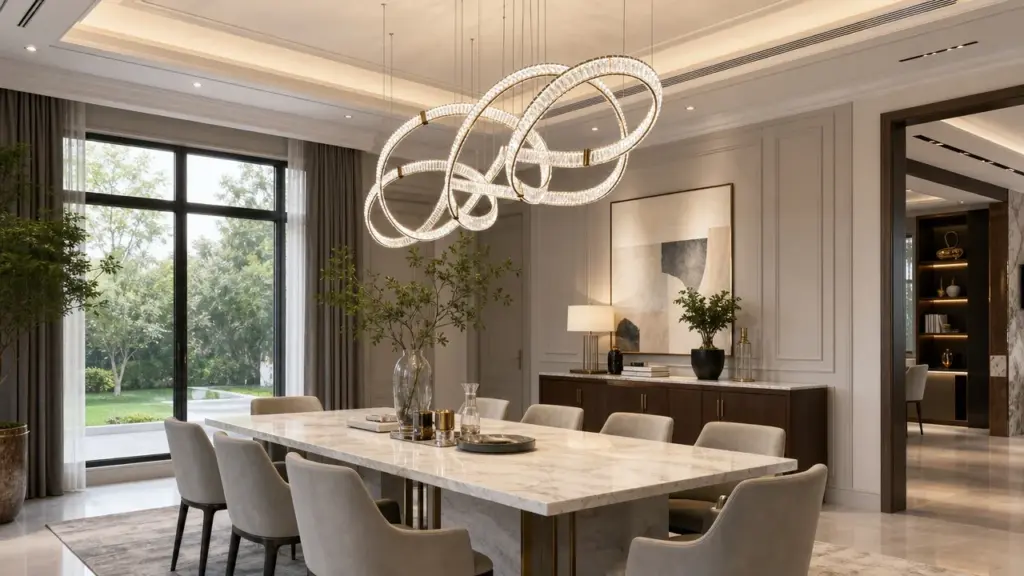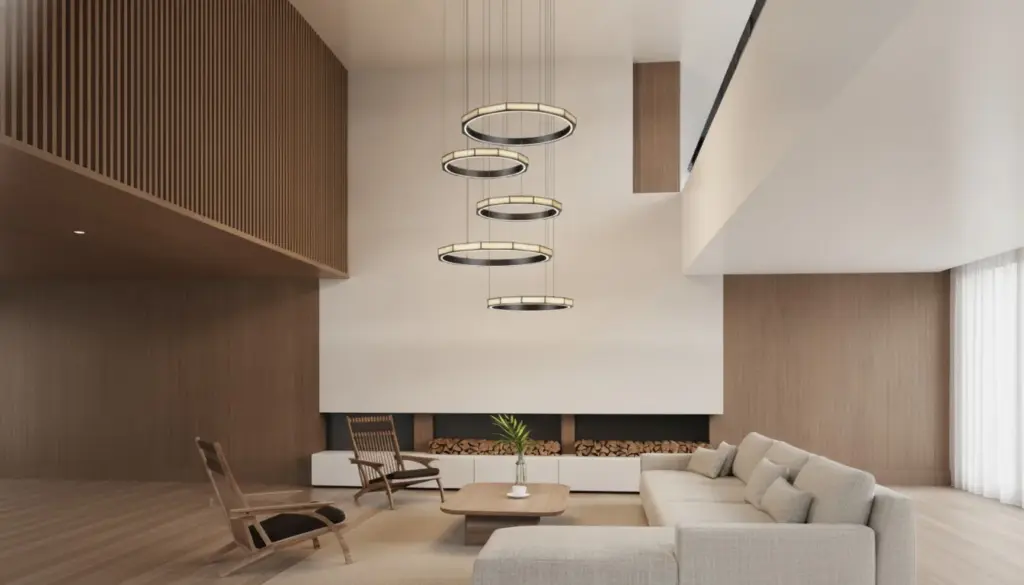
A penthouse chandelier is an engineered suspended system before it is a luxury object, because wind movement, building vibration, ceiling structure, access, and commissioning can all affect how the fixture behaves after installation.
The design may be indoors, but high elevation changes the coordination problem. Large glass walls, roof terraces, tall atria, mechanical systems, elevators, and structural transfer points can make a chandelier move, rattle, reflect, or become difficult to service.
Kinglong Lighting can support penthouse projects by turning the chandelier concept into a suspension handoff package for the designer, structural engineer, control team, installer, and owner.
Key Takeaways
- Treat it as a system: A penthouse chandelier needs structure, suspension, damping, access, and controls.
- Do not calculate casually: Wind and structural loads belong with qualified project engineers.
- Vibration is practical: Movement can cause noise, contact, chipped parts, and owner dissatisfaction.
- Access matters early: High ceilings and finished interiors make late service planning expensive.
- Handoff prevents drift: Design, engineering, factory, and installer notes must align before release.
A penthouse chandelier is not a normal ceiling fixture
The higher the room, the more the chandelier specification becomes a handoff problem.
The ASCE 7 standard page is a reminder that wind and structural loads are professional engineering topics, not decorative guesses. A chandelier manufacturer should not replace local structural design, but the chandelier brief must give engineers the information they need.
FEMA ASCE 7-22 wind highlights reinforces the broader point that wind provisions are code-coordination issues. For a penthouse chandelier, the practical translation is to involve the structural team before the fixture weight, suspension points, and ceiling support assumptions are frozen.
The chandelier may not be exposed directly to wind, but the penthouse environment can still create movement. High-level glazing, terrace doors, mechanical vibration, elevator cores, and long-span ceilings all belong in the coordination conversation.
Wind creates comfort questions even indoors
A penthouse with operable terrace doors, large glazing, or tall interior volume can experience air movement that a lower apartment does not. The chandelier may sway slightly, decorative pieces may touch, or reflections may shift enough for the owner to notice. The issue is not only safety; it is whether the fixture feels solid, quiet, and intentional in a premium space. The brief should mark ventilation paths, terrace openings, and expected room use before finalizing drop and spacing.
Vibration travels through structure and services
Vibration can come from elevators, roof equipment, HVAC systems, building sway, or ceiling assemblies. A small movement may be harmless for a rigid pendant but unacceptable for a chandelier with many glass or crystal elements. The specification should ask where vibration could enter the suspension path and whether spacing, connectors, damping, or modular design can prevent audible contact or visible tremor.
Assign engineering proof before visual release
A penthouse chandelier should not move from rendering to production until the load path is named. The release file should connect fixture weight, suspension points, canopy detail, ceiling backing, access panel, module size, driver location, and installation method.
Calculated from an 80-piece decorative element example, if only 5 percent of hanging pieces can contact under movement, four contact points are enough to create noise, chipping, or visible anxiety. That illustrative estimate is not a structural calculation; it is a reason to check spacing and vibration before approval.
| Handoff item | Who must answer | Failure signal | Release proof |
|---|---|---|---|
| Fixture weight | manufacturer + engineer | ceiling point changes late | weight and load path note |
| Suspension points | engineer + installer | canopy hides weak support | anchor layout and backing |
| Vibration spacing | manufacturer + designer | glass or crystal contact | movement clearance check |
| Driver access | control team + installer | service requires ceiling repair | access location note |
| Installation route | installer + factory | module cannot enter room | module and packing plan |
The UL indoor and decorative lighting page and ANSI UL 1598 page are useful because decorative lighting still needs product evidence. A penthouse chandelier brief should keep safety documentation, support assumptions, and component access visible to the team.
The Lutron control guidance matters because commissioning can expose movement and glare. A fixture that is visually correct at full output may reveal reflection, flicker, or service limitations during the final scenes.
Suspension design should reduce movement, noise, and service risk
Suspension is not only a strength decision. It is also a comfort decision. Cable count, rod stiffness, connector type, decorative spacing, canopy design, and module segmentation all influence whether the chandelier feels calm in a penthouse room.
For crystal and glass clusters, spacing should assume small real-world movement rather than a perfect static render. For long linear fixtures, torsion and twist should be discussed. For large sculptural bodies, the installation route and future service path should be checked before the final shape becomes too large to manage.
A good penthouse specification also separates engineering responsibility. The manufacturer can provide fixture weight, component layout, and suspension interface. The project engineer verifies building support. The installer confirms access and anchoring. The owner approves the service implications.
That division should also name what is not being approved. A designer can approve the silhouette, but not the building support. A manufacturer can confirm component weight, but not the penthouse slab or backing detail. When those boundaries are written down, the final chandelier can stay visually ambitious without asking one party to quietly absorb another party’s engineering risk.
The same boundary protects later service. If a driver location, access panel, or lowering method is not named until after ceiling closure, the chandelier may be technically installed but practically unserviceable. A penthouse owner usually experiences that as a luxury failure, not as a coordination footnote. The handoff should make service access part of the release decision.
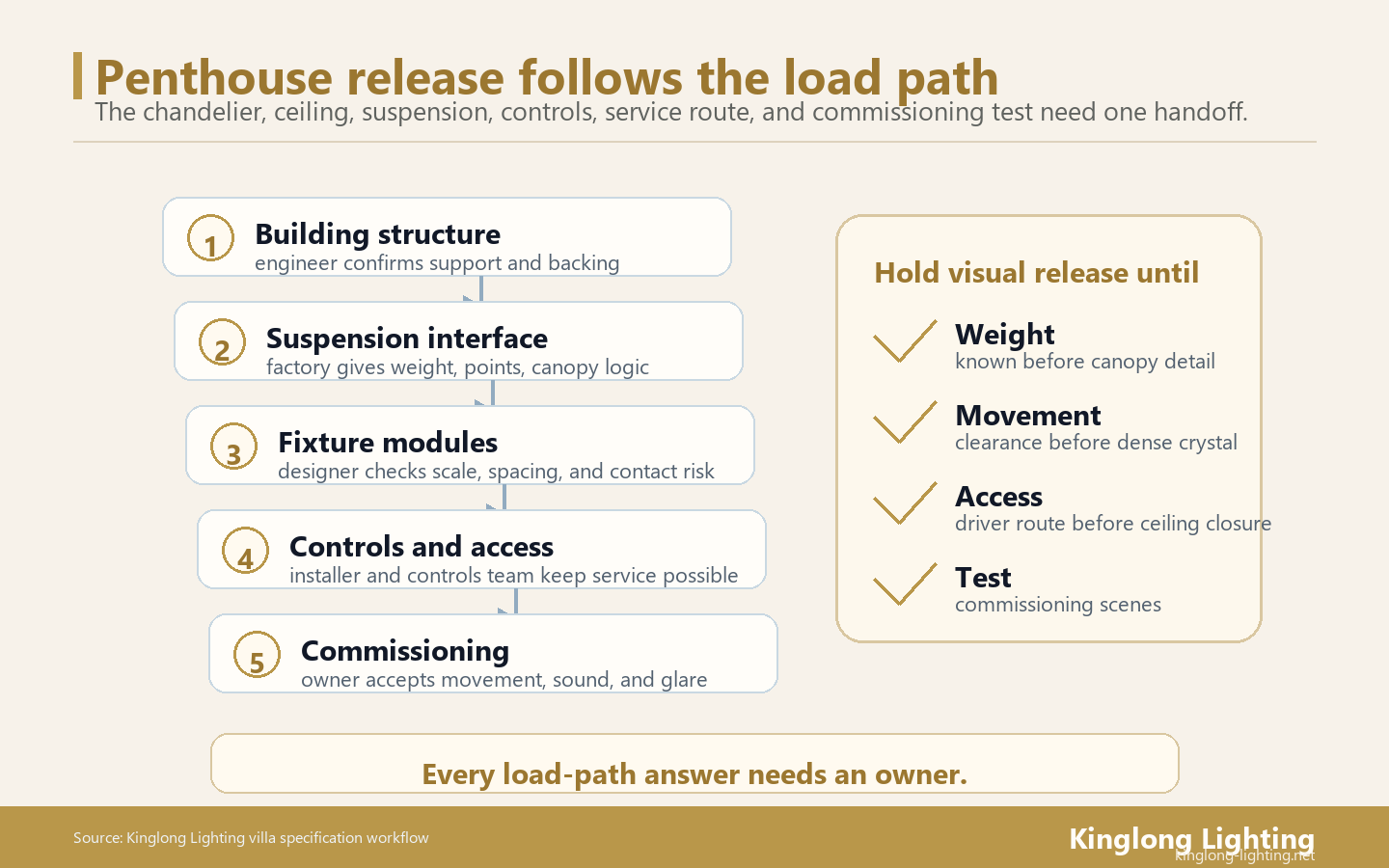
How Kinglong Lighting can support the suspension handoff
Kinglong Lighting’s customization workflow can convert the chandelier concept into drawings, module planning, finish proof, and suspension information that the project team can review. The Mofun Design Platform can also help test visual scale before the engineering package is frozen.
The next step is to send ceiling drawings, room height, terrace conditions, HVAC or elevator adjacency, desired fixture size, material density, and access constraints through the project inquiry page. Ask Kinglong Lighting for a suspension handoff sheet that the structural engineer and installer can actually use.
Write a penthouse suspension handoff sheet
The handoff sheet should be one of the first deliverables, not an afterthought attached to a beautiful rendering. It makes the project safer, but it also protects the aesthetic because fewer engineering decisions have to be improvised after the owner approves the design.
A practical sheet should be written in the language of decisions: what is known, who owns the next answer, what proof is required, and what design change follows if the answer fails.
It should also distinguish design preference from field constraint. A longer drop may be more dramatic, but it may increase movement. A denser glass cluster may look richer, but it may reduce clearance. A hidden driver may look cleaner, but it may make service harder. The handoff sheet should make those tradeoffs visible before anyone treats the render as final approval.
Name the load path before naming the final canopy
The canopy can hide complexity, but it should not hide uncertainty. The handoff sheet should name expected fixture weight, suspension points, mounting interface, ceiling backing assumption, and whether the support is central, multi-point, or distributed. If the ceiling cannot support the desired form, the team should change weight, module count, or suspension strategy before finishing the decorative detailing.
Name the movement tolerance before spacing decorative parts
Crystal drops, glass pieces, metal leaves, and sculptural elements need a clearance assumption. The handoff sheet should state whether parts are allowed to move independently, whether contact is acceptable, and where damping or spacing is required. The goal is to prevent a quiet luxury room from developing small sounds, chips, or visual shake that the owner experiences every day.
Name the service route before closing the ceiling
Drivers, connectors, suspension hardware, and replaceable decorative components should be serviceable without turning maintenance into demolition. The handoff sheet should show where access occurs, what equipment is needed, and which components require spare parts. This is especially important in penthouses where lifts, furniture protection, and building rules can make service scheduling harder than in a normal house.
Name the commissioning test before owner handover
Commissioning should verify more than illumination. The team should observe the chandelier under approved scenes, near terrace-door operation, at low dimming, and from the main seating or dining positions. The handoff sheet should define pass and fail signals: no visible flicker, no excessive movement, no contact noise, no distracting reflections, and no access issue left unresolved.
Test the chandelier as a moving object before release
Penthouse projects should avoid the assumption that a chandelier will behave like a static render. Even small movement can matter when the fixture has long drops, close crystal spacing, polished metal, or a sightline from a quiet seating area.
The practical test is not a substitute for engineering. It is a design-and-manufacturing check that asks whether the fixture can tolerate the real room’s movement, access route, and commissioning behavior without becoming noisy, nervous, or hard to service.
Use a 4-point observation plan during mock-up or commissioning: terrace-door condition, HVAC condition, low dimming, and seated viewpoint. If movement or noise appears in any 1 of those 4 checks, the issue should be assigned before owner handover.
Check room air movement before finalizing drop length
A penthouse room may experience air movement from terrace doors, stack effect, HVAC supply, or pressure changes between rooms. The chandelier drop and piece spacing should be reviewed with those conditions in mind. Longer drops and lighter components can look elegant but may move more visibly. If the room is active, the design may need shorter modules, heavier lower elements, wider clearances, or a different suspension rhythm.
Check module size against elevator and lift logistics
A penthouse chandelier can fail the schedule before installation if the modules do not fit the building path. The project should check elevator size, stair route, service lift, corridor turns, doorway dimensions, and room protection before production packaging is frozen. This logistics check belongs with engineering because a design that ships in impossible modules will force site improvisation, added handling, and higher damage risk.
Check damping and spacing before approving fragile density
Dense glass or crystal can be beautiful in a still mock-up and irritating in a moving environment. The team should review whether decorative parts can touch, twist, or transmit sound. Damping, connector choice, spacing, and module grouping should be discussed before the owner approves density. If the design needs close spacing for visual richness, the release file should explain why contact risk is controlled.
Check the finished room under commissioning conditions
The final commissioning check should include the approved evening scene, cleaning scene, low dimming, terrace-door condition if relevant, and the main seated viewpoints. This test can reveal reflections, movement, buzz, or access problems that do not appear in a factory photo. The handover should record any remaining limitation so the owner knows what is normal behavior and what requires correction.
Penthouse suspension action card
- Send weight, ceiling, terrace, and vibration context together.
- Ask engineers to verify support before canopy detailing.
- Check decorative spacing for movement and contact risk.
- Freeze access and driver location before ceiling closure.
- Commission movement, glare, and dimming before handover.
Related Guides
- Double-Height Foyer Chandelier Selection
- Custom Villa Chandelier Lead Time Guide
- Smart Lighting for Luxury Chandeliers
Frequently Asked Questions
Do penthouse chandeliers need structural engineering review?
Large or heavy penthouse chandeliers should be reviewed by the project structural team because fixture weight, suspension points, ceiling backing, and building movement are project-specific. The manufacturer can provide fixture data, but local engineering must verify support.
Can wind affect an indoor penthouse chandelier?
Wind may not act directly on an indoor chandelier, but terrace doors, high glazing, air movement, and building sway can affect comfort. The specification should check movement, spacing, and owner-visible behavior.
What causes chandelier vibration in penthouses?
Vibration can come from building movement, elevators, HVAC equipment, roof machinery, flexible ceiling assemblies, or long suspension elements. The release file should identify likely sources before production.
What should Kinglong Lighting receive for penthouse projects?
Send room height, ceiling drawings, expected chandelier size, material density, terrace conditions, nearby mechanical systems, access constraints, and control requirements so Kinglong Lighting can prepare a usable handoff package.