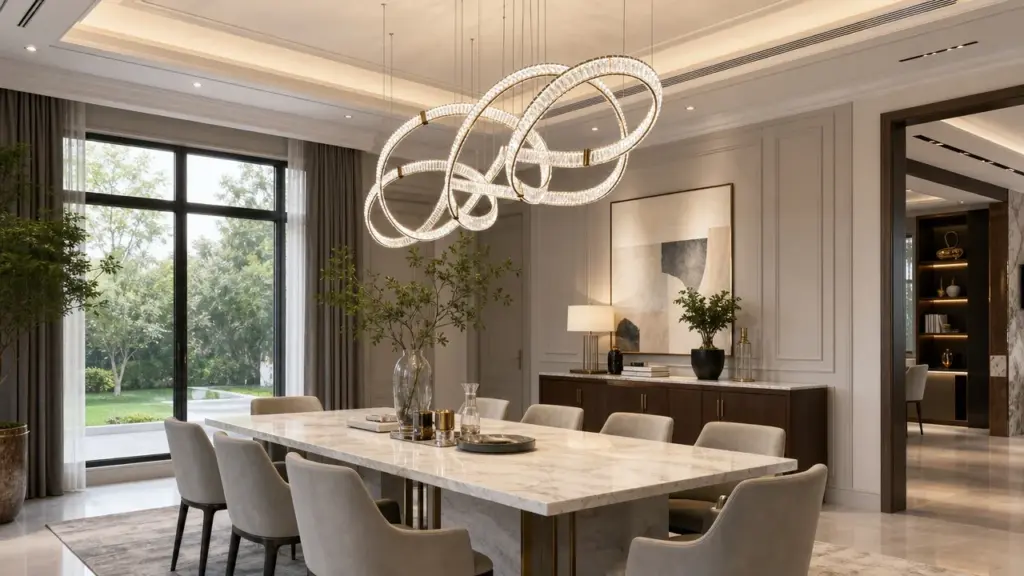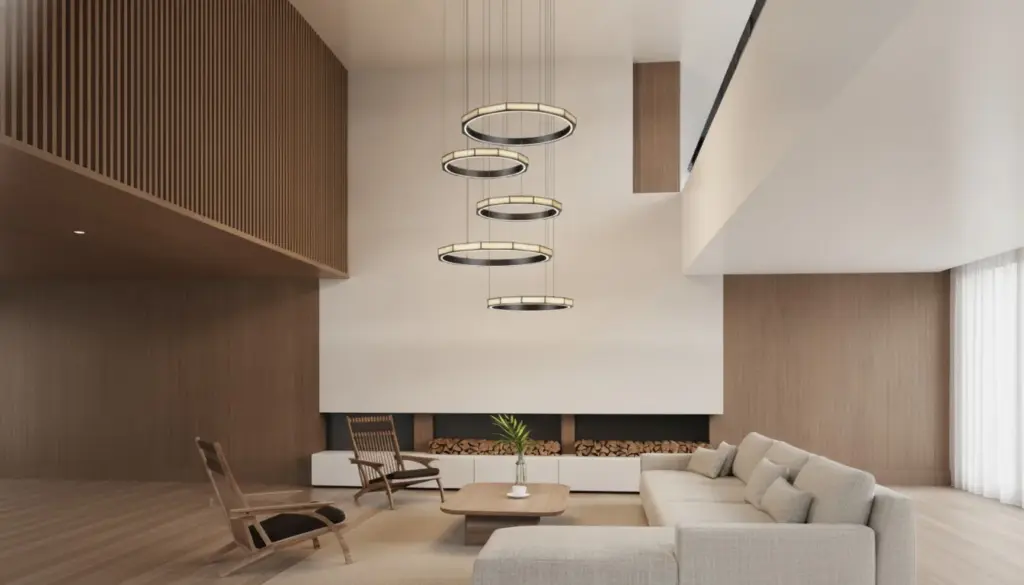
Grand foyer chandelier height is often reduced to the 7-foot clearance rule, but that rule is only the safety floor. A villa entry still needs arrival scale, comfortable sightlines, glare discipline, upper-view finish, and enough access for cleaning and future service.
The common mistake is treating 7 feet as the design answer. In a modest room, that may protect head clearance. In a double-height or grand foyer, it says almost nothing about whether the chandelier fills the volume, aligns with the stair view, or looks intentional from the upper landing.
Kinglong Lighting can help turn the 7-foot rule into a full release envelope: minimum clearance, preferred bottom height, vertical fill, suspension evidence, material proof, and installation access.
Key Takeaways
- 7 feet is a floor: The rule protects basic clearance but does not finish the design decision.
- Height needs context: Door height, ceiling height, stair view, and upper landing change the preferred bottom position.
- Scale can move upward: If the bottom must stay high, use tier spacing, diameter, or density to restore presence.
- Comfort beats spectacle: A grand foyer should feel impressive without pushing sparkle into face-level movement zones.
- Release file required: Height approval should include suspension, service, driver access, and finish proof.
The 7-foot rule is a minimum, not the chandelier design
The clearance rule keeps people safe; it does not tell a grand foyer how to feel.
The IES Lighting Library supports application-specific lighting decisions. In a villa foyer, the application includes arrival, orientation, architectural scale, and movement between levels. The 7-foot rule answers only one piece of that larger problem.
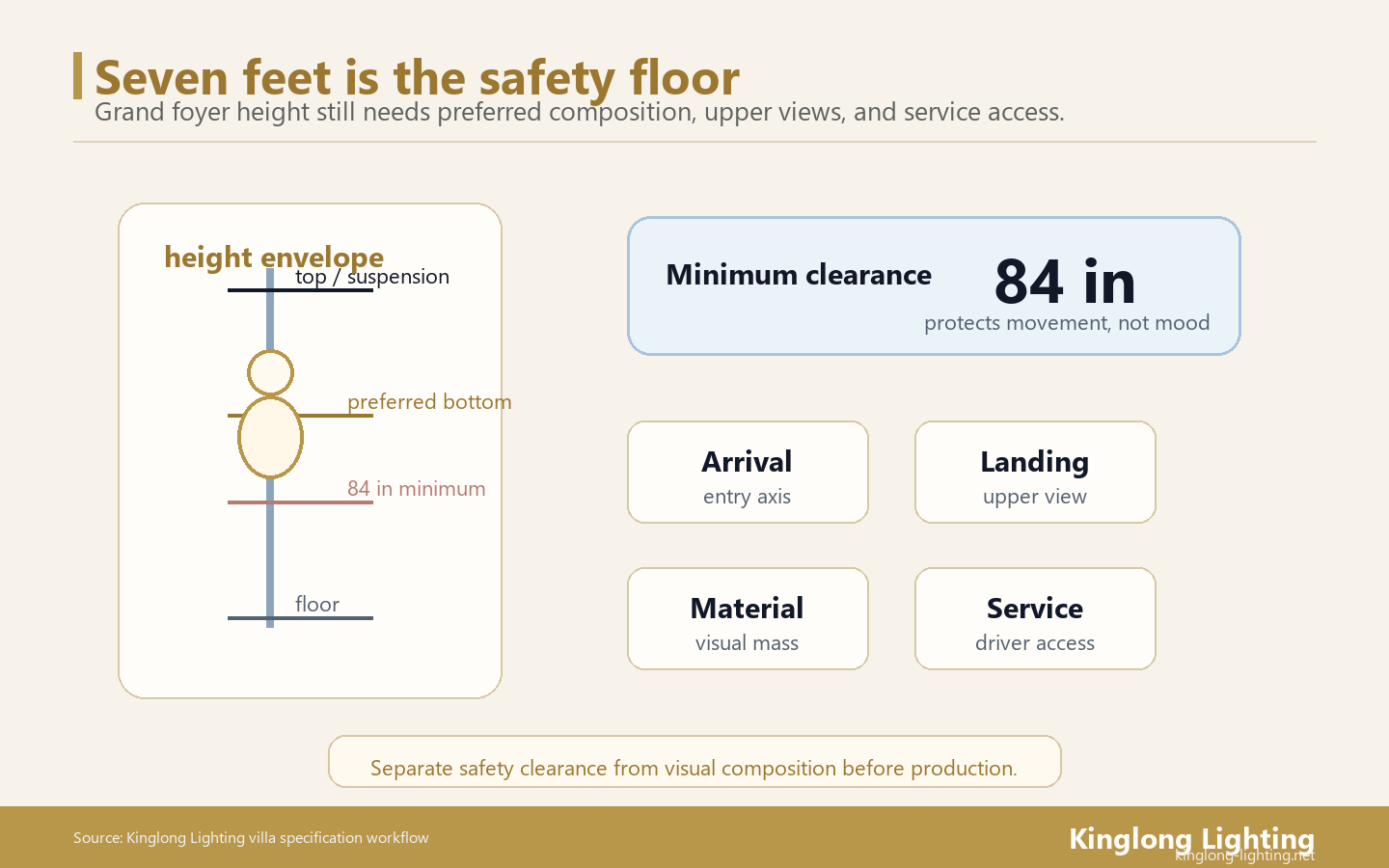
Calculated from the 7-foot clearance rule, 84 inches minimum clearance plus 6 inches of project review margin equals a 90 inch no-conflict target for many circulation paths. That target is still not the final aesthetic height; it is the lower boundary that keeps the team from approving a beautiful but intrusive fixture.
The decision rule is to separate minimum clearance from preferred composition. Minimum clearance protects bodies and movement. Preferred composition protects the architecture. Both numbers should appear in the release file.
Minimum clearance protects movement
Seven feet is useful because it gives the team a clear lower boundary in walking zones. If the chandelier crosses a place where people pass under it, carry luggage, move furniture, or walk from the entry into the living room, the bottom of the fixture needs a hard clearance check. The rule is especially important when the foyer is not a pure display void but part of a daily circulation route. For a clearance decision, record the 84 inch minimum, preferred visual bottom height, upper landing eye line, and service access condition on the same elevation. In practice, that note should make clear which number protects safety and which number protects composition.
Grand foyer height protects proportion
Once minimum clearance is safe, the team still has to decide whether the chandelier visually belongs to the room. A small fixture placed high enough to satisfy clearance may look remote. A wide fixture placed low enough to create drama may crowd the doorway. Grand foyer height therefore depends on volume, entry axis, stair view, upper landing, material density, and the way the chandelier is seen from adjacent rooms. For a clearance decision, record the 84 inch minimum, preferred visual bottom height, upper landing eye line, and service access condition on the same elevation. In practice, that note should make clear which number protects safety and which number protects composition.
Use three height numbers before approving production
A practical foyer height review should name the minimum bottom height, the preferred visual bottom height, and the maximum top or suspension height. Those three numbers define the chandelier envelope. They also make it easier to compare a tiered chandelier, a pendant cluster, a cascade, or a sculptural body without reopening the whole concept.
In practice, if clearance pushes the fixture higher than the first design image, the answer is not always to make the chandelier lower. The better answer may be to increase vertical rhythm, use a wider but lighter upper tier, add controlled sparkle higher in the volume, or support the chandelier with other lighting layers.
| Height number | What it controls | Risk if ignored | Evidence to request |
|---|---|---|---|
| Minimum bottom | safe movement under the fixture | people feel crowded by the chandelier | dimensioned elevation |
| Preferred bottom | arrival scale and visual weight | fixture looks too remote or too heavy | entry and stair view render |
| Top/suspension | ceiling connection and service access | cables or canopy look unresolved | canopy and suspension detail |
| Upper landing eye line | glare and top finish | fixture looks unfinished from above | landing view proof |
| Service height | cleaning and replacement access | beautiful fixture becomes hard to maintain | service route note |
The IES Illuminance Selector FAQ is useful because lighting criteria depend on task and application context. For foyers, that means circulation, arrival, and upper-level views should be treated as separate approval contexts.
The Lutron layered lighting guidance is useful because ambient, task, and accent layers should be planned together. A grand foyer chandelier can therefore carry identity while concealed layers, wall lighting, or stair lighting protect comfort and movement.
Material density changes how height feels
A chandelier with clear glass rods, open metal arms, or small suspended points can often sit within a larger visual envelope than a dense crystal mass. The measured bottom height may be the same, but the perceived weight changes. This is why material samples should be reviewed with height, not after height.
The DOE residential lighting guide is useful because residential lighting quality depends on more than fixture selection; glare, controls, and layered lighting also matter. A grand foyer should therefore test brightness and sparkle from the entry door, stair, upper landing, and nearby living threshold.
The UL residential lighting guidance is useful because decorative luminaires need completed product evidence. For a large foyer chandelier, that makes support, wiring, driver access, replacement parts, and safe installation sequence part of the height decision.
How Kinglong Lighting turns clearance into a release envelope
Kinglong Lighting’s villa lighting service is strongest when the buyer provides foyer dimensions, ceiling height, stair position, door height, upper landing photos, preferred style, and any structural or maintenance restriction. Those inputs turn a simple clearance rule into a project-specific chandelier envelope.
The customization workflow can then translate the envelope into drawings, material samples, suspension logic, and production details. The practical next step is to ask through the project inquiry page for a height review that separates minimum clearance from preferred visual composition.
Translate clearance into a production-safe height envelope
The production-safe height envelope is more useful than a single number. It states the lowest permitted point, the preferred bottom range, the highest visual mass, the suspension zone, and the service access condition. This lets the design team adjust form without reopening safety.
If the owner wants more drama, the team can compare four correction paths: lower the fixture only if circulation allows it, widen the upper tier, increase vertical rhythm, or add supporting architectural light. The 7-foot rule remains protected while the foyer still gains presence.
The installer should see the same envelope before production. A fixture that clears people but cannot be lifted, wired, cleaned, or repaired is not truly release-ready. Service access should therefore be part of the clearance conversation from the beginning.
In practice, Kinglong Lighting can return a marked elevation with minimum clearance, recommended bottom range, top suspension detail, material density note, and cleaning route. That drawing turns a general rule into a manufacturable villa chandelier brief.
The clearance file should also state where the 84-inch floor applies. A pure display void, a furniture route, a luggage path, and a stair landing do not carry the same risk. Marking the actual walking route lets the team protect safety without forcing every part of the chandelier to obey the most conservative point.
| Envelope layer | Question | Output |
|---|---|---|
| Minimum clearance | Where do people pass? | 84 in floor or higher |
| Preferred bottom | Where does the chandelier feel balanced? | visual bottom range |
| Vertical fill | How is presence restored? | tiers, rhythm, or density |
| Service layer | Can the fixture be maintained? | access and spare note |
Grand foyer clearance action card
- Mark the 7-foot minimum only after identifying every walking and furniture route under the fixture.
- Add preferred bottom height, top height, and landing eye line to the same elevation.
- Test whether scale should be solved by lower drop, wider tier, taller rhythm, or material density.
- Review glare from the upper landing and stair before freezing crystal or glass density.
- Attach suspension, service, driver access, and replacement notes to the final height approval.
Related Guides
- Double-Height Foyer Chandelier Selection
- Villa Chandelier Size Formula
- Staircase Chandelier Drop Length
Build the grand-foyer seven-foot clearance release file before final approval
For grand foyer chandelier height, the useful starting point is application context rather than decorative preference. The practical question is whether villa owner, interior designer, architect, lighting supplier, and installer can agree on what must be proven before the chandelier is released. The answer is a short packet that turns design intent, operating risk, evidence, and responsibility into one approval conversation.
The main risk is the 7-foot rule being treated as enough while door swing, guest movement, upper views, and fixture mass still need review. That risk is strongest when a beautiful fixture is separated from the evidence that makes it buildable, maintainable, and safe to release. Calculated from a 5-gate review, 2 unresolved gates out of 5 leave about 40 percent of the approval logic open, which is too much uncertainty for a custom decorative lighting order.
Use seven feet as a floor, not the full decision
The first approval question should define the height decision. The decision is not whether a chandelier looks premium in isolation; it is whether the selected approach protects the room role, guest or owner experience, operating reality, and production handoff at the same time. The release note should name the decision owner, the proof expected, and the change that would force a redesign. That boundary lets the buyer reject a tempting option for a specific reason instead of relying on taste language.
Check clearance along the actual walking route
The first failure point usually appears where the visual promise meets daily use. Calculated from the 5-gate grand-foyer seven-foot clearance release file, 1 weak gate times 3 downstream teams equals 3 review paths that can be delayed by one missed proof item. The review should include the view or operating condition that would be most expensive to fix later. Scene behavior and context should be tested before the fixture is treated as release-ready.
Balance low-point safety with vertical presence
Supplier evidence is useful only when it matches the risk being controlled. The request should convert that risk into proof such as clearance map, door and stair route, lowest point dimension, suspension note, service access, and visual-height rationale. If the risk is scale, request a marked elevation and sightline view. If the risk is color, request a material sample under the target scene. If the risk is maintenance, request the cleaning route and spare-part logic. Evidence should change the release decision, not decorate the file.
Document the clearance exception before production
Kinglong Lighting’s project workflow moves custom hospitality and villa chandeliers through drawings, samples, manufacturing, packing, shipping, and site installation. The final handoff should state what is approved, what remains flexible, and who can reject a change. In practice, the release packet should include at least 5 named gates and one owner for each gate. That keeps a later suggestion from turning into a redesign after the fixture has already entered production.
Frequently Asked Questions
Is 7 feet always enough clearance for a grand foyer chandelier?
Seven feet is a useful minimum in walking zones, but grand foyers often need additional review for door height, stair views, furniture movement, upper landing sightlines, and maintenance access.
Should a grand foyer chandelier hang lower for drama?
It can hang lower when the chandelier is outside the walking path and the landing view remains comfortable. If it sits over circulation, drama should often come from vertical rhythm, tier spacing, or material density rather than a lower bottom point.
How do I know if a foyer chandelier is too high?
A chandelier may be too high if it looks remote from the entry, fails to fill the double-height volume, or leaves the lower foyer visually empty. Review entry, stair, landing, and adjacent room views before changing the drop.
What should Kinglong Lighting review before production?
Kinglong Lighting should review foyer dimensions, ceiling height, door and stair alignment, minimum clearance, preferred visual bottom height, material density, suspension, cleaning access, and driver location.