A staircase chandelier drop length is correct only when it protects the mid-landing sightline. The lower hall view may make a long cascade look impressive, but the mid-landing is where residents meet the fixture at eye level, turn their body, and judge whether the chandelier feels graceful or intrusive.
This is why a staircase chandelier should not be approved from a single front elevation. Drop length controls vertical drama, clearance, glare, cleaning access, and the way the fixture appears from above. If the mid-landing view fails, the chandelier can feel unsafe or visually crowded even when the overall stair void is tall enough.
Kinglong Lighting can support the decision by turning stair photos, ceiling height, landing height, rail type, and preferred material into a drop envelope before custom production begins.
Key Takeaways
- Mid-landing first: Approve drop length where people meet the chandelier, not only where they photograph it.
- Sightline envelope: Mark eye level, rail height, stair turn, and fixture edge before freezing drop.
- Clearance is not mood: A long drop can be beautiful but still wrong if it enters the daily movement zone.
- Glare changes by height: Crystal, glass, and exposed lamp points should be checked from above and beside.
- Release proof: Drop length should travel with suspension, module order, cleaning, and spare-part notes.
The mid-landing is the real approval point
A staircase chandelier drop length should be approved where the resident meets the fixture, not where the render looks tallest.
The IES Lighting Library treats lighting as an application decision, and a villa stair is a movement application. The user is not standing still under a decorative center point. They are climbing, turning, pausing, and looking across the void.
The mid-landing usually creates the tightest visual condition. It combines eye-level viewing, handrail interruption, changing ceiling distance, and side reflection. In practice, the same chandelier can feel elegant from the entry but too bright, too close, or too wide from the landing.
The decision rule is simple: if the mid-landing view is not resolved, the drop length is not ready for production. This does not mean the chandelier must be short. It means the long form needs a safe visual channel through the stair path.
Lower hall approval can hide landing problems
The lower hall often exaggerates vertical drama because the viewer looks up into the full void. That angle can hide a bottom tier that lands too close to the turn, a crystal cluster that sits directly in the upper sightline, or a suspension rhythm that feels random from the side. The lower hall should confirm arrival mood, but it should not be treated as the only sign-off view. For a drop-length decision, record the view position, eye-line mark, rail offset, lower limit, and service owner beside the drawing. In practice, that note should state whether a later design change can move the lowest tier or must solve scale through rhythm instead.
The landing view turns beauty into ergonomics
At the mid-landing, drop length becomes ergonomic. The fixture edge relates to face height, rail height, shoulder movement, and reflected glare from glass or polished stone. A design that is only 150 mm too low may not violate a simple ceiling-height rule, but it can still feel like an object people must avoid while using the stair every day. For a drop-length decision, record the view position, eye-line mark, rail offset, lower limit, and service owner beside the drawing. In practice, that note should state whether a later design change can move the lowest tier or must solve scale through rhythm instead.
Build a drop envelope before choosing the longest cascade
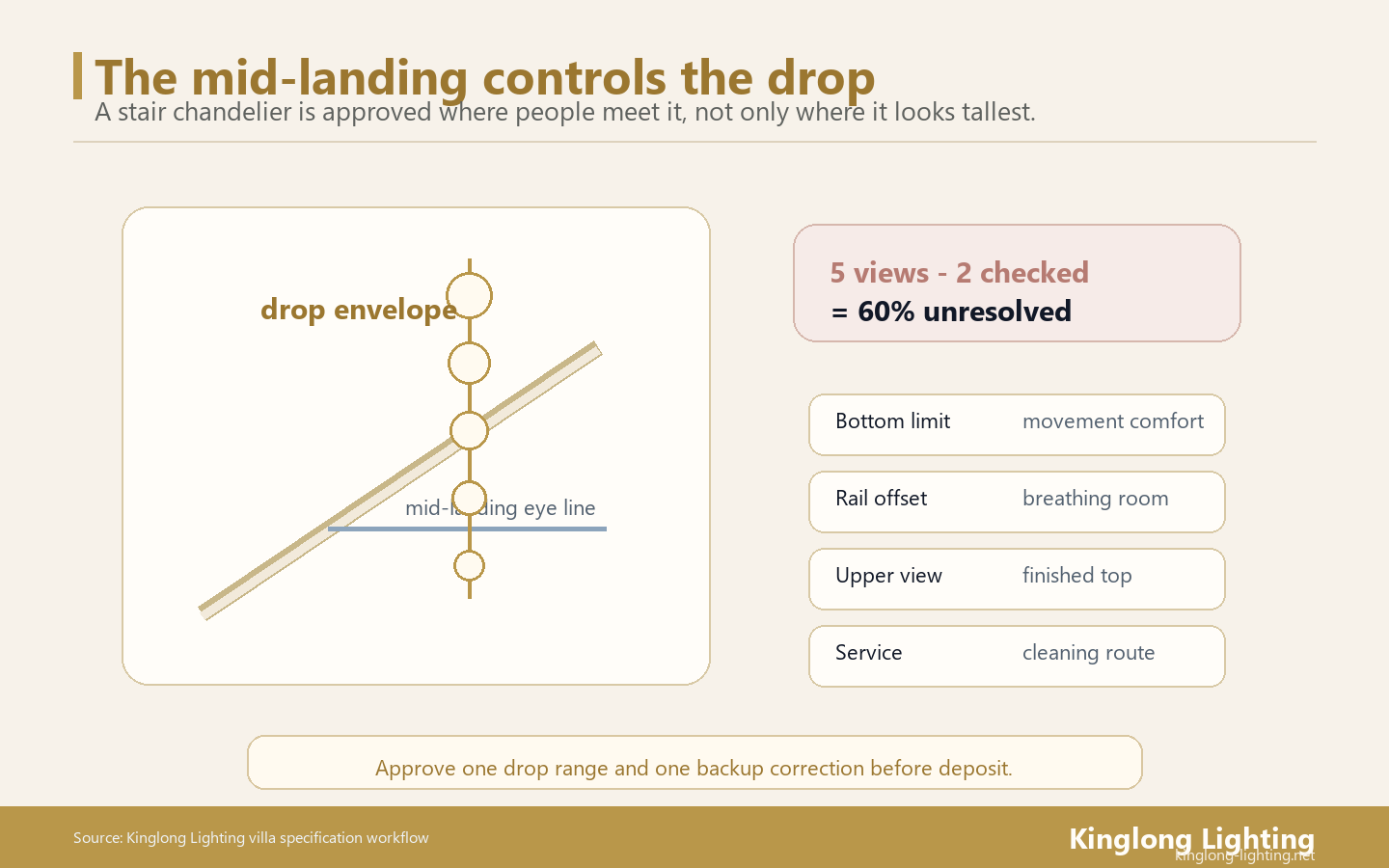
A drop envelope is a measured safe zone for the chandelier body. It should include top suspension, bottom limit, maximum width near the landing, rail offset, wall distance, and the line where the fixture becomes visually dominant from the upper hall.
Calculated from a 5-view stair audit, 5 required views minus 2 reviewed views equals 3 missing views, which means 60 percent of the approval model remains unresolved when only the lower hall and front elevation are checked.
| Envelope item | What it protects | Typical failure | Release evidence |
|---|---|---|---|
| Bottom limit | head comfort and daily movement | lowest tier feels intrusive | marked elevation |
| Landing eye line | side view and glare control | sparkle sits at face height | landing render or photo overlay |
| Rail offset | movement and visual breathing room | fixture crowds the turn | plan with rail dimension |
| Module order | installation and service access | parts cannot be cleaned safely | packing and service note |
| Upper view | finished top and cable discipline | fixture looks unfinished from above | top-view finish proof |
The DOE high-performance residential lighting guide is useful because residential lighting quality depends on layered comfort, controls, and glare discipline. That is useful for staircases because the chandelier should be one visible layer, not the only safe navigation layer.
In practice, the drop envelope should be approved before material density. A dense crystal body may need a shorter or slimmer lower zone than an open metal or glass composition, even if both share the same overall height.
Glare and reflection change the safe drop length
The Lutron layered lighting guide separates ambient, task, and accent logic. For stairs, this means the chandelier can stay decorative while wall, step, or cove lighting handles low-level movement. That separation lets the chandelier be dimmed without making the staircase feel unsafe.
Glare is not only a lamp-output issue. It is also a position issue. Clear glass, faceted crystal, polished metal, and mirrored wall panels can all become brighter when they sit near landing eye level. A small shift in drop length can be more effective than changing the whole fixture style.
The UL residential lighting guidance is useful because decorative luminaires need completed product evidence. For staircase drop length, that evidence should include fixture weight, suspension detail, driver access, module connection, and replacement-part logic.
How Kinglong Lighting can support the drop-length decision
Kinglong Lighting’s villa lighting workflow is useful when the buyer provides lower hall photos, stair side photos, landing height, ceiling height, rail material, wall finish, and target mood. The team can then translate inspiration into a drop range rather than a single risky dimension.
The customization workflow can turn the approved range into drawings, sample proof, suspension details, and a production handoff. The practical next step is to send the stair photos and landing dimensions through the project inquiry page and ask for a mid-landing sightline review before production release.
Run the landing review before the production deposit
The landing review should happen before the production deposit because it can change module order, bottom tier position, glass density, and suspension spacing. A late landing problem is expensive because the chandelier may already be engineered around the wrong visual center.
The review does not need to slow the project. A marked stair photo, a side elevation, and a short note on rail height can often expose the risk quickly. If the landing view passes, the owner can approve the dramatic lower-hall view with more confidence.
Kinglong Lighting can use this review to separate design preference from manufacturing constraint. The designer protects the staircase mood, the owner understands daily comfort, and the factory knows which dimensions must not move during production.
In practice, the release note should name one approved drop range and one backup correction. If the lowest tier has to move upward, the backup may be added upper density, adjusted crystal spacing, or a supporting stair-wall layer rather than a full redesign.
The backup correction should be chosen before the owner sees the final quote. If a longer cascade is not safe at the landing, Kinglong Lighting can still protect drama through tighter upper spacing, a lighter lower tier, or a secondary wall-wash layer. That keeps the design decision calm when the most dramatic render needs restraint.
| Landing review item | Decision it protects | Who should approve it |
|---|---|---|
| Eye-line overlay | glare and crowding | designer and owner |
| Rail offset | movement comfort | designer and installer |
| Bottom range | safe drama | owner and manufacturer |
| Service route | cleaning and replacement | manufacturer and installer |
Staircase drop-length action card
- Photograph the stair from lower hall, mid-flight, mid-landing, upper corridor, and service position.
- Mark the landing eye line, rail height, bottom limit, and fixture edge before selecting drop length.
- Check reflection and glare with the intended glass, crystal, or metal density.
- Approve a drop range, not only a single attractive render.
- Freeze suspension, module order, cleaning access, and spare-part logic with the final drop.
Related Guides
- Staircase Chandelier Design for Grand Villas
- Villa Chandelier Size Formula
- Double-Height Foyer Chandelier Selection
Build the staircase drop-length mid-landing sightline file before final approval
For staircase chandelier drop length, the useful starting point is application context rather than decorative preference. The practical question is whether villa owner, designer, staircase contractor, lighting supplier, and installer can agree on what must be proven before the chandelier is released. The answer is a short packet that turns design intent, operating risk, evidence, and responsibility into one approval conversation.
The main risk is drop length being chosen from total height while the mid-landing view creates glare, crowding, or visual collapse. That risk is strongest when a beautiful fixture is separated from the evidence that makes it buildable, maintainable, and safe to release. Calculated from a 5-gate review, 2 unresolved gates out of 5 leave about 40 percent of the approval logic open, which is too much uncertainty for a custom decorative lighting order.
Use the mid-landing as the control viewpoint
The first approval question should define the drop-length decision. The decision is not whether a chandelier looks premium in isolation; it is whether the selected approach protects the room role, guest or owner experience, operating reality, and production handoff at the same time. The release note should name the decision owner, the proof expected, and the change that would force a redesign. That boundary lets the buyer reject a tempting option for a specific reason instead of relying on taste language.
Define drop length as a range, not a single guess
The first failure point usually appears where the visual promise meets daily use. Calculated from the 5-gate staircase drop-length mid-landing sightline file, 1 weak gate times 3 downstream teams equals 3 review paths that can be delayed by one missed proof item. The review should include the view or operating condition that would be most expensive to fix later. Scene behavior and context should be tested before the fixture is treated as release-ready.
Protect side-view rhythm from visual crowding
Supplier evidence is useful only when it matches the risk being controlled. The request should convert that risk into proof such as mid-landing eye line, drop range, clearance map, vertical spacing, light-source shielding, and service route. If the risk is scale, request a marked elevation and sightline view. If the risk is color, request a material sample under the target scene. If the risk is maintenance, request the cleaning route and spare-part logic. Evidence should change the release decision, not decorate the file.
Confirm service reach before approving final drop
Kinglong Lighting’s project workflow moves custom hospitality and villa chandeliers through drawings, samples, manufacturing, packing, shipping, and site installation. The final handoff should state what is approved, what remains flexible, and who can reject a change. In practice, the release packet should include at least 5 named gates and one owner for each gate. That keeps a later suggestion from turning into a redesign after the fixture has already entered production.
Frequently Asked Questions
How low should a staircase chandelier hang?
Start with the stair void height, then protect the mid-landing sightline, rail offset, head comfort, and service access. The correct drop is usually a range that balances vertical drama with daily movement.
Why is the mid-landing more important than the lower hall view?
The lower hall shows drama, but the mid-landing shows how the chandelier behaves at eye level. It exposes glare, crowding, unfinished top views, and side-view weakness that a front render can hide.
Can a staircase chandelier be very long if the ceiling is high?
Yes, but length should be expressed through rhythm, spacing, and material density rather than simply pushing the lowest tier downward. A tall void still needs safe clearance and comfortable sightlines.
What should I send Kinglong Lighting for a drop-length review?
Send stair photos from multiple views, floor-to-ceiling height, landing height, rail material, wall finish, preferred style, and any cleaning or installation restrictions.