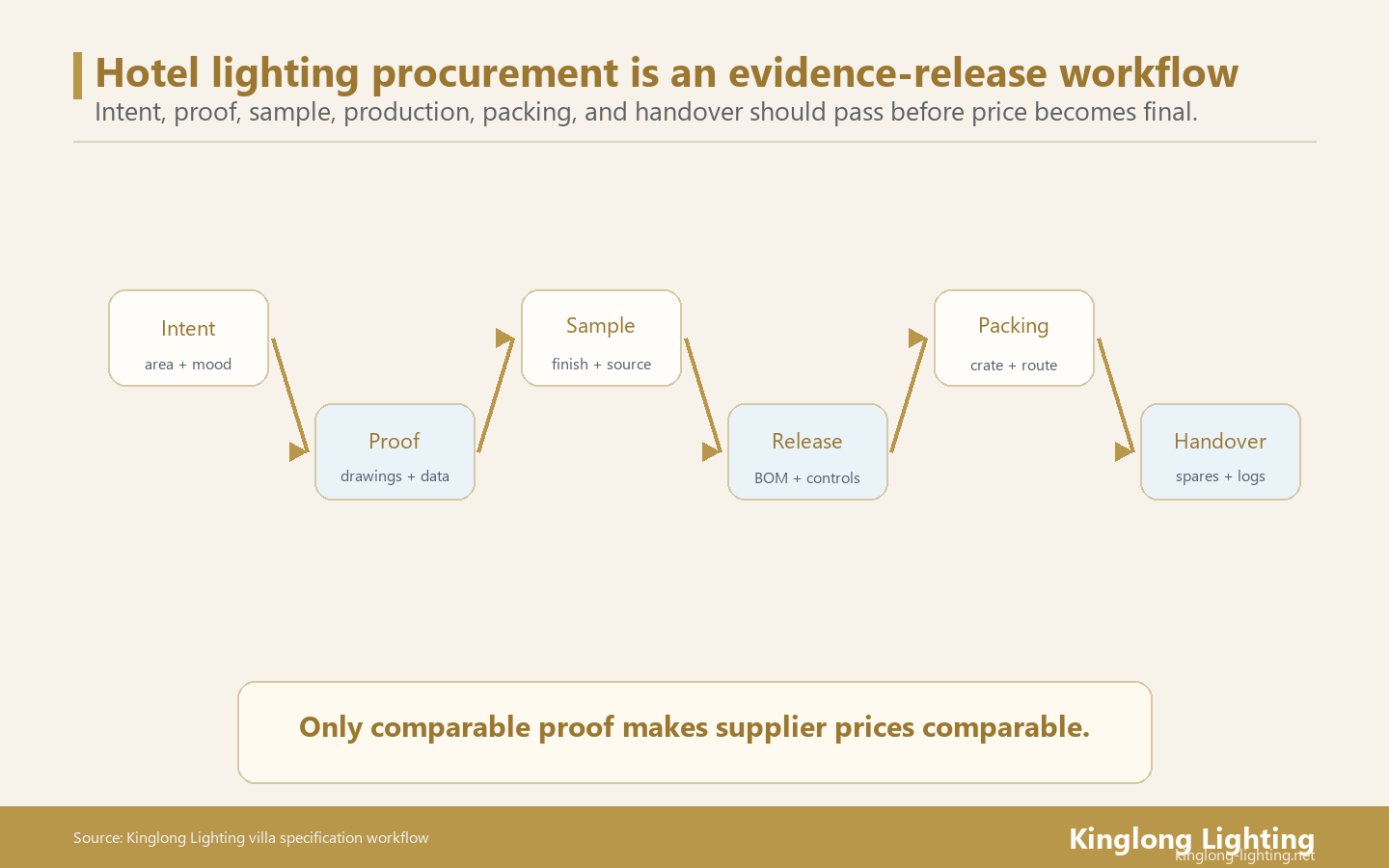
Hotel project lighting procurement should be managed as an evidence-release workflow, not a race to the lowest fixture price. Specifiers protect the opening date by separating design intent, technical compliance, sample approval, production release, packing, and site handover. Under a simple risk model, a two-day dispute across designer, procurement, factory, and site teams becomes 8 crew-days before replacement parts, freight, or opening-delay cost is counted. The supplier should enter price comparison only after the proof file shows what will be built, tested, packed, installed, and maintained.
A hotel lighting package is unusually easy to underestimate. It contains public-area statement pieces, guestroom repetitions, corridor rhythm, restaurant mood, ballroom scene control, villa or suite upgrades, and service-area practicalities. The purchase order may look like a product list, but the real work is a chain of approvals. Every missing drawing, sample, driver note, safety path, crate label, or spare-part rule becomes a late question for someone else.
Key Takeaways
- Procurement is staged: Move from intent freeze to technical proof, sample approval, production release, shipment, and handover.
- Price comes later: Compare suppliers after scope, evidence, testing path, logistics, and responsibilities are comparable.
- Samples are evidence: A sample should confirm material, finish, light quality, construction, cleaning, and replacement logic.
- Testing must be named: Ask which UL, IEC, NRTL, ISO, or laboratory evidence applies to the project location and product type.
- Handover protects operations: Spare parts, access notes, packing maps, and maintenance instructions belong in the procurement file.
Treat procurement as an evidence-release workflow
The buyer should not ask “who quoted fastest?” until the project can answer “who proved the same scope?”
The first procurement mistake is turning a hotel lighting schedule into a quote race before the project has frozen intent. The designer may still be deciding mood. The engineer may still be checking load and power. The operator may not have reviewed cleaning access. The contractor may not know crate routing. A supplier can quote quickly in that environment, but the price will hide assumptions.
Use release gates instead of a single RFQ date
Set procurement gates: design intent, technical evidence, sample approval, production release, shipment release, and handover. Each gate should have a required document or physical proof. Kinglong Lighting’s customization and OEM/ODM manufacturing model fits this gate logic because custom hotel lighting cannot be separated from drawings, samples, quality control, packing, and project communication. The buyer should ask for a proof file, not just a catalog selection.
Freeze design intent before supplier comparison
A supplier cannot protect design intent that has not been written down.
Design intent does not need to become a heavy design manifesto. It needs enough clarity to prevent drift: target property type, area schedule, visual mood, finish palette, material preference, ceiling height, installation constraints, and guest experience role. For public spaces, include viewing distances and camera angles. For guestrooms and corridors, include repetition count, finish tolerance, replacement access, and control scenes. For ballrooms, include event modes.
Kinglong Lighting’s hospitality lighting page shows why the scope matters: hotel projects include lobby centerpieces, ballrooms, guestrooms, suites, restaurants, bars, corridors, and installation support. A procurement framework should therefore group the package by guest journey and technical risk, not only by product category.
Define the technical proof file
Technical proof is the part of procurement that prevents the beautiful approved fixture from becoming a site problem.
The technical proof file should contain shop drawings, dimensions, weight, suspension assumptions, material specification, finish samples, light-source data, driver and dimming data, electrical rating, certification path, packaging method, installation notes, and spare-part plan. The exact compliance path depends on the project country and local authority. For North American electrical contexts, UL luminaire testing and certification and OSHA’s NRTL program are useful references for understanding third-party testing expectations. International projects may use IEC 60598 vocabulary for luminaire safety discussions.
Separate quality system evidence from product test evidence
A quality management certificate and a product test report answer different questions. ISO 9001 supports discussion of quality management systems, while ISO/IEC 17025 is tied to competence requirements for testing and calibration laboratories. For hotel lighting procurement, the specifier should ask what each document proves, which product or process it covers, and whether the evidence is current, relevant, and accepted by the project authority. A certificate should not be used as a substitute for the actual fixture evidence.
| Procurement gate | Decision owner | Evidence before release | Failure if skipped |
|---|---|---|---|
| Intent freeze | Designer and owner | Mood, materials, area schedule, guest journey role | Supplier quotes different design assumptions |
| Technical proof | Engineer and supplier | Drawings, load, driver, safety path, wattage | Late code, ceiling, or dimming conflict |
| Sample approval | Designer, owner, procurement | Finish board, light sample, construction sample | Mass production does not match visual intent |
| Production release | Procurement and factory | Signed drawing, BOM, QC plan, packaging map | Rework after deposit or during shipment |
| Site handover | Contractor and hotel operations | Installation guide, crate labels, spares, maintenance file | Opening-week confusion and service delays |
Connect lighting procurement to energy and controls early
Lighting procurement is part of the building system, especially when drivers, dimming, controls, and energy documentation enter the project.
Decorative fixtures still affect electrical design and energy compliance. The project engineer may need wattage, driver type, power factor, control protocol, emergency interface information, or local code notes. ANSI/ASHRAE/IES Standard 90.1 is a common reference for energy-efficient commercial building design, and DOE COMcheck may be used in US compliance workflows. The supplier should give the engineer the data early enough to avoid late substitutions.
Controls require the same discipline. A chandelier that is technically dimmable may still fail if the driver, protocol, circuit grouping, control system, and commissioning owner are not aligned. Ballrooms, restaurants, executive lounges, and villas often need scene notes. Guestrooms need intuitive switching and night behavior. Procurement should ask for data sheets and control assumptions, then let the project controls specialist confirm compatibility.
Make the final quote comparable
A comparable hotel lighting quote names the same scope, evidence, responsibilities, logistics, and handover deliverables.
Ask each supplier to quote against the same drawing version, quantity, finish, material grade, light-source specification, certification path, control requirement, packaging method, spare-part assumption, delivery destination, incoterm, and site-support scope. If one quote includes installation guidance and spare parts while another excludes them, the lower price may simply be missing hotel-risk work.
If your hotel project has reached RFQ stage, send the spec, drawings, quantity, destination, control intent, certification requirement, and current evidence gaps to Kinglong Lighting through the project lighting inquiry. The useful deliverable is not a slogan or a fast number; it is a review of what must be proven before production release.
Based on our analysis of a 6-gate procurement file, the project should pass through intent freeze, technical proof, sample approval, production release, shipment release, and site handover before deposit. The simple risk calculation, 4 owners x 2 unresolved days = 8 crew-days, makes the dispute visible because designer, procurement, factory, and site teams all spend time reopening the same decision. The decision rule is to compare price only after at least 5 proof groups are present: drawings, samples, certification path, driver/control data, and packing or installation evidence. In practice, the lowest quote is not really lower if it postpones these proof items into the opening schedule. A good procurement file therefore reads like a project-control document: it says what is approved, who approved it, what evidence is missing, and what must be held before deposit or production release. It should also record who can approve substitutions, who can release a sample, who can accept a test report, and who owns the final handover file after installation. That ownership record is often the difference between procurement control and opening-week improvisation.
Related Guides
- 5-Star Hotel Chandelier Specification Guide
- Ballroom Chandelier Specification Guide
- Guestroom and Corridor Lighting Standards
Hotel Lighting Procurement Action Card
- Freeze design intent before quote comparison.
- Request drawings, samples, certificates, drivers, and packing maps.
- Separate product test evidence from factory quality evidence.
- Confirm controls, wattage, spares, and installation owner.
- Ask Kinglong Lighting to review the release file before deposit.
A hotel lighting procurement file should keep price behind proof
Procurement becomes risky when suppliers are compared before the project knows what proof each price includes. A cheaper quote may exclude drawings, sample control, certification path, packing, freight assumptions, installation guidance, spare parts, or handover documentation. A stronger procurement file keeps design intent, technical proof, sample approval, production release, packing, and handover in one evidence workflow.
Make every quote answer the same release stages
The comparison table should ask each supplier to answer the same stages: intent confirmation, shop drawings, material and finish samples, light-source and driver data, control compatibility, certification context, packing method, delivery terms, installation support, spare parts, and maintenance file. If one supplier omits a stage, the buyer can see the gap before choosing a price.
Use proof gaps to clarify responsibility
A proof gap is not always a supplier failure. Sometimes the owner, designer, engineer, contractor, or operator still owns the missing decision. The procurement file should name that owner and deadline. This keeps the project moving without pretending every unanswered item belongs to the manufacturer. Kinglong Lighting can respond more accurately when those boundaries are visible in the RFQ.
Keep the handover record attached to procurement
Procurement should not end when the fixture ships. The file should carry through to installation and handover with drawings, final BOM, finish records, source data, driver locations, crate notes, spare parts, and maintenance guidance. That record helps the hotel operate the lighting package after opening and makes future replacement less dependent on memory or email threads.
Set payment gates around proof gates
Payment timing should follow evidence timing where possible. A deposit may be reasonable after intent, drawings, and scope are clear. Production payment should not ignore unresolved sample, certification, driver, or packing questions. Shipment payment should reflect crate, route, documentation, and handover readiness. Aligning payment gates with proof gates gives procurement leverage without turning every discussion into a price negotiation.
Before final supplier ranking, send Kinglong Lighting the evidence-release workflow and ask for a response by stage. The best comparison is not just which price is lower; it is which price includes the proof needed to build, ship, install, maintain, and defend the hotel lighting package.
The framework should stay active after award. If the project adds guestrooms, changes ballroom controls, revises freight terms, or swaps a finish, the same evidence-release workflow can show which price, schedule, or responsibility needs to be reopened. That continuity is what makes procurement a project-control system rather than a one-time buying event.
Specifier leadership matters most when the project has several fixture families. Lobby chandeliers, ballroom features, corridor sconces, guestroom decorative lights, and restaurant pendants may have different suppliers or packages, but the evidence logic should stay consistent. The procurement file should make clear which evidence is universal and which is area-specific.
The framework should also protect the project from rushed value engineering. If a lower-cost option changes material grade, driver type, finish process, packing method, spare strategy, or installation support, the comparison should show exactly which proof is affected. That way value engineering becomes a documented trade-off rather than a quiet downgrade hidden inside a cheaper line item.
A final procurement review should include the operator, not only design and purchasing. The operator will inherit cleaning access, replacement parts, control behavior, and spare storage after the opening team leaves. Bringing that perspective into the final evidence review helps the project avoid a common mistake: buying a package that wins the tender but creates daily operating friction.
Frequently Asked Questions
What is the first step in hotel lighting procurement?
The first step is freezing design intent and area scope. Without a written guest-journey role, finish palette, fixture schedule, and technical constraints, supplier quotes will reflect different assumptions and cannot be compared fairly.
What documents should a hotel lighting supplier provide?
Ask for shop drawings, material and finish samples, driver data, wattage, safety certification path, test evidence, packing method, installation guidance, spare-part list, and maintenance notes. The exact compliance documents depend on the project location and authority.
How should specifiers compare hotel lighting quotes?
Compare quotes only after scope, material, quantity, certification path, controls, packing, delivery, spare parts, and site-support responsibilities are aligned. Otherwise a lower quote may simply exclude risk that another supplier included.
Why does procurement need site handover planning?
Hotel lighting is installed under opening-date pressure. Crate labels, module maps, installation guides, spare parts, and maintenance instructions reduce confusion when contractors and hotel operations take over from procurement.