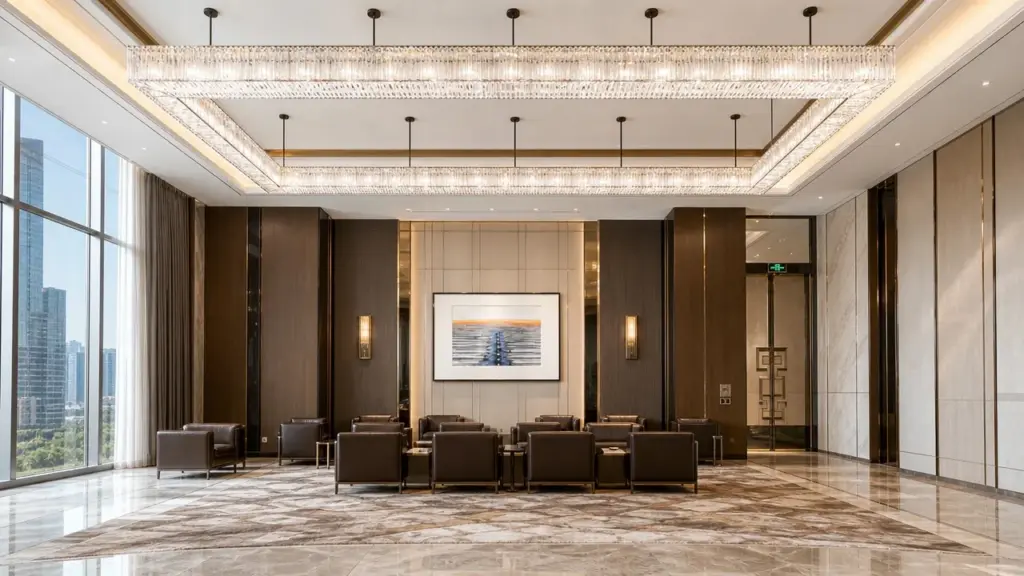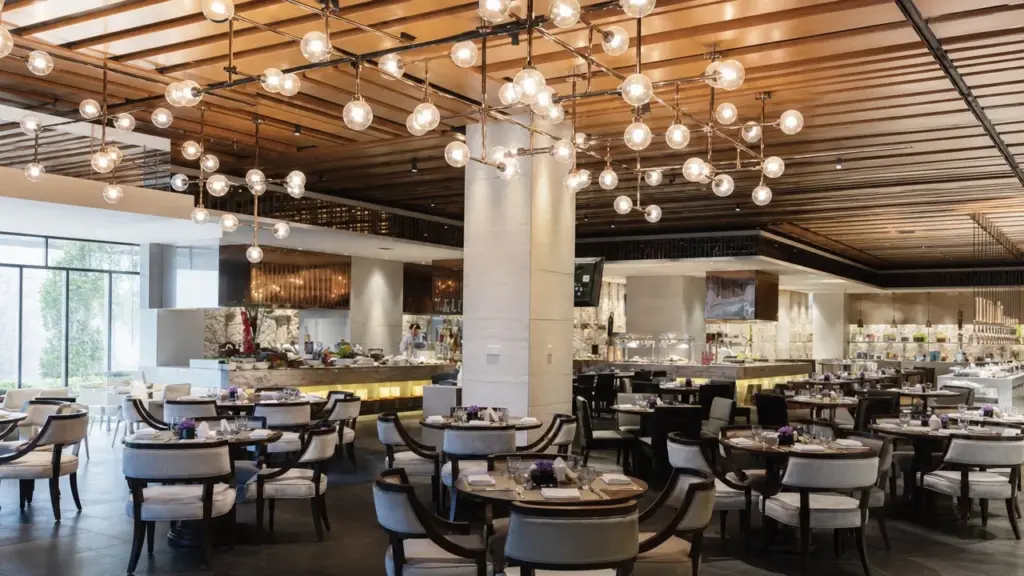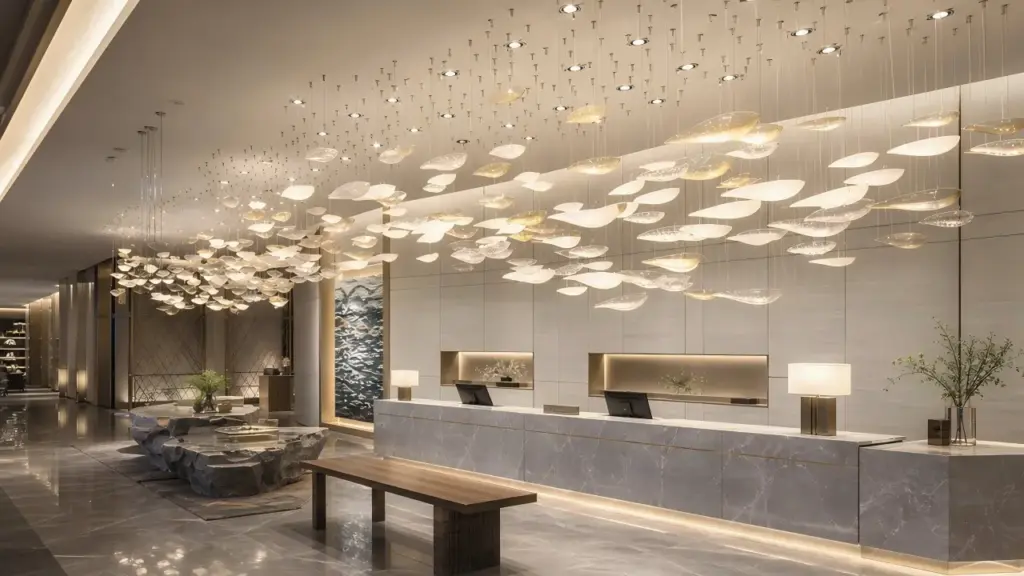
A decorative lighting value engineering process should reduce the cost of delivering agreed functions, not quietly replace those functions with a cheaper design. The owner sets the commercial objective, the designer identifies what must be preserved, and the supplier develops evidence-backed construction options. A saving is ready for approval only when the team understands its installed scope, design consequences and verification results. A visually similar fixture can still be harder to maintain or behave differently when dimmed.
Define What the Lighting Budget Must Protect
Value engineering starts with required functions and agreed design priorities, not a cheaper material list. Before asking for alternatives, identify the drawing revision, fixture schedule, material references and lighting scenes that define the approved direction. Then distinguish mandatory requirements from discretionary preferences. Electrical safety, structural suitability and applicable project requirements cannot be traded away through an informal budget discussion.
WBDG’s cost-management guidance describes a continuing balance between scope, expected quality and budget over the project life cycle.
This is a useful starting discipline, not a promise that every lighting concept can be delivered unchanged for less. For a hotel owner, the practical question is which attributes create the intended guest experience and which details merely describe one way of producing it. The answer may differ between a lobby centerpiece and a repeated corridor fixture.
Make the priorities observable: the silhouette from the entrance, the apparent density of suspended elements, the finish against nearby metalwork, the evening scene and the access needed for maintenance. Replace “keep it luxurious” with references and viewing conditions that the designer can actually review. If the priorities conflict with the available budget, escalate that conflict before suppliers spend time developing unsuitable options.
For a crystal installation, inspect the Crystal Tube design vocabulary to identify the relevant configuration and visible attributes. A Kinglong Lighting collection reference can help frame that discussion, but the project still needs to specify which features of its selected design are protected.
Give Owners, Designers and Suppliers Different Review Duties
Separate budget authority, design acceptance and manufacturing evidence before reviewing options. Any participant can suggest a change; that does not give the proposer authority to approve every consequence. Nominate a procurement coordinator to keep the option references, comments and commercial revisions aligned.
The owner or authorized representative confirms the cost objective, the relevant budget boundary and the discretionary trade-offs the project will accept. Ask whether the target concerns the fixture purchase, the delivered package or the installed project cost. Those are different decisions. The owner also needs to know whether a proposal creates future operating obligations or relies on another package absorbing work.
The designer identifies the appearance and lighting characteristics that must survive the change, then reviews suitable samples or demonstrations against those criteria. Where the interior designer does not hold the electrical or structural remit, involve the appointed specialist. An aesthetic approval should not be presented as an engineering approval.
The supplier explains the proposed construction, why it could reduce cost, what changes from the baseline and which evidence is available. This includes implications for assembly, packing, interfaces and replacement components. “Same effect, lower price” is not a technical proposal. The reviewer needs to see the altered detail and the assumptions behind its quotation.
Circulate one identified option and revision to all reviewers. Record disagreement against the actual requirement, not simply as “designer rejected VE.” The project’s contract and authorization procedure determine who can release the resulting change; a three-party meeting supports that decision but does not create a new contractual authority.

Compare Cost Levers Before Replacing Visible Materials
Assess each cost lever against the function and risk it changes. Investigate avoidable complexity before assuming that visible material must be downgraded. None of the options below is automatically suitable; their value depends on the selected fixture and the site conditions.
Simplify Construction Without Assuming It Is Invisible
A concealed change still needs interface, safety and service checks. Reusing a canopy detail, reducing unnecessary unique components or revising the assembly sequence may be worth investigating. However, the supplier must show which dimensions, loads, connection details or maintenance operations change. A part being hidden from the guest does not make it irrelevant to the installer or operator.
Ask the supplier to separate savings due to repeated manufacture from savings due to removed work. A common component used across several designs may simplify procurement, but it can also constrain the suspension arrangement or replacement method. Likewise, shipping a fixture in smaller assemblies can transfer labor to site. Compare the packing benefit with the assembly resources and checks now required there.
To establish comparable physical references, review Kinglong Lighting’s hospitality material-selection process. Its published workflow includes physical sample boards for crystal, glass and metal finishes. Use identified samples to distinguish what the proposed construction preserves from what it changes; a sample-board review alone cannot verify a mounting or access detail.
Do not combine unrelated modifications into one opaque discount. Price a proposed manufacturing simplification separately from a different finish or light source wherever practical. This lets the team retain a useful construction improvement while declining a design change, and prevents one rejected feature from concealing the merits or risks of the others.
Treat Visible and Lighting Changes as Design Decisions
Changes to visible material, proportions or light behavior need explicit design review. A smaller fitting, a different glass treatment or a reduced decorative density may be acceptable, but it is not automatically the same design. Compare it in the intended location and state what the owner would be accepting.
A finish chip is useful for a surface comparison but does not establish the appearance of a complete assembly. Curved surfaces, joints and the relationship between adjacent materials may affect the designer’s judgment. Where these details carry the visual intent, request a representative assembled section rather than accepting a distant photograph as the only evidence.
The DOE explanation of color-tunable lighting notes that dim-to-warm products become warmer in appearance as their output falls.
Therefore, a proposal that keeps the full-output color but removes the required warming behavior needs review as a functional change. Compare the intended evening scene, not only the fixture at full brightness. This category distinction does not establish the performance of either product under review; that requires applicable product evidence and a suitable demonstration.
Record whether the designer finds an option consistent with the protected intent, acceptable only with a declared change, or unsuitable. These findings give the owner a choice with consequences. They are more useful than a blanket assertion that the proposal makes “no compromise,” especially when the original material or behavior is no longer being supplied.
Calculate the Saving for the Same Installed Scope
Compare the same installed scope and show change costs separately from the unit-price reduction. The net saving is the price reduction remaining after relevant change costs. Subtract additional development, verification, cancellation, logistics and installation costs that the proposed option introduces, without counting the same item twice. If an important cost is unknown, present a provisional comparison rather than a confirmed saving.
| Comparison field | Record against the baseline | Decision supported |
|---|---|---|
| Fixture scope | Quantity, configuration, finish, accessories and exclusions | Is the lower quotation for the same obligations? |
| Change costs | Additional drawings, samples, testing, tooling or cancellation commitments | What reduces the apparent purchase saving? |
| Delivery and installation | Packing, freight scope, assembly labor and site coordination changes | Has cost moved into another package? |
| Operation and service | Access, replaceable parts, maintenance tasks and supported life assumptions | Does the owner inherit a different obligation? |
| Decision status | Verified amounts, unresolved allowances, responsible reviewers and validity dates | Is the saving firm enough to approve? |
Keep immediate project savings distinct from longer-term cost projections. If operating savings are part of the case, use a common study period, usage assumptions and treatment of future costs. Do not add an unsupported lifetime estimate to a firm purchase reduction as though both amounts have equal certainty. Where the operating effect cannot be quantified credibly, describe the changed obligation and leave the financial result unresolved.
Facilities work belongs in this review: CIBSE’s public LG20 overview addresses facilities managers maintaining, modifying and updating electric lighting installations.
That published scope is a reason to involve the operator, not evidence of any particular maintenance cost. Ask who replaces the changed component, what must be removed to reach it and whether the proposed replacement can be identified in the handover information.
For context, examine relevant Kinglong Lighting project references and identify comparable installations to ask about. Portfolio photographs can prompt useful questions about access and assembly; they do not establish a saving, service history or verified result for the option in your project.
Match the Approval Evidence to the Proposed Change
Use evidence that tests the changed characteristic rather than a generic sample approval. Before development begins, name the reviewer, the comparison conditions and the acceptance criterion. A visible finish change calls for an appearance comparison; a revised access arrangement calls for an access demonstration. Neither test automatically answers the other question.
For measured performance, the IES description of LM-79-24 covers optical and electrical measurements of solid-state lighting products under standard conditions.
The public description is not a project acceptance specification. If the changed light source, diffuser or assembly affects a required measured characteristic, the responsible specialist should identify the applicable evidence and its relationship to the offered configuration. Keep measured results separate from the designer’s judgment of the room scene.
Similarly, DALI Alliance’s product database states that luminaires are not listed in it.
A component record may therefore contribute to a controls review, but it cannot by itself approve the changed decorative fixture. Identify which component is being proposed and what remains to be demonstrated at fixture or system level. Avoid using a familiar certification name as a substitute for evaluating the actual change.
Preserve the tested revision and the conditions of the demonstration. An annotated photograph, drawing reference and written finding should allow another reviewer to understand what passed, what failed and what was not assessed. If the sample is subsequently altered, check whether the accepted evidence still applies before releasing that alteration.
Kinglong Lighting describes blueprint review, modeling, prototyping and sample approval. Bring the current drawing, protected requirements and proposed change to that discussion so the development work addresses the review question; the project team retains acceptance authority. For a revised build, review the custom-lighting development workflow.
A Cost-Saving Proposal That Fails Its Own Service Test
Reject an unverified saving even when the visible appearance is acceptable. A failed correction is especially informative: it shows whether the proposed construction can meet the protected requirement, rather than merely whether a supplier has responded to a comment.
Illustrative Review: A Common Canopy for 48 Pendants
Consider an illustrative hotel review covering 48 pendants across 4 dining zones. The owner wants the supplier to investigate a common canopy to reduce construction variants. The designer protects the visible ceiling composition, while the operator requires driver access without disturbing the adjacent ceiling finish. This is a constructed example, not a Kinglong project or a claim about achievable savings.
The identified mock-up looks acceptable from the agreed viewing positions. During the service trial, however, removing the driver requires disturbing the ceiling finish. The team distinguishes those findings: the appearance is acceptable, but the proposed access method fails the protected requirement. The owner does not approve the common-canopy option on the strength of its appearance review or preliminary quotation.
The supplier adds a removable access plate and submits a revised mock-up. The reviewers repeat the removal procedure against the representative ceiling detail, using the actual tool path. The plate still cannot clear that detail. Adding a plate has changed the construction, but the repeat demonstration has not established workable access. The record identifies the revised drawing and the physical obstruction rather than marking the supplier’s comment “resolved.”
A repeated service-access failure can make the original construction the better current decision. Here, the owner retains the previously accepted construction and asks the team to investigate a different cost lever. The failed option stays out of the released package. Further development remains possible, but only a new demonstrated solution can justify reconsideration; the budget target is not a reason to weaken the access requirement after testing.
Record the Agreed Design and the Released Configuration
Release the identified configuration and commercial scope, not a meeting-level agreement. For an accepted option, record the baseline reference, revised drawing, material or component identifiers, affected quantities, reviewed evidence and any expressly accepted design differences. Name the owner’s commercial authorization and the relevant design and technical findings separately.
Give conditional decisions a precise boundary. Approval to develop a sample is not approval to purchase revised production. If a comment must be closed before manufacture, assign its owner and required evidence, then route the completed record through the project’s release procedure. The supplier should be able to tell which document authorizes the build without interpreting an ambiguous email chain.
Carry the accepted change into the quotation or change order, fixture schedule and production documents as applicable. Identify superseded versions so procurement, the installer and the operator do not work from different configurations. Preserve the original comparison as well: it explains why the option was selected and which assumptions should be revisited if quantities, site details or scope later change.
When the review exposes a specific question about samples, technical submissions or supplier evidence, explore supporting decorative-lighting procurement guidance. Use that reading to sharpen the next question for the project team, while keeping the approval tied to the actual option and its evidence.
Frequently Asked Questions
Can value engineering begin after the purchase order is issued?
Yes, but only through the applicable change procedure, with existing commitments and consequences identified before revised work is authorized. Ask what has already been procured or fabricated and how cancellation, redesign and schedule effects will be treated. A revised quotation alone does not amend the project’s purchase authorization.
What if the owner deliberately accepts a different appearance?
Record it as an approved design change, rather than claiming that the original design has been preserved. Identify the revised reference and which discretionary attributes have changed. Obtain the necessary project approvals; owner acceptance of appearance does not remove technical or applicable compliance obligations.
Can a supplier propose the same silhouette as another brand?
Only where the design and its use are legitimate; a cost target does not authorize copying protected designs. Use original or properly authorized alternatives and resolve uncertain rights before development. A reference photograph communicates intent but does not itself establish permission to reproduce the depicted product.
Should every fixture in a hotel receive the same cost reduction?
No. Review the package by visual role, repetition and technical dependencies rather than applying an identical reduction to every item. A repeated detail may offer a different opportunity from a unique focal fixture. Assess the resulting package against the owner’s priorities without assuming a universal saving percentage.