
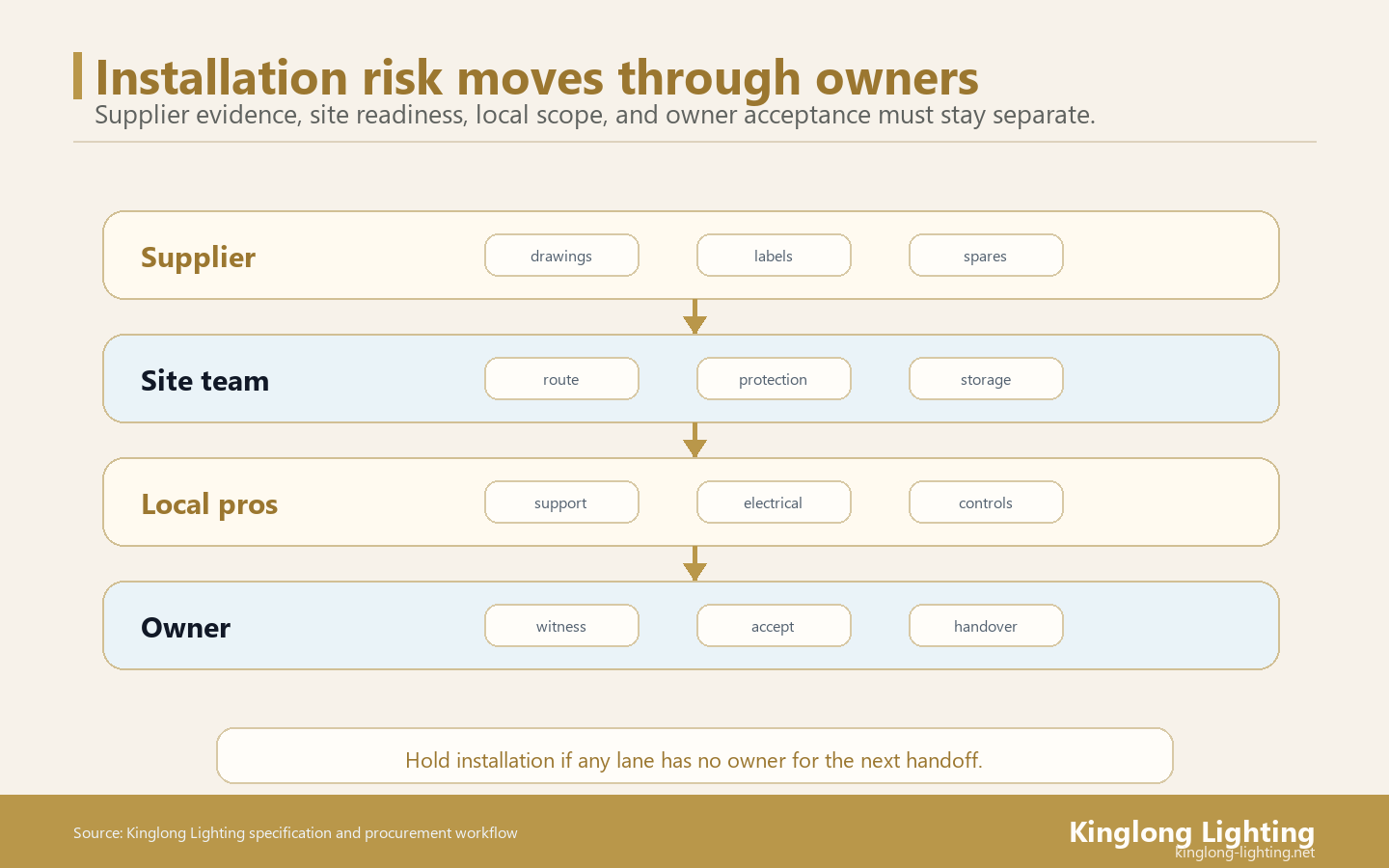
On-site installation of a custom villa chandelier is not just the day the fixture goes up. It is the handoff between manufacturing, packing, receiving, access, protection, electrical readiness, assembly, controls, owner witnessing, and handover. If any handoff is vague, the installation team inherits the risk.
Villa projects are especially sensitive because the space may be occupied, finishes may be delicate, and the owner often expects a high level of visual perfection. The chandelier may be one object, but its installation touches ceilings, floors, stairs, furniture, plaster, controls, cleaning, and future maintenance.
Kinglong Lighting can support installation best practices when the buyer connects the custom chandelier workflow to a site readiness packet. The supplier should not be expected to control the villa site, but it can provide the evidence that helps local teams install the fixture responsibly.
Key Takeaways
- Installation begins before arrival: Receiving, route, access, and protection should be planned before crates reach the villa.
- Every handoff needs an owner: Supplier, contractor, installer, electrician, designer, and owner responsibilities should be named.
- Access is a design constraint: Lift path, canopy reach, module size, and future service should be checked before installation day.
- Controls should be ready: A chandelier can be physically installed but not accepted if dimming, drivers, or scenes are unresolved.
- Handover protects future maintenance: The final file should include piece maps, spares, cleaning, warranty path, and service access notes.
Installation coordination begins with site readiness
A custom chandelier is installed well when the site is ready before the fixture arrives.
The first installation question is not who will hang the chandelier. It is whether the villa is ready to receive, protect, move, assemble, power, test, and hand over the fixture. Site readiness should be confirmed before shipment release whenever possible.
The OSHA aerial lifts page gives a useful boundary because overhead installation and later service require planned access and trained site practice. For project buyers, the practical action is to plan overhead access, lift operation, protection, and qualified local site practice before the crate reaches the villa.
Confirm the route before the crate arrives
The route should include delivery vehicle access, unloading area, doorway width, corridor turns, stair or lift limits, unpacking area, floor protection, and temporary storage. A crate that reaches the villa but cannot be moved safely into the room is a logistics failure, not a manufacturing success.
For fragile custom lighting, route planning should also include when crates are opened and who checks component condition. Opening too early exposes parts to dust and damage. Opening too late may hide shipping issues until the installer is already waiting.
Protect finished surfaces before lifting begins
Villa finishes can be more delicate than commercial site finishes: stone floors, timber stairs, plaster ceilings, custom furniture, and wall coverings may be difficult to repair invisibly. The installation plan should name floor protection, dust control, tool staging, and who approves room readiness.
Protection is not only a contractor issue. The manufacturer can help by providing packing sequence, component labels, and assembly order so the site does not unpack more fragile parts than needed at once.
Separate supplier support from local site responsibility
A lighting manufacturer can support installation with drawings, labels, assembly notes, component maps, replacement parts, remote guidance, and sometimes factory representative support. It should not be treated as the local electrician, structural engineer, safety officer, or site contractor unless that scope is explicitly contracted.
The NFPA 70 National Electrical Code page gives a useful boundary because electrical installation and field acceptance decisions need local qualified code review. For project buyers, the practical action is to keep local electrical responsibility visible and separate from manufacturer product information.
Name who owns electrical readiness
Electrical readiness includes power supply, control wiring, dimming compatibility, driver location, local code compliance, circuit availability, and safe termination. The manufacturer can provide fixture information, but the villa team should confirm local installation requirements through qualified professionals.
The DOE LED lighting page gives a useful boundary because LED performance, heat, service life, and operating behavior need to be part of luminaire decisions. For project buyers, the practical action is to connect driver behavior, dimming expectations, service access, and heat assumptions to the installation readiness checklist.
Name who owns structural readiness
Structural readiness includes support point, ceiling condition, suspension interface, and any required local engineering review. The shop drawing can show fixture weight and suspension logic, but the villa structure must be checked by the appropriate local party.
This boundary protects the owner. It prevents the project from assuming the chandelier can be hung from a point that was never reviewed for the actual load, vibration, ceiling condition, or access method.
Use a handoff map during receiving and assembly
The day crates arrive, the site needs a handoff map. The map should show who receives, who photographs, who verifies labels, who checks damage, who protects parts, who assembles, who connects electrical work, and who witnesses final operation.
The ICC Incoterms 2020 page gives a useful boundary because international delivery responsibility should be named before goods, crates, and spare parts move. For project buyers, the practical action is to connect delivery responsibility, crate handoff, insurance, and destination receiving to the installation plan.
Receiving photos should be taken before blame exists
Receiving photos should capture crate condition, labels, damage, moisture, seal condition, and piece count before the installation team begins work. If damage is found later without receiving evidence, the owner may struggle to separate shipping, handling, site storage, and installation causes.
The ISTA 3A test procedure page gives a useful boundary because packing evidence should be selected around the distribution environment and package profile. For project buyers, the practical action is to use packing and distribution evidence to judge whether fragile components arrived in a condition suitable for installation.
Assembly sequence should follow the component map
Custom chandeliers often have modules, arms, crystals, glass elements, decorative covers, drivers, and special fasteners. The installation team should follow the component map rather than unpacking and assembling by visual guesswork.
A component map also protects future maintenance. If a part is damaged or missing, the team can identify it with a code instead of sending unclear photos and hoping the supplier recognizes the item.
Commission the installed chandelier before visual acceptance
A chandelier that is physically installed is not automatically accepted. The owner should review alignment, level, finish condition, control behavior, dimming, driver noise, glare, room scenes, and service access before final sign-off.
The WBDG building commissioning page gives a useful boundary because commissioning connects design intent, installation quality, operation, and owner handover. For project buyers, the practical action is to treat installed acceptance as operation and handover evidence, not only physical completion.
Controls can turn a good installation into an open issue
A chandelier may be level, clean, and visually correct while still failing the room because dimming flickers, scenes are wrong, drivers buzz, or control labels are confusing. The installation plan should include a control check after physical assembly.
If controls are by another vendor, that responsibility should be named. The supplier can help identify fixture-side assumptions, but scene programming and local integration may belong to the control or electrical team.
Owner witnessing should be planned, not improvised
The owner or designer should witness the final visual and operational review when the room is clean, protected, and ready. If the owner sees the chandelier during a messy construction phase, avoid turning temporary site conditions into permanent judgments.
A good witness record includes installed photos, scene checks, open issue list, accepted variation, cleaning notes, and handover status. That gives the project a clean close instead of a chain of informal messages.
Close installation with a handover file
Installation is incomplete if the villa owner receives only a beautiful room. The owner should receive the information needed to protect the chandelier: drawings, component map, spare parts, cleaning notes, service access, warranty path, and supplier contact route.
The UL 1598 standard page gives a useful boundary because decorative chandeliers are still luminaires that need product evidence and qualified installation review. For project buyers, the practical action is to keep luminaire product evidence connected to the owner's future maintenance and replacement path.
Cleaning instructions should be room-specific
Cleaning advice should reflect material, location, access, and exposure. A crystal chandelier in a stair void, a glass pendant over a dining table, and a metal fixture near a coastal terrace may need different cleaning precautions and service intervals.
The handover file should tell staff what not to do as clearly as what to do. The wrong cleaner, ladder method, or replacement part can damage a custom fixture long after the installation team has left.
Spares should be stored with identification
Spare crystals, glass pieces, drivers, screws, clips, or decorative parts are useful only if they can be identified later. The owner should store spares with codes, photos, and fixture location notes. A box of unmarked pieces is not a support system.
For villas with multiple rooms or related lighting families, Kinglong Lighting can help connect spares and component records back to the villa lighting project support file so future maintenance does not rely on memory.
Villa chandelier installation coordination table
Use this table before crates arrive and again before owner acceptance.
| Decision area | Owner risk if vague | Evidence to request | Acceptance action |
|---|---|---|---|
| Receiving | Damage or missing parts are discovered too late | Crate photos, labels, piece count, damage notes | Record condition before unpacking |
| Route and access | Fixture cannot reach or be serviced in the room | Door, stair, lift, scaffold, floor protection plan | Confirm route and work-at-height method |
| Electrical readiness | Installed fixture cannot be commissioned | Power, drivers, dimming, control ownership | Local qualified team confirms readiness |
| Assembly | Parts are installed out of sequence or damaged | Component map, labels, assembly notes | Follow supplier map and log deviations |
| Handover | Future service cannot identify parts | Drawings, spares, cleaning, warranty, service access | Close installation only after owner file is complete |
Why a one-day installation needs weeks of coordination
The visible installation may take one day, but the dependencies often need two to three weeks of coordination. The receiving date must match site readiness. The route must be clear. The lift or scaffold must be booked. Electrical readiness must be confirmed. The designer or owner must be available for witnessing. Each dependency is small until one is missing.
This does not mean every project needs a long site meeting cycle. It means the installation owner should build a short dependency list and review it before shipment. If all dependencies are green, installation day can be efficient. If several are red, shipping the chandelier early may only move the delay from factory to site.
A useful coordination file therefore has two dates: arrival date and installable date. The arrival date says when crates reach the villa. The installable date says when the site can safely assemble, connect, test, and accept the fixture.
The two-date method is especially helpful when the owner is under schedule pressure. A villa may want the chandelier on site before a family event, photography session, or handover date. If the site is not installable, early arrival can increase risk because fragile components sit in storage, trades move around crates, and the team opens boxes before protection is ready.
A better plan names the evidence needed to move from arrival to installable: route cleared, ceiling support confirmed, floor protected, lift booked, electrical point ready, control responsibility assigned, and owner witnessing window reserved. Once those items are green, the actual installation day becomes much less dramatic.
How Kinglong Lighting supports installation coordination
Kinglong Lighting can support villa chandelier installation by providing drawings, component maps, packing references, assembly notes, spare recommendations, and remote clarification through the custom chandelier workflow. The local site team still owns structure, electrical work, safety, and authority-controlled tasks.
If installation is approaching, the next action is to send the installation readiness packet with destination, arrival date, room photos, route limits, ceiling notes, control assumptions, and the installer contact. Kinglong Lighting can then help identify missing evidence before the crate arrives.
Before the chandelier arrives on site
Use this short action list before the next approval meeting. It is intentionally practical, because vague approval language is the usual source of later rework.
- Confirm receiving area, crate route, unpacking space, and floor protection.
- Assign owners for structure, electrical readiness, access equipment, and assembly.
- Check component labels and packing sequence before unpacking everything.
- Plan owner or designer witnessing after the room is clean and powered.
- Close with drawings, spares, cleaning notes, warranty path, and service access.
FAQ
Who installs a custom villa chandelier?
Installation usually involves a local qualified installer, electrician, contractor, and sometimes supplier guidance. Structural, electrical, and safety responsibilities should be locally assigned.
What should be ready before chandelier installation?
The site should have route access, floor protection, ceiling support review, electrical readiness, lift or scaffold plan, component map, owner witness plan, and storage space.
Can the manufacturer handle on-site installation?
Sometimes support is available, but the scope must be contracted. Manufacturers can provide evidence and guidance, while local teams handle site safety and regulated work.
What should be checked after installation?
Check alignment, level, finish, damage, dimming, driver noise, scenes, access, spare parts, cleaning notes, warranty path, and final handover records.