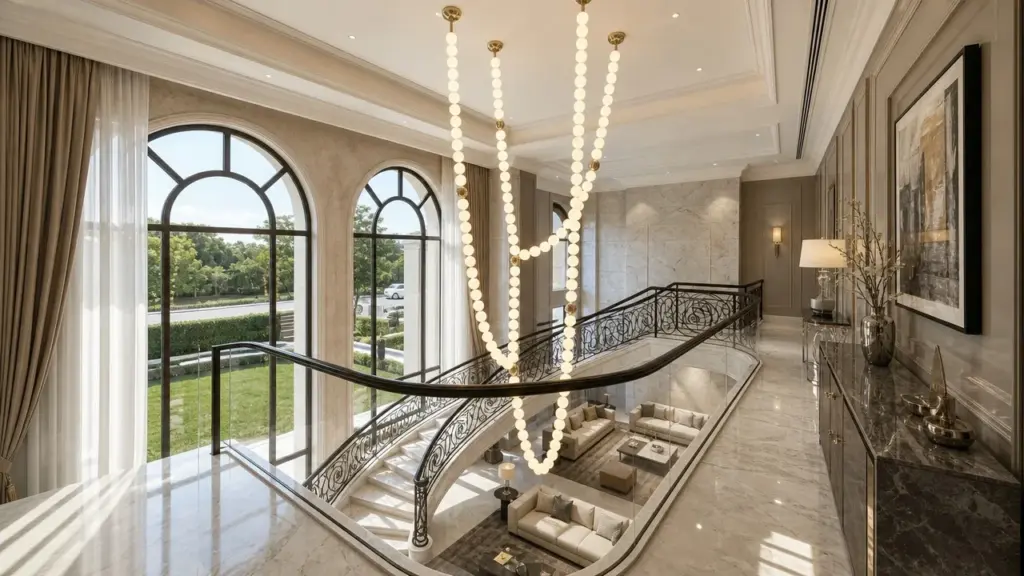
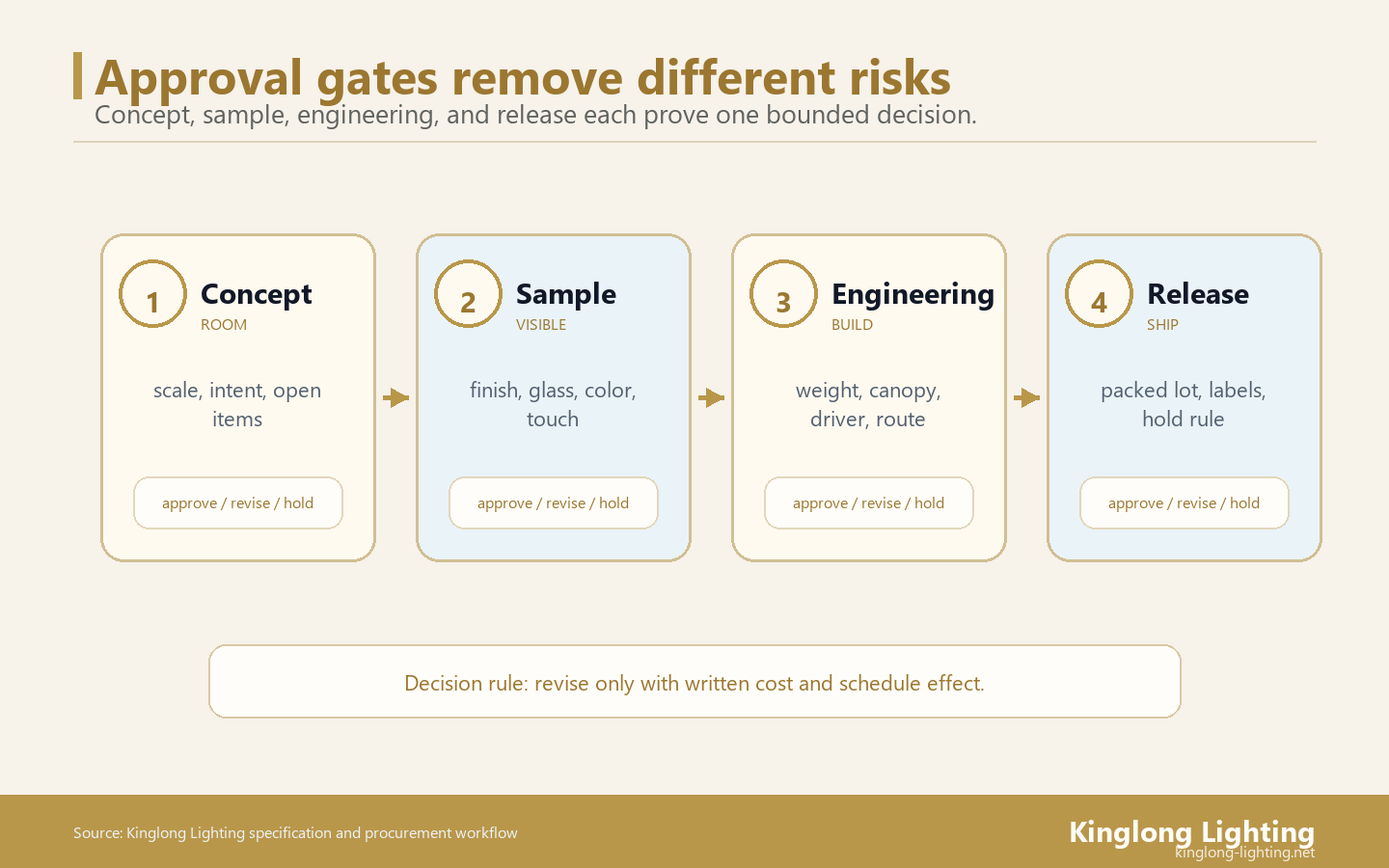
A custom chandelier approval workflow should not be a single yes after a pretty rendering. Four different decisions are needed: whether the room direction is right, whether visible materials are acceptable, whether the design can be built and installed, and whether the finished goods should ship.
When these decisions are collapsed, the owner may approve beauty while leaving buildability open, or approve engineering while still arguing about finish. The result is late change, unclear responsibility, and expensive rework. A four-stage process gives the owner and manufacturer a cleaner way to say approve, revise, or hold.
Kinglong Lighting can use the custom chandelier manufacturing workflow to connect these stages to drawings, samples, engineering notes, inspection, packing, and handover. The goal is controlled creativity: the chandelier remains bespoke, but the approval evidence is not improvised.
Key Takeaways
- Stage 1 protects intent: Concept approval should confirm room promise, proportion, and design direction, not every technical detail.
- Stage 2 protects visible quality: Sample approval should freeze finish, glass, crystal, color, and tactile references before production.
- Stage 3 protects buildability: Engineering approval should address weight, suspension, drivers, canopy, modules, route, and local review boundaries.
- Stage 4 protects shipment: Pre-shipment approval should verify what was built, packed, labeled, photographed, and held for correction.
- Every stage needs a hold rule: Approval is useful only when the team also knows when to revise, retest, or stop.
The four stages should reduce different risks
A custom chandelier approval process works when every yes says exactly what has been proven and what remains outside that approval.
The most common approval mistake is asking one review to answer too many questions. A rendering cannot prove finish. A finish sample cannot prove site access. A shop drawing cannot prove packing. A pre-shipment video cannot fix a poorly defined room intent.
The DOE lighting design page gives a useful boundary because lighting decisions should be judged around the whole space and its use, not only fixture appearance. For project buyers, the practical action is to connect concept approval to room purpose, visual comfort, and use instead of treating the chandelier as an isolated object.
Concept approval removes direction risk
Direction risk means the project team is not yet aligned on what the chandelier should do for the room. The owner may want drama, the designer may want restraint, and the manufacturer may optimize for buildability. Concept approval should create one shared target before details multiply.
The concept package should include room intent, proportion, approximate drop, viewing angles, design references translated into attributes, and known constraints. It should also state which items are still preliminary. That prevents the owner from later believing a conceptual image promised every final detail.
Later approvals should not reopen the whole design
Once concept is approved, sample, engineering, and pre-shipment reviews should answer their own questions. They may reveal a need to revise the concept, but they should not become a fresh design competition. Otherwise every stage resets the project and consumes schedule without clear accountability.
The workflow should therefore include a change rule: if a later stage changes the approved concept, the team records the reason, affected evidence, cost effect, schedule effect, and owner decision. That keeps creative changes possible but prevents invisible drift.
Stage 1 concept approval locks the room promise
Concept approval is the owner’s first serious yes. It should be given only when the room promise, general form, approximate scale, visual language, and major constraints are visible. It should not be delayed until every nut, driver, and crate is known.
The DOE TM-30 FAQ gives a useful boundary because color quality needs more precise language than warm, cool, or beautiful when materials are being approved. For project buyers, the practical action is to describe material and color expectations with precise review language before physical samples are requested.
Approve attributes, not copied references
A concept board may include references, but the approval should name attributes: vertical rhythm, low-glare sparkle, warm brass tone, translucent glass, floating cluster, or sculptural calm. This helps the manufacturer create an original solution rather than chase a protected product outline.
The Mofun Design Platform can support this stage by testing scale, drop, and visual mass before the owner commits to sample spending. It is a way to reduce proportion risk while the design is still flexible.
Record open items with an owner decision date
Concept approval often leaves open items: exact finish, glass density, driver location, module split, or final route. These open items are acceptable if they have decision dates. They become dangerous when everyone assumes someone else will close them later.
The concept record should say what is approved, what is not approved, who decides the open item, and when the decision is needed to protect the schedule. That simple discipline prevents early excitement from becoming late confusion.
Stage 2 sample approval locks what eyes can judge
Sample approval is where owners and designers judge what renderings cannot prove. It should include the material and light qualities that define the chandelier’s perceived luxury: finish, glass, crystal, resin, leather, diffusion, sparkle, texture, and color appearance.
The UL 1598 standard page gives a useful boundary because decorative chandeliers are still luminaires that need product evidence and qualified installation review. For project buyers, the practical action is to keep sample approval connected to luminaire evidence and avoid treating appearance as the only acceptance layer.
A sample master needs a stable reference
The accepted sample should become a master reference. That may be a physical sample, a signed sample board, a labeled component, or a documented photo set with limitations clearly stated. The important point is that production can be compared with the same reference later.
Owners should avoid approving samples only through phone photos. Camera, screen, and lighting conditions can distort metal tone, glass color, and sparkle. Photos are useful evidence, but the workflow should say which physical or documented reference is the final master.
Sample approval should name acceptable variation
Handmade glass, crystal strings, metal finishing, natural materials, and certain decorative effects may have variation. The owner should know what variation is acceptable. If the project needs strict repeatability, that should be stated before production. If variation is part of the design, that should also be stated.
This is where sample approval protects both sides. The owner avoids a surprise. The manufacturer avoids being judged against an unstated tolerance. The designer gains a clearer basis for explaining the final appearance to the client.
Stage 3 engineering approval locks what the site must carry
Engineering approval is not a visual review. It is the stage where the team checks whether the chandelier can be fabricated, supported, powered, assembled, routed, accessed, and serviced. Owners should keep qualified local professionals visible in this stage.
The NFPA 70 National Electrical Code page gives a useful boundary because electrical installation and field acceptance decisions need local qualified code review. For project buyers, the practical action is to separate manufacturer evidence from local electrical responsibility and authority-controlled decisions.
Shop drawings should answer site questions
The shop drawing package should answer more than shape. It should show dimensions, drop, canopy, suspension logic, module split, approximate weight, driver location if applicable, component map, assembly order, and any assumptions that local professionals must verify.
A drawing that looks beautiful but hides driver access, route limits, or ceiling interface is not ready for engineering approval. The owner should ask: what would an installer, electrician, engineer, or maintenance team still need to know before the fixture can be responsibly released?
Access and service are engineering issues
Access is sometimes treated as a maintenance topic, but it belongs in engineering approval because it affects canopy design, driver location, module size, suspension, and installation method. If a future service task requires damaging the ceiling, the design is not fully engineered from the owner’s perspective.
The OSHA aerial lifts page gives a useful boundary because overhead installation and later service require planned access and trained site practice. For project buyers, the practical action is to include overhead access, lift path, protection, and qualified site practice in the approval record rather than leaving them to installation day.
Stage 4 pre-shipment approval locks what will arrive
Pre-shipment approval is the last chance to confirm the chandelier before it becomes a logistics problem. It should verify production, finish, labels, components, spare parts, packing, documents, and open corrections. It should not introduce new design preferences unless the owner accepts the consequence.
The ICC Incoterms 2020 page gives a useful boundary because international delivery responsibility should be named before goods, crates, and spare parts move. For project buyers, the practical action is to connect inspection, packing, crate movement, delivery responsibility, and destination handoff before shipment release.
Inspection should compare against the signed package
Pre-shipment inspection should compare the finished chandelier with approved drawings, sample master, component list, finish reference, and any owner change log. The question is not whether the fixture looks generally good. The question is whether it matches what was approved.
Useful evidence includes overview photos, detail photos, finish comparison, light-on check where practical, label photos, spare part photos, packing photos, crate marks, and issue list. If a correction is needed, it should be closed before release or explicitly accepted by the owner.
Packing approval should be part of final review
Packing is part of quality for custom chandeliers. A perfect fixture can become a failed project if fragile glass, crystal, metal, or finish components arrive damaged or untraceable. Owners should ask for piece maps, labels, crate sequence, and protection logic before shipment.
The ISTA 3A test procedure page gives a useful boundary because packing evidence should be selected around the distribution environment and package profile. For project buyers, the practical action is to match packing evidence to the real distribution risk and avoid treating a crate photo as enough proof by itself.
Four-stage custom chandelier approval table
Use this table as an owner-side approval rule. Each stage asks a different question and should produce a different evidence set.
| Decision area | Owner risk if vague | Evidence to request | Acceptance action |
|---|---|---|---|
| Concept | The room promise is unclear or copied from a reference | Intent sentence, scale test, reference attributes, open items | Approve direction or rewrite the concept |
| Sample | Finish, glass, color, or texture surprises the owner | Sample master, photos, acceptable variation, material notes | Freeze visible reference or request revision |
| Engineering | The fixture cannot be supported, serviced, routed, or controlled | Shop drawings, weight, canopy, driver, route, access assumptions | Release only with local review boundary visible |
| Pre-shipment | Goods ship with unresolved defects or unclear packing | Inspection photos, component list, labels, spares, crate record | Ship, correct, or hold with owner decision |
| Handover | Future maintenance cannot identify approved parts | Final file, warranty path, spare list, cleaning and service notes | Attach support file before final close-out |
Approval drift: how to keep each yes narrow
Approval drift happens when a yes at one stage is later treated as a yes for another stage. The owner approves the concept, and the supplier assumes the finish is final. The designer approves a sample, and the site assumes the engineering is solved. The project approves a shop drawing, and someone assumes packing will take care of itself. Each assumption moves risk forward without naming it.
The cure is to write narrow approval language. Concept approved means the room direction and visual mass are accepted, while finish, engineering, and packing remain open. Sample approved means the visible reference is accepted, while support, driver access, and shipment remain open. Engineering approved means buildability assumptions are accepted within stated boundaries, while finished goods still need inspection.
This narrow language may feel formal, but it protects creativity. The owner can say yes to beauty without accidentally accepting an unresolved technical condition. The manufacturer can proceed confidently without pretending that every future question has been answered. The designer gains a cleaner record for explaining why a late change affects cost, time, or evidence.
How Kinglong Lighting supports four-stage approval
Kinglong Lighting can support custom chandelier approval by keeping design intent, samples, drawings, production inspection, packing, and handover evidence in one project path. The custom chandelier workflow is most useful when each stage ends with a clear approve, revise, or hold decision.
When the buyer is preparing a live project, the practical next action is to send the custom chandelier approval package with concept references, room constraints, sample questions, engineering concerns, destination, and desired approval dates. Kinglong Lighting can then respond around missing evidence rather than generic product options.
Before you approve a custom chandelier
Use this short action list before the next approval meeting. It is intentionally practical, because vague approval language is the usual source of later rework.
- Separate concept, sample, engineering, and pre-shipment approval instead of using one final yes.
- At each stage, write what is approved, what remains open, who decides, and when the decision is needed.
- Use physical or documented sample masters for finish and material approval.
- Keep qualified local review visible for structure, electrical work, access, and safety.
- Do not release shipment until inspection, packing, labels, spares, and open corrections are clear.
FAQ
What are the four stages of custom chandelier approval?
The four stages are concept approval, sample approval, engineering approval, and pre-shipment approval. Handover support should follow before final close-out.
Can sample approval happen before concept approval?
It can, but it is risky. Samples are more useful after the owner has approved room intent, approximate scale, material direction, and non-negotiable constraints.
What should be checked before chandelier shipment?
Check finished appearance, approved drawing match, sample match, component list, labels, spare parts, packing photos, crate marks, and unresolved correction items.
Who should approve chandelier engineering drawings?
The owner and designer can approve design intent, but structural, electrical, access, and authority-controlled questions should remain with qualified local professionals.